SOTD – After My Grandmas Death, My Husband Rushed Me to Sell Her House, When I Learned the Reason, I Was Furious and Made Him Regret It
The day my grandmother died, something in my world shifted—quietly, almost imperceptibly at first—until the shift became an undeniable fracture running straight through my marriage.
I’m Mira, thirty-six years old, living just outside Portland in one of those calm, postcard neighborhoods where you can predict who’s walking their dog at what hour. People tend to assume a lot when they see a tidy house, healthy kids, and a decent marriage. They assume stability. Love. Security. And for a long time, I assumed the same.
My husband, Paul, and I had been married seven years. On the surface, he was reliable, polished, composed—exactly the kind of man who looked like he had his life in order. Our twin girls, Ellie and June, adored him. And most days, watching him carry them to bed after our mandatory Friday movie night, I would’ve sworn I adored him too.
But grief has a way of stripping varnish off everything.
My grandmother’s death hit me harder than I ever expected. She had raised my mother in that little house on the hill surrounded by hydrangeas, and she’d raised me in her own way—teaching me how to bake lavender cookies, how to sew a button, how to stand up straight even when life tries to fold you in half. When she died at ninety-two, it felt like losing the last living witness to who I’d been before adulthood tumbled in.
Three days after the funeral, I went back to her house to gather her things. I stood there holding her afghan blanket, still smelling faintly of lavender soap, and felt a lump rising in my throat.
That’s when Paul started pushing.
“We need the money, not your memories,” he said, arms crossed, his tone more impatient than grieving.
The words landed like a slap. The house wasn’t even cold from her absence, and already he was talking about listing it. Something about his urgency scraped at me, a wrongness I couldn’t name yet.
I ignored his pressure the best I could, but his agitation grew louder, sharper, strangely emotional for a man who hadn’t spent much time with her. He kept glancing at the stairs like the house itself owed him something.
Then, as I was preparing to leave, Grandma’s neighbor, Mrs. Callahan, appeared at the gate. A quiet woman, never one for gossip—and yet there she was, eyes darting, voice lowered.
“If you only knew what your husband was doing here… while your grandmother was still alive.”
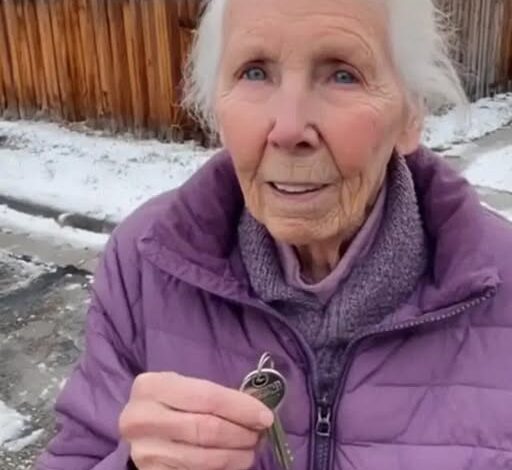
Before I could ask a single question, she pressed a small brass key into my palm. The attic key.
“My grandmother gave this to you?” I asked.
“She made me promise to hand it to you personally.”
And just like that, the ground under my feet shifted again.
Paul was waiting in the car, tapping furiously on his phone. I told him to take the girls home. He wasn’t thrilled, but he left. I climbed the stairs alone, the key warm from my hand.
The attic door creaked open, the single bulb flickering to life, illuminating dust and forgotten relics. A row of old boxes. Stack of afghans. And in the corner, the brown leather suitcase I hadn’t seen since I was a child—the same one I’d pretended was filled with pirate treasure.
Inside the suitcase were photo albums, old bills, neatly labeled envelopes, and on top—a letter.
“For Mira.”
Her handwriting, shaky but unmistakable.
I opened it, heart thudding.
She wrote that Paul had been visiting her for months without telling me. Pressuring her. Insisting she sell the house. Claiming we needed the money badly, that I was fragile, that our marriage would break under financial strain.
She wrote that something about him frightened her. That his stories didn’t add up. That he needed money quickly, and she feared he’d drag me down with him. She apologized for ever believing him and told me she changed her will—leaving the house solely to me.
“If you can prove he deceived me, the house is yours,” she wrote. “Be careful, my dear. Paul needed a lot of money. I don’t know why.”
It felt like ice water poured straight through my chest.
I gathered every document she’d left, locked them in a storage unit, and placed the most important papers in a bank safety deposit box under only my name.
By the time I returned home, something inside me had gone very still.
The next morning, I confronted him.
He denied everything at first. Then he deflected. Then he tried to charm his way out. But when I told him I had proof—written, legal, irrefutable—the mask cracked.
Turns out, my financially polished husband had gambled away two-thirds of our savings on a crypto scam. When it crashed, he panicked. Lied about bills. Lied about repairs. And when those lies couldn’t cover the bleeding anymore, he looked to my grandmother as his way out.
He called it a “mistake.”
I called it what it was: betrayal.
I didn’t scream. I didn’t break anything. I didn’t let him sweet-talk or guilt-trip or twist the story.
I hired a lawyer.
The divorce was filed quietly. He cried, begged, promised, pleaded—but there are some things you don’t come back from. Manipulating a dying woman who loved me? That was it. That was the end.
He moved out. I kept the house—the one he tried so hard to steal out from under me. I changed the locks. Painted the walls. Hung up the photo of Grandma and me baking. And on my office shelf, I placed her letter in a silver frame.
Not as a warning.
As a reminder.
She protected me until her last breath. And even from the grave, she saved me from a man who never deserved the life he was pretending to build with me.
Some inherit money. Some inherit land.
I inherited the truth.
And that truth set me free.