I Hired Bikers To Scare My Daughter’s Stalker But They Did Something I Never Expected
I hired bikers to scare my daughter’s stalker but they did something I never expected. When I walked into that motorcycle clubhouse with $500 in cash and desperation in my eyes, I expected violence. I wanted violence. I was ready to pay for violence.
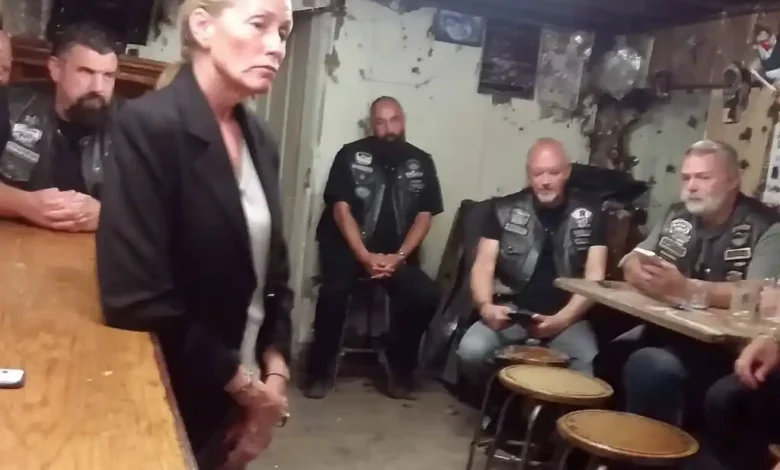
“I need someone hurt,” I told the bearded giant behind the bar. My hands were shaking as I placed the money on the scarred wood. “There’s a man stalking my daughter. The police won’t help. I need him gone.”
The room went quiet. Twenty sets of eyes turned to look at me—a forty-five-year-old suburban mom in my real estate blazer and sensible heels, standing in a room full of leather and tattoos and men who looked like they’d seen the worst of humanity.
The man behind the bar didn’t touch the money. “Ma’am, why don’t you sit down and tell us what’s really going on.”
That’s not what I expected him to say.
“I don’t have time for talking. My daughter Emma is nineteen. This man is thirty-seven. He follows her everywhere. Shows up at her college. Her work. Our house. He leaves gifts. Sends messages. The police say he hasn’t broken any laws.” My voice cracked. “Last week he left a photo under her windshield wiper. A photo of her sleeping. Taken through her bedroom window.”
Several bikers stood up. The tension in the room shifted.
“You show that to the cops?” asked a man with a gray ponytail.
“Of course I did. They said it proved he was on our property but since he didn’t break in or make explicit threats, it’s just trespassing. They gave him a warning.” I laughed bitterly. “A warning. He took a photo of my baby girl sleeping and they gave him a warning.”
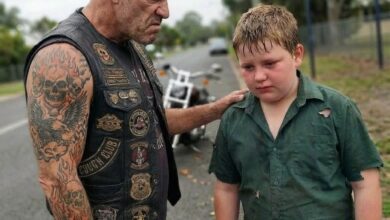
The man behind the bar came around and sat across from me. His vest said “Thomas” and underneath, “President.”
“What’s this man’s name?”
“Richard Kelley. He works at the hardware store downtown. Lives in the Riverside apartment complex. Drives a white Honda Civic.” I’d memorized everything about him. “He first saw Emma at the coffee shop where she works. Started coming in three times a day. She had to quit that job because of him.”
Thomas picked up my money and handed it back to me. “We’re not going to hurt him, ma’am.”
My heart sank. “Then I’ll find someone who will.”
“No,” Thomas said firmly. “You won’t. Because that’s not what your daughter needs. She doesn’t need her mother in prison for hiring someone to commit assault. She needs something better.”
“What could be better than making him stop?”
Thomas smiled. It wasn’t a pleasant smile. “Making him understand what it feels like.”
I didn’t understand what he meant until he explained their plan. And when he did, I realized these bikers were far more intelligent than I’d given them credit for.
“Here’s what we’re going to do,” Thomas said, as the other bikers gathered around. “We’re going to follow Mr. Kelley. Legally. Publicly. Constantly.”
“Follow him?”
“Everywhere. Grocery store. Work. Gym. Doctor’s appointments. When he goes to get coffee, there’ll be a biker there. When he goes to get gas, there’ll be two. When he walks his dog, there’ll be three riding slowly behind him.”
A younger biker with sleeve tattoos added, “We’ll park outside his apartment building. Legally. On public property. We’ll sit outside his work during his entire shift. We’ll be at every restaurant he goes to.”
“But most importantly,” Thomas continued, “we’ll never touch him. Never threaten him. Never speak to him unless he speaks first. And if he does speak to us, we’ll be polite. Friendly even. ‘Beautiful day, isn’t it, Mr. Kelley?’ That sort of thing.”
I stared at them. “That’s… that’s it?”
“Ma’am,” said an older biker with a Vietnam Veteran patch, “you know what the police told you? That they couldn’t do anything until he ‘actually did something’? Well, that works both ways.”
The room erupted in dark laughter.
“He’ll call the cops,” another biker said. “They’ll come. And we’ll explain that we’re just citizens going about our day. Shopping where he shops. Eating where he eats. Exercising our freedom of movement.”
Thomas leaned forward. “Your stalker thinks he’s clever, using the law’s limitations to terrorize your daughter. But he’s about to learn that we can play that game too. And we’re much, much better at it.”
“How long will you do this?”
“Until he stops stalking your daughter. Or until he leaves town. Whichever comes first.”
I looked around the room at these men I’d judged so harshly just minutes before. “Why would you do this for us? You don’t even know us.”
Thomas’s expression hardened. “Because I have a daughter. She’s twenty-three now. When she was sixteen, she had a stalker. An ex-boyfriend who wouldn’t let go. The police gave us the same bullshit they gave you. So I handled it myself. The wrong way. Spent eight months in county jail for assault.”
He paused, his jaw clenching at the memory.
“When I got out, he was still stalking her. My violence didn’t stop him. It just gave him ammunition to play victim. But then my brothers here came up with a different solution. The one we’re offering you. And it worked. He lasted nine days before he moved to another state.”
“Nine days?”
“Nine days of never being alone. Nine days of feeling watched. Nine days of understanding what he’d put my daughter through.” Thomas stood up. “We don’t need your money, ma’am. We need your daughter’s schedule and a recent photo of Mr. Kelley.”
I pulled out my phone with trembling hands and showed them everything. Emma’s class schedule. Her work hours. The thirty-seven photos I’d taken of Richard Kelley without him knowing. The screenshots of his social media showing his routines.
“You’ve been doing your homework,” a biker named Marcus observed.
“I’m a mother. I’ve been planning his destruction for months. I just didn’t know how to execute it.”
“Well now you do,” Thomas said. “Go home. Tell your daughter she’s safe. And let us handle Mr. Kelley.”
The next morning, it began.
Richard Kelley walked out of his apartment at 7
AM like always. But today, there were two motorcycles parked across the street. The riders were just sitting there, helmets off, drinking coffee from thermos cups.
He got in his Honda Civic. The motorcycles started up and followed him. Not aggressively. Just… there. Behind him at every traffic light. Pulling into the hardware store parking lot thirty seconds after he did.
Emma texted me from her morning class: “Mom, Mr. Davis (her professor) said two bikers are sitting outside the lecture hall. Said they’re making sure I’m safe. What did you do?”
“What I had to, baby. Just focus on your studies.”
By noon, Richard Kelley had called the police twice.
I know because Thomas sent me the video. One of the bikers recorded it on his phone. Richard standing in the hardware store parking lot, gesturing wildly at two cops while four bikers sat peacefully on their motorcycles fifty feet away.
“They’re stalking me!” Richard was saying. “They followed me here!”
The cop looked over at the bikers. “Are you gentlemen following this man?”
“No sir,” Thomas replied calmly. “We’re just shopping for some lumber. Is there a law against being in a hardware store parking lot?”
“They were at my apartment this morning!”
“We were visiting a friend who lives in that complex,” another biker said. “Small world, isn’t it?”
The cops left. They had to. No crime had been committed.
That evening, Richard tried to go to the gym. Six bikers were already there, working out. He turned around and left. They didn’t follow him out—they just kept exercising. But when he got home, two different bikers were sitting in the apartment complex’s visitor parking.
Day two, Richard called in sick to work. But staying home didn’t help. The bikers weren’t technically on his property. They were on public sidewalks. In legal parking spots. Following every law while making their presence absolutely known.
He tried to go grocery shopping at 10 PM, thinking he could avoid them. Three bikers were in the cereal aisle. Two more in produce. One at the checkout line.
“Evening, Mr. Kelley,” one said politely. “Lovely night for shopping.”
Richard abandoned his cart and fled.
Day three, he tried a different strategy. He drove to Emma’s college campus.
Twenty bikers were already there.
They formed a loose perimeter around Emma’s building. Not blocking anything. Not preventing his movement. Just there. Visible. Watching.
Richard sat in his car for an hour. Then he drove away.
That night, Emma came home laughing. Actually laughing. “Mom, everyone at school is talking about my ‘biker bodyguards.’ Ashley said it’s the coolest thing she’s ever seen. Professor Davis said he’s never felt safer on campus.”
It was the first time I’d seen my daughter genuinely smile in six months.
Day four, Richard tried to file a restraining order against the motorcycle club.
The judge almost laughed him out of court.
“Mr. Kelley, you’re asking for a restraining order against… how many people?”
“At least twenty! Maybe thirty!”
“And what have they done to threaten you?”
“They follow me everywhere!”
“Have they touched you?”
“No.”
“Threatened you verbally?”
“No, but—”
“Have they prevented you from going about your daily activities?”
“They’re intimidating me!”
The judge looked at the paperwork. Then she looked at Richard. “Mr. Kelley, I see here that you’ve been reported for stalking a young woman. Following her to work and school. Taking photos of her. Is that correct?”
Richard went pale.
“It seems to me,” the judge continued, “that these bikers are doing exactly what you’ve been doing. Following someone in public spaces without making direct contact. If what they’re doing is illegal, Mr. Kelley, then what you’ve been doing is also illegal. Would you like to confess to stalking so we can arrest them for the same crime?”
Richard left without another word.
Day five, he tried to confront them.
I watched the video Thomas sent me. Richard marching up to a group of six bikers outside his apartment.
“What do you want from me?!”
“Nothing at all, Mr. Kelley,” Thomas replied calmly. “We’re just enjoying this beautiful city. It’s a free country, isn’t it?”
“You know what you’re doing!”
“We’re exercising our constitutional rights. Just like you’ve been doing with that young lady you’ve been following. Emma, isn’t it?”
Richard’s face went red. “I haven’t done anything illegal!”
“Neither have we.” Thomas smiled. It was terrifying. “Frustrating, isn’t it? When someone uses the law’s limitations to make you feel unsafe? To make you feel watched? To take away your peace?”
“This is harassment!”
“No, Mr. Kelley. This is exactly what the law allows. We’ve consulted with lawyers. We’re very careful to stay within legal boundaries. Just like you have been.” Thomas stood up, his full six-foot-four height towering over Richard. “The difference is, we have more people. More resources. And much more patience.”
Richard backed away.
“How long?” he whispered. “How long are you going to do this?”
“As long as it takes,” Thomas replied. “You see, we’re retired. We have nothing but time. And we’ve grown quite fond of this routine. Morning coffee outside your apartment. Afternoon workouts at your gym. Evening shopping at your grocery store. We could do this for years.”
Day six, Richard didn’t leave his apartment at all. But the bikers were still there. Rotating shifts. Four in the morning. Four in the afternoon. Four at night. Always visible from his window. Never hiding. Never trying to be subtle.
Day seven, Richard’s employer called the police about the bikers sitting outside the hardware store. The police explained there was nothing they could do about people parking on public property.
His employer then told Richard that while he sympathized, the constant police visits were bad for business. Maybe Richard should consider a leave of absence until this was “sorted out.”
Day eight, Emma went on a date.
A normal date. To a restaurant. Without looking over her shoulder. Without fear.
Four bikers sat at a table across the restaurant, but they weren’t watching Emma. They were watching for Richard. He never showed. He was trapped in his apartment, afraid to leave because he knew they’d be there.
Day nine, Richard broke.
I was at work when Thomas called. “He’s packing his car. Loading boxes. Looks like he’s leaving for good.”
“How do you know he won’t come back?”
“Because we’re going to follow him to the state line. Make sure he knows that if he ever returns, we’ll be waiting.”
And they did. Fifteen motorcycles followed Richard Kelley’s white Honda Civic for two hundred miles to the state line. They pulled over at the welcome sign and watched him continue driving.
Thomas texted me a photo. Fifteen bikers giving a one-finger salute to a white car disappearing into the distance.
That evening, the entire motorcycle club showed up at my house. I thought they were coming for payment. Instead, Thomas handed me back my $500.
“We don’t take money for protecting kids,” he said. “We did this because it was right.”
Emma came outside and saw them all. Twenty-something bikers in leather and patches, looking like the most dangerous people in the world. She walked right up to Thomas and hugged him.
“Thank you,” she whispered. “Thank you for giving me my life back.”
I watched this giant, terrifying man gently pat my daughter’s back while she cried. “You’re safe now, sweetheart. He’s gone. And if he ever comes back, he knows we’ll be waiting.”
One of the younger bikers spoke up. “We’ve got his photo distributed to clubs in six surrounding states. If he tries this with another girl, he’ll get the same treatment.”
Emma pulled back, wiping her eyes. “Why did you do this for us?”
Thomas looked at his brothers. “Because we have daughters. Sisters. Mothers. Because we know what it’s like to feel powerless. And because sometimes the system fails good people while protecting bad ones.”
“But mostly,” added Marcus, “because your mom was brave enough to ask for help. And when someone asks us to protect their kid, we don’t take that lightly.”
They started heading back to their bikes. I called out, “Wait! At least let me buy you all dinner. Or beer. Something.”
Thomas turned back with a grin. “Ma’am, seeing that bastard run away with his tail between his legs was payment enough. But if you really want to thank us, we do a toy run every Christmas for underprivileged kids. Maybe you and Emma could help out?”
“Absolutely,” Emma said before I could answer. “Absolutely we will.”
As they rode away, twenty motorcycles thundering into the night, Emma stood beside me on our porch.
“Mom, when you said you were handling it, I thought you meant lawyers.”
“I tried lawyers. They said the same thing the cops did. Nothing they could do until he escalated.”
“So you went to a motorcycle club?”
I looked at my daughter. Really looked at her. For the first time in months, she wasn’t hunched over. Wasn’t looking over her shoulder. Wasn’t afraid.
“I went to fathers,” I said. “I went to men who understood that sometimes the law isn’t enough. Sometimes you need something more creative.”
“They never touched him.”
“They didn’t need to. They just showed him what it felt like. To be followed. To be watched. To never have peace.”
Emma was quiet for a moment. “The cops really wouldn’t help them either?”
“Nope. They got the same answer we did. ‘Can’t do anything unless an actual crime is committed.’”
“That’s brilliant.”
“That’s justice,” I corrected. “Not legal justice. Street justice. And sometimes that’s the only kind that works.”
Two months later, Emma started therapy to deal with the trauma of being stalked. She’s doing better every day. She got a new job at a bookstore. Goes to classes without fear. Lives her life.
Richard Kelley? Thomas has connections in other clubs. Last we heard, Richard tried to get an apartment in Oregon. Three bikers showed up at the viewing. He withdrew his application.
Tried again in Nevada. Four bikers were already living in the complex.
Arizona. Same story.
The network of motorcycle clubs had effectively blacklisted him from the entire western United States. Not illegally. Never violently. Just making it clear that wherever he went, they’d be watching.
He eventually moved to Florida. As far from our state as he could get. Started over with a new job, new apartment, new life. And as far as we know, he’s never stalked another woman.
Because he learned what it feels like. And he knows that if he ever does it again, the bikers will return.
I used to think justice meant punishment. Jail time. Violence. Official consequences through official channels.
But those bikers taught me something different.
Sometimes justice is creative. Sometimes it’s psychological. Sometimes it’s using the system’s own limitations against those who exploit them.
And sometimes, justice comes in the form of twenty bearded men in leather who understand that protecting the innocent doesn’t always mean following the rules.
It means understanding them well enough to bend them without breaking them.
Emma still goes to the club’s toy runs. She helps organize their charity events. She’s become something of a mascot for them—the girl they saved without throwing a single punch.
And every time I see a motorcycle on the road, I don’t see a thug or a criminal.
I see someone’s father. Someone’s brother. Someone who might be willing to spend nine days of their life sitting outside an apartment building to save a nineteen-year-old girl they’d never met.
I see heroes.
Unconventional ones, maybe. But heroes nonetheless.
Last week, Emma told me she’s thinking about getting a motorcycle license. “I want to learn to ride,” she said. “I want to be the one protecting people, not the one needing protection.”
I told her I’d pay for the lessons.
Because if there’s one thing this whole experience taught me, it’s that sometimes the scariest-looking people are the safest ones to have on your side.
And sometimes, when the law fails you, you don’t need violence.
You just need creativity, patience, and a group of bikers who understand that the best revenge isn’t illegal—it’s poetic.