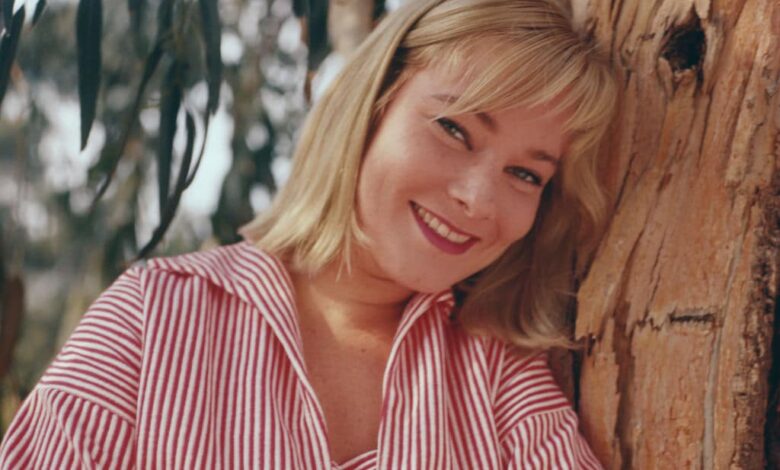
With heavy hearts, we announce the passing of this wonderful actress who broke all barriers. When you find out who she is, you will cry
May Britt, the Swedish-born actress whose Hollywood career and personal life placed her at the center of one of the most controversial interracial marriages in American history, has died at the age of 91.
Her son, Mark Davis, confirmed that Britt passed away from natural causes on December 11 at Providence Cedars-Sinai Tarzana Medical Center in Los Angeles.
Born Maj-Britt Wilkens on March 22, 1934, in Lidingö, just outside Stockholm, Britt’s early life was far removed from the glamour and scrutiny that would later define her public image. She grew up in Sweden without any clear path toward international stardom, and her entry into film came almost by accident.
In the early 1950s, while working as an assistant to a photographer in Stockholm, Britt was noticed by Italian filmmakers Mario Soldati and Carlo Ponti, who were searching for a new and unconventional screen presence. They cast her in Italian adventure and drama films, including Jolanda, the Daughter of the Black Corsair (1953), and she quickly became a recognizable figure in European cinema.
Her growing reputation led to a role in King Vidor’s ambitious 1956 adaptation of War and Peace, starring Audrey Hepburn and Henry Fonda. That appearance proved pivotal. Buddy Adler, then head of 20th Century Fox, took notice and offered Britt a long-term studio contract, prompting her move to Hollywood in the late 1950s.
Once in the United States, Britt was quickly positioned alongside major stars of the era. She appeared opposite Robert Mitchum in the Korean War drama The Hunters (1958) and played a romantic interest to Marlon Brando in The Young Lions (1958). Her most prominent role came in 1959, when she starred in Edward Dmytryk’s remake of The Blue Angel, stepping into the iconic role of cabaret performer Lola-Lola, made famous by Marlene Dietrich in the 1930 original.
That same year, Britt’s rising star was cemented when she appeared on the cover of Life magazine, presented as a striking new presence in Hollywood with a modern, European sensibility.
Swedish actress May Britt, circa 1960. She was married to entertainer Sammy Davis Jr. from 1960 to 1968. (Photo by Keystone/Hulton Archive/Getty Images)
However, her professional ascent soon collided with the social realities of mid-20th-century America. Britt married Edwin J. Gregson, an American real estate heir, in 1958, but the marriage ended within a year. In 1959, she met entertainer Sammy Davis Jr., and their relationship immediately drew intense public attention.
When Britt and Davis married in November 1960—after she converted to Judaism—their union became a national flashpoint. Interracial marriage was still illegal in many U.S. states, and the couple faced open hostility, harassment, and death threats. At times, they required armed protection.
The backlash extended into Britt’s career. Shortly after their engagement became public, 20th Century Fox declined to renew her contract, effectively bringing her Hollywood studio career to an abrupt end. Despite the professional consequences and personal danger, Britt later said she never regretted her decision.
The couple welcomed a daughter, Tracey, in 1961 and later adopted two sons, Mark and Jeff. While the family faced relentless public scrutiny, their daughter later recalled a home environment defined by love and resilience rather than fear.
One enduring controversy from that era involves President John F. Kennedy’s 1961 inauguration. Sammy Davis Jr., a prominent supporter of Kennedy’s campaign, was initially scheduled to perform but was reportedly dropped due to backlash surrounding his marriage to Britt. According to Tracey Davis’s 2014 memoir, the decision was deeply disappointing but not unexpected.
“It was disappointing, but I was prepared for anything,” Britt was quoted as saying in her daughter’s book. “I knew what I was getting into.”
Britt and Davis separated in 1967 and divorced the following year, citing the strain of Davis’s demanding career and personal pressures. After the divorce, Britt returned briefly to acting, appearing in television series such as Mission: Impossible and The Danny Thomas Hour, and starring in the psychological horror film Haunts (1976). Her final on-screen appearance came in 1988.
In her later years, Britt lived quietly in California, devoting herself to painting and family life. In 1993, she married Lennart Ringquist, an entertainment executive and horse breeder. The two remained together until his death in 2017. Britt was portrayed by Megan Dodds in the 1998 television film The Rat Pack, which revisited the era that had shaped much of her public identity.
May Britt is survived by her sons, her sister Margot, and several grandchildren. Her daughter Tracey passed away in 2020 at the age of 59.
Remembered both for her contributions to film and for the courage she showed in defying deeply entrenched social barriers, May Britt holds a distinctive place in Hollywood history—not only as a screen actress, but as a woman whose personal choices challenged the prejudices of her time and helped reshape the cultural conversation around love, race, and equality.