I Bought A Stranger’s Jacket For $280. What I Found In The Pocket Made Me Track Him Down.
I bought a stranger’s memories for $280 in a trendy city boutique. I didn’t know I was wearing a man’s sacrifice until I tracked him down to a dying town three states away.
The jacket was hanging in the back of a curated vintage shop in Brooklyn, the kind of place that smells like expensive candles and plays lo-fi hip hop. It was a masterpiece of 1970s craftsmanship: navy blue wool, cream leather sleeves cracked like a dry riverbed, and heavy chenille patches. On the back, it shouted STATE CHAMPS ’78. On the front chest, embroidered in fading gold thread, was the name Buck.
It fit me perfectly. I looked in the mirror and saw a version of myself I desperately wanted to be: rugged, established, part of a team. I tapped my card, ignoring the fact that $280 was half my grocery budget for the month. I told myself I was buying an aesthetic.
But when I got home and reached into the rip in the lining of the inner pocket, I pulled out a time capsule.
There was a movie ticket stub for Superman, dated October 1978. And there was a black-and-white photobooth strip. A young man with a square jaw and a girl with feathered hair, laughing, her cheek pressed against his shoulder. On the back, in cursive ballpoint pen: “Wait for me after the shift. Always. – Martha.”
I’m a graphic designer. I spend my life staring at pixels, optimizing engagement for brands I don’t care about. I live in a shoebox apartment surrounded by millions of people, yet I often go days without speaking a word to another human being. Holding that photo, I felt a pang of jealousy so sharp it hurt. I wanted to know what it felt like to be that anchored. To be Buck.
So, I did something impulsive. I Googled the high school on the patch. It was in a small town in the Rust Belt, a place the news usually describes with words like “forgotten” or “angry.”
I took a Friday off, threw the jacket in the passenger seat of my hatchback, and started driving.
The landscape changed rapidly. The glass towers and gridlock gave way to rolling hills, then to miles of cornfields, and finally to towns that looked like they were holding their breath. I passed shuttered factories with weeds growing through the parking lots. I saw yard signs for politicians that my friends back in the city made fun of. I felt a tightening in my chest—that modern American anxiety. I was an intruder here. A hipster tourist in a land of hardship.
I found the address listed in an old public directory. It was a small, siding-clad house at the end of a gravel driveway. The porch sagged slightly to the left. An old truck, rusted down to the wheel wells, sat on cinder blocks in the yard.
A man was sitting on the porch swing. He was watching the cars go by, a cane resting against his knee. He looked nothing like the linebacker in the photo, but the square jaw was still there, hidden under a gray beard.
I walked up the driveway, clutching the jacket. My heart was hammering.
“Can I help you, son?” he called out. His voice was gravel. “I’m not buying whatever subscription you’re selling.”
“I’m not selling anything,” I stammered. I held up the navy wool. “I think I have something of yours.”
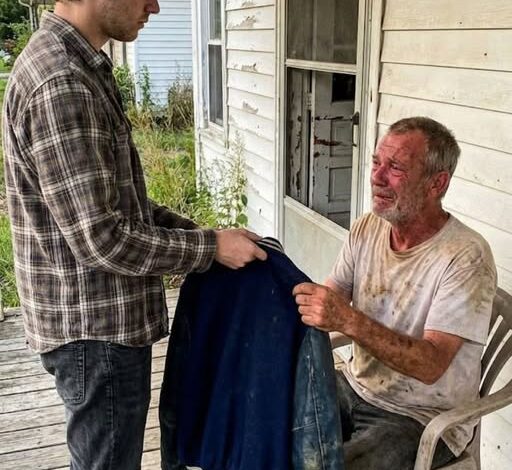
The man froze. He squinted, leaning forward. Then, he used the cane to push himself up, his movements slow and painful. He walked down the steps and reached out a trembling hand. He didn’t look at me; he looked at the chenille patch. His thumb brushed over the embroidery.
“Buck,” he whispered. It wasn’t a question.
“I found it in a shop in the city,” I said. “I found the photo inside, too.”
He looked up at me then, eyes watery and blue. “You drove all the way out here to return a jacket?”
“I… I guess I just wanted to know the story,” I admitted.
He studied me for a long moment, assessing the skinny jeans and the city haircut. Then he nodded toward the porch. “Well, the coffee is stale, but it’s hot. Sit down.”
His name was actually William, but everyone called him Buck because he hit like a deer in headlights back in ’78. We sat on the porch as the sun started to dip.
“I didn’t lose it,” Buck said after a while, staring at the jacket draped over the railing. “I sold it. Five years ago.”
I felt a pit in my stomach. “Oh.”
“My wife, Martha. The girl in the picture,” he gestured to the photo I had placed on the table. “She got sick. Really sick. The insurance we had from the plant didn’t cover the new meds she needed. It was the ‘donut hole’ or whatever they call it. We were short. I took everything I had of value to a pawn broker in the next county.”
He took a sip of his coffee. “He gave me forty dollars for that jacket. It paid for three days of pills.”
The silence that followed was heavy. I thought about the boutique owner pricing it at $280, marketing it as “authentic Americana.” I thought about the markup. The profit margin on a man’s desperation.
“Forty dollars,” I repeated, my voice quiet.
“It kept her comfortable,” Buck said simply. “I’d sell it again for ten.”
“I’m sorry,” I said.
“Don’t be. She’s gone now. But she had those three days.”
We sat there as the twilight settled. The air smelled of damp earth and diesel.
“It was different back then,” Buck said, his eyes drifting to the empty road. “When I wore that jacket… we knew who we were. My dad worked at the plant. I worked at the plant. We didn’t have much money, not like you folks in the city, but we had enough. We left the doors unlocked. If you got a flat tire, three trucks would pull over before you could get the jack out.”
He looked at me. “Now? Now everyone is angry. Everyone is scared. The plant is gone. The kids leave as soon as they graduate. And the ones who stay… they feel like the world is laughing at them.”
I looked at this man, who the internet told me was my political opposite, my cultural enemy. I didn’t see an enemy. I saw a man who had done everything right and still lost.
“It’s not so great in the city either, Buck,” I said softly.
He looked surprised. “No?”
“I make three times what my dad made,” I said. “And I’ll probably never own a house. I work twelve hours a day. I’m surrounded by people, but I’m lonely. We’re scared too. We’re just scared of different things.”
Buck nodded slowly. He reached into a cooler beside his chair and pulled out two cheap lagers. He cracked one and handed it to me.
“To Martha,” he said.
“To Martha,” I answered.
We drank in silence. Two men from different worlds, bridging the divide with a cold beer and a shared realization that the “American Dream” had become a struggle for survival for both of us. The friction wasn’t between us; it was between the people who sell the jackets for $280 and the people who have to sell them for $40.
When it was time to leave, I stood up and left the jacket on the swing.
“Son, take it,” Buck said. “You bought it fair and square.”
“I was just holding it for you,” I said. “It doesn’t fit me right anyway. The shoulders are too broad.”
I pulled out a notepad and wrote down my phone number. “If you ever want to talk about the ’78 season, or just yell at a city kid, call me.”
Buck looked at the number, then at the jacket. He didn’t say thank you. He didn’t have to. He just gave me a nod—a sharp, respectful tilt of the chin that said more than words.
I drove back to the city in the dark. I didn’t listen to a podcast. I didn’t check my notifications.
I thought about how easy it is to judge a demographic from a screen, and how hard it is to hate someone when you’re sitting on their porch drinking their beer.
We spend so much time fighting over the scraps, blaming each other for the fact that the table is empty. We romanticize the past because the present feels so fragile. But looking at Buck, I realized the “good old days” weren’t good because of the economy or the politics. They were good because we showed up for each other.
I lost $280 that day. I came home with an empty passenger seat. But for the first time in years, the world felt a little less heavy.
We aren’t as divided as they want us to be. We’re just all waiting for someone to pull over and help us change the tire.