47 Truckers Came to My Uncles Funeral, But Only One Spoke Up With a Secret That Changed Everything We Knew About Him
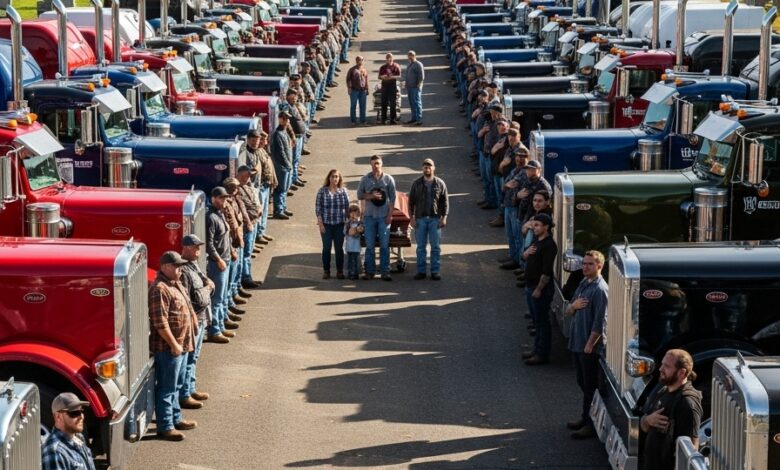
The day of my uncle’s funeral was bright and unyielding. Sunlight bounced off polished chrome as forty-seven trucks lined the cemetery road in perfect formation. Their engines were silent, but the presence of so many drivers—leather vests patched with years of dust and pride—spoke louder than words.
He wasn’t famous. He wasn’t a club president. To the world, he was just my uncle. Yet here they were, forty-seven truck drivers standing shoulder to shoulder, waiting.
I couldn’t shake the question: Why them? Why now?
Before the pastor even began the service, an older driver with a gray beard and dark sunglasses stepped toward me. He didn’t offer condolences. He didn’t shake my hand.
Instead, his gravelly voice cut through the silence.
“Did he tell you?”
I frowned. “Tell me what?”
He studied me for a moment, then stepped back into the line, folding his arms. My stomach tightened. Something about the way he said it—like there was a secret meant only for me—made the grief feel heavier.
As the pastor spoke about faith and loss, I kept glancing at those drivers. None moved. None left.
After the service, I walked over. “Why are you all here?” I asked, unable to contain myself.
For a long moment, silence. Then a tall driver finally spoke.…The tall driver, whose name tag simply read “Mack,” looked down at me with eyes that seemed to have seen every mile of asphalt in the country. He didn’t answer immediately. Instead, he pulled a weathered, leather-bound logbook from his vest pocket.
“Your uncle didn’t just haul freight, kid,” Mack said, his voice a low rumble. “He hauled souls.”
The Hidden Network
I looked at the line of forty-seven men and women. They weren’t just colleagues. There was a precision to their grief, a military-like discipline in their stance.
“We aren’t a trucking company,” Mack continued, gesturing to the silent rigs. “We’re the Safe Lane. And your uncle? He was the one who built the map.”
He handed me the logbook. I opened it, expecting to see fuel receipts or delivery signatures. Instead, I saw names. Hundreds of them. Next to the names were dates and destinations, but no cargo descriptions. Just a single word repeated in the margins: Secured.
“Ten years ago,” Mack said, “your uncle found a girl hiding in his trailer at a stop in El Paso. She was bruised, terrified, and running from a trafficking ring that had its hooks in the local police. Most men would’ve called the cops and washed their hands of it. Your uncle? He put her in the sleeper cab, covered her with a blanket, and drove six hundred miles off-route to get her to a safe house in Colorado.”
The Forty-Seven
I felt a chill that had nothing to do with the wind. “And the rest of you?”
“Every driver here was recruited by him,” Mack explained. “He realized that a long-haul trucker is the only person who can move across state lines without anyone questioning why they’re there or what’s in the back. He turned his life into a shadow. He stayed ‘just an uncle’ to you because he couldn’t risk the people he was saving—or you—by being anything else.”
The older driver with the gray beard stepped forward again. He finally took off his sunglasses. His eyes were wet. “He saved my daughter,” he whispered. “He found her when I couldn’t. He didn’t just bring her home; he made sure the people who took her never walked again. He was the most dangerous ‘nobody’ I ever knew.”
The Shattering Truth
Then came the secret that broke me. Mack flipped to the very last page of the logbook. There was a map of our hometown, with a small circle drawn around our family’s old house.
“You think your father left when you were six because he didn’t love you?” Mack asked softly.
I froze. That was the family wound—the father who walked out and never looked back, leaving my uncle to step in and help my mother raise me.
“Your father didn’t leave,” Mack said, his voice heavy with the weight of the truth. “He was part of the same scum your uncle spent his life fighting. Your father was the one running the El Paso route. He was the one selling the ‘cargo.’”
I gripped the logbook so hard the leather groaned.
“Your uncle didn’t just ‘help’ your mom,” Mack revealed. “He gave your father a choice: leave the state and never breathe a word to your family again, or go into the ground. Your uncle spent twenty years paying your father’s ‘child support’ out of his own pocket so you’d never know the monster your dad really was. He took the blame for being the ‘boring’ uncle who stayed behind, while he was actually the guardian standing at the gate.”
The Final Salute
As the first shovel of dirt hit the casket, a sound erupted that shook the very air. Forty-seven air horns wailed in unison—a deafening, mournful blast that echoed off the hills.
The drivers began to move back to their trucks. Mack paused, placing a heavy hand on my shoulder.
“He left the keys to the black Peterbilt at the end of the line to you,” Mack said. “The logbook is yours now, too. There’s a girl in a shelter in Reno who needs a ride to her grandmother’s in Maine. She’s waiting for a driver she can trust.”
I looked at the trucks, then at the grave of the man I thought I knew. He wasn’t just my uncle. He was the shadow that kept the world from swallowing me whole.
I didn’t say a word. I walked to the end of the line, climbed into the cab of the black truck, and turned the key. The engine roared to life, a promise kept in chrome and steel.