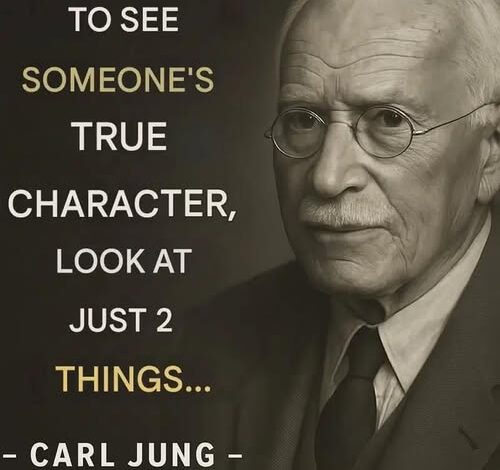
How to Recognize True Character! The Two Signs That Reveal Everything
In our journey through life, we encounter countless individuals who present a polished exterior of kindness and dependability. Yet, as the years unfold, we often discover that the surface rarely tells the whole story. While it may seem that understanding someone’s true nature requires a lifetime of observation, psychological wisdom suggests otherwise. By focusing on the quiet, unguarded moments of daily life, we can uncover a person’s core character in mere minutes.
The Swiss psychiatrist Carl Jung championed the idea that character is not revealed when we are prepared and performing for an audience, but rather when our guard is down and the social masks we wear are set aside. Jung’s insights point toward two definitive barometers of the human soul: how we treat those who can offer us nothing, and how we respond when life refuses to go our way. These signs bypass the curated images people project on social media or in professional settings, cutting straight to the heart of their integrity.
The first and perhaps most profound indicator of character is how an individual interacts with those who hold no power over them. In any social hierarchy, it is easy to be polite to a boss, a wealthy client, or an influential peer. True character, however, is revealed in the exchange with a waiter who makes a mistake, a janitor cleaning a hallway, or a retail clerk at the end of a long shift. When a person offers genuine respect and kindness to someone in a service role, they demonstrate a foundational belief in shared human dignity. They prove that their moral compass is not calibrated by status or potential gain, but by empathy. Conversely, someone who is charming to their equals but dismissive or arrogant toward those they deem “beneath” them reveals a deep-seated insecurity and a lack of genuine moral substance.
The second revealing sign is the way a person navigates frustration and adversity. Comfort is a poor teacher; it allows us to maintain a veneer of patience. Real nature emerges in the crucible of a crisis, whether that crisis is a major life setback or a minor daily annoyance like a traffic jam or a delayed flight. Does the individual lash out and seek someone to blame, or do they maintain their composure and seek a constructive path forward? Jung reminded us that emotional maturity is measured by the ability to remain balanced when the world feels chaotic. A person who can maintain their humanity while under pressure demonstrates a level of self-control and humility that grand gestures can never replicate.
Beyond these primary signs, several subtle clues offer further insight. A person’s sense of humor can be a window into their subconscious; compassionate humor that connects people reflects internal security, while sarcasm used as a weapon often hints at hidden hostility. Similarly, pay attention to how someone speaks about those who are absent. Those who habitually gossip or tear others down are usually broadcasting their own dissatisfactions. Finally, consider how a person uses power. Whether in a family or a boardroom, those who lead with fairness and humility show that their values are rooted in service rather than ego.
For those of us with the benefit of decades of experience, these truths feel like old friends. We have seen relationships flourish or fail based on these very traits. We know that while words are cheap, consistent action is the only currency that matters. In a world increasingly obsessed with “image,” it is vital to remember that character cannot be filtered or staged. It is built in the quiet choices we make every day. By observing these small, powerful signs, we not only learn whom to trust, but we also find a mirror for our own growth. Character, at its best, is the steady light that remains when the applause dies down and the road gets difficult.