I Noticed a Little Boy Crying in a School Bus, and I Jumped in to Help after Seeing His Hands!!!
I’m Gerald. I’m 45. I drive a school bus in a town most people would pass through without noticing.
And until last week, I thought I understood exactly what my job was.
Rain, snow, fog thick enough to swallow headlights—I’m there before dawn, unlocking the gate, climbing into that creaky yellow beast, and coaxing the heater to life like it’s an old friend that needs encouragement. It’s not glamorous work, and my wife, Linda, is quick to remind me of that whenever the bills land on the kitchen counter like threats.
“You make peanuts, Gerald. Peanuts!” she snapped just last week, waving the electric bill in my face like it had personally insulted her.
“Peanuts are protein,” I muttered.
She didn’t laugh. Not even a little.
Still… I love this job. I love the rhythm of it. The way kids climb aboard half-asleep and leave wide awake. The way brothers argue for three stops straight and then share a snack like nothing happened. The way little ones whisper secrets into the air like the bus is a vault.
Those kids are why I show up.
Last Tuesday started like any other.
Except the cold.
It wasn’t normal cold. It was the kind that feels like it has teeth. The kind that crawls up your legs and settles in your bones, making you feel older than you are. My fingers stung just turning the key in the ignition.
I stomped my boots on the steps, shook frost off my scarf, and put on my usual “stern-but-not-mean” voice.
“Alright, hustle up! In quick! The air’s got teeth this morning!” I called out, trying to sound tough while my breath came out in little white bursts.
The kids laughed as they piled on—scarves flapping, boots clunking like tiny soldiers, backpacks bouncing against seatbacks.
Then little Marcy appeared at the bottom step. Five years old. Pink pigtails. Bossy stance. Mitten hands on her hips like she paid taxes.
“You’re so silly, Gerald!” she said.
And then she squinted at my fraying scarf like she’d spotted a crime.
“Ask your mommy to get you a new scarf!”
I leaned down and lowered my voice like I was sharing state secrets. “Sweetie, if my momma were still around, she’d buy me a scarf so fancy it’d make yours look like a dish rag.”
Marcy squealed with laughter and trotted down the aisle, humming like the world was safe.
That tiny exchange warmed me more than the heater ever could.
We finished the route. I dropped the kids off. The doors hissed shut behind the last one, and the bus went quiet.
Normally, after the morning run, I do my usual sweep—checking seats for mittens, homework, forgotten granola bars. I’ve learned the hard way that if you don’t check, you’ll find an apple rotting under seat 12 three days later and wonder why your bus smells like sadness.
I was halfway down the aisle when I heard it.
A sniffle.
Soft. Small. Wrong.
I froze, one hand braced on a seatback.
“Hey,” I called, keeping my voice gentle. “Someone still here?”
No answer. Just the sound again—like someone trying not to be heard.
I stepped toward the back corner and found him.
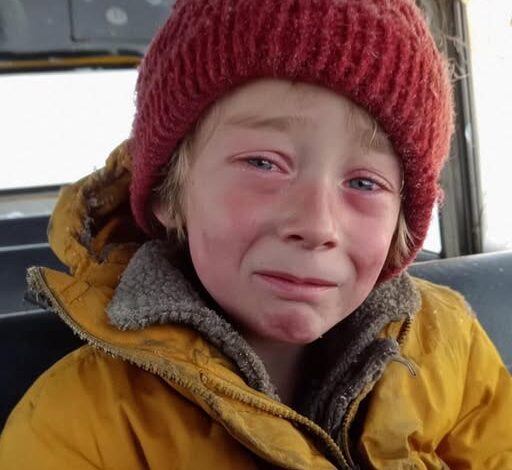
A little boy—seven, maybe eight—huddled against the window. Thin coat pulled tight around him like it was all he had. Backpack on the floor near his shoes, untouched, like he hadn’t moved since everyone got off.
“Buddy?” I crouched down a few feet away so I wouldn’t scare him. “Why aren’t you heading inside?”
He stared at his lap. Wouldn’t look up. His shoulders trembled slightly.
“I… I’m just cold,” he whispered.
Something tightened in my chest.
“Can I see your hands, bud?”
He hesitated, then slowly brought them forward like he expected to get in trouble for them.
And I swear my brain went quiet for a second.
His fingers weren’t just pink from the cold. They were bluish, stiff. Knuckles swollen like the cold had been chewing on them for hours. Like he’d been exposed for longer than any kid should be.
“Oh no,” I breathed, and before I could even think about it, I tugged off my own gloves and slid them onto him.
They swallowed his hands. Hung past his fingertips. Ridiculous.
But warm.
“There,” I said softly. “Not perfect, but they’ll help.”
He finally looked up at me. His eyes were watery, red-rimmed, the kind of eyes that belonged to a kid who had learned how to be quiet about big things.
“Did you lose yours?” I asked.
He shook his head. “They ripped. Mommy and Daddy said they’ll get me new ones next month. Daddy’s trying hard.”
That sentence hit me harder than the cold ever could.
He didn’t complain. He didn’t blame anyone. He just… accepted it. Like a seven-year-old was supposed to understand budgets and hard months and grown-up worry.
I swallowed, trying to keep my voice steady.
“Well, I know a guy,” I said, adding a wink like we were in on a joke together. “He sells the warmest gloves and scarves you’ve ever seen. After school, I’ll get you something. But for now—these are yours. Deal?”
His face shifted—just a little. Like hope tried to peek through.
“Really?” he asked.
“Really,” I said, giving his shoulder a gentle squeeze.
And then he stood up and hugged me.
Not a polite hug. Not a quick one.
A real one.
The kind that doesn’t ask permission, because it isn’t about manners—it’s about need. About relief. About being seen.
He let go fast, like he was embarrassed, grabbed his backpack, and ran toward the school doors without looking back.
I sat there for a moment in the quiet bus, staring at my empty hands, my chest aching in a way I couldn’t name.
That day I didn’t get my usual coffee. Didn’t stop anywhere to warm up.
I went straight to the little shop down the block—nothing fancy, just a place with reliable winter stuff. The owner, Janice, knew me well enough to recognize my face and not ask too many questions. When I told her what happened, her mouth tightened like she wanted to cry and fight someone at the same time.
I picked a thick pair of kids’ gloves and a navy scarf with yellow stripes—one of those scarves that looks like it belongs to a kid who still believes in superheroes.
I used my last dollar and didn’t hesitate once.
Back on the bus, I found a shoebox and put the gloves and scarf inside. Then I wrote on the lid with a marker:
“If you feel cold, take something from here. — Gerald, your bus driver.”
I set it behind my seat like it belonged there all along.
I didn’t announce it. Didn’t wave it around. I just drove my afternoon route and watched through the rearview mirror.
Kids noticed.
They stopped. Read the note. Looked at each other. Whispered.
No one said a word to me.
And then, halfway through the ride, I saw a small hand reach forward and take the scarf.
The same boy.
He didn’t look up. Didn’t smile like he was caught. Just tucked it into his coat like it was a normal thing to do, like he was allowed to have warmth.
When he got off the bus, he glanced toward me—just a flicker—and smiled.
That should’ve been the end of it.
But it wasn’t.
Later that week, my radio crackled as I finished a drop-off.
“Gerald, the principal wants to see you.”
My stomach dropped right into my boots.
I did the mental scramble: Did someone complain? Did a parent see the gloves and assume the worst? Did I break some policy I didn’t know existed?
When I stepped into Mr. Thompson’s office, he greeted me with a smile and a folder in his hand.
“Have a seat, Gerald,” he said warmly.
I sat stiffly. “Am I in trouble?”
He chuckled. “Not even close.”
Then he told me the boy’s name—Aiden. And he told me what I didn’t know.
Aiden’s father, Evan, is a firefighter. He’d been injured during a rescue months earlier—out of work, stuck in physical therapy, the family struggling to keep everything afloat. Mr. Thompson said Aiden’s parents were embarrassed. Not about their son—about needing help. About coming up short.
“What you did,” Mr. Thompson said, leaning forward, “meant the world to them. And it reminded the rest of us what we’re supposed to be.”
I blinked, feeling something sting behind my eyes. “I just didn’t want him freezing.”
“That’s exactly why it mattered,” he said.
Then he slid a sheet of paper across the desk.
They were starting a school-wide clothing fund—coats, boots, gloves, scarves. No questions asked. No kids singled out. Discreet, quiet help. A way for families to breathe without shame.
And it started because of one shoebox on one bus.
I walked out of that office feeling… strange.
Not proud like you feel when you win something. Proud like you feel when you realize you can still be useful in a world that’s always trying to make you feel small.
After that, things moved fast.
A local bakery dropped off boxes of mittens and hats. Parents donated gently used coats. A retired teacher offered to knit wool caps. Janice from the shop called and told me she’d donate gloves weekly.
The shoebox behind my seat became a bin. Then the bin became another bin. Then the hallway by the office had one. The cafeteria got one. The project spread beyond our school to others in the district.
Kids started leaving notes inside.
“Thank you, Mr. Gerald. Now I don’t get teased.”
“I took the red scarf. I hope it’s okay. It’s really warm!”
Every note made my throat tighten.
Because kids don’t write those things unless they mean it.
Then came the day I’ll never forget.
The spring assembly.
They asked me to attend, which was unusual. I wasn’t staff. I was “just the driver.” But I showed up anyway in my cleanest coat and sat at the back of the gym as the kids sang “You’ve Got a Friend in Me.”
When it ended, Mr. Thompson stepped up to the microphone.
He talked about community. About kindness. About how the smallest actions can change the shape of a whole place.
Then he said my name.
“Please welcome Gerald—our district’s bus driver and local hero.”
The gym erupted.
Kids stood on benches waving. Parents clapped. Teachers smiled like they were proud of something they hadn’t even known they needed.
I walked to the stage feeling like my boots were too heavy, like I didn’t know where to put my hands, like I didn’t belong up there.
Mr. Thompson handed me a certificate and explained the expansion: what started on my bus had become The Warm Ride Project across multiple schools.
And then he paused.
“There’s one more surprise,” he said. “The man you helped most wants to meet you.”
I turned.
Aiden stepped onto the stage, clutching someone’s hand.
Behind him was a tall man in a firefighter uniform. His posture was careful, his gait slow, like pain still lived somewhere in his body. But his eyes were clear. Proud. Wet with emotion he didn’t try to hide.
Aiden looked up at him, then back at me.
“Mr. Gerald,” he said loudly into the mic, “this is my dad.”
The firefighter stepped forward, extended his hand, and when I took it, his grip was strong enough to make my chest ache.
“I’m Evan,” he said. “Thank you. That winter was the hardest we’ve ever faced. You didn’t just help my son. You helped our whole family.”
I nodded, unable to speak like a normal person.
Then he leaned in, close enough that only I could hear.
“Your kindness… it saved me too.”
That sentence sat in my bones.
Not because it was dramatic.
Because it was true.
Sometimes people don’t need miracles. They need one person to notice them before they disappear.
When the applause finally faded and I stepped off the stage, I didn’t feel like a hero.
I felt like a man who finally understood his own job.
It isn’t just driving carefully and showing up on time.
It’s paying attention.
It’s seeing the kid who stays quiet.
It’s one pair of gloves.
One scarf.
One small moment that tells a child, You matter. You’re not alone. You don’t have to freeze in silence.
And for the first time in a long while, I felt proud—not of what I did, but of who I chose to be when it mattered.