My Mom Adopted Me After Finding Me on Her Doorstep, 25 Years Later, My Biological Mother Showed Up as I Was Becoming Successful
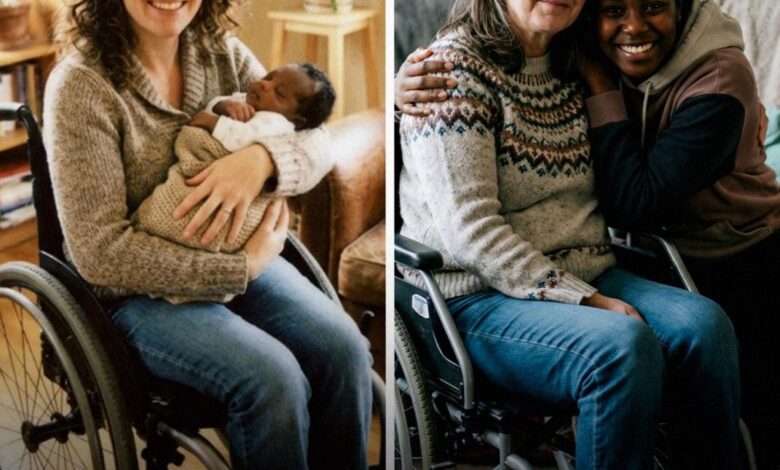
The concept of family is often painted in the hues of biology, yet for me, it was forged in the clinical light of a hospital ward and the steady hum of wheelchair wheels on linoleum. My name is Isabel, and my story didn’t begin with a lineage; it began on a cold doormat. Twenty-five years ago, my mother—the woman who raised me—faced a life-altering tragedy. In her early twenties, a drunk driver had shattered her spine, leaving her paralyzed from the waist down. Doctors were blunt: she would never walk again, and the possibility of carrying a child was non-existent. She cried exactly once, then decided that her life was still hers to live. She moved into an accessible apartment, mastered hand-controlled driving, and built a successful career as a paralegal. Children were a closed chapter in her book, or so she thought, until one morning a thin, piercing cry pierced the quiet of her hallway.
When my mom wheeled over and opened her front door, she found a baby carrier. Inside was a shivering newborn—me—wrapped in a thin, inexpensive blanket. Next to me was a note that read: “I can’t keep her. I have no choice. I’m sorry.” While the world saw a woman in a wheelchair and a tragic abandonment, my mother saw a daughter. She ignored the skeptics who told her that a single, disabled woman shouldn’t take on such a burden. She brushed off the condescension of social workers who suggested a “normal” family would be a better fit. She fought through the red tape with the tenacity of a lioness until the adoption was finalized. She named me Isabel, but to me, she was never an adoptive parent; she was simply the sun around which my world orbited.
Growing up, it was always just the two of us. There were no grandparents or aunts to lean on, only her unwavering presence. She was at every school play, parked in the front row, clapping with a ferocity that made me feel like a star. She taught me that life doesn’t happen to you; you happen to life. Whenever a building lacked a ramp, she didn’t just find another way—she demanded accessibility. She taught me to cook, to advocate for myself, and to understand that a heart that hurts is simply a heart that is growing. When I moved into my college dorm, she was the one arranging my desk and telling me that I was destined to build something great.
That “something” manifested during my junior year as a clothing brand. My best friend Lena and I were tired of poor-quality basics, so we began sketching designs for soft, durable, minimalist apparel. We operated out of our dorm room, surrounded by energy drinks and cardboard boxes. We named the brand “Doorstep”—partially because of its catchy ring, but mostly as a silent tribute to the place where my life truly began. My mom was our unofficial third partner. After her long days at the law firm, she would wheel into our tiny, windowless office to help us fold shirts. She called herself “Quality Control,” and she was terrifyingly efficient. By twenty-five, the business had exploded. I had finally achieved the success my mother always promised was possible, even buying my first car with my own earnings.
Then came the Tuesday that threatened to undo twenty-five years of peace. I was heading out for work when I opened the front door and found a woman standing on the porch. She was well-dressed, her hair perfectly styled, and she looked at me with a soft, rehearsed smile that didn’t reach her eyes. “Isabel?” she asked. When I confirmed my identity, she sighed with performative relief. “I’m Karen. I’m your biological mother. I’ve been looking for you.” My stomach turned to lead.
Karen didn’t come with an apology or an explanation for her twenty-five-year absence. Instead, she came with a sense of entitlement that was breathtaking. She mentioned she had seen the success of Doorstep and noticed my new car. “Sweetheart,” she said, her voice dripping with artificial warmth, “you do realize that without me, you wouldn’t have any of this. I chose to have you. I chose where to leave you so you’d turn out well. I think it’s only fair that I get half of the business and your car as a return on my sacrifice.”
The audacity of her claim was a physical blow. She viewed me not as a daughter, but as a long-term investment that had finally matured. Anger flared in my chest, but I suppressed the urge to scream. I realized that Karen didn’t know who she was dealing with. I had been raised by a woman who fought for every inch of her existence. I smiled at her, a sharp, cold expression. “You’re right,” I told her. “You are connected to my success. Come inside; we shouldn’t do this without my mother.”
Karen followed me inside, her posture relaxing as if she had already won. She greeted my mother, Grace, with a dismissive nod. “Thank you for raising her, Grace. I knew you’d do a good job.” My mom didn’t flinch. She sat at the kitchen table, her hands steady around a mug of coffee. I walked to the bookshelf and pulled down a heavy photo album, placing it firmly on the table between us.
“You want half of everything I’ve built because you started the story,” I said to Karen. “So here is my condition. Before I sign anything over, I want you to find one photo in this book. Just one. Any year, any event. Show me a single time you showed up.”
Karen flipped through the pages. She saw me as a baby sleeping on Grace’s lap. She saw my first day of kindergarten, my awkward middle school years, and my college graduation. In every single image, there was the constant, silver-haired presence of my mother in her wheelchair. Karen’s hands began to move faster, her frustration mounting as she realized the book was a record of her own invisibility.
“This is ridiculous,” Karen snapped, slamming the album shut. “I don’t need photos. I carried you for nine months. That should be enough.”
I stood up, the chair scraping loudly against the floor. “No,” I said, my voice echoing in the quiet kitchen. “That was a biological function. Being a mother is everything that came after the door closed. You weren’t there for the fevers, the exams, the late nights folding shirts, or the moments when I doubted I could make it. You didn’t build this. She did.”
I walked to the front door and held it open. Karen’s eyes went cold, the mask of the doting mother finally slipping. She muttered something about blood being thicker than water and how I would eventually regret my ingratitude. I simply looked her in the eye and told her that blood isn’t a free pass—love is what matters, and showing up is the only currency that counts. After she marched out, I locked the door and leaned against it, the adrenaline finally fading into a deep, shaking relief.
My mom wheeled over and touched my hand, her eyes shimmering with tears. She admitted she had spent years fearing this moment, terrified that I would look at Karen’s able-bodied life and wonder “what if.” I knelt beside her chair and took her hands in mine. “You opened the door,” I told her. “You brought me in, and you stayed. You are the only mother I will ever have.”
That evening, we sat together and looked through the album once more. It wasn’t just a collection of pictures; it was the blueprint of a family built on choice, resilience, and an unbreakable bond. DNA provides a beginning, but it doesn’t write the story. The woman who stayed, the woman who fought, and the woman who loved me without reservation was the only one who deserved a seat at the table of my success. At Doorstep, we don’t just sell clothes; we honor the idea that home is wherever someone chooses to keep the door open for you.