I Baked Pies for Hospice Patients — Until One Day, One Was Delivered to Me and I Nearly Collapsed
Grief doesn’t always arrive loudly. Sometimes it slips into your life quietly, settles into your chest, and teaches you how to move through the world differently. For me, grief pushed me into a kitchen long before I understood what I was doing there. It led my hands to flour and butter, to bowls and rolling pins, to ovens that hummed late at night while the rest of the world slept. I baked to survive. I baked to remember. I baked because it was the only way I knew how to keep loving after everything I loved was gone.
When I was 16, my entire world vanished in a single winter night.
It was January, the kind of cold that feels alive. Sharp enough to make the windows sweat and the air inside the house taste metallic. I was in my bedroom with earbuds in, curled beneath a blanket, half listening to music while my parents laughed at something on television downstairs. My grandfather, who had moved in with us after his health declined, was likely asleep in his recliner, the lamp beside him always left on out of habit.
I smelled the smoke before I heard anything else. It crept into my room, thick and wrong, mixing with the icy air seeping through the walls. I pulled one earbud out just as the fire alarm shrieked, slicing through the house with a sound that still lives in my bones.
My father burst into my room without a word. His boots thundered against the hardwood as he grabbed my arm and pulled me out of bed. I didn’t even have time to protest. He dragged me down the stairs, my bare feet slapping against cold wood, my pajamas offering no protection as he shoved the front door open and pushed me into the snow-covered yard.
I remember the shock of the cold and the way it stole my breath. I remember turning back toward the house, flames already licking at the windows, and seeing my father hesitate for just a second before running back inside.
He went in to get my mother and my grandfather.
None of them came back out.
The fire department arrived too late. The house was already lost, along with everything inside it. They told me later that it was likely an electrical issue in the kitchen. Faulty wiring. Nothing dramatic. Nothing anyone could have predicted. Just a quiet failure that turned catastrophic.
The fire didn’t only take my family. It took our home, our savings, every photo we’d ever taken, and the small ceramic horse my mother had given me on my tenth birthday. It took the proof that my life before that night had existed at all.
Everything was gone.
Everything except me.
For a long time, I wasn’t sure I deserved to be the one who lived.
After the funeral arrangements and the paperwork and the condolences that felt both too much and not enough, I stopped truly living. I moved through days like a ghost, attending school because people told me I had to, answering questions because silence made others uncomfortable. Eventually, a local volunteer organization stepped in and helped me find a place in a community shelter for displaced youth.
They called it a dorm-style housing program. To me, it felt like a pause button on life. A space between devastation and whatever came next.
I shared a small room with another girl who barely spoke. There were two bathrooms per floor and one communal kitchen shared by nearly twenty people. The counters were scratched. The appliances were mismatched. The oven leaned slightly to the left. But it was warm. It was clean. I had a bed.
That alone felt like a miracle.
I could have gone to live with family, technically. My mother’s older sister, Aunt Lorraine, was my only remaining relative. When I called her, my voice shaking as I asked if I could stay with her, she sighed heavily into the phone.
“I’m so sorry, sweetheart,” she said, her tone already distant. “There’s just no space here. Your uncle uses the spare room for his work, and I’m not giving up my reading nook for a teenager. I’m grieving too, you know.”
She was grieving, but not too much to claim half of the insurance money that came to me after the fire. She promised she would use it to help. Clothes. Therapy. Anything I needed.
Instead, she bought herself stacks of romance and mystery novels, a wine fridge, a new car, and an entirely new wardrobe she referred to as her “mourning look.” She showed up to her book club in designer hats and fresh outfits, explaining to anyone who asked that grief had inspired her to reinvent herself.
I didn’t argue. I didn’t have the energy. I told myself that I’d already lost the most important things in my life, and at least now I had a mattress, a desk, and enforced quiet hours between eleven at night and six in the morning.
During the day, I threw myself into school. I studied as my life depended on it, because it did. Scholarships were my only way forward. Education was my escape plan, my proof that I could still build something from the ashes. I needed to matter to someone someday, even if that someone was just my future self.
At night, while the other girls scrolled through their phones or watched television in the common room, I took over the kitchen.
That was where the baking began.
I saved every dollar of my monthly assistance and spent it on flour, butter, and whatever fruit was cheapest that week. I kneaded dough on a scarred Formica counter and rolled it out with an old wine bottle I’d rescued from the trash. The oven was temperamental, heating unevenly, but I learned how to work around it.
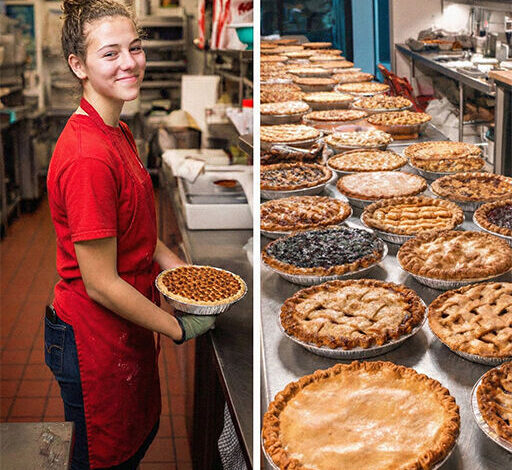
I baked apple pies, blueberry pies, cherry pies, peach pies, and strawberry rhubarb whenever I could afford it. On a good night, I made ten. Once, when I’d managed to stretch my money just right, I made twenty.
I boxed them up carefully and delivered them anonymously to the homeless shelter downtown and the hospice center a few streets away. I always went at night. I handed them to volunteers or nurses. I never gave my name. I never left a note.
I didn’t want recognition. I just needed somewhere to put my love.
I never met the people who ate them. I couldn’t. Seeing their faces would have been too much. It was easier to imagine them warm and comforted, to believe that something I made could soften someone else’s pain, even briefly.
My aunt didn’t understand.
“You’re wasting money,” she told me during one of her sporadic check-in calls. “Those people don’t even know who you are. That money should be going to me. I lost my sister, too.”
She didn’t sound sad. She sounded inconvenienced, as if my existence had become an ongoing annoyance.
I kept baking anyway. The rhythm of it steadied my hands and quieted my thoughts. It gave shape to my grief, turned it into something tangible and, somehow, useful.
Two weeks after I turned eighteen, a box arrived for me.
The receptionist at the shelter handed it to me during lunch. It was plain brown cardboard, my name written across the top in careful, elegant cursive. There was no return address.
I opened it right there at the desk.
Inside was a pecan pie.
It was flawless. A golden crust with braided edges, lightly dusted with powdered sugar, like fresh snow. The smell hit me all at once, rich and buttery and achingly familiar. I felt dizzy, my knees going weak.
I had no idea who sent it.
When I cut into it with a knife the receptionist kept in her drawer, I nearly blacked out. Tucked inside was a folded piece of thick, cream-colored stationery, sealed in clear plastic.
The note read:
To the young woman with the kind heart and golden hands,
Your pies made my final months feel warm and full of love.
I never saw your face, but I felt your soul.
I don’t have family left.
But I would like to leave my home and my blessings to someone who knows what love tastes like.
—E.
I dropped the note.
The box slid from my lap as I sank to the floor beside the mail desk, staring at the pie as my heart pounded behind my eyes. The receptionist rushed over, helped me sit up, and gently suggested I take the afternoon to rest.
Three days later, a lawyer called me.
His name was Martin Hale. His voice was calm and precise. He asked me to confirm my identity and whether I had been delivering baked goods to the local hospice for several months.
“Yes,” I said, barely recognizing my own voice.
“Then you may want to sit down,” he replied. “Evelyn Cross passed away last week. She named you as the sole beneficiary of her estate.”
I thought he had the wrong person.
“What estate?” I asked.
“Her home, vehicle, personal belongings, and a trust fund established by her late husband,” he explained. “It accrued interest for nearly twenty years. Its current value is approximately five point three million dollars.”
I laughed. Sharp, hysterical laughter. I was sitting on a bus bench outside the library, my backpack full of scholarship applications at my feet.
“But she didn’t even know me,” I said.
“She did,” he answered gently. “She asked the hospice staff to help her identify you. One of the night nurses recognized your red coat with the missing button and followed you at a distance one evening. She learned your name and your story.”
I was silent.
“Ms. Cross was blind,” he continued. “She asked for detailed descriptions of every pie you delivered. She guessed the flavors by scent. She saved slices to share with other patients. She kept a journal and wrote about the baker she never met. She once said, ‘Whoever she is, she’s young, quiet, and grieving, but she still knows how to love.’”
Evelyn had been a retired librarian. Widowed. No children. Stage four cancer. According to the staff, she barely spoke before the pies began arriving.
I never told anyone at the shelter. Saying it out loud felt dangerous, like tempting fate.
But Aunt Lorraine found out anyway. The estate notice appeared in the newspaper. She called me that night.
“You owe me,” she said immediately. “I raised you. I’m your family.”
“You gave me nothing,” I replied.
I hung up and blocked her number.
Evelyn’s house sits on a quiet street with wide porches and old trees. It smells like cedar and books. There’s a small greenhouse in the backyard, filled with roses and orchids her husband built for her years ago.
I moved in last month. I still haven’t touched the money.
But I bake in her kitchen now, using her wooden spoons and her rolling pin. A note above the oven reads, The best ingredient is time.
I still deliver pies to the hospice, the shelter, and now the hospital too. This time, I leave my name.
Baked with love, the note says. From someone who’s been where you are.
A stranger’s pie changed my life.
But it was her kindness, not the money, that gave me something I thought I’d lost forever.
Peace.