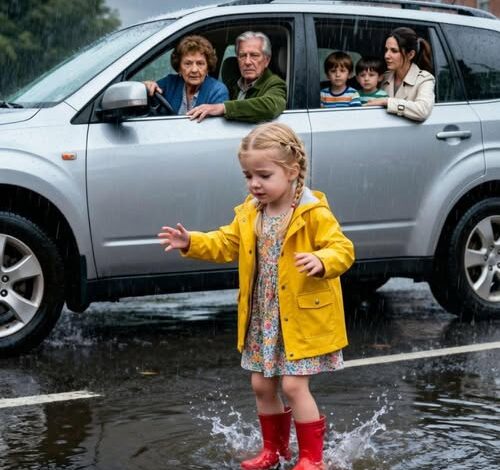
At pickup, my parents took my sister’s children and refused my daughter a ride. When she reached the car, my mother told her to walk home despite the heavy rain. My six-year-old begged, but they drove away, leaving her drenched and in tears.
The rain came down in relentless sheets, pounding the school parking lot until the asphalt looked like a trembling sheet of gray glass. I was halfway through a budget meeting under buzzing fluorescent lights, staring at columns of numbers projected on the wall, when my phone skidded across the conference table so violently it made everyone look up.
Mrs. Patterson’s name flashed on the screen.
Before I even answered, something in my stomach tightened.
“Are you Lily’s mom?” she asked the second I picked up. Her voice was strained, urgent. “She’s outside the gate in this storm. She’s soaked and crying. Your parents were supposed to pick her up… and they left.”
For one terrible second, the room around me went blurry. I grabbed my keys, muttered something about an emergency, and walked out before anyone could stop me. The rain slammed against my windshield so hard it sounded like fists. My wipers couldn’t keep up. Every red light felt cruel.
All I could see was Lily.
Six years old. Small. Trusting. Standing alone in weather that would frighten grown adults.
When I pulled into the lot, I spotted her immediately. Mrs. Patterson was standing over her with an umbrella, trying to shield her from the worst of the storm. Lily’s pink backpack hung limp and heavy with water. Her blond hair was plastered to her cheeks. Her little shoulders were shaking so badly it looked like the cold had gotten into her bones
The moment she saw my car, she ran.
“Mommy!” she cried, her voice breaking as her shoes splashed through puddles.
I jumped out and scooped her into my arms. Her clothes were soaked through, heavy and icy against me. She was trembling so hard I could feel it in my chest. I wrapped my arms around her tightly, as if I could somehow undo the last hour just by holding her hard enough.
“I’m here,” I whispered. “I’ve got you. You’re okay.”
She buried her face in my shoulder and sobbed. When she finally pulled back, her lashes were stuck together with rain and tears.
“Grandma and Grandpa… they left me,” she whispered.
Something inside me turned cold.
Mrs. Patterson apologized for calling late, for not knowing the whole situation, but I barely heard her through the roar in my ears. I thanked her anyway, because she was the reason my daughter hadn’t been standing there alone any longer than she already had.
Inside the car, I blasted the heat and wrapped Lily in my coat. Her teeth kept chattering. I buckled her in with careful hands and brushed wet hair off her forehead.
“Tell me what happened,” I said as gently as I could.
Lily sniffed hard and stared down at her little hands.
“They came like normal,” she said. “Their silver car. I ran to it.”
Her voice wobbled, but she kept going, like she needed me to hear every piece of it.
“I went to open the door… but Grandma didn’t open it. She rolled the window down just a little.”
My grip tightened around the steering wheel.
“What did she say, baby?”
Lily’s eyes filled again.
“She said, ‘Walk home in the rain like a stray.’”
I felt like the air had been punched out of me. Not because cruelty was new in my family. It wasn’t. But because this was my child. My six-year-old daughter. A little girl in a storm.
“And Grandpa?” I asked, though part of me didn’t want to know.
“He leaned over and said, ‘We don’t have room for you.’”
Lily’s lower lip trembled.
“I told them it was raining. I told them it was far. I said, ‘Please, it’s pouring.’”
She wrapped her arms around herself, remembering the cold.
“And Aunt Miranda was there too,” she whispered. “She looked at me like… like she didn’t care.”
That name ignited something ugly inside me.
Miranda. My sister. The golden child. The one everything bent around, no matter who got hurt in the process.
“She said her kids deserved the comfy ride,” Lily went on. “And Bryce and Khloe were in the back. Dry. They just looked at me.”
I blinked hard, forcing my voice to stay steady because Lily was watching me, searching my face for proof that she was safe now.
“So they drove away?” I asked softly.
She nodded, and tears spilled over.
“I stood there and didn’t know what to do. I thought you would come, but… I didn’t know if you knew.”
My throat burned. I reached across the console and took her hand.
“You did nothing wrong,” I told her. “Nothing. Not one thing. Do you hear me?”
She nodded.
The drive home felt like a storm was trapped inside the car with us. I kept my voice calm for Lily, but my mind was racing, lining up moments I had excused for years and seeing them for what they really were.
This wasn’t one awful decision.
It was the final proof of a lifetime pattern.
My parents had always favored Miranda. She stayed close. She had children first. She fit the image they liked to show the world. I was the dependable one—the one they quietly relied on, the one who didn’t “need much,” the one expected to absorb disappointment without complaint.
And for years, I let them.
I helped because I thought that was what family meant. I helped because I wanted Lily to grow up believing love could be generous. I helped because my parents had mastered the art of making their wants sound like urgent needs.
But leaving Lily in the rain? Telling her to walk home like a stray?
That wasn’t carelessness.
That was a choice.
At home, I ran her a hot bath and sat on the bathroom floor while steam filled the room and color slowly returned to her cheeks. Afterward, I made hot chocolate and wrapped her in a blanket so thick she looked tiny inside it. She curled up beside me on the couch, quiet in a way that broke my heart.
“Do I have to see them again?” she asked at last.
“No,” I said immediately. “Not if you don’t want to. You are allowed to feel safe.
Her whole body relaxed at those words, like she had been holding her breath for hours.
When she finally fell asleep, I carried her to bed, tucked her in, and stayed until her breathing turned deep and even.
Then I walked into my office, closed the door, and opened my laptop.
I didn’t do it dramatically.
I did it carefully.
Methodically.
Like surgery.
Because that was exactly what it was. I was cutting off the financial bloodstream that had kept my parents and Miranda comfortable for years.
I opened my accounts and stared at the list of payments I had normalized as part of my life.
Mortgage support for my parents. Nearly three thousand a month.
Their car payment.
Their health insurance.
Utilities. HOA fees. Even my mother’s country club membership because she “needed” to keep up appearances.
And Miranda?
Private school tuition for her kids. A better car lease because she was “under pressure.” Vacation money because “the kids deserved it.” Endless emergencies that somehow always had my name attached to the solution.
I clicked through statement after statement, and the total stacked into something grotesque.
Over four years, it was more than three hundred and seventy thousand dollars.
Money I could have saved for Lily. Money I could have put into our home. Money I had earned with long hours, missed lunches, late nights, and constant pressure—while my parents treated me like an account, not a daughter.
My hands stayed steady.
I canceled the mortgage autopay.
Canceled the car payment.
Removed myself from the insurance.
Stopped the tuition.
Closed every open line, one after another, until the screen looked clean.
Then I leaned back and stared at the silence I had created.
At eleven that night, David found me still sitting there, the spreadsheets open, the total glaring up at me like a verdict.
He leaned over my shoulder, and his face changed as he took it in.
“I knew it was a lot,” he said quietly. “But this?”
“I’ve been a fool,” I whispered.
He turned my chair to face him.
“No,” he said firmly. “You’ve been generous to people who decided generosity was something they were entitled to.”
That night I barely slept. Every time I closed my eyes, I saw Lily standing in the rain.
The next morning, I took her to her favorite breakfast place before school. She ordered chocolate chip pancakes and chatted about classmates and crayons and playground games, like her little heart was trying its best to prove the world could still feel normal.
In the parking lot, she looked up at me.
“Are Grandma and Grandpa mad at us?” she asked.
I crouched so we were eye level.
“They made a bad choice,” I said carefully. “Sometimes adults make bad choices, and there are consequences. But you did nothing wrong. Not ever.”
Her eyes filled.
“But… they left me.”
“I know,” I said, and my voice turned into something solid and unshakable. “And that is why I’m making sure it never happens again.”
She threw her arms around my neck.
“I love you, Mommy.”
I held her tightly.
“I love you more than anything.”
Back in the car, before I started the engine, I sent one group text to my parents and Miranda.
After what you did to Lily, every payment stops immediately. You are on your own. Do not contact me or my daughter again.
Then I turned off my phone.
When I switched it back on later, the messages came in waves.
At first they were confused. Then angry. Then desperate.
My mother demanded to know why the mortgage payment had bounced.
My father accused me of being dramatic.
Miranda’s messages were the worst—furious that her children might now “suffer.”
Not one of them asked if Lily was okay.
Not one asked if she had been cold.
Not one apologized.
Everything was about money.
About inconvenience.
About their comfort.
That was when something inside me finally went quiet, like an engine that had been running for years had at last shut down.
By noon, my father’s calls had turned into lectures about family loyalty. My mother insisted I was destroying the family.
I looked across the room at Lily sitting on the rug, building a crooked little tower and laughing softly to herself, safe in her own home.
And I realized the family wasn’t destroyed by my boundaries.
It had been destroyed the moment they decided my daughter wasn’t worth a seat in the car.
When my father called again, I answered.
Just once.
I let the silence stretch until he understood that something fundamental had changed.
He started in with anger, but before he could finish, I spoke.
“You left my daughter in a storm,” I said, calm as ice. “So don’t talk to me about what I owe you.”
There was a long pause.
So long I could hear him breathing.
And for the first time in my life—
he had nothing to say.