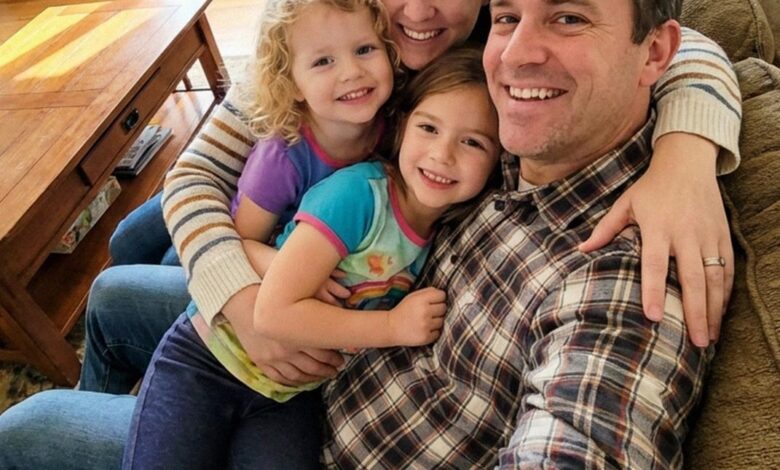
I Married a Widower With Two Little Girls – One Day, One of Them Asked Me, ‘Do You Want to See Where My Mom Lives?’ and Led Me to the Basement Door
I thought I was stepping into a family that had already faced its worst moment and somehow survived it.
Daniel told me early—second date, no hesitation.
“I have two daughters. Grace is six. Emily is four. Their mom died three years ago.”
He said it carefully, like he had repeated it enough times to make it sound steady.
I reached across the table. “Thank you for telling me.”
He gave a tired, almost cautious smile. “Some people hear that and run.”
“I’m still here.”
And I meant it.
The girls made that decision easy.
Grace was bright, relentless in her curiosity, always asking questions like the world owed her answers. Emily was softer, slower to trust—but once she did, she gave it completely. Within a month, she was curling into my lap with books like it had always been hers.
I didn’t try to replace their mother. I just showed up. Meals, cartoons, fevers, glue-covered crafts. The ordinary things that quietly build something real.
We got married by a lake. Small. Simple. Grace asked about cake every ten minutes. Emily fell asleep before sunset. Daniel looked happy—but careful. Like happiness was something fragile, something he didn’t quite trust.
After the wedding, I moved into his house.
It was warm. Lived-in. Full of toys and photos and evidence of a life that had kept going.
And one locked basement door.
I noticed it in the first week.
“Why is that always locked?” I asked one evening.
“Storage,” Daniel said without looking up. “Old tools, boxes… I don’t want the girls getting hurt.”
It sounded reasonable.
So I let it go.
But the house had its own quiet language.
Grace sometimes stared at that door when she thought no one noticed. Emily would pause near it, then hurry away like she’d stayed too long. Once, I found Grace sitting on the floor, just looking at the knob.
“What are you doing?” I asked.
“Nothing.”
Then she ran off.
It wasn’t enough to confront. Just enough to linger.
Until the day it stopped being small.
The girls had colds, so I stayed home with them. They were miserable for about an hour, then turned into chaotic little storms of energy.
“I’m dying,” Grace announced dramatically.
“You have a runny nose,” I said.
By noon, they were racing through the house, playing hide-and-seek like they’d forgotten they were sick.
“No running,” I called.
They ran.
“No jumping off furniture.”
“That was Emily!” Grace yelled.
“I’m baby!” Emily shouted back. “I don’t know rules!”
I was stirring soup when Grace came into the kitchen and tugged my sleeve.
Her face was serious.
“Do you want to meet my mom?”
The words landed wrong.
I stared at her. “What?”
She nodded. “Do you want to see where she lives?”
Something cold slipped through me.
Emily wandered in behind her, dragging her stuffed rabbit.
“Mommy is downstairs,” she said.
Every instinct I had tightened at once.
“Downstairs where?” I asked carefully.
Grace grabbed my hand like she was excited to show me something special.
“The basement. Come on.”
The locked door suddenly felt very different.
At the bottom of the hall, she looked up at me. “You just have to open it.”
I should have waited.
I know that now.
Instead, I knelt, pulled two hairpins from my bun, and worked the lock with hands that wouldn’t quite steady.
The click felt louder than it should have.
Emily stood beside me, sniffling. Grace bounced with anticipation.
“See?” she whispered.
I opened the door.
The smell hit first—damp, stale, something neglected.
I stepped down slowly.
And then my fear changed.
It wasn’t what I had imagined.
It was something quieter.
And somehow heavier.
The basement wasn’t empty.
It was preserved.
A couch with a folded blanket. Shelves of photo albums. Framed pictures everywhere—Daniel’s wife smiling, laughing, holding the girls when they were small. Children’s drawings taped carefully along the walls. Boxes labeled in neat handwriting. A cardigan draped over a chair. Rain boots by the wall. A small tea set on a child-sized table.
An old TV surrounded by stacks of DVDs.
The smell came from a slow leak—a pipe dripping steadily into a bucket, staining the wall.
“This is where Mom lives,” Grace said simply.
I turned to her. “What do you mean?”
“Daddy brings us here so we can be with her,” she explained.
Emily hugged her rabbit tighter. “We watch Mommy on TV.”
“And Daddy talks to her,” Grace added.
I looked back at the room.
This wasn’t a secret.
It was grief, carefully contained.
A locked room full of everything he couldn’t let go of.
Then I heard the front door upstairs.
Daniel was home early.
“Girls?” his voice called.
Grace lit up. “Daddy! I showed her Mommy!”
The silence that followed was sharp.
Then his footsteps—fast.
He appeared in the doorway and went completely still when he saw the door open.
“What did you do?”
His voice was sharp enough to make Grace flinch.
I stepped in front of them. “Do not speak to me like that.”
Something in his face broke almost immediately.
“Why is this open?” he asked, quieter now, but shaken.
“Because your daughter told me her mother lives down here.”
That landed.
Grace’s voice trembled. “Did I do bad?”
He dropped to his knees beside her. “No. No, baby.”
I sent the girls upstairs.
Then I turned back to him.
“Talk.”
He stood there like he didn’t want me to see any of it.
“I was going to tell you.”
“When?”
Silence answered for him.
He sank onto the bottom step. “It’s not what you think.”
“I don’t even know what to think.”
His voice cracked. “It’s all I had left.”
That shifted something in me.
Not enough to excuse it.
But enough to listen.
“I kept going after she died,” he said. “Work, routines, the girls… everyone said I was strong. I wasn’t. I was numb.”
He gestured weakly around the room. “I couldn’t get rid of her things. The girls kept asking about her, so we came down here. We looked at pictures. Watched videos.”
“You knew what Grace believed?”
He closed his eyes. “Not at first. Then… yes.”
“That’s not small.”
“I know.”
I looked around again—the care in it, the refusal to move forward.
“Why keep it like this?”
“Because down here,” he said quietly, “she was still part of the house.”
That honesty sat heavily between us.
Then I asked the question I hadn’t wanted to say out loud.
“Why did you marry me if you were still living like this?”
He didn’t hesitate.
“Because I love you.”
“Do you?”
He swallowed.
“…and because I needed help carrying what was left.”
It wasn’t the answer I wanted.
But it was the truth.
“You asked me to build a life with you,” I said, “while hiding a room like this.”
“I was ashamed.”
“You should have been honest.”
Upstairs, I could hear the girls moving around again.
“They need memories,” I continued. “Not a place they think their mother lives.”
“I know.”
“This isn’t healthy. For them or for you.”
He looked at me, empty and tired. “I don’t know how to let go.”
Something in me softened—not because it was okay, but because it was finally real.
“You don’t have to let go of her,” I said. “But you do have to stop pretending she’s still here.”
The pipe dripped steadily into the bucket.
“We fix the leak,” I added. “And you get help.”
He nodded, almost relieved. “Okay.”
That night, after the girls were asleep, I went back down alone.
The room felt different now.
Not frightening.
Just heavy with everything that had been left unfinished.
I picked up a photo—his wife laughing, reaching for Grace as a toddler.
Alive in a way the room couldn’t hold.
When Daniel came down, I set it back.
“She doesn’t live here,” I said quietly. “Your grief does.”
The next morning, he sat the girls down.
I stayed nearby.
“Mommy doesn’t live in the basement,” he told them gently.
Grace frowned. “But we see her there.”
“You see pictures and videos,” he explained. “Mommy died a long time ago. That means she isn’t in any room in this house.”
Emily’s lip trembled. “Then where is she?”
He took their hands.
“In your hearts. In your memories. In the stories we tell.”
Grace was quiet for a moment.
“Can we still watch her videos?”
His voice broke. “Yes. Of course.”
A week later, the leak was fixed.
A therapist’s number sat on the fridge.
And the basement door stayed unlocked.
That’s not a perfect ending.
It’s just a true one.
Some marriages don’t shatter all at once.
Some open slowly—like a locked door you weren’t meant to find yet.
Ours didn’t break that day.
But it did change.
And now, at least, nothing in this house is pretending anymore.