The young father’s card kept getting declined for baby formula and diapers, and nobody in line knew his wife was home bleeding.
The young father’s card kept getting declined for baby formula and diapers, and nobody in line knew his wife was home bleeding.
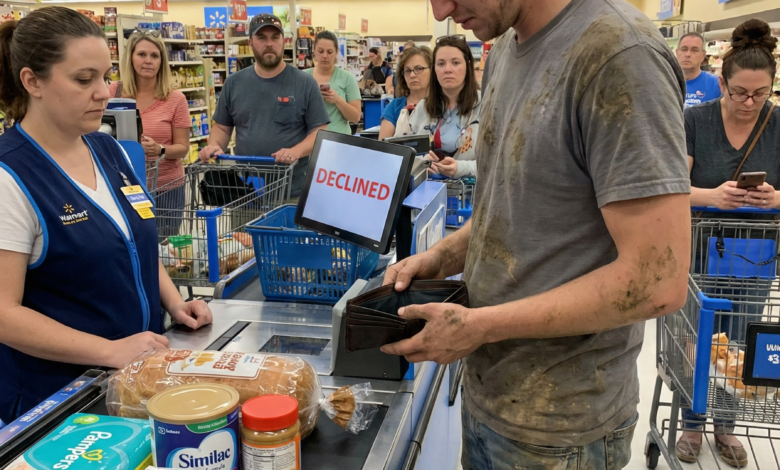
“Run it one more time,” he told the cashier, voice shaking.
She did.
Declined again.
He stood there in a torn gray work shirt, mud dried on his jeans, steel-toe boots leaving little flakes of dirt on the grocery store floor.
In his cart were two cans of formula, a box of diapers, white bread, peanut butter, cough medicine, and a pack of sanitary pads.
The total wasn’t huge.
That was the part that hurt.
It was the kind of number most people spend without thinking.
But for him, it might as well have been a thousand dollars.
The line behind me started doing what lines do.
Little sighs.
Eye rolls.
One woman checked her watch like he was stealing her afternoon.
A man behind her muttered, “Come on.”
I was tired too.
My knees were aching, my freezer food was thawing in the cart, and I had exactly enough money in my checking account to get through the week if nothing went wrong.
So yes, I was irritated.
Until the young dad started taking things off the belt.
“Take off the peanut butter,” he said.
Then, “Take off the bread.”
He swallowed hard and looked at the sanitary pads like they were the hardest thing in the world to touch.
“And those too.”
The cashier hesitated.
He gave a dry little laugh that sounded more like a choke.
“My wife had the baby six days ago,” he said, not looking at anyone. “She’s still bleeding pretty bad. We ran out.”
Nobody in line made a sound after that.
He kept going, talking too fast now, like shame had broken something open.
“The formula has to stay. The diapers too. The medicine too. Our little girl’s been running a fever, and my wife can’t drive yet. I just got off a double shift. I get paid tomorrow. There should’ve been money in there.”
He swiped again.
Declined.
That was when I looked at his hands.
They were raw.
Knuckles split.
Fingertips cracked open like he’d been working with cement or lumber in winter air.
Those were not lazy hands.
Those were the hands of a man who had done everything he knew how to do and still come up short.
And suddenly I wasn’t seeing him.
I was seeing my husband, thirty years ago, standing in a checkout line with a bag of diapers under one arm and panic all over his face because our son had colic and the electric bill had cleared before his paycheck hit.
Back then, nobody stepped in.
We went without.
I still remember tearing old towels into squares because we couldn’t afford enough of anything.
So before I could talk myself out of it, I reached into my wallet and pulled out the emergency cash I kept folded behind my license.
A hundred dollars.
Money I had been saving for my own prescription refill.
I tapped his cart and said, “Sir, you dropped this.”
He turned and looked at the bill, then at me.
His eyes were red already, but now they went glassy.
“I didn’t drop that,” he said quietly.
“Yes, you did,” I said, louder this time, because pride is a fragile thing and sometimes you have to protect it in public.
“It fell out when you grabbed your wallet. I saw it.”
For a second, I thought he might refuse.
He knew what I was doing.
I knew he knew.
But then his mouth tightened, and he took the bill with a hand that trembled so hard it nearly missed mine.
He turned back to the cashier.
“Put the bread back on,” he said.
Then after a pause, almost embarrassed to need one more ordinary thing, “And the peanut butter.”
He glanced at the pads too.
“And those.”
The cashier rang everything through without a word.
When he finished paying, he gathered the bags slowly, like he was trying not to fall apart in front of strangers.
He passed me on the way out.
He didn’t say thank you.
He couldn’t.
He just gave me one broken nod, chin tucked down, eyes shining.
That nod said everything a person can’t say when life has stripped them down to the bone.
I stood there with less money than I should’ve had and more peace than I’d felt in years.
I ate soup for three nights after that so I could stretch what I had left.
And every single spoonful tasted better than a full pantry ever could.