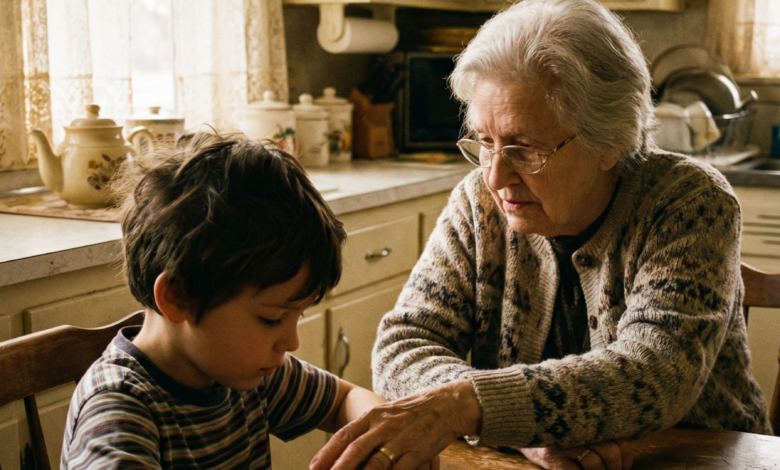
My name is Margaret. I’m 73 years old. When my daughter, Emily, asked if I could look after my grandson, Noah, every Tuesday after school, I didn’t think twice about it. “Just until 5:30,” she said, clearly worn out. “Childcare is just too expensive right now.”
My name is Margaret. I’m 73 years old. When my daughter, Emily, asked if I could look after my grandson, Noah, every Tuesday after school, I didn’t think twice about it. “Just until 5:30,” she said, clearly worn out. “Childcare is just too expensive right now.”
Noah is ten. He’s always been a quiet child. For the first few weeks, he’d sit at my kitchen table, head down, writing in his notebook. He ate whatever I prepared without saying much. I assumed it was just a phase—that he was growing up and becoming more withdrawn.
But after about a month, things started to feel off.
By the fifth week, I began noticing patterns. His schoolwork, especially history, didn’t make sense. Not because he didn’t understand it—but because he was deliberately writing incorrect answers. It wasn’t confusion. It was intentional.
Then one afternoon, I checked his school bag by the entryway. Inside, I found several sandwiches from previous days—uneaten, spoiled at the bottom. When I gently asked him why he wasn’t eating at school, he avoided eye contact and mumbled, “I’m just not that hungry, Grandma.”
But what truly unsettled me was how he reacted to small things. If I accidentally dropped something or moved too quickly, he would tense up immediately, like he was expecting something bad to happen.
The following Tuesday, I couldn’t ignore it anymore.
I sat him down and said softly, “Noah, look at me. Is someone hurting you?”
He hesitated. Then in a quiet voice, he said, “Please don’t tell Dad. He’s already stressed about the car.”
What I learned broke my heart. It wasn’t happening at home—it was at school. A group of older boys had been targeting him. They were taking his food, making fun of him, and cornering him when no one was around. He had even started failing his classes on purpose, hoping that repeating a grade would help him escape them.
At just ten years old, he was carrying the weight of his parents’ struggles, choosing to stay silent so he wouldn’t add to their burden.
That evening, I called Emily. She broke down crying. Between her long work hours and her husband trying to find stable employment, they hadn’t realized what their son was going through.
When I contacted the school, the response was disappointing. I was told, “Children need to learn to toughen up.” I made it clear that this was not something I would accept. I told them plainly that if they failed to protect my grandson, I would make sure their inaction became known to others.
Things changed quickly after that. Noah was moved to a different section of the school, and the students responsible were finally held accountable.
But something unexpected happened as well. Other grandparents began reaching out to me. They had noticed similar quiet changes in their own grandchildren.
So we started meeting every Tuesday. We called our group “The Watch Circle.” It wasn’t just about spending time together—it was about paying attention.
Together, we began noticing things others had missed:
A child struggling in school due to an undiagnosed learning difficulty
A boy dealing with online harassment from someone he trusted
A girl hiding an injury because she didn’t want to worry her family about expenses
Recently, Emily told me, “I was so focused on keeping everything together, I didn’t see how much he was hurting. You noticed what I couldn’t.”
Today, Noah is different. He eats properly, he smiles more, and he actually looks forward to going to school again.
I used to believe that being a grandmother meant stepping back and taking things easy. But I’ve realized it’s something else entirely.
In a world where parents are often overwhelmed by work, financial pressure, and stress, we are sometimes the ones who have the time to truly see what’s going on.
So don’t just watch over children—really observe them. Quiet doesn’t always mean okay. Sometimes, the loudest cries are the ones you never hear.