My Former Teacher Embarrassed Me for Years – When She Started on My Daughter at the School Charity Fair, I Took the Microphone to Make Her Regret Every Word
I knew something was wrong the moment Ava stopped talking.
My daughter has never been quiet by nature. She talks in the car, at the table, while brushing her hair, while doing homework, while pretending not to do homework. At fourteen, she has opinions about everything and no interest in keeping most of them to herself.
So when she came home from school, dropped her backpack by the door, and just sat at the kitchen table pushing food around her plate without a single complaint about cafeteria pizza, algebra, or the unfairness of early mornings, I felt it instantly.
“What happened?” I asked.
She shrugged without looking up. “Nothing.”
That answer told me plenty.
I sat down across from her and waited. Ava has always been like me in that way. If you give her silence, eventually she fills it.
After a minute, she sighed.
“There’s this teacher,” she said.
Something in the way she said it pulled me straight back into my own past.
I kept my face calm. “What about her?”
Ava picked at a piece of bread, breaking it into tiny pieces she didn’t eat. “She keeps embarrassing me in class. Like… little things, but in front of everyone. She says stuff that makes the whole room laugh.”
My stomach tightened.
“What kind of stuff?”
She swallowed. “That I’m not very bright. That I always miss the point. That some students just don’t have what it takes.”
I didn’t speak for a second.
Because I knew that voice. Even before I knew the name, I knew the type of cruelty she was talking about. The kind that dresses itself up as discipline. The kind adults get away with because they sound calm while they do damage.
“What’s her name?” I asked.
Ava shook her head. “I don’t know. She’s new.”
Then she looked up, fast, eyes wide with panic. “Mom, please don’t come to school. Please. If you make a big deal out of it, everyone will know, and it’ll just get worse.”
I wanted to say no immediately. I wanted to tell her nobody gets to talk to my daughter that way and walk away comfortable.
But I also recognized that look on her face, because I had worn it once too.
So I said, “Okay. Not yet.”
She nodded, relieved, but I could see the strain in her shoulders, the way she held herself smaller than usual. That hurt more than her words.
And the worst part was how familiar it all felt.
Because school had once been the worst place in the world for me too.
Not all of it. Just one classroom. Just one teacher. But when you’re thirteen, one cruel adult can poison an entire year of your life.
Her name was Mrs. Mercer.
Even now, after all these years, I can still hear the way she said my name when she wanted the class to laugh. I can still feel the heat in my face when she looked me over and made comments about my clothes, as if being poor were a moral failure and not simply the fact of my life.
Once, she stood in front of the whole class, looked directly at me, and said, “Girls like you grow up to be broke, bitter, and embarrassing.”
I was thirteen.
I went home that day and didn’t eat dinner.
I never told my parents. I was too afraid she’d punish me for it. Too afraid of making it worse. And because I already had braces, hand-me-down clothes, and enough reasons for kids to notice me when I didn’t want to be noticed, I told myself silence was safer.
When I graduated, I left that town with one suitcase and a promise to myself that I would never think about her again.
I built a life somewhere else. A steady one. A decent one. It wasn’t glamorous, but it was mine. I worked hard, made a home, raised my daughter, and put that part of my life where I thought it belonged—in the past.
So no, when Ava first mentioned a teacher, I didn’t think it was her.
I only thought it felt dangerously familiar.
Then, before I could deal with it, life got in the way.
The very next day, I came down with a respiratory infection bad enough that my doctor put me on strict bed rest. By evening, my mother had driven up with a casserole, her overnight bag, and the kind of expression that meant I wasn’t winning any arguments.
She took over the house the way only mothers can. Lunches, school drop-offs, laundry, soup, medicines, reminders to drink water. She moved through it all with warm efficiency while I lay in bed feeling more helpless by the hour.
Every afternoon, I’d ask the same thing.
“How was Ava?”
“She’s okay,” my mother would say, smoothing the blanket at the edge of my bed. “Now eat something.”
But “okay” wasn’t enough for me. Not when I knew what it looked like when a girl started shrinking inside herself.
So I watched the days pass and told myself that as soon as I was back on my feet, I would handle it.
Then the school announced a charity fair, and something shifted in Ava.
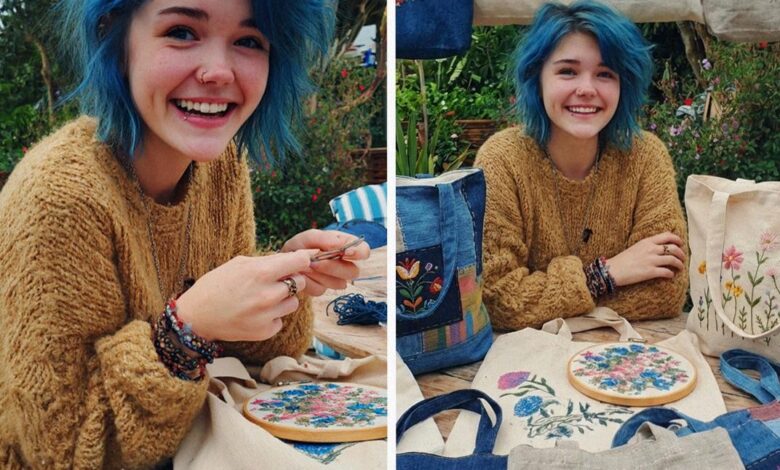
She signed up immediately. That same night, I found her at the kitchen table surrounded by piles of donated fabric from the community center, carefully threading a needle under the yellow glow of the overhead light.
“What are you making?” I asked.
She didn’t even look up. “Tote bags.”
“For the fair?”
She nodded. “Reusable ones. So all the money can go to families who need winter clothes.”
There was something different in her then. Not lighter, exactly. More determined.
Over the next two weeks, she worked every night.
I’d come downstairs close to eleven and find her still there, shoulders bent, face serious, guiding fabric beneath the machine or stitching small seams by hand when the machine jammed. I told her more than once that she didn’t need to work so hard.
She’d just smile and say, “People will actually use them, Mom.”
I watched her and felt that old, familiar ache of pride mixed with worry.
Whatever was happening at school, she wasn’t letting it make her small at home.
Then, on a Wednesday morning, I found out the name.
The fair flyer came home folded in Ava’s backpack. I was sitting in bed, halfway through a cup of tea, when I read the bottom line.
Faculty Coordinator: Mrs. Mercer.
I stared at it.
Then I checked the school website, because part of me still hoped it had to be a coincidence.
It wasn’t.
Her face appeared on the screen older, sharper somehow, but unmistakable. Mrs. Mercer. The same woman who had spent a year grinding me down in front of a classroom was now standing in my daughter’s school doing it all over again.
I folded the flyer slowly and slipped it into my pocket.
I was going to that fair.
And I was going to be ready.
The school gym smelled like popcorn and cinnamon the morning of the charity fair. Folding tables lined the walls, covered in crafts, cookies, painted rocks, raffle baskets, and all the noisy brightness schools seem able to create out of nothing more than effort and folding chairs.
Ava’s table was near the entrance.
She had arranged twenty-one tote bags in two neat rows, each one different—patchwork, striped, floral, denim, some with pockets, some with hand-stitched lettering. Beside them was a little handwritten sign explaining that all proceeds would go to winter clothing drives.
Within twenty minutes, parents were already gathered around her table.
They picked up the bags, turned them over, smiled, and asked questions. One woman bought two. Another told Ava she should start selling them online. A little girl dragged her father over because she liked the sunflower pattern on one of them.
And Ava—my quiet, hurting girl—was glowing.
For a moment, I let myself think maybe today would be simple. Maybe she’d just have one good day, and that would be enough to remind her who she was.
Then Mrs. Mercer appeared.
I saw her before Ava did.
She moved through the gym with the same air she’d had twenty years earlier, as if the room existed to affirm her opinion of it. Her hair was thinner now, streaked with gray, but the posture was the same. The same mouth. The same way of scanning people like she was mentally sorting them into categories.
Her eyes landed on me, and she stopped.
“Cathy?” she said, recognition flickering across her face.
I gave one small nod. “I was already planning to meet you. About my daughter.”
She followed my glance toward Ava’s table.
“Oh,” she said. “I see.”
Then she walked over.
I watched her pick up one of the bags between two fingers, like she was checking something sticky she’d found on the floor.
She leaned toward Ava just enough for me to hear.
“Well,” she murmured, “like mother, like daughter. Cheap fabric. Cheap work. Cheap standards.”
The words hit me like a slap from the past.
And then, just like she used to do, she straightened and smiled as if she had said nothing at all.
She set the bag down, glanced at me, and moved away, muttering something about Ava not being as bright as the other students.
I turned to my daughter.
She was staring at the table, both hands pressed flat against the fabric she had spent two weeks making.
And in that moment, something I had carried inside me for over twenty years stopped being silent.
Someone had just finished an announcement over the loudspeaker and left the microphone on the side table.
I walked over and picked it up before I could second-guess myself.
“I think everyone should hear this,” I said.
The room shifted.
Voices quieted. Heads turned. Somewhere behind me, I could feel Ava go perfectly still.
Across the gym, Mrs. Mercer had stopped walking.
“I think everyone should hear this,” I repeated, my voice steadier than I felt, “because Mrs. Mercer seems very concerned about standards.”
More people turned toward her.
She didn’t move.
“When I was thirteen,” I said, “this same teacher stood in front of a classroom and told me that girls like me would grow up to be broke, bitter, and embarrassing.”
A ripple moved through the crowd.
“And today,” I continued, “she said something very similar to my daughter.”
Now the whole room was paying attention.
I walked back to Ava’s table, picked up one of the tote bags, and held it up for everyone to see.
“This,” I said, “was made by a fourteen-year-old girl who stayed up every night for two weeks using donated fabric so that families she has never met could have winter clothes.”
The gym was so quiet I could hear the popcorn machine humming in the corner.
“She didn’t make these for extra credit. She didn’t make them for praise. She made them because she thought it might help someone.”
I let that sit.
Then I asked the question I hadn’t planned to ask until the moment it left my mouth.
“How many of you have heard Mrs. Mercer speak to students that way?”
For one long second, no one moved.
Then a hand went up.
A student near the back.
Then another.
Then a parent.
Then another.
And another.
Mrs. Mercer stepped forward, face tightening. “This is completely inappropriate—”
A woman near the front turned to her calmly and said, “No. What’s inappropriate is humiliating children.”
Another parent lifted his hand slightly. “She told my son he’d never make it past high school. He was twelve.”
A student’s voice came from the bleachers. “She told me I wasn’t worth the effort.”
That was the moment the room changed.
It stopped being my story.
It stopped being Ava’s story.
It became everyone’s.
Not chaotic. Not dramatic.
Just person after person deciding they were done staying quiet.
I looked directly at Mrs. Mercer.
“You don’t get to stand in front of children and decide who they become.”
Sweat had started to gather at her temples. For the first time in my life, she looked uncertain.
But I wasn’t done.
Because the next part wasn’t for the room. It was for the thirteen-year-old girl still living somewhere inside me.
“You told me what I would become,” I said. “And you were wrong.”
My voice caught slightly, but I kept going.
“I’m not rich. But that does not define my worth. I worked hard for my life. I raised my daughter with love. And I don’t tear people down to feel powerful.”
Then I held up the tote bag one last time.
“This is what I raised. A girl who works hard. A girl who gives without being asked. A girl who believes helping people matters.”
I looked at Ava.
She was standing taller now.
Shoulders back. Chin lifted. Eyes bright.
And then, as if the morning had been waiting for it, the principal started walking toward us through the crowd.
“Mrs. Mercer,” he said. “We need to talk. Now.”
No one defended her.
The room simply opened, letting her pass without the authority she had walked in with.
By the end of the fair, every one of Ava’s bags was sold.
Parents came back to buy more that didn’t exist. Kids told her they were cool. One woman asked if Ava took custom orders. She sold out before any other table in the gym.
That evening, when we got home and the house was finally quiet again, Ava sat beside me on the couch and twisted a scrap of leftover fabric between her fingers.
“Mom,” she said softly, “I was so scared.”
I put my arm around her. “I know.”
She leaned into me and was quiet for a moment.
Then she asked, “Why weren’t you?”
I thought about a narrow classroom. Braces. Hand-me-down clothes. A teacher with a cruel mouth and a room full of kids who laughed because they didn’t know any better.
Then I looked at my daughter.
“Because I was scared of her once,” I said. “I just wasn’t anymore.”
Ava rested her head on my shoulder, and I held her there.
Mrs. Mercer got to try defining me once.
She does not get to define my daughter.