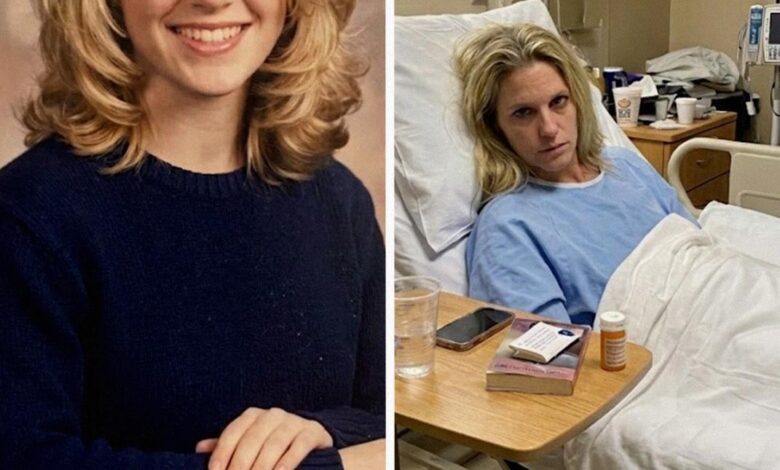
My High School Bully Demanded I Resign From My Nursing Job On Her Discharge Day, I Did Not Realize My Boss Was Standing Right Behind Her
The trauma of high school is supposed to have an expiration date, a silent agreement that once you cross the stage in a polyester gown, the ghosts of the hallways lose their power. But for some of us, that pain doesn’t dissolve; it just goes into hibernation. I’m Lena, a forty-one-year-old nurse who has spent sixteen years mastering the art of the poker face in the high-stakes environment of a med-surg floor. I’ve handled combative patients, grieving families, and double shifts that felt like marathons. Yet, nothing prepared me for the moment I looked at the chart for Room 304 and saw the name that used to make my stomach do somersaults: Margaret.
Twenty-five years ago, Margaret was the undisputed queen of the social hierarchy. She had the kind of effortless, expensive beauty that functioned as armor, while I was the “scholarship kid” in thrift-store sweaters whose mother cleaned the very houses Margaret spent her weekends in. She didn’t just ignore me; she targeted me. She was the architect of the “Library Lena” nickname, the one who whispered about the smell of my “old” clothes and tipped my lunch tray onto the floor while her circle of friends provided a soundtrack of giggles. I spent my teenage years shrinking, trying to become invisible so the predator wouldn’t see me.
Walking into that room at 7:12 a.m., I prayed that a quarter-century of life had blurred her memory of me. She had aged—fine lines around the eyes, reading glasses perched on her nose—but that sharp, biting tone remained unchanged. When I introduced myself as her nurse, she didn’t even look up from her phone, merely complaining that I had taken “forever” to arrive. For the first two days, I thought I was safe. I hid behind my mask of professional clinical care, checking her IV pumps and monitoring her vitals with robotic precision. But Margaret always had a sixth sense for vulnerability.
By the third day, the air in the room shifted. I was scanning her morning medications when I felt her gaze burning into the side of my head. “Wait,” she said, a slow, predatory smile spreading across her face. “Do I know you?” I tried to deflect, but the realization hit her like a lightning bolt. “Oh, my God. It’s you. Library Lena.”
In an instant, the hospital walls vanished, and I was sixteen again, standing in a crowded cafeteria with milk soaking into my sneakers. The cruelty in her eyes hadn’t dimmed with age; it had simply refined itself. She began a calculated campaign of psychological warfare. She mocked my career choice, asking why I hadn’t become a doctor and snidely wondering if I “couldn’t afford” med school. She pried into my personal life, and when I mentioned I was a single mother of three, she smugly remarked that having more than one child “divides one’s attention too much,” implying I was a failure as a parent.
Statistically, workplace bullying in the healthcare sector is a staggering issue. Studies from the American Nurses Association suggest that nearly 18% to 31% of nurses experience some form of bullying or “incivility” in the workplace. Usually, it’s “nurses eating their young,” but when a patient becomes the aggressor, the power dynamic becomes incredibly skewed. I was bound by a code of ethics and professional conduct; Margaret was bound by nothing but her own malice.
She began to escalate. She would flinch when I touched her IV as if I were being intentionally rough. She complained to the CNAs that I was “tugging” her pillows. When doctors were in the room, she was a portrait of grace and suffering, but the moment the door closed, the mask slipped. I realized she wasn’t just being mean; she was building a case. She was trying to destroy the one thing I had worked my entire life to build: my reputation as a caregiver.
On her discharge day, the tension reached a breaking point. My supervisor, Dr. Stevens, asked me to handle her discharge personally—a request that felt heavy with unspoken implications. When I entered Room 304, Margaret was dressed in a designer silk blouse, her bags packed, looking more like a CEO than a patient. Before I could even open the discharge folder, she leveled me with a cold stare. “You should resign, Lena. Immediately.”
The audacity of it took my breath away. She informed me that she had already spoken to the administration about my “mistreatment” and “unprofessional tone.” She looked me in the eye and told me that if I didn’t quit quietly, she would make it “messy.” She was using her status and her voice to gaslight me, banking on the fact that hospitals almost always side with the “patient experience” metrics over the staff. She wanted me to lose my livelihood because I reminded her of a version of herself she didn’t want to confront—the girl who was mean for sport.
But the universe has a funny way of balancing the scales. “That won’t be necessary,” a voice boomed from the doorway.
Margaret froze. Dr. Stevens stepped into the room, followed closely by a younger woman who looked remarkably like Margaret—her daughter. It turned out that Dr. Stevens had been tipped off by my visible distress and had decided to stand just outside the door to witness the discharge process himself. He had heard every word of her threat. He had seen the “Library Lena” mask slip.
The humiliation was absolute. Margaret’s daughter, who apparently had a much stronger moral compass than her mother, turned bright red. She looked at my name badge and then at her mother with a mixture of horror and pity. “Mom? Is this the woman from high school you were telling me about?” she whispered. The daughter realized in that moment that her mother hadn’t just been “venting” about a bad nurse; she had been actively trying to ruin a woman’s life over a childhood grudge.
Dr. Stevens didn’t mince words. He informed Margaret that her complaint was not only unfounded but that her behavior constituted harassment of hospital staff. He offered her a choice: withdraw the complaint and leave quietly, or face the potential legal ramifications of filing a false report against a licensed professional.
The daughter stepped in immediately, apologizing profusely on her mother’s behalf and ushering the stunned, silenced Margaret out of the room. For the first time in twenty-five years, Margaret had no retort. She had no clever nickname, no sharp cut, and no audience to cheer her on.
After they left, Dr. Stevens stayed behind for a moment. He told me that my professionalism had been exemplary and that he would be filing a formal commendation in my file to ensure my record was protected. When he left, I sat down in the empty hospital room and finally let out the breath I felt like I’d been holding since 1999.
I looked at the unmade bed and realized that Margaret hadn’t changed, but I had. I wasn’t that quiet girl in the library anymore. I was a mother, a survivor, and a professional who was essential to the functioning of that hospital. I decided that day that I was done shrinking. Margaret tried to make me resign from my job, but she ended up resigning from her position as the villain of my story. I straightened my scrubs, adjusted my stethoscope, and walked into Room 305. I had work to do, and for the first time in my life, I knew exactly what I was worth.