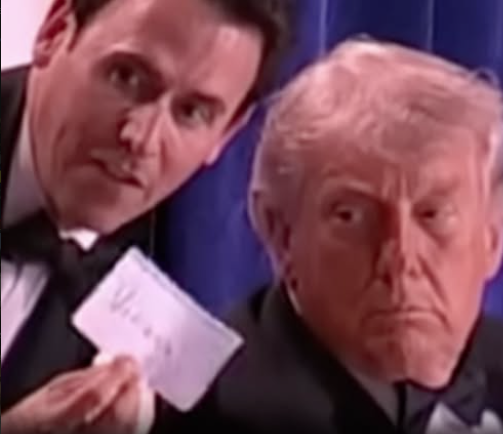
Body language expert reveals why Donald Trump did not react during WHCD assassination attempt
Footage from the White House Correspondents’ Dinner captured a moment that quickly drew attention online: while panic spread and guests took cover, Donald Trump appeared to remain seated and relatively still during the first seconds after gunfire was heard.
The incident itself was serious. Authorities say a suspect, identified as Cole Tomas Allen, allegedly forced his way past security with multiple weapons and exchanged gunfire with law enforcement before being subdued. Officials later confirmed he was charged in connection with an attempted attack targeting government officials, including the president.
As videos circulated, many viewers focused less on the chaos and more on Trump’s initial reaction—or lack of one.
A body language commentator known online as “Dr G” analyzed the footage and suggested that what people saw might not be as unusual as it first appeared. According to that interpretation, several individuals near Trump displayed what psychologists often describe as a “freeze response”—a common, instinctive reaction when people encounter sudden danger.
In simple terms, human responses to threat are often grouped into three patterns: fight, flight, or freeze. While “fight” and “flight” are more visible, freezing can happen just as quickly, especially in the first seconds of confusion when the brain is still trying to process what’s happening.
In the video, people around Trump reportedly leaned back or paused before moving—something the expert described as a reflexive, almost automatic response. As the situation became clearer, movement followed, and security teams began evacuating key figures.
What stood out to viewers, however, was that Trump’s facial expression and posture appeared more controlled than those around him. The expert suggested that this could reflect a different perception or processing of risk, though interpretations like this are inherently subjective.
It’s worth noting that body language analysis—especially from short clips—has limitations. Without full context, audio clarity, or insight into what each individual knew in that moment, conclusions can easily lean toward speculation rather than certainty.
There are also practical factors to consider. Public figures, particularly heads of state, are trained to rely on security teams in high-risk situations. Remaining still for a moment while assessing cues from trained personnel isn’t necessarily unusual, especially in an environment where abrupt movement could create additional confusion.
In the end, what the footage shows is a brief, chaotic moment interpreted through different lenses. Some see composure, others see delayed reaction, and many simply see the unpredictability of human behavior under stress.
What remains clear is that the situation was contained quickly, and no fatalities were reported—something officials have credited to the rapid response of security forces.
As for the reaction itself, it says as much about how people interpret behavior as it does about the moment captured on camera.