My Husband Stopped Me From Giving My Sister The Baby I Carried For Her
Carol had always wanted to be a mother. It was woven into the very fabric of who she was, from the little girl who babied her dolls to the teenager who was the neighborhood’s most trusted babysitter. When doctors finally told her she could never safely carry a child of her own, the news shattered her. She withdrew from the family, stopped attending our weekly Sunday dinners, and muted the family group chats. Watching her slowly fade into a shadow of herself was heartbreaking.
Then, she showed up at my doorstep one evening, her eyes swollen and red from crying. Standing in my hallway, she clutched my hands and desperately asked if I would ever consider being a surrogate for her. Having already completed my own family with my husband, Paul, and our two wonderful children, I knew the physical toll and the emotional weight of pregnancy. But seeing her pain, I told her I would be honored, pending a discussion with my husband. Paul was incredibly supportive but insisted we do everything properly with doctors and lawyers to protect everyone involved. When we officially gave Carol the green light, she wept tears of pure relief, declaring that I was giving her back her entire life.
At first, the journey was a beautiful, shared experience. Carol joined me at every single doctor’s appointment. The moment the ultrasound confirmed we were having a baby boy, she and her husband, Rob, meticulously painted their nursery a soft pastel blue and stocked it with tiny clothes.
As the months pressed on, however, the atmosphere shifted. Carol’s excitement began to mutate into something intensely suffocating. The boundaries we had carefully set started to erode. One afternoon, my daughter placed her small hand on my growing belly to feel the baby kick. With a tight, strained smile, Carol quickly brushed my daughter’s hand away and replaced it with her own, whispering about her little miracle.
Carol began visiting our house every single day, her hands constantly splayed across my stomach. Paul grew increasingly quiet, watching her behavior with a tense, guarded expression. When he finally voiced his concerns to me one night, I tried to brush them off. I rationalized that she had waited her whole life for this moment and was just anxious. Paul warned me that she was acting as if nothing else in the universe existed besides this unborn child, but I pleaded with him to wait until the birth, promising that everything would settle down once the baby was safely in her arms.
Labor arrived hard and fast two weeks ahead of schedule. Paul rushed me to the hospital through the dark, and soon our delivery room was filled with the sounds of medical staff, monitors, and contractions. Carol stood right by my head, clutching my hand so tightly her knuckles turned white, repeatedly chanting that her boy was almost here.
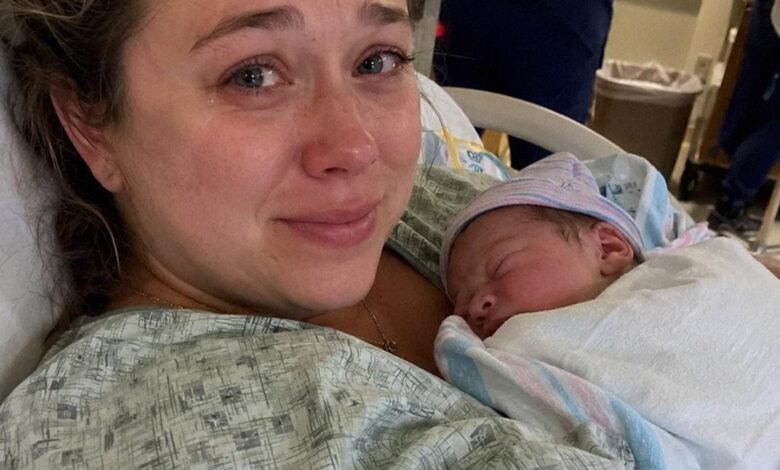
After one final, exhausting push, the sharp cry of a newborn filled the room. The nurses placed the warm, perfect baby boy onto my chest. I looked over at Paul to share the milestone, but the color had completely drained from his face. He was staring past me with sheer panic in his eyes.
I followed his gaze and looked at my sister. The expression on Carol’s face was not one of maternal joy. It was a sharp, desperate, and territorial glare. In a trembling, demanding voice, she told me to hand over her baby, snapping that she should be the one holding him.
The nurse gently intervened to take the baby to the cleaning station first. Carol watched the nurse move across the room like a predator tracking prey, before abruptly walking out into the hallway to call our mother.
The moment the door clicked shut, Paul leaned in close, his voice a frantic whisper. He begged me not to hand the baby over to her yet. When I demanded to know why, he pulled out his phone and showed me a text thread between himself and Carol’s husband, Rob.
My skin crawled as I read the messages. Rob had reached out to Paul in a panic the night before. He explained that Carol was rapidly spiraling and claiming the baby was the only thing keeping her alive. More alarming, she had convinced herself that I was planning to steal the child and was actively plotting to flee the state with the infant immediately after birth so that no one could interfere. Rob had desperately wanted to stage an intervention, but my sudden labor had ruined those plans.
Before we could fully digest the terror of the situation, Carol marched back into the room, her eyes narrowing as she noticed our pale faces and tear-stained cheeks. When Paul tried to calmly suggest we all talk, her fragile composure shattered. She shrieked that we had no right to discuss her baby, demanding that we leave the room as soon as the infant was returned.
Rob entered behind her, visibly broken, and begged her to listen to us. She recoiled from her husband as if he had struck her. Looking at my sister, I saw the hyperventilating chest, the wild, darting eyes, and the sheer panic radiating off her. I realized that to save her, I had to become the villain in her story.
Through my own tears, I told Carol that I loved her, but that I could not hand the baby over to her until she agreed to get professional help.
Carol let out a gut-wrenching, animalistic scream, accusing me of breaking my promise and trying to steal her son. Two nurses rushed into the room to intervene as she spiraled into hysteria, sobbing hysterically that we all believed she was crazy. I tried to comfort her, telling her that we knew she was just deeply hurting, but the emotional damage was done. She collapsed into a chair, weeping with a hollow, broken sound.
A hospital social worker and security team were called to manage the crisis. The hospital administration ultimately made the decision to delay the formal transfer of custody pending a psychological evaluation.
When our mother arrived, she was initially furious with me, accusing me of publicly humiliating my sister at her lowest moment. But when Rob quietly showed her the text messages detailing Carol’s plan to run away with the child, her anger dissolved into stunned silence.
The months that followed were incredibly difficult. Carol entered an intensive inpatient psychiatric facility, undergoing evaluations and therapy. Rob temporarily moved into our guest room so that Paul and I could help him care for the newborn. At first, Carol’s supervised calls were filled with frantic demands for the baby, but slowly, the therapy began to work. She began asking how the baby was doing, and eventually, she began asking how I was doing.
Months later, the medical team cleared us for a supervised family visit. When Carol entered the room and saw the healthy baby boy, tears welled in her eyes. But she didn’t grab him or panic. Instead, she looked at me and softly thanked me for taking care of him.
It was a small, fragile step, but in her quiet voice, I finally heard my sister returning to us.