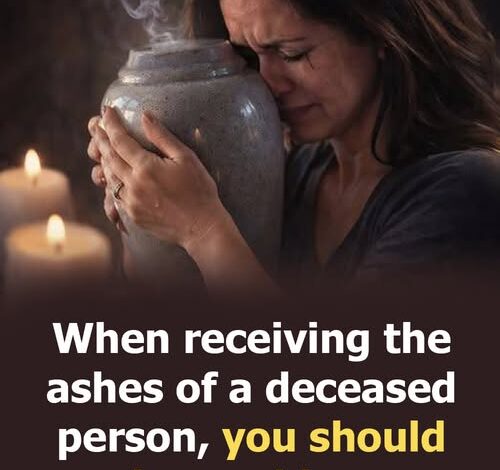
When receiving the ashes of a deceased person, you should know this…
For some people, keeping a loved one’s ashes at home feels comforting — almost like preserving a quiet connection to someone they are not ready to fully let go of.
For others, the idea feels deeply unsettling.
Around the world, beliefs about cremation and human ashes are shaped by religion, culture, family traditions, and personal experiences with grief. What one family considers an act of love, another may see as spiritually inappropriate or emotionally unhealthy.
As cremation becomes more common globally, more families are asking the same difficult question:
Is it actually okay to keep ashes at home?
The answer depends greatly on what people believe happens after death — and what role the living should continue playing afterward.
In many Western countries, especially across the United States and parts of Europe, keeping ashes at home has become increasingly normalized.
Urns are often placed on mantels, shelves, bedside tables, or memorial corners surrounded by candles and photographs. For grieving families, the ashes can feel less like remains and more like continued presence.
Some people speak to the urn during difficult moments. Others include it in holidays, birthdays, or family gatherings because emotionally, the person still feels close.
Modern Western culture tends to place heavy emphasis on personal choice and individualized grieving rather than strict funeral rules. As a result, many families now divide ashes among relatives, place portions into jewelry, or even incorporate them into memorial art and keepsakes.
But even within the same family, opinions can clash.
One relative may find comfort in keeping ashes nearby, while another may feel the deceased cannot truly “rest” until they are buried or scattered.
Religious beliefs often influence those feelings strongly.
Within Catholic Church teachings, cremation is now permitted, but the Church still encourages ashes to be treated with great reverence. Traditionally, Catholics believe remains should ideally be placed in sacred locations such as cemeteries, mausoleums, or columbariums rather than stored casually at home.
The concern is not necessarily fear or superstition. Instead, the Church teaches that human remains deserve dignity and unity, even after death. Because of this, scattering ashes or dividing them among family members is generally discouraged.
For deeply religious Catholic families, keeping ashes permanently in a living room or bedroom may feel emotionally incomplete or spiritually uncomfortable.
In many forms of Buddhism, cremation itself is widely accepted, but attitudes toward ashes vary depending on region and tradition.
In countries like Japan, families often maintain ancestor altars inside the home where loved ones are honored through prayers and offerings. Ashes may remain temporarily at home before eventually being moved to family graves or temple memorials.
At the same time, Buddhist teachings emphasize impermanence and warn against excessive attachment to physical remains. Some monks believe clinging too tightly to ashes may interfere with emotional healing or acceptance of life’s natural cycles.
The balance, for many Buddhist families, lies between remembrance and release.
Within Hinduism, cremation holds profound spiritual significance tied to the soul’s transition into its next existence.
Traditionally, ashes are not meant to remain inside the home permanently. Instead, they are usually scattered in sacred rivers — especially the Ganges River — where flowing water symbolizes purification, release, and spiritual continuation.
For many Hindu families, keeping ashes too long may feel as though the soul is being held back from moving forward peacefully.
In traditional Chinese culture, attitudes toward ashes are closely connected to ancestor reverence and feng shui beliefs.
Some families temporarily keep ashes at home before burial or placement in ancestral temples. Others believe improperly placed urns may create emotional heaviness or disrupt household energy.
Because of this, many families prefer columbariums or memorial spaces specifically designed for honoring the dead.
Still, remembrance itself remains deeply important. The concern is usually not whether ancestors are honored, but how and where that connection happens.
Meanwhile, cultures such as those surrounding Día de los Muertos often approach death with striking openness.
In many Mexican traditions, deceased loved ones remain emotionally present within the family long after death. Altars decorated with candles, flowers, photographs, and favorite foods become ways of maintaining ongoing connection rather than saying permanent goodbye.
Ashes may or may not remain in the home, but visible remembrance is often embraced rather than feared.
Indigenous traditions around the world also carry deeply varied beliefs surrounding spirits, remains, and sacred land.
Some communities believe ashes should return to nature so the spirit can travel freely. Others require specific ceremonies before remains are handled, moved, or stored.
These traditions are rarely centered on fear alone. More often, they focus on maintaining balance between the living, the dead, and the spiritual world.
Today, however, many people no longer follow strict religious customs.
Cremation rates continue rising globally because of changing beliefs, financial realities, mobility, and evolving funeral practices. Families increasingly create deeply personal memorial rituals based on emotional needs rather than tradition alone.
Some people keep ashes for years because they cannot bear another goodbye.
Others scatter them quickly because seeing the urn every day feels too painful.
Grief does not follow a universal rulebook.
For one person, an urn on the shelf may symbolize love, closeness, and comfort.
For another, it may feel like sorrow frozen in place.
And perhaps that is why this question remains so emotional across cultures and generations.
Because at its core, the debate is not truly about ashes.
It is about love.
About memory.
About how human beings struggle to accept the unbearable reality that someone who once laughed, spoke, argued, cooked, hugged, and filled a room with life now exists only in memory and remains.
Every culture tries to answer that pain differently.
Some traditions teach release.
Others emphasize continued connection.
Some focus on the soul’s journey beyond this world.
Others focus on preserving family bonds even after death.
But almost all share one quiet belief:
The dead deserve dignity, respect, and love — long after they are gone.