For forty years my act consisted of one joke. And then she died.
That was the opening line of George Burns’s 1988 memoir Gracie: A Love Story, which he had written 24 years after the death of his wife and comedy partner Gracie Allen, and which he had still been promoting actively in the months before his own death at age 100.
He had been writing about her, in one form or another, for half of his very long life.
George Burns had been born Nathan Birnbaum on January 20, 1896, in New York City. He was the ninth of twelve children of poor Jewish immigrants from what is now Romania. His father, a part-time cantor at the local synagogue, had died of influenza when George was seven years old. From that age, George had worked. He had sold newspapers. He had run errands. He had sung for pennies on street corners and in neighborhood saloons.
By the time he was 26 years old, he had been performing in small vaudeville acts for nearly two decades. He had taken the stage name George Burns. He had built a modestly successful career as a song-and-dance man. He had been briefly married to a fellow dancer named Hannah Siegel, and that marriage had ended in divorce.
He was, by 1922, a relatively unknown vaudevillian working the smaller theaters of the East Coast.
He walked into the Hill Street Theatre in Newark, New Jersey one evening in 1922 to perform.
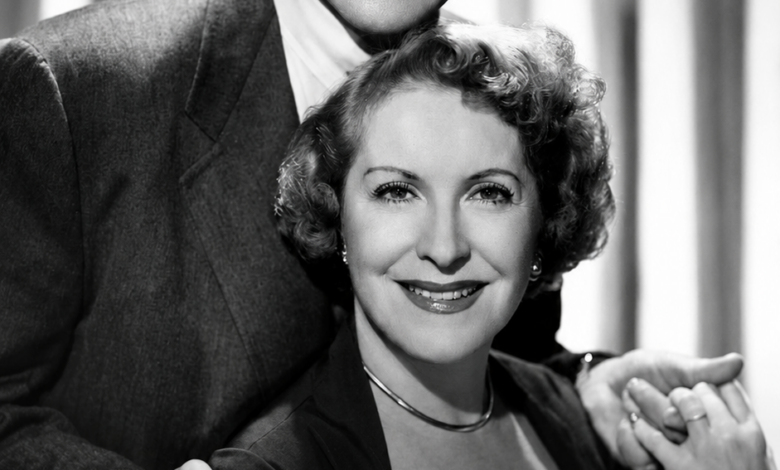
He was introduced, that night, to a young Irish-American actress named Gracie Allen.
She was 26 years old. She had been performing on stage since she was three. She had grown up in San Francisco in a vaudeville family. She had a soft California accent. She had a small, quiet, beautiful manner.
She also, on stage, had something almost no other performer of her generation had.
She had a perfect comic timing.
George Burns offered to partner with her on a small comedy routine.
He had originally written the act with himself as the comedian and her as the straight woman.
It had not worked.
He had figured out, in the first few performances they did together, that the audiences had been laughing at Gracie’s straight lines more than at his punchlines. They had not been laughing because Gracie was telling jokes. They had been laughing because of the way she was reading them.
He had rewritten the entire act within weeks.
He had made her the comedian.
He had made himself the straight man.
He had decided, very quietly, that he was going to spend the rest of his career setting up jokes for her instead of the other way around.
That decision, made in Newark in 1922, would shape every single day of the next 74 years of George Burns’s life.
He proposed marriage four years later.
She was already engaged to another man at the time. She turned him down.
He proposed again.
She turned him down again.
He proposed a third time.
She agreed.
George Burns and Gracie Allen were married on January 7, 1926. He was 30. She was 30.
They stayed married for 38 years.
For nearly four decades, George Burns and Gracie Allen were one of the most famous comedy teams in the entire United States. They built one of the most successful vaudeville acts of the 1920s. They transitioned to radio in 1929. The George Burns and Gracie Allen Show ran on NBC radio from 1932 to 1950. They moved to television in 1950, where the same show became one of the most-watched programs on CBS, running for an additional eight years.
They adopted two children, Sandra and Ronald, in 1934 and 1935.
They lived in a small house in Beverly Hills.
They worked together every single day for 35 years.
In 1958, when Gracie Allen was 63 years old, she made a quiet announcement. She was suffering, she said, from a chronic heart condition. The doctors had warned her that the stress of weekly television production was becoming dangerous. She was, with regret, retiring from show business.
She signed off her final television episode with the line she had been using to close every show for years.
She said: “Goodnight, Gracie.”
George Burns, who had been her straight man on that line for decades, replied with the line he had always given.
He said: “Goodnight.”
She walked off the stage of CBS Television Studios in Hollywood for the last time on June 4, 1958.
She lived for six more years.
She and George traveled together. She entertained at home. She watched her grandchildren grow up. She did the small private things she had not had time to do during 35 years of relentless performing.
On the evening of August 27, 1964, Gracie Allen suffered a sudden, severe heart attack at their Beverly Hills home. She had been upstairs watching television. George had been downstairs in the den working on a comedy script.
She was rushed to Cedars of Lebanon Hospital in Los Angeles.
She died that evening.
She was 69 years old.
George Burns, at the age of 68, had just lost the woman he had been performing with, raising children with, and living with for 38 years.
He was completely lost.
He did, in the weeks following Gracie’s death, something that he would speak about openly in his interviews for the rest of his life.
He began sleeping in Gracie’s bed.
The two of them had slept in separate beds for years, the way many couples of their generation did. After her death, George could not sleep in his own bed. He had moved into hers. He had felt closer to her there. He had slept in her bed, on her pillow, with her things on the nightstand, for the rest of his life.
He also began visiting her grave at Forest Lawn Memorial Park in Glendale at least once a month.
He visited it for the next 32 years.
He visited it through his attempted television comebacks of the 1960s, which mostly failed. He visited it through his unexpected late-life film career in the 1970s, after he was cast at age 79 in The Sunshine Boys opposite Walter Matthau and won the Academy Award for Best Supporting Actor in 1976. He visited it through his subsequent role as God in the 1977 film Oh, God!, which made him an even more beloved figure than he had been at the height of the Burns and Allen Show.
He visited it through his eighties and his nineties.
He visited it through the publication of his many subsequent books, each of which had become a small bestseller.
He visited it through his hundredth birthday on January 20, 1996.
In interviews late in his life, George Burns was asked, again and again, what he had been doing at the grave.
His answer was always the same.
He said: “I talk to her. I tell her what happened during the week. I tell her the show business news. I tell her what the kids are doing. I tell her how much I miss her.”
He did this for 32 straight years.
George Burns passed away peacefully at his Beverly Hills home on March 9, 1996.
He was 100 years old.
He had outlived Gracie Allen by 32 years.
He was buried, by his own explicit request, in the same crypt at Forest Lawn Memorial Park, in the Freedom Mausoleum, where Gracie had been interred since 1964.
The original marker on the crypt had read: “Grace Allen Burns — Beloved Wife and Mother (1902–1964).”
George had it changed after his own death, as his estate executor’s final instruction.
The new marker reads: “Gracie Allen (1902–1964) & George Burns (1896–1996) — Together Again.”
Gracie, after 70 years, had finally been given top billing.
George had insisted on it.
He had spent 38 years on stage with Gracie Allen, setting up her jokes, letting her get the laughs, building one of the most successful comedy partnerships in the entire history of American entertainment.
He had spent 32 more years carrying her, in some quiet form, through every subsequent day of his own long life.
He had slept in her bed.
He had visited her grave every month.
He had told her, out loud, every detail of his life until the day he was finally able to lie down next to her.
In his 1988 memoir, after the line about how his act had been one joke for forty years, George Burns had written one more sentence.
He had written: “I knew when she died, I would die too. The only question was how long it would take.”
It had taken 32 years.
He had spent them, in many quiet ways, getting himself ready.
He had spent them visiting her.
He had spent them writing about her.
He had spent them keeping her name alive, in every interview and on every late-night talk show appearance he made, all the way through to his hundredth birthday.
She had been his joke.
She had been his act.
She had been his entire 74-year career, in two acts of unequal length but equal devotion.
He had walked back to her, finally, on March 9, 1996.
The crypt has read “Together Again” ever since.
Some marriages end when one partner passes.
Some marriages last another 32 years.
Some marriages last forever.
George Burns and Gracie Allen had the third kind.
He had simply needed to wait, in his Beverly Hills house, in her bed, for the years it had taken for him to be old enough to come find her.