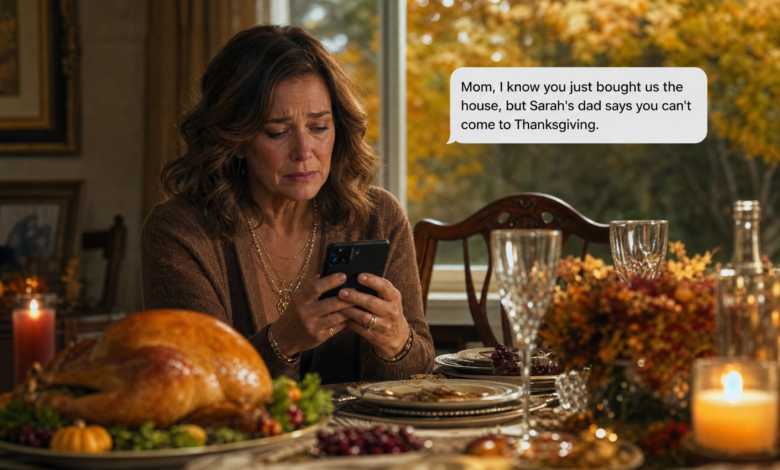
My son texted me: “Mom, I know you just bought us the house, but Sarah’s dad says you can’t come to Thanksgiving.”
I stared at the screen, thought about the $350,000 I had spent to give him a home, and typed one word back: “Okay.” That night, I started taking everything back — beginning with the house they thought was already theirs.
The message came through while I was standing under bright grocery store lights, a pumpkin in one hand, my phone in the other. Around me, carts overflowed with turkeys and cranberries, families laughing, children arguing over pies. I typed responses in my head — about respect, about everything I had given, about what it meant for a son to erase his own mother because someone else said so. I deleted them all. In the end, I sent one word: “Okay.” Then I left the cart right there in the produce aisle and walked out.
My name is Margaret Gray. Sixty years old. Retired. For six years, I had lived smaller than I needed to so my son could live bigger than he deserved. I skipped trips. Drove the same old car. Ate simple meals. Saved everything — not to help him buy a house, but to buy it outright. Three hundred fifty thousand dollars. Every cent of it wrapped in what I thought was love.
Because the house wasn’t the first time. There had been the wedding — $28,000 because her parents “couldn’t afford” the celebration they insisted on. The car — $12,000 when his broke down. Bills — $6,000 when things got tight. Furniture — $10,000 because Sarah refused anything secondhand. Every time it was the same: “Mom, just until next paycheck.” “Mom, I hate to ask…” And every time, I said yes. The thank-yous got shorter. The visits got fewer. The calls only came when something was wrong. And then — just days after I signed the papers handing them a house — a man I barely knew decided I wasn’t welcome in it. And my son agreed.
That night, the purple folder from my lawyer sat on the table, filled with documents I hadn’t really read — too proud, too happy, too certain I was doing something good. I made tea. The good kind. And I read every line. Carefully. “Thirty-day revocation period…” “Subject to reconsideration under significant change…” Something had changed. By two in the morning, my printer was running nonstop — bank records, checks, messages. Every moment I had said yes when I should have paused. The total sat at the bottom of the page: $185,000. Not including the house. I hadn’t just been generous. I had been convenient.
The next morning, I drove downtown. Glass building. Flag in the wind. Tenth floor. My lawyer, Linda Martinez, listened without interruption, flipping through pages. Then she looked up. “In Arizona, a gift like this — followed immediately by exclusion — counts as gross ingratitude. You can take the house back. And the money? That’s not kindness anymore. That’s debt.” I signed the papers. The same steady hand I had used to give everything away now took it back. By afternoon, two certified letters were already on their way — one to his office, one to the house he thought was his. “Cancellation of Gift.” “Repayment required.” Sixty days.
The first call came at 7:13 a.m. I saw “Ethan” on the screen and for a second, something old in me flinched. That reflex — pick up, fix it, make it better. I didn’t answer. By the fourth call, I set the phone face down and poured coffee like nothing had changed. But something had changed. It had changed the moment I signed my name on those legal papers. At 7:42, the voicemail came through: “Mom, what is this? Some kind of mistake? You can’t take back the house. We’ve already moved things in. Sarah’s parents are freaking out. Call me back.” No “How are you?” No “Why did you do this?” Just panic. For the house.
At 9:00, I was sitting across from Linda again. “They received the notice,” she said. “The legal clock is running.” “Good,” I replied. My voice surprised even me. It didn’t shake.
That afternoon I went for a drive — somewhere quieter, somewhere I could think. I stopped at a small park and sat on a bench. My phone buzzed nonstop. The messages turned sharper: “Mom, this is insane.” “You’re humiliating us.” “Sarah’s parents think you’re unstable.” “You’re ruining Thanksgiving.” That last one stayed on the screen longer than the others. Not “missing you.” Not “what happened?” Just ruining Thanksgiving. I laughed once — not because it was funny, but because it was finally honest. I put the phone away. For the first time in years, I didn’t feel like I owed anyone an explanation.
By the third day, Ethan showed up at my house. His car was parked half on the curb, like impatience had been driving. The knock wasn’t a knock — it was pressure. When I opened the door, he looked older than I remembered. Not in years. In entitlement. He walked in without waiting to be invited. That part hurt more than I expected. He turned in the living room like he was checking inventory. “This is ridiculous. You can’t just take back a house.” “I didn’t take anything,” I replied calmly. “I reversed a gift.” “That’s not how it works.” “It is when the agreement includes conditions.”
His jaw tightened. “So this is about Sarah’s dad?” “No,” I said. “This is about you.” That made him pause. I walked to the table, picked up the purple folder, slid out a page, and handed it to him. He didn’t take it at first. Then he did. His eyes moved fast at first. Then slower. Then stopped. That was the moment I saw it — understanding hitting him like weight. Not anger. Recognition. “You’ve been keeping track?” he asked quietly. “I stopped being careless,” I said. “There’s a difference.”
Silence filled the room. Real silence. Then he said something I didn’t expect: “We were going to pay you back.” I looked at him. “You weren’t.” And I wasn’t guessing. I was remembering all the “next month” promises, the forgotten conversations, the times my needs were postponed like they were optional. “I just…” he started, then stopped. For the first time, he looked uncertain. “I didn’t think you’d actually do something like this.” There it was. Not guilt. Surprise. As if consequences were a personality trait I had never been allowed to have. “I know,” I said softly. “That’s the problem.”
Thanksgiving came and went without me. I spent it alone. Not sad. Not bitter. Just aware. I cooked nothing elaborate. Just soup. Simple. Warm. Mine. At 6:00 p.m., Ethan called. Different tone now. Lower. “We’re going to lose the house.” “I know,” I said. A pause. “We didn’t think you’d actually go through with it.” That phrase again. “You keep saying that,” I replied. “Like I was never supposed to choose myself.” Silence. Then, quieter: “I didn’t know you felt like that.” That line landed differently. Not because it fixed anything. Because it admitted something had been missing long before the house.
“I didn’t stop loving you,” I said. “I stopped being invisible.” Another long pause. Then: “What do you want us to do?” That question mattered — not because it solved everything, but because it was the first time he asked. “I want respect,” I said. “Not when it’s convenient. Not when you need something. All the time.” His breathing was uneven. “I don’t know if we can fix this fast,” he admitted. “I’m not asking for fast,” I said. Then he said something small: “I’m sorry… for what I said about Thanksgiving.” It wasn’t perfect. It wasn’t enough. But it was the first real crack in the wall. “I hear you,” I said. And for the first time in a long time, I meant it both ways.
When I hung up, I didn’t feel victorious. I didn’t feel defeated either. I just felt no longer owned. Outside, the night was settling over the street. Inside, the house was quiet in a different way than before. Not empty. Mine. And somewhere in that silence, I understood something simple and final: sometimes love doesn’t end when you stop giving. Sometimes it begins when you finally stop disappearing.