When Tammy Could No Longer Walk, the Whole Neighborhood Finally Carried Her Home
On my last day carrying mail, the only goodbye I got was tied around the neck of an orange cat named Tammy.
I had walked Cedar Loop for eleven years.
Same cracked sidewalks. Same leaning mailboxes. Same porch chairs nobody sat in anymore. Same little cameras blinking at me like they knew me better than the people inside did.
I wasn’t angry about it.
People were busy. People worked from home. People ordered everything to their doors and spoke through tiny speakers instead of opening them. That was just how life had gotten.
Still, after eleven years, I thought maybe one person would remember it was my last day.
Nobody did.
Not until I reached the last mailbox on the loop.
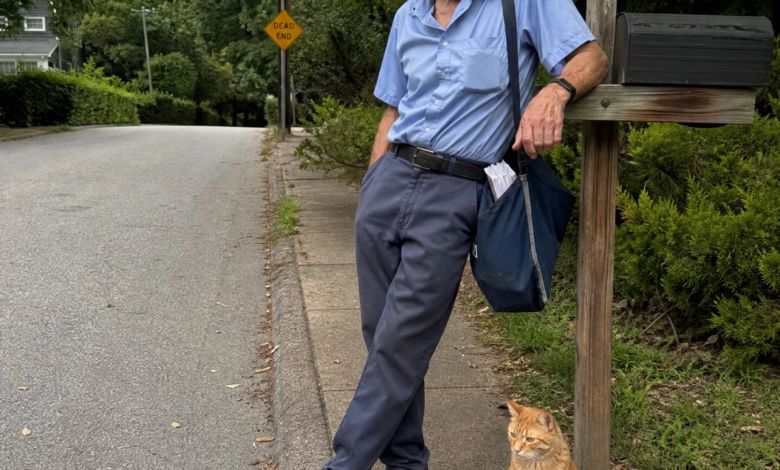
Tammy was waiting there, like always.
She was an old orange cat with a round belly, one cloudy eye, and a crooked little walk that made her look like she had places to be but no reason to hurry. She had been meeting me at that last mailbox since my first week on the route.
At first, I thought she wanted food.
She didn’t.
I thought she wanted attention.
Not really.
Tammy would just stand up when I arrived, stretch like she had been on break, then walk beside me for the last stretch of the street. Twelve houses, one slow curve, and then the dead-end sign by the big maple tree.
After that, she would turn around and go home.
I used to joke with her.
“Well, Tammy,” I’d say, “another day nobody bit us.”
She never answered, of course.
But she stayed.
Some days, that was enough.
That last morning, my knees hurt worse than usual. My bag felt heavier, though it was almost empty. Retirement was supposed to feel like a reward, but all I felt was a strange kind of grief.
A man spends half his life being part of other people’s routines, then one Friday, he just disappears from them.
No announcement.
No cake.
No folded card passed around the neighborhood.
Just one more stack of bills, flyers, birthday envelopes, and grocery coupons.
When I got to the final mailbox, Tammy was sitting in the grass.
Something was tied to her collar.
I bent down slowly.
It was a small white tag, cut from an index card and tied with blue yarn.
The handwriting was shaky.
Thank you for walking him home.
I read it twice.
Then a third time.
“Walking who home?” I whispered.
Tammy looked up at me with that cloudy eye, then started down the sidewalk like she expected me to follow.
So I did.
She led me past the last mailbox, past the dead-end sign, and up to a small white house I had delivered to for years. The curtains were always closed. The porch light was always on, even in daylight.
Before I could knock, the door opened.
Mrs. Evelyn Brooks stood there in a pale sweater, holding the screen door with both hands.
“You found the note,” she said.
I nodded, still holding it.
“I don’t understand.”
She looked down at Tammy and smiled in a way that almost broke my heart.
“My husband had this route before you.”
I knew that much. Not his name, really. Just that an older carrier had retired before I took over Cedar Loop. People used to say he was the kind of man who remembered birthdays, dog names, bad knees, and which doors stuck in winter.
Mrs. Brooks stepped aside.
“You don’t have to come in,” she said. “I just wanted to tell you.”
Tammy walked between us and sat on the welcome mat.
“My husband picked her up as a kitten behind the last mailbox,” she said. “Tiny little thing. Orange as a pumpkin. He brought her home in his mailbag.”
I smiled at that.
“She started meeting him there every afternoon,” Mrs. Brooks continued. “At first, he thought it was cute. Then he started depending on it.”
Her voice got soft.
“Our son moved out west. My health got bad. Neighbors changed. Friends passed. And my husband would come home from the route and say, ‘That last walk is the hardest part of the day.’”
I looked at Tammy.
“She walked him home?”
“Every day,” Mrs. Brooks said. “For years.”
I swallowed hard.
“And after he died?”
“She kept waiting.”
The street was quiet behind me. A lawn mower hummed somewhere far away. A delivery van rolled past without slowing.
“I thought she was waiting for him,” Mrs. Brooks said. “But then she started walking with you.”
I looked down at the tag again.
Thank you for walking him home.
“I didn’t walk him anywhere,” I said.
Mrs. Brooks shook her head.
“No,” she said. “But you let Tammy finish what she started.”
Then she handed me an envelope.
Inside was a note, yellowed at the edges. It was written by her husband before he passed.
If the next carrier ever looks lonely, let Tammy walk with him too. A mailman carries more than mail. Sometimes he carries every quiet house on his back.
I had to turn away.
I didn’t want Mrs. Brooks to see my face crumble, but she saw anyway.
For eleven years, I had thought Tammy was just an odd little cat with a habit.
I never knew she was an inheritance.
A promise.
A kindness passed from a man I never met to a man he somehow understood.
“My wife died six years ago,” I said, though I hadn’t planned to say it. “Some days I sat in my truck after work because I didn’t want to go inside my own apartment.”
Mrs. Brooks nodded like she already knew.
“Tammy knew too,” she said.
That was when the tears came.
Not loud. Not dramatic.
Just the kind that fall when something you kept locked up finally finds a door.
Tammy rubbed against my shoe.
The next morning, I woke up without an alarm for the first time in decades.
I made coffee. I sat at my kitchen table. I tried not to think about Cedar Loop.
Then my phone buzzed.
It was a message from the new carrier.
A photo came through.
Tammy was sitting beside the last mailbox, orange fur bright in the morning sun, tail wrapped around her paws, waiting like she had punched in for work.
The message said:
Does this cat belong to somebody?
I stared at the picture for a long time.
Then I typed back:
Not exactly. She belongs to whoever has to walk the last part alone.
Part 2 — When Tammy Could No Longer Walk, the Whole Neighborhood Finally Carried Her Home.
By noon, the new carrier was standing outside my apartment with Tammy in her arms, and I knew right then that retirement had lasted less than one full day.
Her name was Nina.
She looked young enough to still believe a route was just a route.
Her uniform shirt was too clean. Her mail sat in neat little stacks in the passenger seat of her small white delivery truck. She had that first-week look on her face, the one every carrier gets before the job teaches you that every street has a memory.
Tammy did not look worried.
She sat in Nina’s arms like she had requested the ride herself.
One cloudy eye half closed.
Orange fur sticking out in every direction.
Blue yarn still tied around her collar.
“I’m sorry,” Nina said. “Are you Mr. Harris?”
I nodded.
“Frank,” I said.
She shifted Tammy against her chest.
“You’re the one who texted me back?”
“I am.”
Nina looked down at the cat, then back at me.
“You said she belongs to whoever has to walk the last part alone.”
“I did.”
“That’s beautiful,” she said. “But it doesn’t tell me what to do with her.”
Tammy blinked.
Like she agreed.
I stepped aside.
“Come in for a minute.”
Nina hesitated the way people do when they are not sure if kindness comes with strings.
Then Tammy sneezed.
That settled it.
Nina carried her inside.
My apartment was too quiet for visitors.
I had two chairs at the kitchen table, but only one had been used for years. The other still sat against the wall with a folded sweater on it, as if my wife might come home and ask why I had moved her things.
Nina saw it.
She was polite enough not to stare.
She set Tammy down near the door.
Tammy immediately walked to my kitchen table, sniffed one chair, sniffed the other, then settled under the one my wife used to sit in.
I had to turn toward the sink for a second.
Nina noticed that too.
Carriers notice everything.
Even the ones who are new.
“I don’t want to cause trouble,” she said.
“That’s usually what people say right before trouble shows up.”
She gave a nervous little laugh.
Then her face got serious.
“My supervisor told me not to let animals follow me. Any animal. Dog, cat, goat, whatever.”
“Goat?”
“You’d be surprised.”
“I have been surprised by worse.”
She looked toward Tammy.
“She followed me for twelve houses. I tried ignoring her. I tried telling her to go home. I even walked faster.”
“That never works.”
“She kept up.”
“She’s got a crooked walk, but she has purpose.”
Nina folded her hands together on the table.
“Someone on the route saw her near my truck and called the station.”
I felt my stomach drop.
“Already?”
“She said it was dangerous. Said an old cat shouldn’t be wandering around traffic. Said if the cat got hurt, it would be on me.”
I looked under the table.
Tammy was washing one paw like the entire conversation was rude.
“Was she wrong?” Nina asked.
That was the hard part.
No.
She wasn’t.
Cedar Loop wasn’t a highway, but it wasn’t a painting either.
There were delivery vans, distracted drivers, kids on bikes, lawn crews, garbage trucks, and people backing out of driveways without looking because their cameras beeped at them.
Tammy was old.
Her cloudy eye was worse than it had been a year before.
Her walk had gotten slower.
Love can make you sentimental.
It can also make you stupid.
I knew that.
I had seen people do foolish things because they couldn’t stand the idea of a routine ending.
I had probably been one of them.
Nina rubbed her thumb along the edge of her mail satchel.
“I’m not heartless,” she said. “I just started this route yesterday. I can’t lose it over a cat.”
“You won’t.”
“I might.”
There was fear in her voice.
Not dramatic fear.
Work fear.
The kind people carry now because one mistake can turn into a meeting, and one meeting can turn into a note in a file, and one note can follow you longer than grace does.
I understood that kind of fear.
A lot of people think mail carriers are made of routine.
We are made of weather, bad knees, wrong addresses, barking dogs, and supervisors who count minutes they never walked.
“Did you talk to Mrs. Brooks?” I asked.
Nina nodded.
“She cried.”
That hurt more than I expected.
“She said Tammy always walks the carrier home,” Nina continued. “Then she told me she’s moving.”
I sat back.
“What?”
Nina’s eyes softened.
“Her son is coming this afternoon. She said she can’t stay in the house anymore.”
I knew it should not have surprised me.
The porch light had been on during the day for years.
The curtains had been closed.
Her hands had shook when she held the screen door.
Still, sometimes you tell yourself a house will remain the same because you need one thing in the world to do it.
“Where is she going?” I asked.
“Some senior place closer to her son. Not far, but not Cedar Loop.”
“And Tammy?”
Nina looked under the table.
“That’s the problem.”
Tammy looked back at us.
Then she rested her chin on my wife’s slipper, which I had not realized was still under that chair.
For a while, nobody spoke.
The coffee maker clicked from the counter.
A truck rumbled past my window.
Somewhere upstairs, a television laughed at something that was not funny.
Then Nina said, “Her son wants to take Tammy.”
I nodded slowly.
“That makes sense.”
“It does,” she said. “But Mrs. Brooks says Tammy won’t do well locked in an apartment.”
“She’s not wrong.”
“Her son says letting an old half-blind cat roam a street because of some sweet story is irresponsible.”
I looked at her.
“He said that?”
Nina winced.
“Not cruelly. He seemed tired.”
Tired can sound cruel when it has nowhere else to go.
I knew that too.
“What does Mrs. Brooks want?” I asked.
“She said Tammy should stay where she has always been.”
“And what do you think?”
Nina looked embarrassed.
“I think everybody is asking the cat to carry more than she can.”
That sentence stayed in the room.
It landed harder than she meant it to.
Tammy had carried a dead man’s promise.
She had carried Mrs. Brooks through lonely afternoons.
She had carried me through six years of coming home to a chair that stayed empty.
Now a new carrier had stepped onto Cedar Loop, and before she even learned which mailbox stuck in the rain, we had handed her a legend with fur on it and expected her to know what to do.
I stared at Tammy.
She stared at the doorway.
Like she was ready to leave.
“She needs to go back,” I said.
Nina looked relieved and disappointed at the same time.
“Back to Mrs. Brooks?”
“Back to the last mailbox.”
Nina blinked.
“Mr. Harris, that is exactly what I’m being told not to do.”
“I’m not saying you let her follow you.”
“Then what are you saying?”
I stood up slowly.
My knees complained.
They had been doing that for fifteen years, but now they sounded louder in retirement.
“I’ll take her.”
Nina’s face changed.
“You will?”
“Just for today.”
That was the first lie I told myself in Part Two.
Just for today.
Those are dangerous words.
People say them before they change their entire life.
I found my old route cap hanging by the door.
My wife used to tease me about that cap.
She said I treated it like a crown.
I put it on.
It was faded at the brim.
There was a small tear near the back.
But it still fit.
Tammy stood up the second she saw it.
Not slowly.
Not like an old cat.
Like a worker called back to duty.
Nina whispered, “Oh.”
I opened the door.
Tammy walked out first.
Of course she did.
On the drive back to Cedar Loop, Nina followed behind me in her truck.
I drove my old sedan with Tammy in the passenger seat.
She sat upright the whole way, watching the road through the windshield.
Every few minutes, she made a low sound in her throat.
Not a meow.
More like a rusty engine deciding to keep going.
When we turned onto Cedar Loop, my chest tightened.
I had driven away from that street the day before believing I was done.
That is one of the tricks life plays on you.
You almost never know your last time while it is happening.
And when you think you do, life comes back and asks for one more signature.
Mrs. Brooks’s porch was crowded when we arrived.
Her son stood near the steps with two cardboard boxes.
He was maybe in his late fifties.
Tall.
Neatly dressed.
The kind of man who had flown in after too many phone calls and not enough sleep.
His name was Daniel.
He looked at Tammy through my car window and pressed his lips together.
Mrs. Brooks stood behind the screen door.
Smaller than the day before.
That is what worry does to old people.
It folds them.
I got out.
Tammy jumped down before I could help her.
She landed a little crooked, shook it off, and walked straight to Mrs. Brooks.
The old woman opened the door.
Tammy stepped inside, rubbed against her ankles once, then turned around and sat facing the street.
Daniel gave a hard sigh.
“See?” he said. “This is what I’m talking about.”
Mrs. Brooks did not answer.
Daniel turned to me.
“You’re Frank?”
“Yes.”
“My mother told me about you.”
He said it carefully.
Not rude.
Not warm either.
“You were the carrier?”
“Until yesterday.”
He looked at my cap.
“Retired?”
“Trying to be.”
That almost made him smile.
Almost.
Nina stood near her truck, holding the mail like a shield.
Daniel noticed her.
“And you’re the new carrier?”
“Yes, sir.”
“Then maybe you can help me explain that a mail route is not a cat-sitting arrangement.”
Nina’s cheeks went pink.
I stepped in.
“She didn’t create this problem.”
“I know that,” he said. “None of us created it. But we still have to solve it.”
There it was.
The sentence every adult in a family eventually says.
We still have to solve it.
No matter who broke it.
No matter who ignored it.
No matter who is already exhausted.
Mrs. Brooks opened the screen a little.
“Tammy is not a problem.”
Daniel turned toward her.
“Mom.”
“She isn’t.”
“I didn’t say she’s bad.”
“You said she was a problem.”
“I said the situation is a problem.”
“That’s what people say when they want to make love sound unreasonable.”
That shut him up.
It shut me up too.
Nina looked down at the sidewalk.
Tammy sat in the doorway, tail around her paws, watching the four of us like a judge.
Daniel rubbed his forehead.
“I have two bedrooms,” he said, quieter now. “I made space. I found a window perch. I bought the kind of food she likes. I even asked my building manager about pets.”
Mrs. Brooks’s face softened.
“You did?”
“Of course I did.”
“You don’t like cats.”
“No,” he said. “I don’t. But I like you.”
That was the first time I saw Mrs. Brooks cry.
Not when she handed me the note.
Not when she told me her husband died.
Not when Nina brought Tammy back.
It was when her son said he had made room for something he did not want because he wanted his mother safe.
That kind of love is not pretty.
It does not always sound like a movie.
Sometimes it sounds like forms filled out at midnight.
Furniture moved.
A hallway measured.
A son pretending he is not scared of losing the last parent he has.
Mrs. Brooks wiped her cheek.
“Tammy will hate it there.”
“She might.”
“She’ll stop eating.”
“She might not.”
“She’ll wait by your door all day.”
“Maybe.”
“Then why would you do that to her?”
Daniel looked toward the street.
“Because if she gets hit by a car out here, you will never forgive me for leaving her.”
Nobody had an answer for that.
That was the problem with Daniel.
He was not the villain.
It would have been easier if he were.
If he had said Tammy was inconvenient.
If he had shrugged.
If he had tossed her history into one of those boxes like old curtains.
But he loved his mother.
And he was afraid.
Fear makes people tighten their fists around what they can control.
I looked at Cedar Loop.
A few curtains had moved.
That always happened when a scene formed on a quiet street.
Nobody came out.
Not yet.
People were watching through windows, the way people do now.
Connected to everything.
Present for nothing.
Nina cleared her throat.
“I can’t have Tammy following me.”
Daniel pointed gently toward her.
“Exactly.”
“But,” Nina added, “I also don’t think ripping her away today is right.”
Daniel looked at her.
“So what do you suggest?”
She glanced at me.
I wished she had not.
I had been retired for twenty-four hours.
I had a coffee cup in my sink.
A chair I still could not sit across from.
A life I had not figured out.
And everyone was suddenly looking at me like a man in a faded cap might know how to divide a cat’s heart without breaking it.
“I don’t know,” I said.
It felt shameful to say.
But it was true.
Mrs. Brooks leaned on the doorframe.
“My husband used to say Frank had a gentle walk.”
I looked at her.
“He said that?”
She smiled faintly.
“He watched you from the window the first few months. He was already sick then. He said, ‘That one doesn’t drag his feet like he hates the world. Tammy will like him.’”
My throat tightened.
I had never seen the man.
Not once.
But apparently he had seen me.
That is another thing people forget.
We are witnessed in moments we think are ordinary.
The way we carry a bag.
The way we bend to pet a cat.
The way we wait half a second longer for an old woman to open her door.
Somebody sees.
Even when nobody says goodbye.
Daniel looked tired again.
“I have to move Mom tomorrow morning.”
Tomorrow.
That word hit Mrs. Brooks in the face.
She looked at the porch floor.
Tammy stood and stepped outside.
Then she walked to the edge of the yard, turned toward the last mailbox, and waited.
Her whole body was pointed at the route.
At the place where one life had ended and another had begun.
Mrs. Brooks whispered, “She wants her walk.”
Daniel closed his eyes.
“Mom.”
“She wants her walk.”
“Today is not about a walk.”
Mrs. Brooks looked at him.
“That’s exactly what today is about.”
I do not know what made me say it.
Maybe the note in my pocket.
Maybe my old cap.
Maybe Tammy waiting like the world could still be decent if only we followed through.
“I’ll walk her,” I said.
Daniel looked at me.
“Today?”
“Today.”
Mrs. Brooks held her breath.
Daniel studied me for a long second.
“Then what?”
“I don’t know.”
He gave a small laugh with no humor in it.
“That seems to be the official plan.”
He was right.
I did not like him much in that moment.
But he was right.
Nina stepped closer.
“I’ll finish the route. I can slow down at the last twelve houses, but she can’t be beside me. Not officially.”
“Officially,” Daniel said.
“There are rules,” Nina said, and this time her voice was firm.
I liked her for that.
People talk a lot about kindness.
But kindness without boundaries turns into somebody else’s burden.
Nina was kind.
She was also trying to keep her job.
Both things were true.
So I walked to Tammy.
She looked up at me.
“Well, girl,” I said. “Looks like we got one more.”
Her tail lifted.
I swear she understood.
I started down the sidewalk.
Tammy came beside me.
Slow.
Crooked.
Certain.
Behind us, I heard Mrs. Brooks crying softly.
Daniel said something to her I could not hear.
Nina’s truck door shut.
Then the mailboxes began.
The first one was green and dented from when Mr. Alvarez backed into it five winters ago.
The next had a little painted bird on the side, though no bird had ever gone near it.
The third belonged to a young couple who got more packages than letters and never learned my name.
Or maybe they did and never used it.
I slowed without meaning to.
Tammy matched me.
For eleven years, I had thought she walked my pace.
Now I wondered if I had been walking hers.
At the fourth house, a door opened.
A woman in workout clothes stepped onto the porch.
She held a phone in one hand.
“Is that Tammy?” she called.
I nodded.
She came down the steps.
“I saw the post online.”
Of course there was a post.
There is always a post now.
Before the casserole.
Before the phone call.
Before the knock at the door.
Someone had put Cedar Loop’s heart on a neighborhood message board and asked strangers what to do with it.
The woman looked at Tammy.
“They’re saying the son wants to take her away.”
“He wants to keep her safe.”
“That’s not the same thing.”
“It can be.”
She did not like that answer.
Another door opened across the street.
An older man came out holding his cane.
“He should take the cat,” he shouted.
The woman spun around.
“She belongs here, Mr. Bell.”
“She belongs indoors,” he said. “She’s old.”
“She has a routine.”
“So do I,” he said. “Doesn’t mean I should wander into traffic.”
The woman looked offended.
I almost laughed.
Not because it was funny.
Because it was Cedar Loop.
After eleven years of nobody saying goodbye, here they all were, ready to argue over a cat.
By the sixth mailbox, three more people had come outside.
By the eighth, a teenager was recording from the driveway until his mother told him to put the phone down and “be a human being for once.”
That line nearly made me stop.
Be a human being for once.
Maybe that was the whole story.
Tammy kept walking.
She did not care about the debate.
She did not care who thought she was a symbol and who thought she was a hazard.
She only knew there was a last stretch.
And somebody had to finish it.
At the dead-end sign, she stopped.
Just like always.
The big maple tree leaned over the curb.
Its roots had cracked the sidewalk in three places.
I had tripped there my second year and spilled half a bundle of coupon flyers into the gutter.
Tammy had sat beside me then too.
Not helpful.
Just present.
I looked down at her.
“This where you left him?”
She blinked.
I imagined Mrs. Brooks’s husband there.
A sick man with a mailbag.
Trying to make it home.
Telling himself he just had twelve more houses.
Then a slow curve.
Then the sign.
Then the porch light.
Then the cat.
Maybe everyone has a last stretch.
Maybe no one knows it until they are in it.
I heard footsteps behind me.
Daniel had followed at a distance.
So had Mrs. Brooks, though he held her arm tight.
Nina stood near her truck at the corner, pretending to sort mail while watching us.
The neighbors gathered in little clumps on lawns.
Nobody knew whether to clap or apologize.
So nobody did either.
Mrs. Brooks reached the dead-end sign out of breath.
Daniel looked upset.
Not angry.
Upset because love had made him walk slower than he wanted.
She bent toward Tammy.
“Good girl,” she whispered. “You did it.”
Tammy touched her nose to Mrs. Brooks’s hand.
Then she turned around.
That was the moment I understood something.
Tammy had never been walking the carrier home.
Not really.
She had been walking grief back to where it could survive another day.
For Mrs. Brooks’s husband, it was home.
For me, it had been the truck, then the apartment, then the next morning.
For Nina, maybe it was the first week of a hard job.
For Mrs. Brooks, it was a house she had to leave.
For Daniel, it was a mother he could not save from aging.
Everybody on that sidewalk had a last part.
Some of us just hid it better.
We walked back together.
Not fast.
Not neat.
A retired carrier.
A new carrier.
A widow.
A son.
An old orange cat.
And half a neighborhood pretending they had meant to come outside anyway.
When we reached Mrs. Brooks’s porch, Daniel sat on the bottom step.
He looked at Tammy.
Then at his mother.
Then at me.
“I don’t want to be the man who takes away the thing Dad left her,” he said.
Mrs. Brooks sat beside him.
“You’re not.”
“But I also don’t want to be the man who leaves an old cat out here so everybody can feel sentimental.”
The woman from the fourth house crossed her arms.
“That’s not fair.”
Daniel turned to her.
“No, what’s not fair is everybody having opinions when my mother is the one packing her life into boxes.”
That quieted the porch.
He did not shout.
He did not need to.
The truth has a way of lowering its voice.
Mrs. Brooks patted his knee.
“I know you’re trying.”
Daniel looked at the neighbors.
“Where were all of you six months ago?”
Nobody answered.
He swallowed hard.
“When the porch rail came loose, I fixed it. When the power bill confused her, I drove over. When she forgot the stove, I took the knobs off and cried in my car before I came back inside.”
Mrs. Brooks closed her eyes.
“Daniel.”
“No, Mom. They need to hear this.”
He looked at me then, and I realized I was included.
“You all love the story of Tammy. I get it. It’s a beautiful story. But stories don’t drive people to appointments. Stories don’t notice when the milk is spoiled. Stories don’t wake up at 2 a.m. because your mother didn’t answer the phone.”
That hit me in a place I had not expected.
Because after my wife died, plenty of people loved the story of us.
They loved saying we had been married thirty-eight years.
They loved saying she had the best laugh on the block.
They loved telling me she was watching over me.
But almost nobody came by on Tuesday evenings.
Almost nobody sat through the silence after dinner.
A story can honor a person.
It can also replace the harder work of loving the living.
Mrs. Brooks reached for Daniel’s hand.
“I’m sorry,” she said.
He shook his head.
“You don’t have to be sorry for getting older.”
She laughed once, through tears.
“I wasn’t planning to.”
“No one is.”
Tammy climbed onto the porch step between them.
Then, with great effort, she put one paw on Daniel’s shoe.
He looked down.
His face broke before he could stop it.
“Oh, come on,” he whispered. “Don’t do that.”
Tammy did it anyway.
Mrs. Brooks smiled.
“She’s persuasive.”
“She’s manipulative,” he said.
“She’s a cat.”
“Same thing.”
People laughed.
Not much.
Enough.
The tension loosened, but it did not disappear.
That is how real problems work.
They do not vanish because someone says something tender.
They sit beside you.
Like Tammy.
Daniel wiped his face with the heel of his hand.
“I can keep her at my place,” he said. “I really can.”
Mrs. Brooks nodded.
“I know.”
“But if she stops eating or cries at the door, I don’t know what to do.”
The woman from the fourth house said, “I could take her.”
Everyone looked at her.
She straightened.
“I’m serious.”
Mr. Bell snorted from the sidewalk.
“You have two dogs.”
“They’re gentle.”
“They chase squirrels like they owe them money.”
The teenager laughed.
His mother elbowed him.
Another neighbor, a quiet man named Paul who lived near the curve, lifted his hand.
“My garage has a cat door.”
His wife stared at him.
“It does?”
He looked guilty.
“I put it in during the pandemic.”
“For what?”
“In case we got a cat.”
“We never got a cat.”
“I was optimistic.”
Under other circumstances, it would have been funny.
Maybe it was still funny.
But Mrs. Brooks looked overwhelmed.
Too many hands reaching for the same fragile thing.
Nina stepped onto the grass.
“What if Tammy doesn’t have to belong to just one person?”
Daniel frowned.
“She’s a cat, not a library book.”
“I know,” Nina said. “But she already belongs to the street in a way.”
“That’s exactly the problem.”
“No,” she said. “The problem is everyone likes what she represents but nobody wants to be responsible for the actual cat.”
The porch went quiet again.
Nina looked nervous after saying it.
But she did not take it back.
Good for her.
She pointed toward Tammy.
“She needs food. Shelter. vet care. A warm place. A plan for when she’s tired. Not just a legend.”
Mrs. Brooks nodded slowly.
“You’re right.”
Nina looked surprised.
Mrs. Brooks turned to the neighbors.
“My husband loved that cat. But he did not love her because she made a pretty story. He fed her. He brushed burrs out of her fur. He cleaned her eyes. He got up in the middle of the night when she cried at the door.”
She looked at me.
“And Frank walked with her even when he did not know why.”
I looked down.
I had not done much.
That was the thing about small kindness.
It looks like nothing while you are doing it.
Only later does somebody tell you it was holding up a roof.
Daniel stood.
“I need something solid.”
I understood him.
A son cannot build a plan out of feelings.
“I’ll take mornings,” Paul said.
His wife stared again.
“You will?”
He nodded.
“I walk anyway. Doctor says I have to. I hate it. Maybe I’ll hate it less with Tammy.”
Mr. Bell tapped his cane.
“I can take evenings. She sits on my porch half the time already.”
The woman from the fourth house said, “I can handle food and water.”
Her husband, who had just walked up carrying a mug, said, “We can?”
She gave him a look.
He corrected himself.
“We can.”
Nina said, “I cannot have her follow me on the route.”
“We know,” I said.
She took a breath.
“But I can stop at the last mailbox for ten seconds if she’s safely with someone else.”
Daniel looked at me.
“And you?”
That was the question I had been avoiding.
Everybody else had offered pieces.
Mornings.
Evenings.
Food.
Water.
Ten seconds.
But Tammy’s whole life had been built around the last walk.
And that last walk had somehow become mine.
I looked at my old car.
At the empty passenger seat.
At the apartment waiting with one chair used and one chair not.
I had spent years telling myself I was tired.
I was tired.
But maybe tired was not the same as finished.
“I can come at noon,” I said.
Mrs. Brooks covered her mouth.
Daniel’s eyes narrowed.
“Every day?”
“Most days.”
“That’s not a plan.”
“It’s a start.”
He shook his head.
“I’m not trying to be difficult, Frank.”
“I know.”
“If we do this, it has to be written down. Names. Numbers. Who has her in bad weather. Who takes her if someone moves. Who pays bills.”
The woman from the fourth house whispered, “Bills?”
Daniel looked at her.
“Yes. Bills. Old cats are not free because they’re charming.”
She looked embarrassed.
Good.
We all should have been a little embarrassed.
Love costs something.
Not always money.
Sometimes time.
Sometimes convenience.
Sometimes the story you wanted has to be replaced by the work it requires.
Mrs. Brooks said, “I have money set aside for Tammy.”
Daniel closed his eyes.
“Mom.”
“I do.”
“You should keep that for yourself.”
“I have enough.”
“You always say that.”
“And you always doubt me.”
“That’s because you once said you had enough soup and ate crackers for dinner.”
Mrs. Brooks lifted her chin.
“They were good crackers.”
The teenager laughed again.
This time nobody stopped him.
Daniel sighed.
Mrs. Brooks reached into the pocket of her sweater and took out a small envelope.
Not the one she had given me.
This one was newer.
“My husband left a little account for Tammy,” she said.
The neighbors went silent.
Even Tammy looked interested, though probably only because the envelope moved.
Mrs. Brooks handed it to Daniel.
“I was going to tell you after the move.”
He opened it.
His eyebrows lifted.
“Mom.”
“It is not much,” she said.
“It is more than not much.”
“He said if she was going to be stubborn, she should at least be funded.”
I smiled.
I wished I had known this man.
The more I heard about him, the more I missed someone I had never met.
Daniel folded the paper carefully.
“Okay,” he said. “Then here’s my condition.”
Everybody braced.
“Tammy stays on Cedar Loop for a trial period. Thirty days. She sleeps indoors somewhere safe every night. She does not roam during busy hours. Nobody lets her trail the mail truck. Frank handles the noon walk if he’s able. If Tammy seems stressed, sick, or unsafe, she comes with me.”
The woman from the fourth house opened her mouth.
Daniel raised a hand.
“And if anyone turns this into entertainment, posts her location, or uses my mother’s grief for attention, I take the cat that day.”
That was sharp.
But I respected it.
A few people looked away.
The teenager put his phone fully in his pocket.
Nina nodded.
“I think that’s fair.”
Mr. Bell grumbled, “Fair enough.”
Paul’s wife whispered something to him about the cat door.
Paul looked scared.
Not of Tammy.
Of his wife.
Mrs. Brooks looked at me.
“What do you think?”
I did not know why my opinion mattered.
But it seemed to.
“I think Tammy has been walking people home for a long time,” I said. “Maybe it’s time people walked her home too.”
Mrs. Brooks smiled.
Daniel looked relieved.
And Tammy, who had no respect for serious moments, began scratching her ear.
That afternoon, we made a list at Mrs. Brooks’s kitchen table.
It was the first time I had ever been inside her house.
For eleven years, I had placed mail in the box, waved at the closed curtains, and kept walking.
Inside, the house smelled like lemon cleaner, old wood, and cat food.
There were photos everywhere.
A young Mrs. Brooks in a blue dress.
Her husband in his carrier uniform, standing beside the last mailbox with a kitten tucked into his satchel.
Daniel as a boy, holding a baseball glove.
A family at Christmas.
Tammy in the sink.
Tammy in a shoebox.
Tammy asleep on a stack of newspapers.
Tammy sitting on the old carrier’s shoulder like a small orange supervisor.
I stood in front of that photo for a long time.
Mrs. Brooks came beside me.
“That was Harold,” she said.
“Harold.”
It felt strange to finally have his name.
“He would have liked you,” she said.
“I’m not sure.”
“He liked quiet men. Said they usually listened better.”
“My wife would disagree.”
Mrs. Brooks laughed softly.
“What was her name?”
“Anne.”
“Tell me about her.”
I almost said there was not much to tell.
That is what grief does.
It makes a whole person feel too large to lift, so you pretend they are small.
But Mrs. Brooks waited.
So I told her.
I told her Anne planted basil every spring and killed it by July.
I told her she sang wrong words to songs on purpose.
I told her she would leave notes in my lunch bag that said things like, “Don’t argue with terriers,” and “Buy eggs unless you want cereal for dinner.”
I told her she got sick quietly.
Too quietly.
I told her the apartment still felt like a place waiting for her coat.
Mrs. Brooks listened.
Daniel listened too, from the sink, where he was washing two mugs that did not need washing.
When I finished, nobody gave me advice.
Nobody said she was in a better place.
Nobody told me to move on.
Mrs. Brooks just said, “She sounds lovely.”
That was enough.
Sometimes enough is rare.
We wrote names and phone numbers on a yellow pad.
Nina gave her schedule.
Paul volunteered his garage after a short, intense private conversation with his wife that ended with the words, “Fine, but you’re cleaning the litter box.”
Mr. Bell agreed to keep a heated bed on his enclosed porch.
The woman from the fourth house, whose name was Carla, offered to bring food.
Daniel arranged the vet visit with a small clinic two towns over.
I said I would walk Tammy from the last mailbox to the dead-end sign and back at noon.
“Not the whole route?” Carla asked.
“No.”
She looked disappointed.
I did not blame her.
The whole route made a better story.
But better stories are not always better care.
“Tammy is old,” I said. “Twelve houses is enough.”
Daniel nodded.
For the first time, he looked at me like I was not part of the problem.
That evening, Mrs. Brooks left Cedar Loop.
No parade.
No dramatic speech.
Just Daniel’s car in the driveway, boxes in the back, and Mrs. Brooks standing on the porch with Tammy pressed against her chest.
Everyone who had offered help came out.
So did people who had not.
That is human nature too.
Some people show up when the work begins.
Some show up when the goodbye does.
Mrs. Brooks kissed Tammy between the ears.
Tammy tolerated it.
Barely.
Then Mrs. Brooks handed her to me.
Not to Daniel.
Not to Carla.
Not to Nina.
To me.
“She’ll fuss tonight,” Mrs. Brooks said.
“I expect so.”
“So will I.”
“I expect that too.”
She put her hand over Tammy’s back.
“Harold used to say the last part of a route tells you the truth about the day.”
I swallowed.
“What did today tell you?”
She looked around at Cedar Loop.
At the neighbors on porches.
At the young carrier standing by her truck.
At her son pretending not to cry.
At an old cat with one cloudy eye.
“That we left each other alone too long,” she said. “But maybe not forever.”
Then Daniel helped her into the car.
Tammy made one low, broken sound.
Mrs. Brooks heard it through the window.
Her face crumpled.
Daniel put the car in reverse.
Nobody moved.
As they pulled away, Tammy twisted in my arms, watching the car until it turned the corner.
I held her tighter.
“I know,” I whispered.
She did not scratch me.
She did not fight.
She just went still.
That was worse.
For the next hour, Cedar Loop did not know what to do with itself.
People stood around after the car was gone, holding empty hands.
Carla wiped her face and said she had onions waiting inside, though everyone knew she did not.
Mr. Bell muttered that dust was getting to him.
Paul said he needed to check the cat door.
Nina had to finish her route.
That left me holding Tammy at the last mailbox.
The place where she had always waited.
I looked down at her.
“Well,” I said. “You and me.”
She looked away.
I deserved that.
I took her to Paul’s garage first.
It was clean in the way garages are clean when somebody knows company is coming.
There was a soft bed near the cat door, a bowl of water, a litter pan, and a folded towel.
Paul’s wife had placed a small sign on the wall.
TAMMY’S ROOM.
The letters were crooked.
I liked that.
Tammy sniffed everything.
Then she walked straight out the cat door.
Paul panicked.
“She left.”
“She used the door,” his wife said.
“That means it works.”
“That means she escaped.”
“It’s a cat door, Paul. That is the concept.”
I followed Tammy into the side yard.
She went no farther than the hedge.
Then she sat facing Cedar Loop.
Waiting.
That first night, she did not eat.
Daniel called twice.
Mrs. Brooks called once but could not talk long.
I heard tears in her breathing.
“She’s safe?” she asked.
“She’s safe.”
“Did she walk?”
“A little.”
“Did she look for me?”
I looked through Paul’s kitchen window.
Tammy sat by the back door, one cloudy eye reflecting the porch light.
“Yes,” I said.
Mrs. Brooks was quiet.
“I’m sorry,” I added.
“No,” she said. “Don’t lie about love. It makes it lonelier.”
So I didn’t.
“She looked for you.”
Mrs. Brooks exhaled shakily.
“Thank you.”
After we hung up, I stayed on Paul’s porch for a while.
Paul brought me coffee.
His wife brought a blanket, then pretended she had only brought it for herself.
Tammy eventually came to the steps.
She did not come to me.
She sat six feet away.
That was fine.
Grief should not be rushed.
Not even a cat’s.
At midnight, Paul called.
“I’m sorry,” he said. “She’s crying.”
I was already awake.
I drove back to Cedar Loop in the dark.
The street looked different without the mailbag.
Smaller.
Stranger.
Like a stage after the play is over.
Tammy was inside the garage, sitting by the door, making that low rusty sound.
Paul looked exhausted.
His wife stood behind him in a robe.
“I can sleep out here,” Paul offered.
His wife said, “You have a back problem.”
“I can sit.”
“You fall asleep sitting and snore like a tractor.”
“I do not.”
Tammy cried again.
I looked at her.
Then at my car.
Then at the empty apartment waiting across town.
“I’ll take her for tonight,” I said.
Paul looked relieved.
His wife looked like she had expected this since noon.
Tammy let me pick her up.
In the car, she sat in the passenger seat again.
This time she did not look out the windshield.
She curled into herself.
Small.
Old.
Orange.
By the time we reached my apartment, I had already decided I would not keep her.
That was the second lie.
She walked in like she had been there before.
She went straight under Anne’s chair.
I put down water.
She ignored it.
I put down food.
She sniffed it and gave me a look that suggested standards had collapsed.
Then she climbed, with great difficulty, onto Anne’s chair.
I almost told her no.
Then I heard Anne’s voice in my head.
Oh, Frank, let the cat sit.
So I did.
I sat across from Tammy at the table.
For six years, that chair had been empty.
Now an old orange cat sat there with one cloudy eye and an attitude.
It was not the same.
Nothing is ever the same.
But it was not empty.
That mattered.
At noon the next day, I brought Tammy back to Cedar Loop.
Nina was approaching the last mailbox when we arrived.
She slowed her truck.
I held Tammy in my arms.
“No following,” I said.
Nina smiled.
“No following.”
I set Tammy down when Nina had finished the last box.
Tammy watched the truck pull ahead.
Then she looked at me.
We walked the twelve houses.
At the dead-end sign, she stopped.
Then she turned around.
That was all.
No crowd.
No speech.
Just a cat and a retired man completing an old promise in a safer way.
By the third day, people had opinions again.
They always do.
Carla thought Tammy should live with me.
Paul thought Tammy should stay on Cedar Loop.
Mr. Bell thought cats should not have committees.
Nina thought everyone should let her deliver the mail in peace.
Daniel called each evening to ask what Tammy ate, where she slept, how far she walked, and whether his mother should hear the full truth or the gentle version.
“Full truth,” I told him.
“She cries when I do that.”
“She cries when you don’t too.”
He sighed.
“You’re annoyingly wise for a man who claims not to know anything.”
“I was married a long time.”
“That’ll do it?”
“It helps.”
On the fifth day, Mrs. Brooks called me herself.
“How is my girl?”
“She stole my toast.”
“She likes butter.”
“I noticed.”
“Did you let her?”
“She looked committed.”
Mrs. Brooks laughed.
It was the first laugh I had heard from her that did not break in the middle.
Then she said, “And how are you, Frank?”
I almost gave the answer men my age give automatically.
Fine.
Doing okay.
Can’t complain.
Instead, I looked at Tammy asleep in Anne’s chair.
“I’m less alone than I was.”
Mrs. Brooks went quiet.
Then she said, “Me too.”
That is how it began.
Not as a grand neighborhood movement.
Not as a viral miracle.
Just little repairs.
A door opened.
A porch light meant something again.
Paul walked every morning because Tammy stood by the cat door and judged him until he put his shoes on.
Mr. Bell pretended he did not like her, then bought three different kinds of treats to see which she preferred.
Carla made a schedule so detailed it looked like a military operation, then cried when Tammy ignored all of it.
Nina kept her boundary.
No animals following the truck.
No exceptions.
And because she kept that boundary, everyone respected her more.
Especially me.
Every noon, I drove to Cedar Loop.
Some days my knees ached.
Some days Tammy’s crooked walk was slower.
Some days we only made it six houses and turned back.
I learned not to force the ending.
The point was never the distance.
It was not letting the last part be walked alone.
One afternoon, about two weeks in, I arrived and found Daniel waiting by the last mailbox.
He wore a work shirt and looked like he had driven straight from somewhere important.
Tammy sat beside him.
Not in his arms.
Beside him.
That was progress.
“Mom wanted to come,” he said.
“Is she all right?”
“She’s tired. New place is harder than she admits.”
“Moving always is.”
He nodded.
We watched Tammy sniff a patch of grass.
Daniel put his hands in his pockets.
“I owe you an apology.”
“No, you don’t.”
“I do.”
I waited.
He looked at the dead-end sign.
“I thought you were one of those people who loved the idea of helping because it made you feel good.”
“That’s fair.”
He glanced at me.
“Is it?”
“Sometimes I am.”
He laughed softly.
“At least you admit it.”
“I think most of us are mixed. Good intentions. Bad follow-through. Big feelings. Small calendars.”
Daniel looked down.
“That’s Cedar Loop in one sentence.”
“That’s America in one sentence.”
He smiled, then grew serious.
“I was angry.”
“You had reason.”
“I was angry that everyone suddenly cared when there was a sweet cat involved. Nobody was making posts about Mom’s medicine schedule.”
“No.”
“Nobody was arguing about whether she should keep her independence when I was the one checking burner knobs.”
“No.”
“But then I realized something.”
I looked at him.
He scratched his jaw.
“Maybe people need a doorway.”
“A doorway?”
“To care. They don’t always know how to walk straight into another person’s pain. It’s awkward. It’s heavy. They’re afraid of saying the wrong thing. But a cat at a mailbox? That they can understand.”
Tammy sneezed.
Daniel smiled.
“She’s a very strange doorway.”
“The best ones are.”
We walked together that day.
Tammy between us.
Daniel walked too fast at first.
Then he noticed Tammy falling behind and slowed.
A son learning the pace of old things.
At the dead-end sign, he stopped and looked toward his mother’s empty house.
“For years, I thought Dad belonged to that route more than he belonged to us,” he said.
I did not answer.
“That sounds awful.”
“It sounds honest.”
“He remembered everybody. Birthdays. Dogs. Loose steps. Who had surgery. Who needed packages brought closer to the door.”
“He sounds like a good carrier.”
“He was,” Daniel said. “But sometimes I wanted him to come home with some of that left for us.”
There it was.
The other side of service.
Nobody likes to talk about it.
A man can give his gentleness to strangers all day and come home with nothing but sore feet.
I had done it.
Harold had done it.
Maybe every job that asks you to care has a hidden cost.
Daniel looked embarrassed.
“Mom worshiped that part of him.”
“She probably missed the rest too.”
He nodded.
“I know.”
Tammy turned around.
So we did too.
On the way back, Daniel said, “Mom wants to see the walk.”
“We can bring her.”
“She can’t walk that far.”
“Then we bring the walk to her.”
That Saturday, we did.
Daniel drove Mrs. Brooks to Cedar Loop just before noon.
She looked smaller in the passenger seat, but her eyes lit up when she saw Tammy.
Nina agreed to stop for ten seconds after finishing the last mailbox.
Paul brought a folding chair.
Carla brought lemonade nobody asked for.
Mr. Bell brought himself and claimed that was plenty.
Mrs. Brooks sat near the last mailbox with a blanket over her knees.
Tammy climbed onto her lap like no time had passed.
Mrs. Brooks held her and closed her eyes.
The whole street quieted.
No phones.
Daniel had made that rule.
Anyone who wanted to be there had to be there with their face, not their screen.
That bothered some people.
One neighbor said it was selfish not to share something so touching.
Daniel said, “My mother is not content.”
I could have hugged him for that.
The neighbor went home mad.
Maybe she complained later.
Maybe she told people Daniel was controlling.
Maybe others agreed.
That was the polarizing part of the whole thing.
Some people believed a story like Tammy’s should be shared because it reminded people to care.
Others believed not every tender moment needs an audience.
I stood somewhere in the middle.
Stories can wake people up.
But they can also turn a living person into a lesson before they are ready.
Mrs. Brooks did not need to be a lesson.
She needed to hold her cat.
So that is what she did.
Nina walked to the last mailbox, placed the mail inside, and stepped back.
Tammy lifted her head.
For a second, I thought she would leave Mrs. Brooks’s lap and start the walk.
She didn’t.
She just watched Nina.
Nina touched two fingers to the brim of her cap.
“Afternoon, Tammy.”
Tammy blinked.
Then she settled back against Mrs. Brooks.
The walk had changed.
Nobody said it out loud.
But we all felt it.
That day, I walked alone to the dead-end sign.
Not because Tammy needed it.
Because I did.
At the sign, I turned around and saw Mrs. Brooks in the chair, Tammy in her lap, Daniel beside her, Nina finishing her route, and neighbors standing on porches without pretending not to care.
For the first time since Anne died, I did not feel like going home was the hardest part.
That scared me.
Happiness after grief can feel like betrayal at first.
Like you left someone behind because you laughed.
But when I got back to my apartment that evening, I looked at Anne’s chair and said out loud, “You would have liked that cat.”
The room did not answer.
But it did not feel as empty.
The thirty days passed faster than anyone expected.
Tammy gained half a pound.
Paul lost four.
Mr. Bell began walking to Carla’s porch every evening under the excuse of checking Tammy’s water.
Carla stopped posting on the neighborhood board and started knocking on actual doors.
Nina learned every name on the loop by the third week.
Not because anyone required it.
Because once people came outside, names had somewhere to go.
Mrs. Brooks visited twice.
The second time, she brought a small wooden box.
She asked me to sit with her on the porch.
Daniel stayed in the yard with Tammy, pretending to inspect the railing he had already fixed.
Mrs. Brooks handed me the box.
“What’s this?”
“Harold’s route pins. A few notes. His old whistle. Things I kept too long.”
“You should keep them.”
“I did,” she said. “Now I want them to keep moving.”
I opened the box.
Inside was a faded photo of Harold with Tammy as a kitten.
A metal whistle.
A stack of tiny index cards tied with string.
And a folded note with my name on it.
Not written recently.
Written years ago.
My hands went cold.
Mrs. Brooks nodded.
“He wrote it after he watched you and Tammy for the first time.”
I unfolded it carefully.
The handwriting was the same as the note she had given me before.
Frank walks like a man who knows the weight of quiet houses. If I am right, Tammy will choose him. If she does, tell him this: do not mistake being needed for being trapped. Sometimes being needed is the door back.
I read it twice.
Then a third time.
Mrs. Brooks watched me.
“He didn’t know me,” I whispered.
“No,” she said. “But he knew the route.”
That was when I finally cried for Harold.
Not for Anne.
Not for myself.
For Harold.
A man I never met, who had left behind a cat, a route, and a sentence that reached me years after his hands could no longer deliver it.
Mrs. Brooks placed her hand over mine.
“I think he wanted Tammy to take care of you.”
I looked toward the yard.
Tammy was ignoring Daniel with great focus.
“She did.”
“And now?”
I knew what she was asking.
The thirty days were almost over.
Daniel needed a decision.
Mrs. Brooks needed peace.
Cedar Loop needed to know whether Tammy was staying.
And I needed to stop pretending I was just helping with a schedule.
That night, Daniel came to my apartment.
Tammy was in Anne’s chair.
She had fully claimed it by then.
Daniel looked at her, then at me.
“She looks comfortable.”
“She’s bossy.”
“She always was.”
I made coffee.
He did not take sugar.
Anne used to say you could tell a lot about a person by how they took coffee, but she changed her theory every time someone proved her wrong.
Daniel sat across from me.
In my chair.
I sat in Anne’s.
That was new.
I did not realize it until it happened.
He noticed.
Again, people notice more than we think.
“I talked to the vet,” he said.
“And?”
“She’s old.”
“I paid a professional to tell me that once.”
Daniel smiled.
“She has some vision loss. Stiff joints. A heart murmur, but not severe. The vet said stress matters at her age.”
“That sounds right.”
“She also said routine matters.”
I waited.
Daniel tapped his finger against the mug.
“Mom asked me not to take Tammy away from Cedar Loop unless she’s suffering.”
“And what do you want?”
He looked at Tammy.
“I want one thing in this situation to be easy.”
I nodded.
“But nothing is.”
“No.”
He leaned back.
“I think Tammy should live with you.”
The words hit me harder than I expected.
I had imagined it.
Feared it.
Wanted it.
Resisted it.
All at once.
“Daniel.”
“You already take her most nights.”
“Not every night.”
“Five out of seven.”
“Paul snores.”
“Paul’s wife told me.”
We both smiled.
Then he grew serious.
“You bring her back to Cedar Loop. You do the walk. She eats at your place. She sleeps. She’s calm there.”
I looked at Anne’s chair.
“Your mother?”
“She cried.”
“I’m sorry.”
“She also said yes.”
I looked down.
Daniel’s voice softened.
“She said Tammy knows how to love more than one home.”
That did it.
I turned my face away.
Daniel gave me the kindness of looking into his coffee.
After a minute, I said, “I’m afraid.”
“I know.”
“Not of the work.”
“No.”
“She’s old.”
“Yes.”
“I already said goodbye once. To Anne. I don’t know if I have another goodbye in me.”
Daniel’s eyes changed.
Not sympathy.
Recognition.
“The thing is,” he said, “you don’t get to avoid goodbyes by avoiding love. You just end up saying goodbye to emptiness instead.”
I stared at him.
“That sounds like something people put on pillows.”
He laughed.
“I know. I hated it as soon as I said it.”
“No,” I said. “It’s true.”
“I’m sorry.”
“Truth usually is.”
Tammy woke up, stretched, and jumped down from Anne’s chair.
Then she came to me.
Slowly.
Crookedly.
She put both front paws on my shin and looked up with that cloudy eye.
I had spent years delivering things to other people.
Bills.
Cards.
Coupons.
Bad news.
Good news.
Packages too heavy for the box.
But I had not expected, at seventy-two years old, to have a cat deliver me back to my own life.
I bent down and picked her up.
She was warm.
Heavier than she looked.
Or maybe I was just feeling the weight correctly for the first time.
“All right,” I whispered.
Daniel smiled.
“All right?”
“All right.”
Tammy licked my thumb once.
Then bit it lightly.
“Wonderful,” I said. “I’ve been accepted and warned.”
Daniel laughed.
The next day, we told Cedar Loop.
Not with a post.
Daniel insisted.
We told them outside, after Nina finished the last mailbox.
Tammy would live with me.
She would still come for the noon walk as long as she wanted and as long as it was safe.
When she no longer wanted it, we would not force it for the sake of memory.
That part made some people unhappy.
Carla cried and said the walk was what made Tammy Tammy.
Mr. Bell snapped, “No, being alive makes Tammy Tammy.”
Paul said both things could be true.
Nina said nothing, but she smiled at me.
The debate went on for twenty minutes.
Should an old cat keep a beloved routine if it brought people together?
Or should people let go before love turned into performance?
There was no perfect answer.
That was why everyone had one.
Finally, Mrs. Brooks, sitting in her folding chair, raised one hand.
Everyone stopped.
She looked at Tammy, then at all of us.
“Harold did not ask Tammy to become a monument,” she said. “He asked her to walk with lonely people. If the day comes when she is the one who needs carrying, then we carry her. That is the promise.”
Nobody argued after that.
Not because everyone agreed.
Because some words deserve silence.
Winter came early that year.
Not with drama.
Just cold mornings, stiff fingers, and breath showing above mailboxes.
Tammy’s walks got shorter.
Some days she made it to the sixth house.
Some days she sat at the first mailbox and refused to move.
On those days, I sat beside her on the curb.
Cars slowed.
Neighbors waved.
Nina stopped for ten seconds.
“Afternoon, Tammy.”
Tammy blinked.
That was enough.
One cold noon, she did not want to get out of my car.
I opened the passenger door.
She looked at Cedar Loop.
Then she looked at me.
I knew.
You always know before you admit it.
“No walk today?” I asked.
She tucked her paws under her chest.
I closed the door gently.
Nina saw from the last mailbox.
She walked over.
“Is she okay?”
“She’s tired.”
Nina looked at Tammy through the window.
“Do you want me to say hello?”
I nodded.
Nina bent a little.
“Afternoon, Tammy.”
Tammy opened her cloudy eye.
Then closed it.
Nina wiped her cheek quickly.
“I hate this job sometimes,” she said.
I looked at her.
“Why?”
“You get attached to things you don’t own.”
I smiled sadly.
“That is the job.”
“No one tells you that.”
“No.”
She stood beside me in the cold.
“I thought being a mail carrier was about being invisible.”
“It is some days.”
“And other days?”
“Other days an orange cat ruins your plans.”
Nina laughed through her tears.
When I brought Tammy home, she went straight to Anne’s chair.
She slept for six hours.
That evening, I called Mrs. Brooks.
“It’s happening,” I said.
She did not ask what.
She knew.
“I’ll come tomorrow.”
Daniel brought her the next day.
We did not gather the neighborhood.
Not this time.
Some things are too tender for a crowd.
Mrs. Brooks sat at my kitchen table in Anne’s chair.
I sat across from her.
Tammy lay between us on a folded blanket.
Mrs. Brooks stroked her fur.
“You look tired, old girl.”
Tammy purred.
It was faint, but it was there.
Mrs. Brooks smiled.
“She used to sleep inside Harold’s mailbag.”
“I saw the photo.”
“He said she made the letters warmer.”
“I bet she made them heavier.”
“Oh, she did.”
We laughed.
Then Mrs. Brooks said, “Frank, when she goes, don’t think the promise goes with her.”
I looked down.
“I don’t know how not to.”
“You keep walking.”
“With who?”
She reached across the table and touched my hand.
“With whoever needs it.”
That sentence scared me more than goodbye.
Because goodbye is an ending.
Purpose is a responsibility.
Tammy stayed with us through the new year.
She stopped going to Cedar Loop in the last weeks.
Nina still texted me pictures of the last mailbox.
Sometimes empty.
Sometimes with leaves around it.
Sometimes with her own boot beside it and the message:
Still said hello.
I always wrote back:
She heard you.
Maybe she did.
Maybe she didn’t.
I have learned that not every comfort needs to be proven.
On Tammy’s last morning, the apartment was quiet.
She was not in Anne’s chair.
She was by the front door.
Sitting upright.
Waiting.
My heart knew before my mind did.
“You want one more?”
She blinked.
I wrapped her in Anne’s old blue sweater.
The one that had stayed on the unused chair for years.
Then I carried Tammy to the car.
At Cedar Loop, Daniel was already there with Mrs. Brooks.
Nina had arranged her route so she reached the last mailbox at noon.
Paul came.
Carla came.
Mr. Bell came with his cane and no complaints.
Nobody had called everyone.
They just knew.
That still happens, even now.
News can travel without a screen when people are paying attention.
I carried Tammy to the last mailbox.
She was too weak to walk.
So I walked for her.
Twelve houses.
One slow curve.
The dead-end sign.
The big maple tree.
Everyone followed at a respectful distance.
No phones.
No talking.
At the sign, I stopped.
Tammy lifted her head from the sweater.
For one small second, her cloudy eye faced the street like she was checking the work.
Then she rested her chin against my arm.
Mrs. Brooks touched her back.
“Good girl,” she whispered. “You walked us all home.”
Nina cried openly.
So did Daniel.
So did I.
And because Tammy had always had excellent timing, she did not pass right there in front of everyone like a scene from a movie.
She sneezed.
A tiny, ridiculous sneeze.
Then she looked annoyed that we were all emotional about it.
Everyone laughed.
Even Mrs. Brooks.
Especially Mrs. Brooks.
That was Tammy’s real goodbye.
Not tragic.
Not neat.
A little crooked.
A little funny.
Full of people who had finally come outside.
She passed later that evening in my apartment, on Anne’s chair, wrapped in Anne’s sweater, with my hand on her back.
Quietly.
No fear.
No drama.
Just one last breath leaving a small orange body that had carried more love than anyone had asked of it.
For a long time after, I sat beside her.
I thought I would feel empty again.
I did.
But not the same empty.
This one had shape.
It had meaning.
It had paw prints.
The next morning, I drove to Cedar Loop without her.
I do not know why.
Habit, maybe.
Grief, probably.
When I reached the last mailbox, Nina was there.
So were Paul, Carla, Mr. Bell, Daniel, and Mrs. Brooks.
A small wooden bench sat beneath the maple tree near the dead-end sign.
I stared at it.
Carla said, “Before you get mad, Daniel approved it.”
Daniel lifted both hands.
“I did.”
There was a little brass-colored plate on the bench.
No real titles.
No big speech.
Just a few simple words.
For Tammy.
For Harold.
For Anne.
For everyone walking the last part alone.
I sat down.
My knees thanked me.
Mrs. Brooks sat beside me.
Nina placed the mail in the last box, then walked over and touched the top of the bench.
“Afternoon, Tammy,” she said.
The street was quiet.
But not empty.
That is what changed.
People still worked from home.
Cameras still blinked.
Packages still came.
Life did not turn back into some perfect old version of itself.
But doors opened more.
Carla checked on Mrs. Brooks twice a week by phone.
Paul kept walking.
Mr. Bell pretended he only came outside to criticize Paul’s pace.
Daniel stopped carrying everything alone.
Nina learned that being new did not mean being invisible.
And me?
I kept walking.
Not every day.
Not with a mailbag.
Not because anyone required it.
I walked at noon when I could.
Sometimes someone joined me.
Sometimes nobody did.
Sometimes I sat on Tammy’s bench and said Anne’s name out loud.
Sometimes I said Harold’s too.
A few months later, a boy from the loop came and sat beside me.
Thirteen maybe.
Hood pulled up.
Eyes on his shoes.
His parents had split up that spring.
Nobody told me.
I just knew the way carriers know things.
Even retired ones.
We sat there for ten minutes without talking.
Then he said, “Was that your cat?”
I looked at the empty space near the mailbox.
“Not exactly.”
He nodded like that made sense.
After a while, he said, “My dad moved out.”
“I’m sorry.”
He shrugged.
But his mouth trembled.
I did not give advice.
I did not say it would be okay.
I did not tell him to be strong.
I just sat with him until his breathing steadied.
Then I stood.
“My knees need a walk,” I said.
He glanced at me.
“To where?”
“Dead-end sign and back.”
“That’s not far.”
“No,” I said. “But sometimes it’s the last part that counts.”
He stood.
We walked.
Slowly.
Past twelve houses.
One curve.
Under the maple.
Then back again.
No orange cat beside us.
No crooked little paws.
No cloudy eye.
But I felt her there anyway.
Not like a ghost.
Like a lesson finally learned.
A mailman carries more than mail.
A cat can carry more than anyone understands.
A neighborhood can forget how to be a neighborhood.
And then, if it is lucky, something small and stubborn can remind it.
On my last day carrying mail, I thought nobody had said goodbye.
I was wrong.
Tammy had been saying it for eleven years.
Every step.
Every stretch.
Every slow walk to the end of Cedar Loop.
She had been saying:
You are seen.
You are needed.
You do not have to finish the last part alone.
And now, whenever someone sits on that bench, whenever Nina taps the last mailbox, whenever Mrs. Brooks calls to ask who walked today, whenever a quiet person falls into step beside me, I understand what Harold meant.
The promise was never Tammy.
Tammy was the messenger.
The promise was us.