The Secret Message from Beyond: Why Cemetery Officials Are Desperate to Destroy This Man’s Final Tribute
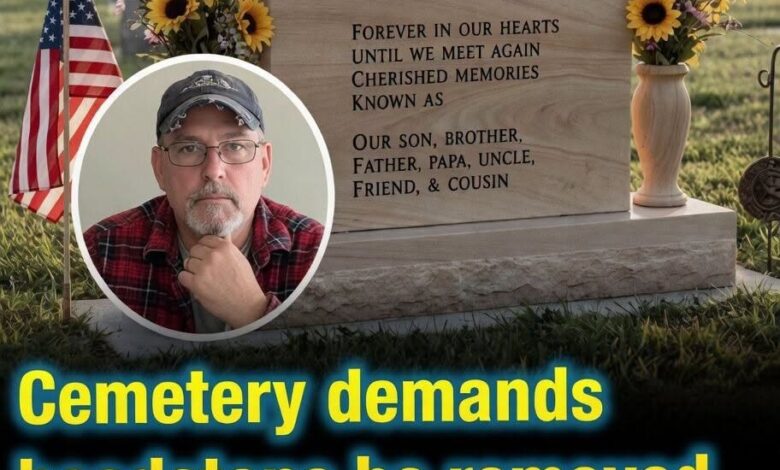
A quiet Iowa cemetery has become the unlikely epicenter of a national scandal, and it all comes down to one man’s final, defiant act of rebellion. When Steven Paul Owens was laid to rest, his grieving family sought to honor his legendary sense of humor with a headstone that looked perfectly ordinary to the casual observer. But they had hidden a secret message in plain sight—a coded acrostic that, when decoded, sent the local cemetery board into a tailspin of outrage. Now, officials are demanding its immediate removal, but the family is digging in their heels. What does the stone really say?
For the family of Steven Paul Owens, the loss was profound, but their grief was inextricably linked to the memory of a man who refused to take life—or death—too seriously. Steven was remembered by his inner circle as a man with a sharp, lightning-fast wit, a playful soul, and a penchant for pushing boundaries. He wasn’t the type of person to appreciate a somber, generic monument. To his loved ones, a standard headstone would have been an insult to the man he actually was. They wanted a memorial that felt as authentic as he did—a lasting, tangible piece of his personality that would stand the test of time.
They poured their hearts into the design, crafting an inscription that initially appeared to be a traditional, respectful tribute to a life lived. It featured the usual dates and expressions of love, words that would blend seamlessly into the quiet rows of any rural cemetery. However, the family had meticulously integrated a hidden acrostic message into the carving. By reading the first letter of each line vertically, a phrase emerged—a phrase that was, in the eyes of the cemetery trustees, nothing short of a public obscenity. To the Owens family, it was merely an inside joke, a final, mischievous wink from a man who had spent his entire life laughing at the absurdity of the world.
When the cemetery officials finally realized what the headstone was saying, the reaction was immediate and fierce. They argued that cemeteries are not merely private plots of land; they are public, sacred spaces intended to provide comfort, peace, and solace to a diverse community of families who are often navigating the most difficult moments of their lives. The board members maintained that they had a fiduciary and moral responsibility to uphold certain standards of decorum and shared decency. They viewed the headstone not just as an individual monument, but as a dangerous precedent. If they allowed one family to bypass the rules with a hidden, coded insult, how could they possibly prevent others from turning the cemetery into a venue for personal vendettas or tasteless humor?
The legal and social battle that followed escalated far beyond the boundaries of their small Iowa town. The community found itself deeply divided. On one side stood those who believed that a cemetery should remain a place of quiet reflection, where the collective sensibilities of the grieving take precedence over the individual’s desire for a final punchline. For these residents, the headstone was an intrusion—a disruption of the silence that is the cemetery’s primary purpose. On the other side were those who championed the family’s right to memorialize their loved one in a way that truly represented him. They argued that the headstone was a celebration of individuality, a refreshing departure from the cookie-cutter tributes that turn burial grounds into rows of uniform, impersonal stone.
The Owens family remained resolute, refusing to apologize for a tribute that was, in their view, a private communication between them and the man they had lost. They pointed out that the message was not visible to anyone who wasn’t looking for it, and that the “offense” taken was entirely subjective. To them, the cemetery board’s obsession with removing the stone was an act of censorship that ignored the reality of Steven’s character. They insisted that his life was defined by that specific sense of humor, and to scrub it away would be to rewrite his history to suit the comfort of strangers.
Years have passed since the headstone was first set in the ground, and yet the controversy remains unresolved. The stone still stands, a silent, stubborn monument to a man who managed to continue his mischievous legacy even after his passing. For visitors who walk the grounds, the headstone has become a strange landmark—a place where people stop to debate the boundaries of grief, the limits of individual expression, and the power of language. It serves as a reminder that the dead still have a voice, and sometimes, that voice is loud enough to spark a national conversation.
The impasse between the family and the trustees continues to ask a difficult question that has no easy answer: Who owns the narrative of a life once that life has ended? Does the individual have an absolute right to dictate how they are remembered, or does the public have a right to dictate the environment in which we process our loss? As the debate lingers, the headstone remains a focal point for those who believe in the sanctity of the past and those who believe that even in death, a man should be allowed to be exactly who he was. Steven Paul Owens, it seems, has achieved exactly what he intended: he has ensured that even from the grave, he is still the center of attention, still stirring the pot, and still leaving everyone talking. His memorial is no longer just a marker of where he is buried; it has become a testament to the fact that while a life may end, the impact of a personality—no matter how irreverent—is nearly impossible to bury.