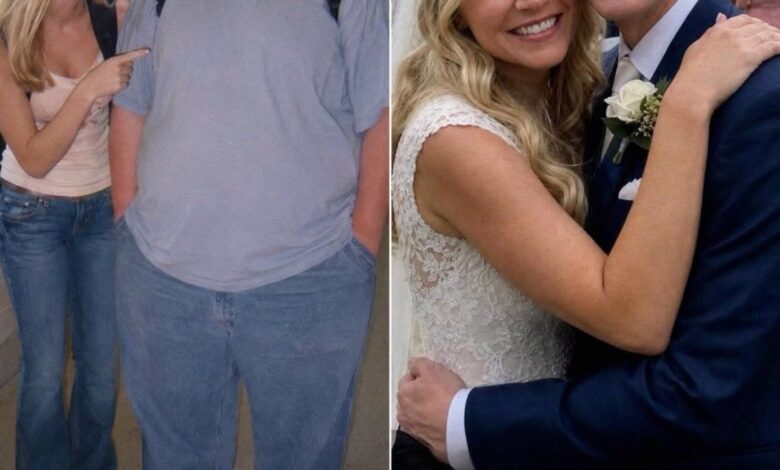
I Married the Guy I Mistreated in School, but I Didn’t Recognize Him – On Our Wedding Night, He Said, ‘It’s Time You Learned Why I Really Married You’
I spent years trying to forget the girl I had been in high school. Then I married a man I loved, only to learn on our wedding night that he was one of the people I had hurt the most. The envelope he handed me next forced me to confront a truth I’d spent decades avoiding.
My husband had known who I was from the beginning.
I have thought about those high school years more than I ever admitted to anyone. Not constantly, not every day, but the memories had a way of surfacing at quiet moments—late at night, or in the middle of ordinary afternoons. Always with the same sick feeling: I wished I could go back and stop myself.
In high school, I was part of the popular crowd. Being popular at 17 came with a particular set of expectations. You laughed when everyone else laughed. You stayed quiet when someone should have spoken. Eventually, silence started feeling like innocence.
It wasn’t.
The Boy We Called “Potato Bag”
There was a boy named Adrian. We treated him like he existed solely for us to laugh at. He was the kind of boy cruel kids noticed first—overweight, wearing thick-framed glasses and braces. He had the particular misfortune of being sensitive in an environment that treated sensitivity as an invitation.
We mocked the way he walked, laughed at what he wore, and said specific, cruel things that find a soft place in someone and stay there. I watched him leave school in tears more than once.
Back then, I carried an excuse: I told myself it wasn’t really my fault, that I hadn’t started it, and that I was just going along with everyone else. After graduation, I moved away, built a different life, and tried to become someone better. But growing up does not erase what you did. Leaving something behind isn’t the same as being free of it.
A Chance Encounter in a Coffee Shop
Three years ago, I met a man named Adrian on a Tuesday afternoon in a coffee shop two blocks from my office. At first, I told myself the name was just a coincidence.
This Adrian was tall, broad-shouldered, and well-dressed, with dark hair, an easy smile, and a natural confidence. We talked for forty minutes. He looked absolutely nothing like the boy I remembered. The image I’d carried from high school bore no resemblance to the man standing in front of me. It simply didn’t occur to me.
We had dinner that week, then another, and another. Gradually, and then completely, I fell in love with him. Adrian was genuinely kind. He noticed when someone was uncomfortable and made room for others without making a show of it. When he proposed, I said yes before he could even finish the sentence.
The Wedding Night Confrontation
The wedding was beautiful. We danced, laughed, and Adrian’s speech made the whole room cry in a good way. Looking across the reception, I let myself believe I had finally found something completely safe.
But on the drive to the hotel, Adrian went quiet.
Once in the suite, he stood by the window, looking like he had been waiting all night to say something.
“Did you really not recognize me?” he finally asked.
I thought I’d misheard. “Recognize you?”
He calmly stated the name of my high school, and then he said the nickname our group had given him: Potato Bag.
The shame found me immediately. The room went dead still. Looking at his face, for a second, I saw the boy I had hurt, and then the man I had loved for three years.
He reached into his jacket and took out an envelope filled with pages of typed and handwritten letters and journal entries spanning fifteen years.
Fifteen Years of Hidden Pain
I read the pages crying. They were things he wrote while trying to heal. Some words carried a quiet, folded-away anger. One entry described his first year of college—how he chose corner tables, ate quickly, and still expected people to laugh at him even when nobody was laughing. Another described how hard it was for him to believe a woman who loved him years later, always waiting for kindness to turn into a cruel joke.
“You recognized me when we met?” I whispered.
“In the coffee shop. Yes,” Adrian replied. “I almost walked away. I had every reason to. But something made me stay for one conversation to find out who you are now.”
“And you didn’t walk away.”
“No,” he said, “because the person I met wasn’t who I remembered. Over three years, I kept looking for the girl who made me feel that way, to see if that cruelty was permanent. I never found her.”
“Why tell me on our wedding night?” I asked.
“Because I couldn’t start a marriage hiding something this large,” Adrian said gently. “And because I needed to know if you could face it, or if you’d run.”
I looked down at the pages. “I’m not going to make excuses,” I said. “I went along with things I knew were wrong because it was easier than being the person who stopped them. That’s the whole of it.”
Adrian was quiet. “I spent fifteen years wondering if you’d changed. The last three gave me my answer.”
Choosing to Stay and Making Amends
We did not spend our wedding night the way I had imagined. We talked until four in the morning—eventually shifting to ordinary things like his favorite coffee and my terrible sense of direction. The kind of things people say when they are choosing to stay.
In the weeks that followed, I did something I had avoided for over a decade: I reached out to former classmates to apologize. Some answered, some didn’t. One woman was quiet for a long time before saying, “Do you know you’re the first person who’s ever called? I spent years wondering if anyone remembered. Turns out somebody did.”
I also organized a fundraiser and a small scholarship for a local school program. It was imperfect, but accountability that waits for a perfect gesture never arrives. Adrian knew about it, though he never asked me to do it.
A year later, we held a small, private ceremony with close family to exchange new vows—vows written across a distance we no longer needed to maintain. Walking out into the afternoon, he took my hand.
“I spent fifteen years wondering if you’d changed,” he smiled. “I wanted to say it again now that the answer is different. The last three years gave me my answer. The next thirty are going to be even better evidence.”
We walked out together. Not perfectly healed, not finished with the past, but completely honest. And for the first time, that felt like enough.