At 76, I Took a Bus to See My First Love After 50 Years – But Fate Interrupted Before I Could Reach Her
Harrison had spent hours on a bus imagining the moment he would finally see his first love again after half a century of regret. But when an unfamiliar voice called during a roadside stop and begged him to say he had not arrived yet, the trip became something far more urgent than a reunion.
Margaret was my first love.
The only woman I ever truly believed I was meant to grow old with.
But 50 years ago, I let her walk away.
I never stopped loving her. That would have been easier to live with.
I let her go because I was young, proud, and foolish in the specific way men sometimes behave.
I had just lost my job at the mill, my father was sick, and money was thin.
Margaret had a chance to leave our small town and build something brighter than what I thought I could offer her.
So I told myself I was doing the right thing.
I told myself love meant stepping aside and letting her go.
What I actually did was break both our hearts and call it a sacrifice.
I never married after that.
I came close once or twice, I suppose, in the way lonely people come close to many things.
I almost married a woman from church who liked the same books I did and a widow in my 40s who smelled like lavender and laughed with her whole body.
But every time life started to ask something serious of me, I stepped back.
These women were not unkind or unworthy. They just were not Margaret.
And when you spend long enough measuring the world against one lost thing, you end up living beside life instead of inside it.
I had no children. I had no family left except a few distant cousins I mailed Christmas cards to out of habit more than closeness.
My days grew orderly in that durable way old age can take on when nothing exciting happens.
I had my coffee at six and watched the news at seven.
I took a walk if my knees allowed it.
Evenings were spent in my chair, reading or listening to the radio.
My life was so small it could be carried in two hands.
Then, six months ago, I found Margaret’s name online.
It happened by accident.
I was looking up an old classmate from high school, which is the kind of thing a man does when he has too much time on his hands.
My mind was full of people I’d once assumed would remain young forever, and I just wanted to check them out,
I typed one name and then, as I was scrolling through this page, Margaret’s popped up on “People You May Know.”
I stared at the screen so long that my tea went cold.
Her page had her phone number and some pictures.
It showed her partaking in a church charity committee and a garden club.
There was enough proof that she was real, somewhere, breathing under the same sky as me after all this time.
I didn’t plan to call.
At least that is what I told myself for three days.
Then one Tuesday evening, with my hands shaking like I was 19 again, I dialed the number.
She answered on the fourth ring.
“Hello?”
Time is a strange thing. It had roughened us both, but not erased us.
Her voice was lower than I remembered, softer perhaps, but unmistakably hers.
Something in my chest nearly gave way.
“Margaret? It’s Harrison,” I said.
There was a pause.
Then, quietly: “Harrison?”
Our first phone call lasted four hours.
Neither of us meant for it to. We simply kept finding one more thing to say.
One more name from the past, one more memory, and one more apology that had ripened for too many years.
She told me she had married once, had one daughter, then lost her husband to cancer nearly 15 years earlier.
I told her I had never married and watched silence gather gently between us when she understood what that meant.
We had another call and then another.
Before long, we were talking every evening as though the last 50 years had been an unfortunate scheduling issue instead of a whole lifetime.
We had so much to bond over.
We talked about books, weather, old songs, stubborn joints, and the strange indignities of getting older.
We talked about our mothers and fathers, about the people we’d buried, about the younger versions of ourselves we still carried around like folded notes.
One night she said, very softly, “I wish we’d had one more chance.”
Neither of us slept after that.
A week later, she mailed me her address.
I still remember the feel of the envelope in my hands.
Her handwriting had changed, but not completely. It slanted the same way on the capital M.
I stared at it for nearly an hour before opening it, as if delaying might somehow make the hope inside easier to survive.
Then I sold my old truck, packed one suitcase, and bought a one-way bus ticket.
At 76, it felt ridiculous and brave in equal measure.
This wasn’t just a trip.
It felt like I was finally walking back toward the life I’d left behind.
The ride was almost 12 hours. I spent every mile imagining the moment I’d finally see her again.
Would she recognize me at once? Would she still tilt her head when she laughed?
Would the years between us collapse in a second, or would we stand there like polite strangers wearing the faces of the people we once loved?
Halfway through the journey, the driver slowed the bus and pulled into a roadside station.
“We’ll be here for about 15 minutes,” he announced.
Most people got off for coffee or a restroom break.
I stayed in my seat, holding the envelope with Margaret’s address.
I had already taken it out three times that morning, as if the ink might vanish when I wasn’t looking.
Then my phone rang.
It was an unknown number.
I almost ignored it, but something told me not to.
So, I answered.
For several seconds, there was only breathing.
Then an unfamiliar woman’s voice asked, “Are you, Harrison?”
“Yes.”
She took a shaky breath. “Please tell me you haven’t arrived yet.”
I stood up so fast that my envelope fell down.
I picked it up quickly as my heart raced.
“What happened?”
There was a pause, then the woman said, “I’m Margaret’s daughter. My name is Ellen. My mother had a heart attack this morning.”
For a second, the whole bus seemed to go distant around me, as if I had been dropped underwater.
“Is she…” I couldn’t finish.
“She’s alive,” Ellen said quickly. “She’s in the hospital. They stabilized her, but they’re worried. She kept asking whether you’d already arrived. I found your number in her address book.”
I sat down hard in the nearest seat.
“What hospital?”
She told me.
And in one of those moments that feels too arranged to be random, it turned out to be not far from the bus route at all.
Close enough that if I got off at the next stop, took a cab, I could be there in an hour.
After learning this from the driver, I called Ellen back.
“I’ll be there in an hour,” I said, my voice shaking. “I’m one stop away.”
“Then come,” she said, and something cracked in her voice. “Please come now.”
I don’t remember the next stretch of road clearly.
Only that I prayed for the first time in years with real desperation.
I bargained, pleaded, and begged the world not to make me late twice in one life.
At the next stop, I got off and found a cab.
By the time I reached the hospital, my hands were trembling so badly I had to sign in as slowly as possible for my signature to appear as mine.
Ellen met me in the lobby.
The moment I saw her, I knew who she belonged to. She had Margaret’s eyes exactly.
The same wide, thoughtful shape.
The same way of looking straight at you and somehow past her own fear to do what needed doing.
“Harrison?”
“Yes, this is me.”
She nodded, then, to my surprise, she reached out and hugged me.
“She’ll be glad you’re here,” she whispered.
Margaret was awake when I entered her room.
She was small and pale.
She was surrounded by machines that made soft sounds.
For one terrible second, I only saw illness, the sharpness in her face, the hospital blanket pulled too high, the wires, and the stillness.
Then she turned her head, saw me, and smiled with difficulty.
It was her.
She was older, yes. She seemed fragile in a way that frightened me instantly. But still, it was her.
Still Margaret, who at 19 had laughed in the rain and kissed me behind a grocery store.
“You took your time,” she whispered.
That almost undid me.
I went to her bedside and took her hand very carefully, as if the years between us might bruise.
“I came as fast as I could.”
“I know.”
I sat there for a long time without speaking, just looking at her and letting the impossible fact of her settle inside me.
Her hand was warm.
Her eyes filled, then mine did too, and suddenly we were both old and weeping like bereaved people.
“I thought I might miss you,” I said finally.
“You almost did,” she answered, but she smiled when she said it.
Later that afternoon, the doctor asked to speak with Ellen and me in the hallway.
The words were gentle. So gentle, I knew before they were finished that they would not save us.
Margaret had significant damage, the doctor said.
They could keep her comfortable and give her some time, but not much.
Days, perhaps. A week, if they were lucky.
I stared at the floor tiles while he spoke because looking at his face would have made it real too quickly.
When he left, Ellen wiped her eyes and said, “She’s been weaker than she admitted on the phone.”
That hurt in a fresh way.
“Did she know how bad her heart was?” I asked.
Ellen nodded. “She knew enough to take her medications, but we didn’t know it had gotten so bad.”
I thought of all our evening calls then.
All the tenderness in them and the urgency I had mistaken for simple late-life honesty.
She had probably felt that time was narrowing and still waited for me to come on my own terms.
I loved her more for that and hated the world a little.
So I stayed.
I rented a room at a motel near the hospital and spent every day in Margaret’s room.
We talked through 50 lost years with the strange greed of people finally allowed to speak after a lifetime of interruption.
She told me about Ellen’s birth, about her marriage, about the years after her husband died, and about learning to be lonely without becoming bitter.
I told her about the jobs I’d had, the towns I’d lived in, the women I never married, and the quiet shape of my life.
I told her about the fact that no matter what I had done with my hands, part of me had always remained with her.
She laughed at some things. Cried at others.
Once she said, “I would have been poor with you, Harrison. I don’t think I would have minded.”
“I was too foolish and proud to realize that. I know now,” I replied.
Ellen came and went, bringing coffee, making phone calls, and handling the terrible practical machinery that begins humming the moment death enters a room.
In between, we talked too.
At first, carefully, because what exactly is the right tone with the man your mother once loved before you were born?
Then less carefully.
She told me she’d grown up hearing my name in fragments.
It was never spoken bitterly or in a scandalous way. It was simply said occasionally, in old stories, when Margaret spoke about being young.
“She always called you the one who got away,” Ellen said one evening while Margaret slept.
I looked down at my hands. “I’m sorry for that.”
She shook her head. “I don’t think she meant it with regret by the end. More like… a room in her heart that never got closed.”
I didn’t know what to say, so I reached for her hand and squeezed it once.
On Margaret’s final morning, the light through the hospital blinds was soft and yellow, almost kind.
She had been drifting in and out for hours.
Ellen had gone downstairs to speak with a nurse about paperwork, and for a few precious minutes, it was only Margaret and me.
She stirred and opened her eyes.
“Harrison?”
“I’m here.”
She looked at me as if she were still checking whether I had really come all this way.
Then she smiled, that same small smile from the first moment.
“I got one more chance,” she said.
I bent over our joined hands and pressed my forehead against them because I could not bear the size of what she was giving me.
“So did I.”
She died that afternoon while I was holding her hand.
Ellen was on one side of the bed. I was on the other.
Together, we felt the immense quiet of a life folding shut.
Afterward, I sat in the hospital chapel alone for nearly an hour because I could not yet step into a world where she was past tense again.
The funeral was three days later.
I stayed for all of it. I chose flowers with Ellen.
We picked simple white peonies and pale blue delphinium because she had loved planting them in her garden.
Ellen said the colors looked like her mother’s best Sunday dress.
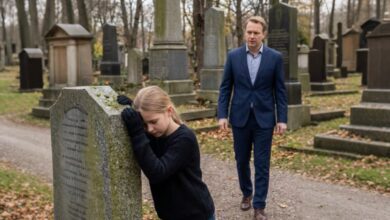
At the burial, Ellen slipped her arm through mine as if it had always belonged there.
That nearly broke me as much as the grave itself.
I went home after the funeral because I was too old to start pretending that grief can be outrun by geography.
My house looked exactly the same as when I’d left it.
It was a world untouched by the fact that mine had just split open and closed around a different shape.
But Ellen called two days later.
And then again on a Sunday to check up on me.
And after that, somehow, we kept going.
I still longed for Margaret. I still reached for the phone at dusk for weeks before remembering there would be no call.
I still woke some mornings with that awful first second of forgetting and then knowing again.
But Ellen and I continued bonding until we were naturally part of each other’s lives.
She sent me copies of old photographs I’d never seen.
Margaret, in her 30s, holding baby Ellen on a porch swing.
Margaret at 50 in a sunhat, laughing at something out of frame.
Margaret last spring, standing among tomatoes in her garden with one hand on her hip, looking exactly like a woman who had earned every line in her face.
I told Ellen stories in return.
Margaret at 17, barefoot in a creek. Margaret, furious over a dented library book.
Ellen laughed and cried in equal measure.
Sometimes she visits me now.
Sometimes I take the bus to see her.
We talk about Margaret often, but not only about Margaret.
We talk about recipes, weather, and her personal life.
I ask about her work, her church, and her roses.
Once she brought her son — Margaret’s grandson — to meet me, and I nearly lost all power of speech hearing a child run through a yard that had been silent for years.
I am old enough to know life does not often return what it takes.
But sometimes it leaves something at your door that you never expected to receive.
I did not get forever with Margaret.
I did not get the marriage, the children, and the ordinary decades we might have had if I had been braver at 26.
What I got instead was shorter and, in its own way, no less sacred.
I got to see her again. I got to hear her forgive me without needing to say the word. I got to hold her hand at the end.
And because I loved her late instead of not at all, I found a daughter I never expected to have.
I still miss her every day.
But gratitude has made room beside the grief.
At 76, I took a bus to see my first love after 50 years.
Fate interrupted before I could reach her front door.
But it did not stop me from reaching her.
And in the strange mercy of that, I found a life I would never have known to ask for.
Now, the question at the center of this story is: If you were Harrison, would becoming part of Ellen’s life afterward feel like a comfort, or a constant reminder of the family you never had with Margaret?
Enjoyed the read? Here’s another story you might like: For 30 years, I hated my birthday. It was the day my first love died. Or so I believed. Then a young woman who looked exactly like Lily walked into my yard holding a video, and within seconds, the life I’d spent decades grieving began to unravel.