I Woke Up to Find My Entire Swimming Pool Filled with Orbeez – When We Finally Uncovered What Was Hidden at the Bottom, Cop Cars Began Arriving at Our House Within Minutes
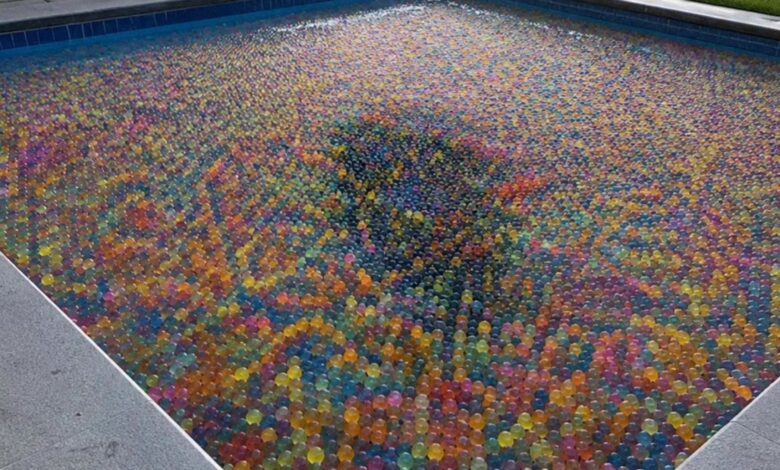
Yesterday morning, our pool vanished beneath millions of Orbeez. Something large rested under them, too deep to identify and too deliberate to be a prank. Carmelo reached for the net. I reached for the one name we had not stopped saying in three years.
The first Orbeez rolled across the patio when I opened the back door.
Bright blue.
No bigger than a marble.
It bumped against my slipper and stopped.
Then I looked at the pool.
Every inch of the water’s surface had disappeared beneath millions of tiny, colorful beads.
For several seconds, I forgot to move.
Then I saw the shape at the bottom.
Large.
Rectangular.
Too straight to be debris.
I gripped the doorframe and screamed.
“Carmelo.”
My husband came into the kitchen carrying two coffee mugs.
“What?”
I pointed.
One mug slipped from his hand and struck the counter. Coffee ran beneath the toaster, but neither of us reached for a towel.
He stepped outside.
The Orbeez moved softly against the pool tiles, making a faint clicking sound that reminded me of rain hitting glass.
Carmelo stared at the shape below them.
“Was that there last night?”
“No.”
“You checked?”
“I covered the pool at nine,” I said.
He looked toward the folded cover stacked beside the fence.
Someone had removed it. That detail frightened me more.
This was not children sneaking into our yard.
Someone had come prepared.
Carmelo set the remaining mug on the patio table and walked toward the pool net.
“Don’t touch anything, Abby.”
His hand stopped.
I could hear my own breathing, shallow and uneven, though I was standing still.
Only one person had ever filled this pool with Orbeez.
Mason… our son.
He used to beg me for them every summer.
He liked watching them float.
At six years old, he believed each color had a job.
Blue ones were for people who felt lonely.
Yellow ones were for birthdays.
Red ones were for emergencies.
He never explained green.
“Those are private,” he would say.
Three unopened boxes of Orbeez still sat in our garage.
I had never thrown them away.
Carmelo looked at me. He knew exactly where my thoughts had gone.
“Abby, this doesn’t mean…”
“I know.”
The answer came too quickly.
I did not know anything.
Three years earlier, Mason had vanished during the summer festival.
That was the word everyone used.
Vanished.
As if a child could simply become air.
The park had been crowded that afternoon. Food trucks lined the grass. A band played near the fountain. Children ran between game booths carrying painted faces and paper crowns.
Mason held my hand until we reached the ring toss.
Then someone bumped my shoulder.
I looked down.
He was gone.
For less than a minute, I believed he had ducked behind me.
Then five minutes passed.
Then ten.
By sunset, the entire town was searching.
By midnight, helicopters circled the park.
For three weeks, volunteers walked ditches, fields, creek beds, and abandoned roads.
They found one sneaker that did not belong to him.
One red jacket that belonged to someone else.
Nothing that belonged to Mason.
The pool became the hardest place in the house.
Mason had learned to swim there.
He had shouted “Watch me” before every jump, even when I was already watching.
After he disappeared, Carmelo drained it once.
I asked him to fill it again because the empty concrete looked worse.
Now it was full of color.
And something waited beneath it.
Carmelo lowered the net.
The Orbeez slid away in clusters, then rolled back into place.
He tried again.
Each scoop came up heavy and shining.
We emptied them into plastic storage bins, flowerpots, buckets, anything we could find.
It took almost 20 minutes to clear one small patch.
The object remained blurry beneath the water.
Box-shaped.
Carmelo worked faster.
I carried full buckets away from the edge.
A blue bead stuck to my wrist.
I brushed it off.
It rolled across the patio and disappeared beneath a chair.
“Stop,” Carmelo said.
I turned.
He had cleared enough to see one corner.
Acrylic. Thick. Sealed.
The case was larger than a coffee table and weighted at the base. Something had been arranged inside it, though the layers of water and moving Orbeez distorted everything.
Carmelo leaned closer.
Then he went completely still.
“What?”
He did not answer.
He reached into his pocket and took out his phone.
“Carmelo?”
He pointed through the water.
At first, all I saw were pale shapes.
Then the Orbeez shifted.
Yellow plastic flashed beneath them.
Small.
Bright.
A handle.
My fingers closed around the pool rail.
Mason’s shovel had been yellow.
He carried it everywhere that summer.
The beach.
The park.
The festival.
The police listed it among the items missing with him.
Tiny yellow shovel with a crack near the grip.
Carmelo called 911.
He spoke clearly until the dispatcher asked what was inside the case.
Then he looked at me.
“I don’t know,” he said.
Police cars entered our street within seven minutes.
The first officer asked us to step away from the pool.
The second photographed the removed cover, the bins of Orbeez, and the wet footprints we had left around the patio.
A third officer examined the gate.
No broken lock.
No damaged fence.
Whoever entered had known how to lift the latch from the outside.
Neighbors gathered behind curtains and hedges.
Someone recorded from across the street until an officer asked them to stop.
Detective Rios arrived last. He had worked the case of Mason’s disappearance.
I had not seen him in nearly a year, but he still looked at me the same way.
As if every sentence might break something.
“Abby.”
I pointed toward the pool.
“The shovel.”
He followed my hand.
Then he crouched near the edge.
“Can we confirm it from here?”
Carmelo shook his head.
“Not completely.”
Rios called for the fire department’s water rescue team.
While we waited, officers searched the yard.
One found wheel marks near the side gate.
Another found several torn plastic bags behind the hedge, the kind Orbeez came in when purchased in bulk.
Nothing carried a name.
Nothing explained why.
The rescue team entered the pool at 10:17 a.m.
Two divers cleared the remaining beads from the case while another secured straps around the base.
The object rose slowly. Water ran from its sides.
The case was transparent and perfectly sealed.
Inside were drawings.
Dozens at first. Then hundreds.
Folded letters. Friendship bracelets. Origami birds. Small toys. A stuffed dinosaur with one missing eye. A baseball card. A paper crown.
And resting across the top of everything was a little yellow shovel.
The crack near the handle faced me.
My knees folded.
Carmelo caught my arm and lowered me onto the patio step.
Nobody spoke.
Not the officers.
Not the firefighters.
Not even the neighbors behind the fence.
The display case settled onto a blue tarp.
Detective Rios knelt beside it.
One bundle of letters had a paper label tied around it.
He read the words.
“What does it say?” I asked.
Rios looked toward another officer.
“Call the community center.” He stood. “Ask for the festival director.”
The acrylic case stayed sealed.
Procedure, they told us.
Everything had to be photographed before anyone opened it.
Every item logged.
Every surface checked.
I sat beside the pool while the bright Orbeez drifted into corners like pieces of a celebration nobody had explained.
At 11:12, a small silver car stopped beside the curb.
A woman stepped out wearing mismatched shoes and a cardigan buttoned wrong.
I recognized her as Mrs. Lewis, director of the town community center.
She saw the case.
Then she covered her mouth with both hands.
“Oh no.”
Detective Rios met her near the gate.
“Do you know what this is?”
She nodded. Her eyes moved toward me.
“I know what was inside it.”
That was not the same answer.
Rios heard the difference too.
“Inside?”
Mrs. Lewis looked at the pool. Then at the Orbeez covering our yard.
“I didn’t know anyone was bringing it here.”
Carmelo stepped closer.
“Bringing what?”
She pressed her fingers against her lips, buying time she clearly did not have.
Finally, she looked at us.
“The town has been keeping something from you for three years.”
And for the first time that morning, the mystery became larger than the pool.
Mrs. Lewis sat beside me on the patio step.
The acrylic case remained between us, still sealed, while officers moved quietly around the yard.
“For the first few weeks after Mason disappeared,” she said, “children left things at the festival memorial.”
I looked through the case wall.
Crayon drawings.
Bracelets tied with yarn.
Folded paper animals.
“A temporary table was set up near the fountain,” she added. “We thought we’d keep everything until the search ended.”
Her hands closed around each other.
“But the search didn’t end the way anyone hoped.”
Carmelo stood behind me, one hand resting on my shoulder.
Mrs. Lewis looked toward the yellow shovel.
“When the memorial came down, nobody could bring themselves to throw anything away. So the community center stored it.”
“Why didn’t you tell us?” I asked.
Her answer did not come quickly.
“At first, everyone thought seeing it might hurt you, Abby,” she muttered.
I looked at the case.
“It did.”
Mrs. Lewis nodded.
“I know.”
Then she looked toward the scattered Orbeez.
“But every summer, children kept bringing more.”
The festival returned each year.
Not the same.
Never the same.
Still, families came. Music played. Booths reopened. Children who remembered Mason grew older, and children who had only heard about him began leaving things too.
One letter.
One drawing.
One small object at a time.
“We never asked them to,” Mrs. Lewis said. “They just did.”
Detective Rios finished speaking with the evidence team and came toward us.
“The case can be opened once the exterior is cleared,” he said. “Nothing indicates immediate danger.”
Mrs. Lewis exhaled.
Then Rios looked at her.
“Who moved it?”
Her shoulders shifted beneath the cardigan.
“A few volunteers wanted to return it before this year’s festival. Some of us thought we should ask permission first.”
“And someone ignored that?”
She nodded. “They thought leaving it quietly would be kinder.”
Carmelo looked at the pool.
“They filled our yard with millions of Orbeez.”
Mrs. Lewis gave a helpless little laugh that died almost immediately.
“One volunteer remembered Mason loved them,” she recounted. “Another said children had been dropping one Orbeez into a glass bowl beside the memorial every summer.”
She looked toward me.
“Three years’ worth.”
The case was opened at noon.
Detective Rios lifted the lid while an officer photographed each layer.
The yellow shovel slid forward first.
I caught it with both hands.
For three years, I had imagined it lying somewhere in the park, buried under leaves or washed into a drain.
Instead, someone had kept it.
Underneath were letters.
The first was written in thick purple marker.
“Dear Mason,
Thank you for sharing your crayons when mine broke.”
Another.
“You told me freckles were tiny stars.”
I pressed the paper flat against my knee.
The handwriting changed from letter to letter.
Some names I recognized.
Most I didn’t.
One child wrote:
“You let me win the beanbag game because I was crying.”
Carmelo opened a small envelope from a volunteer firefighter.
“Your son helped me pass out water bottles for 20 minutes. He made a hard day feel lighter.”
Carmelo read it twice.
Then he rubbed one hand over his face.
“He was only there 20 minutes.”
I looked at him.
“Apparently, that was enough.”
Mrs. Lewis knelt beside the case and lifted a photograph from the bottom.
It had been taken minutes before Mason disappeared.
He stood near the festival fountain, laughing with the yellow shovel in one hand while children crowded around a plastic tub filled with Orbeez.
On the back, someone had written:
“He made sure every child found the brightest one.”
I closed my eyes.
For three years, every memory of that day ended with an empty hand.
Now, for the first time, something came before it.
Mason laughing.
Mason sharing.
Mason noticing who needed help.
I had known him as my son.
The town had known him as the little boy who made room for everyone else.
By late afternoon, the officers had finished documenting everything.
No arrests were made.
The volunteers who moved the case would answer questions and pay for the damage to the pool, but Detective Rios said their mistake looked like misguided love, not malice.
The Orbeez took hours to remove.
By evening, the water was clear again.
Carmelo carried the acrylic case inside while I stayed near the pool with Mason’s shovel.
One bright blue Orbeez remained caught in the shallow end.
I reached for the skimmer.
Then stopped.
Instead, I picked it up with my fingers and placed it inside the yellow shovel.
The blue bead rolled into the cracked corner and stayed there.
I carried both inside.
Mason’s framed photograph stood on the mantel.
I placed the shovel beside it.
—