The Gray Band That Turned Daniel’s Perfect Plan Back Against Him-dynana
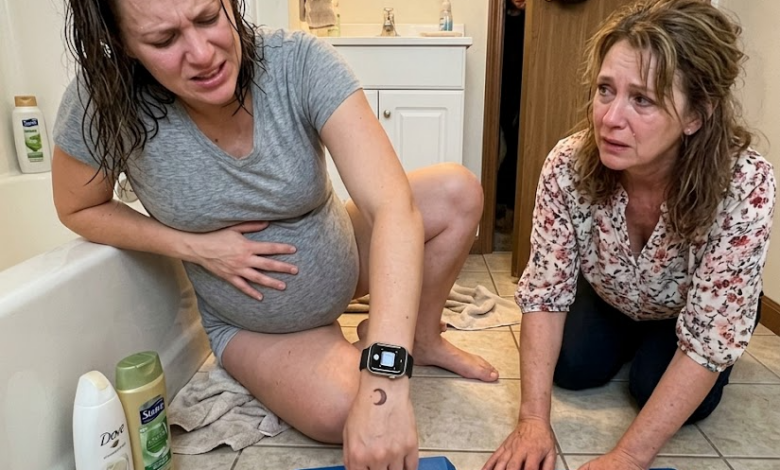
Evelyn’s phone lit with my name because Daniel had replaced himself with her in the pregnancy app three days earlier. He meant the alert to summon the woman he had chosen to take my baby; instead, it opened a live emergency line to the person now kneeling beside me.
She answered without greeting anyone and gave the dispatcher my address, my stage of pregnancy, and the fact that my husband had locked me inside a bathroom during active labor.
Daniel struck the door once with his palm.
“Mom, end the call.”
I pressed my shoulder against the bathtub and told Evelyn not to unlock anything until the private maternity center knew the paperwork was disputed.
Another contraction tightened beneath my ribs, and I counted the screws in the towel rack because looking at something useless kept me from watching Daniel’s shadow move under the door.
Evelyn searched her phone with both thumbs while the dispatcher stayed on the line.
Daniel had emailed her a delivery schedule from Willow Maternity Center, along with instructions to bring my identification and the blue folder as soon as the pregnancy alert arrived.
He had even written that I might become emotional and accuse them of stealing my child.
Evelyn opened the message, selected every address Daniel had included, and attached the photographs from my watch.
Then she typed that she withdrew from the arrangement, disputed every signature, and did not consent to receiving or transporting my baby.
I read the words over her wrist before she sent them.
Her thumb came down.
The message left her phone with a timestamp Daniel could not pull back.
Outside, he stopped knocking.
For several seconds, the only sounds were the exhaust fan and the dispatcher asking whether I could feel the baby moving.
I said yes, although the word came out thin.
Daniel finally turned his key and opened the door six inches, wearing the careful expression he used whenever someone else might be listening.
“Claire, I was trying to keep you safe until the transport team arrived.”
I told the dispatcher that the door was opening and asked her to record his exact words.
Evelyn stood first, holding the blue folder against her stomach, and blocked Daniel from reaching me.
He looked at her missing pearl earring instead of her face.
“You don’t understand what she agreed to.”
Evelyn said she understood enough.
I grabbed the sink, rose halfway, and waited for the dizziness to pass before moving one bare foot onto the hallway carpet.
The air outside the bathroom felt too warm, and the house smelled like the chicken Daniel had left burning in a pan downstairs.
He reached for my elbow.
I pulled away.
“Do not touch me.”
The sentence was quiet, but the dispatcher repeated it through Evelyn’s speaker so there could be no mistake.
When the front door opened downstairs, Daniel took one step toward the bedroom and then stopped because Evelyn had already photographed the folder, the lock, and the key still hanging from his hand.
The paramedics found me beside the linen closet with a bath towel wrapped around my waist and my watch pressed against my pulse.
Daniel began explaining that I was a surrogate suffering from confusion caused by labor medication, although I had taken nothing stronger than two antacids since breakfast.
I gave the lead paramedic my full name, date of birth, and insurance number before Daniel could offer the cards in his pocket.
Then I pointed at Evelyn.
“She rides with me. He does not.”
Daniel smiled as though I had made an embarrassing joke.
No one laughed.
As they moved me toward the ambulance, I pressed the illuminated elevator-style button beside our front door twice even though it controlled nothing except the porch light.
The second press achieved nothing.
Daniel followed us outside carrying a packed diaper bag I had never seen before, and I watched him place it carefully on the porch rather than hand it to anyone.
His control always looked most convincing when he behaved as if he were helping.
Inside the ambulance, I opened the safety screen on my watch and found an audio file beginning nine minutes before Evelyn entered the bathroom.
The app had started recording when I held the emergency screen awake through three abnormal contractions.
It had captured the lock turning, Daniel telling me to stay down, Evelyn identifying herself, and Daniel asking whether I was cooperating.
I exported the file to Evelyn’s phone and to the emergency account attached to my obstetric clinic.
The progress circle stalled at ninety-eight percent while the ambulance crossed an intersection sometime that afternoon.
I held my breath until it finished.
At the hospital, a nurse named Nina rolled me toward maternity admissions and glanced at the electronic banner above my chart.
“We’ll get the intended mother settled after we examine the carrier.”
I stopped the wheelchair with both feet.
The rubber soles dragged against the polished floor, and pain shot through my left hip where the bathroom tile had bruised it.
“I am the mother. That banner is fraudulent.”
Nina looked from me to Evelyn, then turned the monitor away and called the charge desk without correcting herself.
The electronic record was worse than the folder.
Daniel had pre-registered me for a scheduled induction through Willow’s transfer network, identified me as a gestational carrier, and uploaded a consent packet bearing scans of my driver’s license and copied signature.
Evelyn’s withdrawal email had stopped the private center from sending a transport team, but it had not erased the packet already sitting inside the hospital system.
For the first time since the bathroom door opened, Daniel had regained something.
The hospital could freeze the newborn release process, but it could not quietly delete documents involved in an active identity dispute.
Every page had to be preserved and reviewed.
I asked them to mark my admission confidential, remove Daniel from the bedside list, and place a written statement in my chart saying I did not consent to any transfer of my child.
Between contractions, I wrote that statement by hand because I did not trust another signature pad.
My fingers cramped before I reached the bottom.
I signed anyway.
Evelyn wrote her own statement beside mine, declaring that Daniel had deceived her and that she claimed no parental right over my baby.
She paused over the relationship box.
Then she left it blank.
A security officer took the blue folder to copy it, but I made him inventory every item while I watched: my license, my insurance card, fourteen contract pages, the private-center instructions, and three sealed dividers Daniel had never shown Evelyn.
The officer returned the folder and remained outside my room while the police responding to the emergency call took Daniel’s statement down the hall.
I could hear only fragments through the door.
Daniel told them the lock had been necessary because I had threatened to run into traffic.
I had been barefoot, full-term, and on the second floor.
Evelyn sat beside my bed, rubbing the pale mark left by her wedding ring even though she was not wearing one.
I asked when Daniel had first contacted her about the surrogacy.
She said it had been shortly after he told her he had found old information about the daughter she lost at St. Agnes.
My contraction monitor climbed.
I looked at the blue folder.
Evelyn did too.
When the pain loosened, I opened the first sealed divider.
Inside were copies of her hospital discharge papers, including the infant case number and the description of the crescent-shaped mark on the baby’s left wrist.
The next sheet was my county foster intake record.
It carried the same infant case number.
My mouth went dry.
The room was cold enough that Evelyn’s hands had turned pale, but sweat collected under the gray band around my wrist.
I opened the second divider.
Daniel had placed my sealed birth certificate beside Evelyn’s discharge summary and clipped both to an email he sent himself months before he introduced the idea of a surrogate to her.
The subject line contained only two words: Hart match.
He had known.
He knew the woman he called Mom had been told her daughter died, and he knew the woman sleeping beside him was that daughter.
He did not bring us together.
He kept the truth inside a blue folder until my pregnancy gave him a use for it.
Evelyn covered her mouth, but no sound came out.
I kept reading.
Daniel’s messages to her said the surrogate wanted anonymity, had already been paid, and would become dangerous if allowed to bond with the baby after delivery.
Messages supposedly sent from my number warned Evelyn never to mention St. Agnes because the subject triggered unstable behavior.
He had built an explanation for every true thing I might say.
I turned to the last divider and found a newborn transport authorization naming Daniel as the person permitted to collect the baby on Evelyn’s behalf.
Evelyn would have been the legal-looking parent on paper.
Daniel would still have left with my child.
A contraction came before I could set the page down, and I crushed the corner in my fist.
Evelyn reached for me, stopped herself, and held the bed rail instead.
“Tell me what you need.”
I told her to photograph every page again, including the email dates and the transport authorization.
Then I asked her to send them to the hospital’s patient-safety address while I watched each attachment load.
She did not ask me to call her my mother.
She did not say the baby belonged to her.
She asked whether my feet were cold and pulled the blanket lower without touching my stomach.
A little later, Daniel appeared beyond the narrow window in my door with his hands open at his sides.
He had removed his jacket and loosened his tie, making himself look like a frightened husband who had spent the day begging people to help his wife.
“Claire, this can still be handled privately.”
I asked the nurse to close the blind.
Daniel continued speaking through the door.
He said the hospital would keep the baby if I forced them to investigate, that foster services would become involved, and that Evelyn was too fragile to survive another loss.
His concern always contained instructions.
I put one saltine in my mouth and chewed until it became a dry paste.
The television above the sink showed a cooking program with the sound muted, and someone on-screen kept whisking a yellow sauce while my daughter’s heartbeat filled the room.
For less than a minute, nothing dangerous happened.
Then Evelyn noticed a page stuck inside the folder’s back lining.
I slid my finger under the torn cardboard and pulled it free.
It was the original cover message Daniel had sent Willow with the forged packet, and the submission history showed that he had uploaded my documents from our home computer before he ever asked Evelyn to participate.
Her involvement had not created the plan.
She had been selected because her grief made the plan look compassionate.
The final line instructed the center to contact only Daniel if the carrier attempted to revoke consent.
I handed the page to the officer outside my room.
He added it to the inventory and called the responding detectives back from the lobby.
By then, my contractions were too close for more questions.
I told the medical team that no one except Evelyn could enter, and I told Evelyn she could stay only if she followed every instruction without arguing.
She nodded once.
During the next several hours, she held water where I could reach it, counted breaths when I asked, and looked away when I needed privacy.
At one point, she picked a loose label from the blanket and rolled it between her fingers until it became a tiny white tube.
She placed it on the windowsill.
Shortly before dawn, my daughter was born.
She cried before I did.
The nurse put her against my chest while another nurse confirmed aloud that the newborn-release restriction was active and that no transfer paperwork would be honored without direct review.
I counted ten fingers, then counted them again.
Evelyn stood near the wall with both hands clasped behind her back.
For a few minutes, I believed the hard part was finished.
Daniel was off the maternity floor, Willow had suspended its file, and my daughter wore a hospital band matching mine.
Then the registration office called my room.
Daniel had submitted a second copy of the authorization through the hospital portal after the police interviewed him, claiming the documents in the blue folder were drafts and the electronic copy was the valid version.
The second copy carried a different witness stamp and a cleaner image of my signature.
The hospital extended the release freeze.
My daughter could remain with me, but neither of us could leave until the competing records were resolved.
Daniel had lost access to the room and still managed to keep us inside a building.
I asked for my watch.
A nurse brought it from the property bag, its gray band damp where the bathroom floor had soaked it.
I opened the emergency recording and played the first minute for the registration supervisor, the patient-safety officer, and the detectives now standing beside my bed.
They heard Daniel lock the door.
They heard him tell me not to make labor harder on the baby.
They heard Evelyn enter with my identification and ask about my birthmark.
Then they heard Daniel call her Mom and ask whether I was cooperating.
I played the final section too, where Evelyn said he could not know she believed me and Daniel ordered her to bring the folder downstairs before the transport team arrived.
The second authorization did not sound like a voluntary agreement after that.
The hospital compared its upload history with the photographs from my watch and found that Daniel’s so-called valid document had been created from the same scanned signature embedded in the earlier packet.
The witness stamp had been added later.
Before noon, the registration office marked both authorizations disputed and barred them from any birth or discharge decision.
Willow sent written confirmation that its arrangement was void.
The hospital recorded me as my daughter’s sole releasing parent, pending any future court order obtained through a real proceeding rather than uploaded papers.
I read the corrected screen myself.
Only then did I sleep.
Two days later, a judge reviewed the emergency recording, the folder photographs, Evelyn’s withdrawal message, and the hospital upload history before issuing a temporary protective order that prohibited Daniel from contacting me or approaching the baby.
The criminal investigation continued, and I did not pretend a temporary order was the same as a finished case.
It was enough to let us leave through the hospital’s main doors without him waiting beside the curb.
Evelyn carried the diaper bag.
I carried my daughter.
At my request, we went to a small furnished apartment arranged through the hospital’s family-safety office rather than returning to the house Daniel had locked from the inside.
The place smelled faintly of somebody else’s laundry detergent, and one kitchen drawer contained seven plastic forks but no spoons.
I checked every window latch before feeding the baby.
Evelyn waited in the hallway until I invited her in.
Over the next week, we requested the surviving St. Agnes records through the formal release process and submitted cheek swabs to an accredited kinship laboratory.
The hospital files showed that Evelyn’s daughter had been transferred alive to county care under the same case number later assigned to me.
Eleven days after my daughter was born, the laboratory report confirmed that Evelyn was my biological mother.
I read the result at the kitchen table while my baby slept in a laundry basket lined with two folded towels because the portable crib had not arrived yet.
Evelyn sat across from me and asked whether the coffee was too strong.
Neither of us knew how to fit twenty-seven missing years into that room.
I did not forgive her for something she had not done, and I did not give her a place in my life simply because a report said we shared blood.
I gave her smaller things.
I let her wash bottles.
I told her which brand of diapers leaked.
One afternoon, when the baby would not settle, I placed her in Evelyn’s arms and stayed close enough to take her back.
Evelyn did not call herself Grandma.
She walked slowly between the couch and the window, talking about the pearl earring she had lost somewhere between her car and my bathroom.
My daughter fell asleep before the story ended.
The blue folder eventually came back from evidence processing in a clear protective sleeve, with every false document indexed behind the records Daniel had tried to hide.
I added the corrected hospital release, the kinship report, and a copy of the protective order.
Then I placed the folder in a fireproof box with my daughter’s real hospital bracelet.
I removed the pregnancy watch, cleaned the bleach from its face, and exported the last copy of the recording.
The gray band now circles the handle of that box.