Seven-Year-Old Pushes Newborn Twins Miles to an Emergency Room
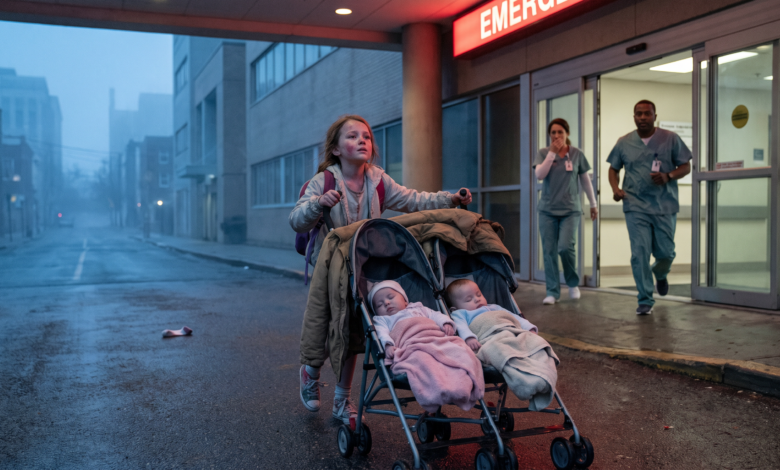
The first thing the receptionist noticed was the wheelbarrow.
It came through the emergency room doors with a rusty squeal that sounded completely out of place against the polished floor.
For half a second, she wondered whether a child had wandered in while playing some strange game outside.
Then she saw what was inside it.
The wheelbarrow was dented and streaked with dirt, with the smell of old rain and dried blood clinging to it.
Behind the wooden handles stood a barefoot girl who looked no older than seven.
Her arms were shaking so badly that she could barely hold the weight steady.
Her hair was damp against her cheeks, her eyes were swollen red, and every breath looked like work.
She pushed the wheelbarrow another few feet before her strength seemed to disappear.
“Help,” she rasped.
The receptionist’s hand stopped above the phone.
“My little siblings won’t wake up.”
A man in the waiting area who had been bouncing one knee while waiting for stitches suddenly went still.
The receptionist looked down again.
Inside the wheelbarrow, wrapped together beneath a yellowish sheet, were two newborn babies.
Twins.
Their faces were pale.
Their mouths were still.Their tiny hands were curled close to their chests.
The receptionist did not need to call twice.
A nurse was already running toward them.
She crouched beside the wheelbarrow and reached carefully for the first baby, moving with the controlled speed of someone who understood immediately that there was no room for wasted motion.
“Where is your mommy?” she asked.
The little girl did not answer.
She kept staring at the babies as the nurse lifted one from the sheet.
Only then did the nurse notice the child’s hands.
Both palms were blistered raw where the wooden handles had rubbed against them.
Her fingers were dirty and stiff, but she still held on to the wheelbarrow as if letting go might somehow mean letting go of the babies too.
At 2:17 p.m., an emergency intake clerk opened a pediatric trauma form.
In the notes field, the clerk typed three words: child with twins.
Those words barely described what was happening.
By 2:19, two nurses, a resident, and the on-call pediatric physician were gathered around the newborns.
The little girl remained close enough to see them but far enough not to interfere.
Nobody had told her where to stand.
She simply seemed to understand that the adults needed space.
By 2:21, the medical team knew that whatever had happened before the children reached the emergency room, this was not a misunderstanding and not a situation that could wait.
The twins were dangerously cold.
The doctor checked them and looked toward the girl.
“How long have they been like this?”
She lowered her eyes.
For the first time, the doctor noticed her feet clearly.
They were bleeding from the walk.
Dust covered her ankles, and scratches ran along her legs beneath the hem of her dress.
Purple and brown bruises marked her knees.
Her lips were split from thirst.
She looked as though she had spent every ounce of energy she had getting those two babies through the doors.
The doctor tried again, keeping his voice calm.
“Do you know how long the babies haven’t been waking up?”
The girl’s answer changed the room.
“I don’t know. My mommy has been sleeping for three days.”
The doctor stopped.
“Sleeping?”
The girl nodded.
Her voice stayed quiet and painfully matter-of-fact.
“She doesn’t move. She doesn’t open her eyes anymore. And the babies stopped crying yesterday.”
For a moment, the doctor’s attention moved from the twins to the child standing beside the wheelbarrow.
She was seven years old.
She had apparently been alone with a mother who would not move and two newborn babies who had stopped crying.
And somehow, with no adult beside her, she had decided what to do next.
The doctor turned sharply toward the team.
“Warmers. Oxygen. Neonatal team. Now.”
The nurses moved faster.
The babies were transferred from the wheelbarrow, and the emergency room filled with the controlled urgency of people working against a condition that could not be ignored.
The little girl watched everything.
She did not scream.
She did not demand answers.
She seemed to be concentrating on one thing only: making sure the babies were finally in the hands of people who could help them.
Once the twins were being treated, one of the nurses turned back toward her.
Up close, the signs of the girl’s journey were impossible to miss.
There were scratches across both legs, bruising around her knees, dirt ground into the folds of her dress, and dehydration visible in her cracked lips.
A small piece of twine had been tied around one wrist.
The nurse looked at the raw skin on her palms again.
“How far did you walk?”
The girl glanced toward the emergency room entrance as though the road outside was still waiting for her.
“From the house. It’s far.”
The nurse tried to get a more useful answer, but the girl had no number to give her.
No mileage.
No clear set of directions.
Only the certainty that she had come from home and that home was far away.
Then the girl added something that explained why she had kept moving despite her feet, her thirst, and the weight of the twins.
“Mom said if something happened, I should come here. That you all help.”
She did not say it as if she expected praise.
She said it as though she were repeating an instruction she had been determined not to forget.
Something had happened.
Her mother had once told her where to go.
So she had gone.
Whatever fear she felt had apparently come second to completing that instruction.
The nurse crouched until she was closer to the girl’s eye level.
“What’s your name?”
The child whispered it.
The doctor, still moving between the babies and the questions that now had to be answered, asked about another adult who might be able to explain what was happening.
“What about your daddy?”
The answer came immediately.
“I don’t have a daddy.”
There was no hesitation and no explanation after it.
The doctor looked toward the nurse.
The next question was unavoidable.
“And your mommy is still at the house?”
The girl nodded.
That was when one tear finally escaped and moved down her dirty cheek.
Until then, she had been holding herself together with the same stubborn determination that had apparently gotten the wheelbarrow all the way to the emergency room.
“I said I would go back for her,” she whispered.
Then she looked toward the twins.
“But first I had to save the babies.”
The receptionist, still watching from the intake desk, covered her mouth.
One of the nurses turned her face away for a moment and blinked hard before returning to work.
The girl had not arrived asking for anyone to admire what she had done.
She had arrived because she believed the adults inside that building would honor a promise her mother had once made about them.
If something happened, go there.
They help.
For the child, that had apparently been enough.
She had found a wheelbarrow.
She had put the twins inside it.
She had wrapped them in the sheet.
Then she had pushed.
The evidence of that trip was everywhere on her body.
It was in her bleeding feet and her scratched legs.
It was in the blisters across her palms.
It was in the thirst that had split her lips and the exhaustion that made her tremble even after she no longer had to push anything.
The road itself remained difficult for the adults in the emergency room to imagine because the girl could not describe it the way an adult would.
She did not know exactly how many miles she had traveled.
She did not have a map.
She had no carefully memorized address ready to recite.
She had simply known where she needed to end up.
At 2:43 p.m., hospital security contacted county dispatch.
The problem had now become larger than the two newborns receiving care in the emergency room.
Somewhere outside the hospital was the house the girl had left behind.
And inside that house was her mother, who, according to the child’s own words, had been “sleeping” for three days without moving or opening her eyes.
At 2:46, a police incident report was opened.
At 2:51, a social worker was paged.
The response around the girl widened, but the most immediate questions remained painfully simple.
Where was the house?
How could anyone find it?
And what exactly would they discover when they got there?
The twins stayed under heat lamps while the little girl remained focused on something the adults had not expected to matter so much.
The wheelbarrow.
Someone tried to guide her toward a place where she could sit.
She resisted.
Not because she wanted to leave the hospital immediately, and not because she distrusted the people helping the babies.
She simply would not settle down until she knew what would happen to the battered wheelbarrow she had pushed through those doors.
“It’s how I brought them,” she whispered.
To an adult, it was an old, dirty tool with a rusty wheel.
To her, it was the thing that had carried her brother and sister when her own arms could not.
It was proof that the impossible trip had actually ended.
One nurse stayed with her and held her gaze.
“You did exactly right. Do you hear me?”
The girl listened without moving.
“You did exactly what your mommy told you to do.”
Her chin trembled.
The words seemed to give her permission, perhaps for the first time since she had left the house, to stop being the only person responsible for everyone else.
But only for a moment.
Her next question showed exactly where her mind still was.
“Can I go back now?”
Nobody had an easy answer.
The adults could not simply allow a seven-year-old with injured feet and blistered hands to retrace an unknown route alone.
But telling her she could not leave did not solve the real problem either.
Her mother was still out there.
The house was still out there.
And the child clearly believed she had unfinished work waiting for her beyond the emergency room doors.
She had promised herself she would go back.
First, however, she had chosen the babies.
Now the adults had to figure out how to follow the path she had traveled without expecting a frightened seven-year-old to describe it like a driver giving directions.
They began asking careful questions.
Did she know the road name?
Could she remember anything near the house?
Was there a store, a turn, a fence, a sign, a vehicle, anything that might help officers identify the right place?
The girl tried.
Her exhaustion made every answer harder.
She had spent hours concentrating on forward movement rather than memorizing landmarks for someone who might later need to follow her.
She had been watching the wheelbarrow wheel.
She had been watching the babies.
She had been trying not to fall.
She had been trying to reach the one place her mother had told her could help.
The adults kept the questions simple.
The name of the road came first.
Then pieces of an address.
She could not give everything at once.
Each detail had to be pulled from memory while the events of the previous days pressed against her from every direction.
Meanwhile, the emergency department remained divided between two urgent realities.
The newborn twins needed medical attention because they were dangerously cold.
Their seven-year-old sister needed care too, even if she did not seem to understand that yet.
And an adult woman remained at an unidentified house with no one there to explain her condition.
The child had carried the crisis as far as she physically could.
Now she had reached the point where the adults had to take over.
At 3:08 p.m., after repeated attempts to help her remember, the girl finally managed to give officers a partial address.
She also remembered the road name.
It was progress, but not enough to remove every doubt.
A partial address could still leave several possibilities, especially when the only person who knew the route was exhausted, dehydrated, and seven years old.
The officers needed something more concrete.
The girl closed her eyes for a moment and searched her memory for the road she had just traveled.
Not the whole road.
One piece of it.
Something she had seen often enough that she knew it belonged near home.
Then she opened her eyes.
There was one detail she was absolutely sure about.
A blue mailbox.
It stood near the ditch.
And it was bent sideways.
That image was clearer to her than the numbers of the address.
Clearer than the distance she had walked.
Clearer than the turns that had blurred together while she pushed the twins toward the hospital.
A blue mailbox, bent sideways near the ditch.
The officers now had the road name, a partial address, and that single unmistakable landmark.
Somewhere beyond the emergency room, the same route the little girl had crossed barefoot now had to be followed in the opposite direction.
The child had already done everything she knew how to do.
She had listened to her mother.
She had chosen the babies first.
She had pushed them for miles despite her blistered hands and bleeding feet.
She had gotten them through the hospital doors before they stopped being solely her responsibility.
But one part of her promise remained unresolved.
Her mother was still back at the house.
And at that moment, the only thing standing between the officers and finding her was a frightened seven-year-old’s memory of a blue mailbox bent sideways beside a ditch.