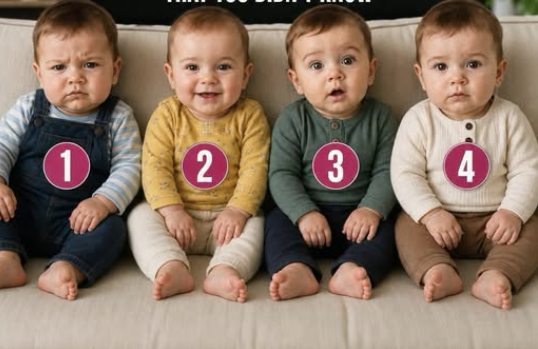
Which of These Four Babies Is a Little Girl Psychological Test!
A viral “psychological test” presents four baby photographs and asks viewers to identify which child is a girl. After a choice is made, the post promises a personality reading based on the selected number. The format is simple and effective: people answer quickly, compare results with friends, and often feel that the description sounds surprisingly accurate.
The first problem is that a baby’s gender identity cannot be established from facial appearance. Even biological sex cannot reliably be inferred from hairstyle, clothing color, expression, or other visual stereotypes in a small photograph. The image may have an answer selected by its creator, but viewers are not performing a meaningful assessment of the children.
Most people make the choice by searching for culturally coded clues. A softer expression, rounder cheeks, a headband, longer hair, or a particular color may be interpreted as feminine. Those cues say more about styling and social expectations than about the baby. Change the clothing or crop the hair, and many viewers would choose differently.
The personality result uses a familiar technique. Each option is paired with a broad description containing desirable traits and a manageable weakness. One answer may call the viewer intuitive but sensitive; another may describe confidence with hidden vulnerability. Because the statements are flexible, readers can easily connect them to memories from their own lives.
Psychologists often refer to the tendency to accept vague, generally applicable statements as uniquely personal as the Barnum or Forer effect. Horoscopes, quizzes, and fortune-style readings frequently rely on it. A sentence such as “You care deeply about others but sometimes need space” fits an enormous number of people, yet it can feel intimate when presented as the result of a choice.
That does not make the puzzle worthless. It can be a fun observation exercise and a useful conversation about assumptions. Viewers can ask which clue influenced them, whether they answered immediately or studied each face, and how strongly color or grooming affected their judgment. The discussion becomes more interesting when the group examines the reasoning rather than competing over who was “right.”
The test should not be used to judge intelligence. A fast answer may reflect familiarity with the puzzle’s stereotypes, while a slow answer may reflect skepticism about the premise. Refusing to choose can be as thoughtful as selecting one of the four babies. There is no validated scoring system connecting the image to IQ, empathy, leadership, or any other psychological trait.
It is also important to remember that the babies are real children, even if the photograph is used as entertainment. Describing one child as more attractive, gentle, or appropriately feminine can reinforce expectations that affect children long before they understand them. Playful content is healthier when it focuses on the viewer’s perception instead of assigning value to a child’s face.
If you want to turn the post into a genuine observation challenge, examine neutral details. Count visible objects, compare background patterns, or note how lighting changes each face. Then describe the exact evidence behind your choice and list at least one alternative explanation. That method encourages careful thinking without pretending the photograph reveals someone’s identity.
So which baby is the girl? The creator may publish a numbered answer, but the picture itself cannot prove it. The more revealing question is why a particular face looked feminine to you and which cultural clues shaped that impression. As entertainment, the quiz is harmless fun; as psychology, it is not a diagnosis and should not be treated as one.
Parents and educators can even use the image to discuss stereotypes with older children. Ask how toy colors, hairstyles, and advertising shape expectations, then imagine how the answers would change if the same babies wore different clothes. That turns a disposable online quiz into a useful lesson about perception, uncertainty, and the importance of not defining people by appearance alone.