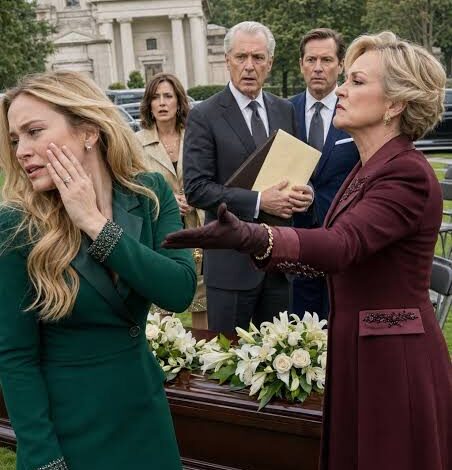
My Stepmother Banned Me From My Father’s Funeral—She Didn’t Know I Owned His Grave
PART 3 The funeral director stepped forward carefully. “Perhaps we should discuss this privately.” Mrs. Ostrander entered through the side door before anyone could answer. She was wearing the same navy coat she’d worn in the cemetery office. In one hand she carried a worn leather folder. In the other was the original cemetery ledger. “I believe,” she said calmly, “this concerns interment rights.” You could almost hear Bonnie stop breathing. The Truth in Front of Everyone Mrs. Ostrander walked directly to the front table and opened the ledger.
“Ronald Marsh purchased plots 12-A and 12-B on April 14, 1998.” She turned the book so everyone nearest could see. “12-A: Ellen Marsh.” Her finger slid one line lower. “12-B: Reserved for Ronald Marsh.” Then she tapped the final column. “Right holder: Tracy Ellen Marsh.” Bonnie laughed. It sounded forced. “That’s ridiculous. I’m his wife.” Mrs. Ostrander nodded politely. “I’m aware.” “I make funeral decisions.” “You may arrange the funeral. You do not own cemetery property.” Bonnie’s attorney—whom I hadn’t even noticed sitting in the back—stood. “This is an unnecessary disruption. As surviving spouse—” Mrs. Ostrander interrupted him with surprising confidence. “Counselor, are you familiar with perpetual interment deeds?” He stopped speaking. “The burial location belongs to the deed holder. State law is very clear.” She closed the ledger with a soft thud. “The grave will not be opened without Miss Marsh’s authorization.”
Every eye shifted back to me.
I hadn’t wanted power.
I had wanted my father.
Those weren’t the same thing.
The Letter Inside the Casket
The funeral director cleared his throat.
“There is… one additional matter.”
Bonnie looked confused.
“What additional matter?”
He hesitated before answering.
“When Mr. Marsh completed his pre-need funeral instructions six weeks ago, he left a sealed envelope with very specific directions.”
Bonnie spun toward him.
“What envelope?”
He looked almost embarrassed.
“It was to be opened only if there was a dispute regarding his burial.”
My heart started pounding.
The director reached into a locked drawer beneath the memorial table and removed a cream-colored envelope.
Across the front, in my father’s handwriting, were seven words.
If Bonnie objects, open this immediately.
Gasps rippled through the chapel.
Bonnie lunged forward.
“That is private.”
The director stepped back.
“It is addressed to the funeral director and the cemetery.”
He broke the seal.
Inside were three papers.
The first was a notarized burial instruction.
The second was a copy of the cemetery deed.
The third was a handwritten letter.
He unfolded it.
“Would you like me to read it?”
My throat tightened.
“Please.”
His voice became the only sound in the room.
“If you’re hearing this, then my girls are being separated again.
Ellen was my first home.
Bonnie was my second chance.
But Tracy has always been my daughter.
I failed her more times than I can count because I confused keeping peace with doing what was right.
Do not bury me away from Ellen.
And do not ask Tracy to surrender something I gave her to protect both of us.
She’ll think she is causing trouble.
Tell her she isn’t.
She’s keeping a promise I asked her to keep.”
The director stopped.
People were crying.
Including me.
I hadn’t cried when he died.
I cried hearing him apologize.
A Son Speaks Up
From the third row, a chair scraped.
My stepbrother, Adam, stood.
Adam was twenty-nine.
Bonnie’s son.
We’d never been close, but we’d never hated each other either. We were children living in the same weather.
He looked at his mother.
“Is it true?”
Bonnie didn’t answer.
“Mom.”
She folded her arms.
“Your father was confused near the end.”
The sentence landed like a slap.
Adam looked at me.
“Did Grandpa’s cemetery lady show you the deed?”
I nodded.
He walked over.
“Can I see it?”
Mrs. Ostrander handed him the photocopy.
He studied it for nearly a minute.
Then he looked at the signature.
“Dad signed this in 1998.”
He swallowed.
“That wasn’t dementia.”
Bonnie’s face hardened.
“Sit down.”
Instead, Adam turned toward the mourners.
“My dad visited Tracy every Sunday.”
The room shifted.
Bonnie whispered sharply, “Adam.”
“No. You told everyone they hadn’t spoken in years.”
He looked at me with sad eyes.
“I used to hear him leave the house with tomatoes every August.”
Mrs. Ostrander smiled faintly.
Adam continued.
“He wasn’t golfing.”
Bonnie closed her eyes.
For the first time, I realized everyone else had known pieces of the truth.
No one had known the whole picture.
The Drive to the Cemetery
At 10:40, the funeral procession finally began.
The printed programs still said Plot 14-B.
The hearse drove instead toward Section 12.
Bonnie rode alone.
I followed behind the hearse with Mrs. Ostrander.
She kept one hand resting on the ledger in her lap.
“You okay?” she asked.
“No.”
“Good.”
I looked over.
She smiled sadly.
“The people who pretend they’re okay usually explode later.”
I laughed through tears.
That would have been my father.
He always said crying and laughing lived in neighboring houses.
When we arrived, the grave beside my mother had already been prepared.
Fresh earth.
Green carpet.
Two white chairs.
My mother’s stone caught the morning sunlight.
ELLEN MARSH Beloved Wife and Mother
Beside it was a temporary bronze marker waiting for my father.
Empty.
Waiting.
Exactly as he’d planned.
The Rose Nobody Expected
The minister began the committal service.
Halfway through, Bonnie quietly stepped away from everyone.
I thought she was leaving.
Instead, she walked to the back of the hearse.
She opened the floral compartment.
From beneath dozens of arrangements, she removed a single red rose.
She stood over my mother’s grave for several seconds.
Then, without looking at anyone, she laid the rose gently against Ellen’s headstone.
“I hated competing with a ghost,” she whispered.
Only I heard it.
Before I could respond, she walked back to her car.
She drove away before the burial finished.
I watched the taillights disappear between the cemetery pines.
I didn’t know then that the hardest part of my father’s final gift wasn’t the grave.
It was the locked safety deposit box whose key would be discovered the following morning—and the document inside would change everything Bonnie thought she owned.
PART 4
The morning after we buried my father, the bank manager looked at my ID, then at the envelope in his hand, and quietly asked, “Tracy… did your father ever tell you about Box 117?”
I shook my head.
“No.”
“He told us,” the manager said gently, “that if he passed away before closing the box himself, we were to contact you. Only you.”
The words settled over me like cold rain.
I had spent the previous day believing the cemetery was my father’s final act of protection. I was wrong.
It was only the beginning.
The Call That Changed the Morning
I had barely slept after the funeral.
My apartment still smelled faintly of the lilies people had insisted on sending home with me. Sympathy flowers lined my kitchen counter, and every bouquet felt strangely heavy.
At 8:12 a.m., my phone rang.
“Miss Marsh?”
“Yes?”
“This is Daniel Cooper from First County Bank. I’m very sorry for your loss. We have instructions regarding your father’s safety deposit box. If possible, could you come in today?”
“I’m not the executor.”
“You don’t need to be.”
That was all he said.
Twenty minutes later, I was driving with my father’s letter folded carefully inside my purse.
Box 117
The vault was colder than the rest of the building.
Daniel unlocked one key.
I inserted the second.
The drawer slid open.
Inside wasn’t money.
It wasn’t jewelry.
It was organization.
Every document rested inside labeled folders written in my father’s unmistakable block handwriting.
TRACY
HOUSE
LIFE INSURANCE
LETTERS
And one folder that made my stomach tighten.
OPEN LAST
Daniel excused himself, closing the vault door behind him.
I was alone.
The first folder contained copies of the cemetery deed.
The second held my birth certificate, my mother’s death certificate, and dozens of photographs I had never seen.
There was one of my mother laughing while pregnant.
One of Dad holding me as a newborn.
One of the three of us eating watermelon on a porch I barely remembered.
I cried quietly.
Not because they were extraordinary.
Because they proved my childhood had once been happy.
The House That Was Never Fully Hers
The third folder stopped me.
Inside was the deed to my father’s house.
I already knew Bonnie lived there.
What I didn’t know was what my father had done in 2004.
Attached to the deed was something called a Life Estate Agreement.
A yellow sticky note in his handwriting read:
“Have a lawyer explain this. Don’t assume.”
I didn’t.
I photographed it and called the attorney whose business card was clipped to the file.
Her name was Margaret Ellis.
She answered immediately.
“I wondered when you’d call.”
“You knew my father?”
“For seventeen years.”
“I found a life estate.”
She became very quiet.
“Can you come by my office?”
My Father’s Real Plan
Margaret spread the paperwork across a conference table.
“Your father loved Bonnie,” she said first.
“And?”
“And he was terrified of leaving you unprotected.”
She pointed to the document.
“This gave Bonnie the legal right to live in the house for the rest of her life.”
“So she owns it?”
“No.”
She looked directly at me.
“You do.”
I stared.
“What?”
“Ron transferred the property into your name in 2004 while reserving a life estate for himself and, after his death, occupancy rights for Bonnie.”
I couldn’t breathe.
“He never told me.”
“He specifically instructed us not to.”
“Why?”
“Because he knew you would refuse.”
That sounded exactly like me.
Margaret continued.
“You cannot sell the house while Bonnie lives there. She cannot leave it to anyone in her will. She may live there peacefully, but ownership has belonged to you for twenty-two years.”
I whispered, “She thinks it’s hers.”
“She probably does.”
The Will Bonnie Never Mentioned
Margaret opened another folder.
“This is the actual will.”
Not a letter.
Not a draft.
A signed, witnessed will.
I read the first page.
My father had left Bonnie his retirement accounts, savings, two vehicles, and nearly every liquid asset.
She was financially secure.
Then I reached the final paragraph.
I intentionally leave the residence outside probate because ownership was previously transferred. My daughter Tracy knows nothing about this. Please tell her only after my death.
I laughed through tears.
“He really knew me.”
Margaret smiled.
“He wrote another note.”
She handed me a folded page.
“Trace,
If you’re reading this, Bonnie is probably furious.
Don’t punish her.
Let her stay.
A house isn’t love.
It’s shelter.
Give her that, even if she never gave you belonging.”
I folded the letter carefully.
Some people leave money.
My father kept leaving instructions on how to stay kind.
Bonnie’s Lawyer Arrives
Three days later, my phone rang again.
“Miss Marsh, this is Gerald Whitmore. I represent Bonnie Marsh.”
Of course.
“My client has concerns regarding certain documents.”
“I imagine she does.”
“She believes the property transfer may have been obtained under undue influence.”
“My father transferred it twenty-two years ago.”
Silence.
He hadn’t known that.
“I… see.”
“There’s a recorded deed.”
More silence.
“I’ll speak with my client.”
He hung up.
I never heard from him again.
The Visit I Didn’t Expect
A week after the funeral, someone knocked on my apartment door.
Adam.
He held a cardboard box.
“I found these in Dad’s workshop.”
Inside were thirty-four cassette tapes.
Each had dates.
Sunday Calls.
I looked up.
“He recorded them?”
Adam nodded.
“He had an old answering machine hooked into the garage phone. He said someday you might want to hear your own life.”
I picked up one tape.
March 2008.
Another.
December 2015.
Another.
February 2026.
Every Sunday.
Eighteen years.
“I never knew.”
“He didn’t want Mom finding them.”
Adam hesitated.
“She’s moving out.”
“What?”
“She said she can’t live in a house that belongs to someone she spent twenty-five years pretending didn’t belong.”
I felt no victory.
Only sadness.
“She doesn’t have to leave,” I said.
Adam smiled faintly.
“I know.”
“She really doesn’t.”
“She won’t believe you unless you tell her yourself.”
The Kitchen Conversation
I drove to the house two days later.
The same house where I had learned to tiptoe.
Bonnie answered the door.
She looked smaller somehow.
No makeup.
No perfect hair.
Just a widow in an oversized sweater.
“I’m not here to fight.”
“I figured.”
She stepped aside.
We sat in the kitchen where my mother had never sat.
I placed the deed on the table.
“I own the house.”
“I know.”
“You can stay.”
She stared at me.
“I’m serious.”
“I was horrible to you.”
“Yes.”
“I kept him from you.”
“Yes.”
“I can’t undo that.”
“No.”
Tears filled her eyes.
“Why would you let me stay?”
I took my father’s final letter from my purse and slid it across the table.
She read it.
By the time she reached the last line, she was crying openly.
Give her shelter, even if she never gave you belonging.
Bonnie covered her mouth.
“He wrote this?”
“He did.”
She whispered, “I spent years trying to win against a woman who was already gone.”
“My mother wasn’t your enemy.”
“I know that now.”
It didn’t erase twenty-five years.
But it ended them.
As I stood to leave, Bonnie called my name for the first time without bitterness.
“Tracy.”
I turned.
“I’m sorry.”
There are apologies that repair everything.
This wasn’t one of them.
It was simply the first honest thing she had ever given me.
And sometimes, that is where families begin again.
PART 5
Six months later, at exactly 7:00 p.m. on a Sunday, my phone rang from my father’s old garage number—a number that had been disconnected since the funeral.
For one impossible second, I thought it was him.
I answered anyway.
“Hello?”
A familiar voice laughed softly.
“Don’t panic. It’s Adam.”
I exhaled so hard I had to sit down.
“I finally got the old answering machine working,” he said. “I think there’s something you should hear.”
Twenty minutes later, I was driving to the house.
Not Bonnie’s house.
Not my house.
Just home.
The Garage Where Love Hid
The garage smelled exactly the same.
Motor oil.
Fresh-cut wood.
And the peppermint candies Dad always kept in a coffee tin beside his workbench.
The old answering machine sat on a shelf connected to a cassette player with wires Adam had somehow restored.
“There was one tape that never had a date,” he said. “It was hidden behind the others.”
He pressed PLAY.
Static filled the room.
Then my father spoke.
“If this tape is playing, then Tracy finally found the garage.”
I covered my mouth.
“Hi, sweetheart.”
His voice was warm, calm, ordinary.
Exactly how I remembered every Sunday.
“I figured letters might not be enough. Some things are easier said than written.”
The recording paused as if he were gathering his thoughts.
“When your mom died, everyone kept telling me to be strong. I thought being strong meant never letting you see me cry. Turns out it meant something else entirely.”
I looked at Adam.
He quietly stepped outside and closed the garage door, leaving me alone with my father.
His Greatest Regret
The tape continued.
“I owe you an apology, Trace.”
Tears rolled down my face before he finished the sentence.
“You deserved a father who stood between you and every hurt. Too often, I stood beside it instead.”
He wasn’t talking about one moment.
He was talking about twenty-five years.
“Every Christmas I should have knocked on your apartment door instead of calling from the driveway.”
“Every birthday I should have insisted you sit at the table.”
“Every Sunday wasn’t enough.”
I whispered into the empty garage, “I know.”
As if he could still hear me.
Why He Chose the Cemetery
His voice became lighter.
“You probably wondered why I bought those cemetery plots so fast after your mom died.”
I had.
“Because I was terrified someone would someday tell my little girl she didn’t belong beside her own mother.”
My chest tightened.
“So I put your name on the deed. You were six. You couldn’t even spell cemetery.”
I laughed through tears.
Neither could I now, honestly.
“People think inheritance is about money. It isn’t.”
A pause.
“It’s about making sure the people you love always know where home is.”
Bonnie at the Window
When the tape ended, I stayed there for several minutes.
No dramatic music.
No final speech.
Just the click of an old cassette stopping.
I opened the garage door.
Bonnie stood at the kitchen window holding two mugs.
She gave me a small, uncertain smile.
“Hot chocolate?”
I nodded.
It was the first time she had ever invited me inside without my father asking.
The Recipe Card
While she poured the milk, I noticed an old recipe card taped inside the cupboard.
My mother’s handwriting.
Ellen’s Sunday Chocolate.
Bonnie saw me looking.
“I found it behind the spice rack after the funeral.”
“You kept it?”
“She was here first.”
There was no jealousy in her voice.
Only acceptance.
She handed me one mug.
“I thought… maybe we could keep Sundays.”
I looked at her.
“You don’t have to replace him.”
“I know.”
“I’m not Mom.”
“I know.”
She smiled sadly.
“I’m just a woman who made too many mistakes.”
For the first time in my life, I reached across the counter and squeezed her hand.
Not because everything had been forgiven.
Because forgiveness has to begin somewhere.
The Garden
Spring arrived quietly.
Adam built raised garden beds behind the house.
Bonnie planted roses.
I planted tomatoes.
Mrs. Ostrander laughed when she visited.
“Your father would be unbearable about these.”
“He’d say mine needed more sun,” I replied.
“And he’d be right.”
We all laughed.
By August, the tomato vines had climbed taller than the fence.
Exactly as they had every year my father secretly carried baskets to the cemetery office.
One afternoon, Adam loaded two boxes into his truck.
“Where first?”
I smiled.
“Mrs. Ostrander.”
She cried when we handed them over.
“You kids remembered.”
“No,” I said.
“We continued.”
One Year Later
On the anniversary of my father’s funeral, the four of us met at Section 12.
Mrs. Ostrander had retired three weeks earlier, but she came anyway carrying pruning shears in her purse.
My mother’s stone had fresh roses.
My father’s permanent headstone had finally been installed.
It read:
RONALD MARSH
Beloved Husband
Devoted Father
And beneath that, in smaller letters chosen from his own recording:
“Home is where the people you love belong.”
Bonnie brushed a leaf from the granite.
“I think Ellen would approve of the flowers.”
“I think she would too,” I answered.
Adam placed three tomatoes at the base of the stone.
We all looked at him.
“What?” he shrugged. “Dad always brought tomatoes.”
We laughed so loudly that birds lifted from the nearby maple trees.
I realized then that grief had changed its shape.
It no longer felt like drowning.
It felt like carrying someone whose weight had become part of your own strength.
As we turned to leave, I looked back one last time.
My parents rested side by side, exactly as they had promised each other decades before.
And for the first time since I was six years old, I no longer wondered where I belonged.
I already knew.
It wasn’t inside a safety deposit box. It wasn’t recorded on an old cassette tape. It was buried beneath the floor of his garage. I was standing in my kitchen on a Sunday morning when Adam called. “Trace?” Something in his voice made me put down my coffee. “What happened?” There was a pause. Then he said something I never expected. “I think you need to come over.” I stared through the kitchen window. Rain had been falling since dawn, tapping softly against the glass. “Is Bonnie okay?” “She’s fine.” “Are you okay?” Another pause. “I’m not sure.” That answer frightened me more than anything else he could have said.
“What happened?” “I was repairing the floor in Dad’s garage.” “And?” “I found something.” My hand tightened around the phone. “What?” “I don’t want to tell you over the phone.” “Adam.” “Please.” His voice cracked slightly. “Just come here.” Twenty-five minutes later, I pulled into the driveway. The house looked different than it had during my childhood. Not physically. The same white siding was there. The same porch. The same maple tree leaned slightly toward the driveway.
But something about the house no longer made me feel like an unwanted visitor. Maybe because I finally knew my name had been attached to it for more than twenty years. Maybe because Bonnie no longer stood at the window waiting to see how quickly I would leave. Or maybe because grief had somehow softened every sharp corner. Bonnie opened the front door before I reached the porch. She wore gardening gloves. There was dirt on one knee of her jeans. “Adam’s in the garage.” No hello. No explanation. Her face told me enough. “You saw it?” She nodded. “What is it?”
“I think you should let Adam explain.”
I walked through the kitchen.
For years, I had crossed that room as quietly as possible.
Now my mother’s recipe card still hung inside the cupboard.
Ellen’s Sunday Chocolate.
Bonnie had laminated it.
I noticed that every time I visited.
Maybe because it still surprised me.
Maybe because some gestures take longer to believe than others.
The garage door was open.
Adam was kneeling beside the workbench.
Three wooden floorboards had been removed.
Beside him sat an old metal box.
It was approximately the size of a shoebox.
Rust covered the corners.
A strip of faded masking tape ran across the lid.
My father’s handwriting was still visible.
TRACY.
I stopped walking.
Adam looked up.
“I haven’t opened it.”
“You’re sure?”
“I saw your name and called you.”
I crouched beside him.
“Where was it?”
“Under the workbench.”
He pointed toward the opening in the floor.
“I’m replacing some boards because of water damage. When I pulled this section up, I saw a plastic sheet.”
The metal box had been wrapped inside several layers of thick plastic.
Dad had wanted it protected.
Not forgotten.
Protected.
Bonnie stood quietly in the doorway.
I looked at her.
“Did you know about this?”
“No.”
Her answer came immediately.
Then she added softly,
“Apparently there were a lot of things I didn’t know about your father.”
There was no anger in her voice anymore.
Only sadness.
Adam handed me the box.
It was heavier than I expected.
A tiny brass padlock hung from the front.
“Do we have the key?”
Adam pointed toward Dad’s old workbench.
“There was one taped underneath.”
Of course there was.
My father had always hidden spare keys in places nobody would look unless they already knew where to search.
I inserted the key.
For several seconds, it wouldn’t turn.
The lock had rusted.
Adam reached for it.
“Want me to—”
“No.”
I twisted harder.
Click.
The sound seemed impossibly loud.
I lifted the lid.
Inside were envelopes.
Dozens of them.
Some yellow with age.
Some newer.
Each one had a year written across the front.
1998.
1999.
2000.
2001.
2002.
They continued.
Every year.
All the way to 2026.
I looked at Adam.
“What are these?”
He shook his head.
At the bottom of the box was a note.
OPEN IN ORDER.
I laughed despite myself.
“Of course.”
Adam smiled.
“Dad loved instructions.”
Bonnie leaned against the doorway.
“He labeled leftovers.”
“That too.”
For a moment, all three of us laughed.
Then I opened the first envelope.
1998.
Inside was a photograph.
My father and I were standing beside my mother’s grave.
I was six years old.
I wore a red coat.
Dad was crouched beside me.
I didn’t remember the photograph being taken.
Behind it was a letter.
Trace,
You asked me today why people have graves.
I told you graves help us remember where someone is.
That wasn’t a very good answer.
People we love aren’t inside stones.
They’re inside habits.
They’re inside recipes.
They’re inside jokes.
They’re inside the way you wrinkle your nose exactly like your mother.
Someday you’ll understand that.
I hope I’m there when you do.
Dad.
I stopped reading.
Adam looked away.
Bonnie stepped backward into the kitchen.
I wiped my eyes.
Then I opened 1999.
Another photograph.
This one showed me sitting on Dad’s shoulders at a county fair.
A letter.
2000.
My first bicycle.
2001.
A school photograph.
2002.
Dad and me standing beside a Christmas tree.
Every envelope contained something small.
A photograph.
A ticket stub.
A drawing.
A note.
A memory.
But then I reached 2004.
That envelope was thicker.
I immediately remembered what else had happened in 2004.
The house.
The life estate.
The transfer into my name.
I opened it.
There was no photograph.
Only a letter.
Trace,
Today I did something you won’t know about for many years.
Maybe you’ll be angry when you eventually find out.
I transferred the house.
Your name is now on it.
You’re twelve years old, so obviously you cannot understand why.
Maybe I don’t completely understand either.
But I know something I haven’t admitted aloud.
I’m afraid.
I’m afraid I’m building a new life by slowly removing you from it.
That sentence hurt more than I expected.
I kept reading.
Bonnie isn’t cruel every day.
I need you to know that.
People are complicated.
She makes me laugh.
She takes care of me.
She has loved me through some difficult years.
But when it comes to you, something changes.
I keep telling myself she needs time.
I have been telling myself that for years.
Maybe the truth is that I need courage.
Until I find it, I’m going to protect what I can.
The house belonged to the life I built after your mother died.
Someday it will belong to you.
Not because I love Bonnie less.
Because I should have made sure you never felt erased.
Dad.
I lowered the letter.
Adam was staring at the floor.
Bonnie had returned.
She had heard.
I could tell from her face.
“I’m sorry,” I said automatically.
Then I almost laughed at myself.
Why was I apologizing?
Bonnie shook her head.
“Don’t.”
She walked into the garage.
“Please don’t protect me from the truth anymore.”
That sentence sounded like something my father should have learned years earlier.
So I continued.
2005.
2006.
2007.
Then 2008.
That was the year I moved away for college.
The envelope contained a motel receipt.
I frowned.
“Why would he keep this?”
The motel was located six miles from my college.
I turned the receipt over.
Dad had written:
Move-in weekend.
Stayed nearby in case she needed me.
Never told her.
I stared at the words.
I remembered that weekend.
Dad had helped me unload my boxes.
Bonnie had called three times asking when he would be home.
He left before dinner.
I had assumed he drove straight back.
He hadn’t.
He had stayed nearby.
Just in case.
My throat tightened.
“He never told me.”
Bonnie sat on Dad’s old stool.
“He never told me either.”
The next envelope contained a restaurant receipt.
2010.
Another note.
Tracy’s twenty-first birthday.
Sat across the street because she was celebrating with friends.
Didn’t want to embarrass her.
I laughed.
“He thought his presence would embarrass me?”
Adam smiled.
“Dad thought wearing white socks with sandals was fashionable.”
“That embarrassed everyone.”
Even Bonnie laughed.
But underneath the laughter was something heavier.
Evidence of a father who had spent years loving me from parking lots, garages, motel rooms, and telephone calls.
Love had always been there.
Courage had been missing.
Those were different things.
And somehow understanding that made everything both easier and harder.
I opened 2014.
There was a newspaper clipping from the company where I had received my first promotion.
I hadn’t known Dad had seen it.
2017.
A photograph of my apartment building.
2020.
A printed email I had sent him during the pandemic.
2023.
A birthday card I had mailed.
Then I reached 2025.
The envelope contained only one page.
My father’s handwriting was shakier.
Trace,
The doctor says we need more tests.
I haven’t told anyone yet.
Don’t be angry.
I’m scared.
Not of dying.
Of running out of time before I fix what I broke.
I stopped.
“Did you know he was sick in 2025?”
Adam shook his head.
Bonnie whispered,
“No.”
Apparently Dad had carried that fear alone too.
The final envelope was 2026.
My hands trembled as I opened it.
Inside was a photograph taken only weeks before his death.
Dad stood beside my mother’s grave.
Mrs. Ostrander must have taken it.
He was holding tomatoes.
Of course he was.
On the back he had written:
Almost time to go home.
I pressed the photograph against my chest.
Then something slipped from the envelope.
A small key.
Not a house key.
Not a car key.
It was narrow and silver.
Attached to it was a paper tag.
STATION 4.
Adam picked it up.
“What’s Station 4?”
“I have no idea.”
Bonnie frowned.
“Neither do I.”
At the very bottom of the envelope was another note.
This one contained only three sentences.
Trace,
If you found the key, there is one thing left.
Ask Mrs. Ostrander about Station 4.
She promised she would wait until you were ready.
I looked at Adam.
He looked at me.
Bonnie stood.
“I’ll drive.”
Mrs. Ostrander lived twenty minutes outside town.
Her retirement house was a small yellow bungalow surrounded by hydrangeas.
When our car pulled into her driveway, she was already standing on the porch.
That should have been my first warning.
She didn’t look surprised.
She looked relieved.
I climbed out holding the key.
Her eyes immediately dropped to it.
“Oh,” she whispered.
“You know what this is.”
She nodded.
“What is Station 4?”
Instead of answering, she opened her front door.
“Come inside.”
Her living room looked exactly how I imagined it would.
Books everywhere.
Framed photographs.
A grandfather clock.
And three enormous baskets of knitting yarn.
She made coffee.
Nobody asked for coffee.
She made it anyway.
Then she sat across from me.
“Your father gave me instructions about this nearly eight years ago.”
“Eight years?”
“Yes.”
“What is Station 4?”
She folded her hands.
“The old train station.”
Our town had once had a passenger station.
It closed when I was a teenager.
The building had later been converted into a small historical museum.
“What does Dad have there?”
“Not there.”
She looked at the key.
“Under it.”
Adam leaned forward.
“What do you mean under it?”
Mrs. Ostrander sighed.
“The station was used as an emergency communications center during the 1950s. There are storage rooms beneath the platform.”
I stared at her.
“My father had a storage room under a train station?”
She smiled.
“Your father had strange hobbies.”
That sounded accurate.
“Why?”
Her smile disappeared.
“Because there is something he didn’t want kept at the house.”
Bonnie became still.
“What?”
Mrs. Ostrander looked at her.
Then at me.
“I don’t know everything.”
“What do you know?”
She hesitated.
“Ron came to me about eight years ago carrying a cardboard box.”
“What was inside?”
“He didn’t show me.”
“Then why involve you?”
“Because he wanted someone outside the family to know where it was.”
She walked toward a desk and opened the bottom drawer.
She removed a sealed envelope.
My name was written across it.
Again.
TRACY.
“When did he give you this?”
“Two months before he died.”
My heart began pounding.
“Why didn’t you give it to me before?”
“Because he specifically told me not to.”
“Until?”
“Until you arrived with the key.”
I opened the envelope.
Inside was a map.
A hand-drawn map of the old train station.
A red X marked a staircase.
Then a hallway.
Then a small square labeled:
4.
Beneath it Dad had written:
Some truths should be discovered only after anger is gone.
I read the sentence twice.
Bonnie whispered,
“Maybe I shouldn’t come.”
I looked at her.
“Why?”
“Because whatever is there might be about me.”
She swallowed.
“And I don’t know if I have the right to see it.”
Six months earlier, I might have agreed.
Now I wasn’t sure.
My father’s entire life had been shaped by people deciding who belonged in which room.
I didn’t want to continue that tradition.
“You’re coming.”
Her eyes filled with surprise.
“Tracy—”
“You’re coming.”
Adam stood.
“Then let’s go.”
The old train station had been closed for renovations since spring.
Mrs. Ostrander had a key because she volunteered with the historical society.
Apparently retirement had lasted approximately eleven minutes before she found another job.
“You really cannot stop working, can you?” I asked.
“I can.”
She unlocked the side entrance.
“I choose not to.”
The station smelled like dust and old wood.
Our footsteps echoed through the empty building.
Mrs. Ostrander led us behind an exhibit about the town’s railroad history.
There was a narrow door I had never noticed.
Behind it was a staircase.
Down we went.
The basement was colder.
Concrete walls.
Exposed pipes.
Old electrical boxes.
Doors numbered 1.
2.
3.
Then 4.
I held the silver key.
Nobody spoke.
I inserted it.
The lock opened immediately.
Inside was a tiny room.
Maybe eight feet by ten.
There was a table.
Two chairs.
And one cardboard storage box.
That was all.
Adam turned on the overhead light.
I approached the box.
Across the top, Dad had written:
FAMILY RECORDS.
I removed the lid.
The first thing I saw was a photograph.
Not of me.
Not of Bonnie.
Not of Adam.
Of my mother.
Ellen.
She looked approximately twenty-five.
She was standing beside Dad.
But there was someone else in the photograph.
A man I didn’t recognize.
Tall.
Dark hair.
One arm around my father.
On the back was written:
Ron, Ellen, Michael.
1989.
“Who’s Michael?” Adam asked.
“I don’t know.”
Bonnie did.
I saw it instantly.
The color disappeared from her face.
She sat down.
“Bonnie?”
She didn’t answer.
“Who is Michael?”
Her lips parted.
For several seconds, no words came.
Then she whispered,
“Your father’s brother.”
I stared at her.
“My father didn’t have a brother.”
“Yes.”
“No. He was an only child.”
“That’s what he told people.”
“Why?”
Bonnie closed her eyes.
“Because Michael disappeared.”
The room suddenly felt colder.
“What do you mean disappeared?”
“In 1991.”
I looked at the photograph again.
My mother.
My father.
Michael.
All smiling.
“What happened?”
Bonnie shook her head.
“I only know pieces.”
“How do you know anything?”
“Because Ron told me once.”
“When?”
“About fifteen years ago.”
“Why didn’t he tell me?”
“I don’t know.”
I looked inside the box.
There were newspaper clippings.
Police reports.
Letters.
Photographs.
Dozens of them.
Adam picked up a clipping.
The headline read:
LOCAL MAN MISSING AFTER WEEKEND TRIP.
Michael Marsh.
Age twenty-seven.
Last seen October 12, 1991.
Vehicle located near Lake Weller.
No body recovered.
I sat down.
My father had a brother.
My uncle.
And nobody had ever told me.
Then I noticed something beneath the newspaper clippings.
Another envelope.
This one was different.
It wasn’t addressed to me.
It was addressed to Bonnie.
I handed it to her.
She stared at the handwriting.
“I don’t want to open it.”
“It has your name.”
“What if I don’t like what it says?”
I thought about Dad.
About twenty-five years of silence.
About all the damage caused by avoiding difficult truths.
“Then at least you’ll know.”
She opened it.
Inside was one page.
Her eyes moved across the first line.
Then stopped.
Her hand began trembling.
“What?”
She handed me the letter.
I read it.
Bonnie,
There is something about Michael I never told Tracy.
There is something about Ellen I never told you.
And there is something about the night Michael disappeared that neither of you knows.
My stomach dropped.
The next line was underlined.
Michael did not disappear alone.
I looked at Bonnie.
“What does that mean?”
“I don’t know.”
Adam had begun searching through the box.
“Guys.”
We turned.
He was holding another photograph.
This one had been taken at night.
The date printed in the corner was October 12, 1991.
The same night Michael disappeared.
Three people stood beside a car.
Dad.
Michael.
And my mother.
Ellen.
My mother had supposedly been home that night.
At least, that was the story I had always heard.
But there she was.
Standing beside the lake.
Beside the man who disappeared hours later.
Adam flipped the photograph over.
There was handwriting.
Not Dad’s.
My mother’s.
Four words.
Ron cannot know yet.
Nobody spoke.
Then Mrs. Ostrander reached into the bottom of the box.
“There’s something else.”
She lifted out a cassette tape.
Of course there was.
My father had apparently documented half his life on magnetic tape.
A label was stuck to the front.
OCTOBER 13, 1991.
DO NOT DESTROY.
Adam found an old cassette player on a shelf.
Probably placed there intentionally.
He inserted the tape.
Pressed PLAY.
Static.
Then a man’s voice.
Not my father.
“Ron?”
A pause.
“If you’re hearing this, something went wrong.”
I gripped the table.
The voice continued.
“I know you’re angry.”
More static.
“I know you think I left.”
Bonnie covered her mouth.
Adam whispered,
“Michael.”
The recording continued.
“I didn’t leave because of money.”
Static swallowed several seconds.
“I left because Ellen found out.”
My heart stopped.
Found out what?
The tape crackled.
Then Michael said something that made every person in that basement freeze.
“Ron, if you ever tell Tracy about me, tell her the truth.”
I stopped breathing.
There was a long pause.
Then:
“She deserves to know why her mother was at the lake.”
The recording cut into static.
Adam adjusted the player.
“Come on.”
Nothing.
Then Michael’s voice returned for one final sentence.
“Ellen wasn’t trying to stop me from leaving.”
Click.
The tape ended.
“That’s it?” I asked.
Adam rewound it.
Played the final seconds again.
Same thing.
“Ellen wasn’t trying to stop me from leaving.”
Click.
I looked at the photograph.
My mother.
My father.
Michael.
A family secret buried for thirty-five years.
Mrs. Ostrander began searching the box.
“There has to be another tape.”
There wasn’t.
But there was one final envelope.
It had been taped beneath the cardboard bottom.
Adam found it accidentally when he lifted the box.
The envelope was sealed.
Across the front, Dad had written:
TRACY — ONLY AFTER YOU HEAR MICHAEL’S TAPE.
My fingers shook as I opened it.
Inside was a letter.
Trace,
If you reached this point, then you know Michael existed.
You also know your mother was with him the night he disappeared.
Before you decide what that means, remember something.
Photographs show moments.
They do not show motives.
Police reports show facts.
They do not always show truth.
And frightened people tell stories that help them survive.
I sat down.
The letter continued.
For thirty-five years, I believed I understood what happened at Lake Weller.
Six months before I died, I learned I was wrong.
Michael did not die that night.
I stopped reading.
“What?”
Adam grabbed the page.
“What does it say?”
I handed it to him.
His eyes widened.
Bonnie whispered,
“That’s impossible.”
I took the letter back.
There were three more lines.
I found proof that Michael survived.
I also found proof that he knew about you.
And if I am right, Tracy, he may still be alive.
Nobody moved.
Thirty-five years.
My father had spent thirty-five years believing his brother was gone.
Then, shortly before his death, something had changed.
I turned the page over.
Nothing.
“Where’s the proof?”
Adam searched the envelope.
Empty.
Mrs. Ostrander examined the box.
Nothing.
Bonnie whispered,
“Maybe that’s what OPEN LAST meant.”
I suddenly remembered the metal box from the garage.
The folder labeled OPEN LAST.
I had never opened it.
Not really.
There had been so much happening that day.
The deed.
The will.
The letters.
The photographs.
I had taken everything home.
The OPEN LAST folder was still inside a storage container in my apartment.
I stood so quickly the chair scraped across the concrete.
“We need to go.”
The drive back to my apartment felt twice as long.
Rain hammered the windshield.
Nobody spoke.
Adam drove.
Bonnie sat beside him.
I sat in the back holding the photograph of Michael.
I kept looking at his face.
There was something familiar about him.
Not enough to identify.
Just enough to disturb me.
When we reached my apartment, I ran upstairs.
The storage container was inside my bedroom closet.
I pulled it out.
Documents.
Letters.
Photographs.
Then I saw it.
OPEN LAST.
I carried it into the living room.
Adam and Bonnie stood beside me.
Mrs. Ostrander had followed in her own car.
I opened the folder.
Inside was a single photograph.
A recent photograph.
Taken outside a grocery store.
An older man was pushing a shopping cart.
Gray hair.
Bent shoulders.
But unmistakably the same face.
Michael.
On the back Dad had written:
Taken February 2026.
Havenport, Maine.
Alive.
Underneath was another piece of paper.
A printed email.
FROM: R. MARSH
TO: Michael Hart
SUBJECT: Tracy
My father had written:
Michael,
I know it’s you.
I’m not asking why you left.
I’m asking one question.
Does Tracy deserve to know?
Below it was a response.
Only six words.
Yes.
But not until you tell her.
My knees weakened.
Dad had found him.
They had communicated.
And Michael knew about me.
Then I noticed the final sheet.
A phone number.
A Maine area code.
And beneath it:
Do not call unless you are ready to hear what Ellen did for us.
My mother.
Not what Ellen did to us.
For us.
I read that word again.
For.
Everything shifted.
Maybe the photograph wasn’t evidence of betrayal.
Maybe the lake wasn’t where something terrible had happened.
Maybe it was where my mother had tried to save someone.
Adam touched my shoulder.
“You don’t have to call tonight.”
Bonnie nodded.
“You don’t have to call at all.”
Mrs. Ostrander said nothing.
She understood my father better than either of them.
She knew what I was going to do.
I picked up my phone.
Typed the number.
My thumb hovered over CALL.
Thirty-five years of silence sat on the other side.
Then I pressed it.
One ring.
Two.
Three.
Four.
I almost hung up.
Then someone answered.
No greeting.
Just breathing.
“Hello?”
Silence.
“My name is Tracy Marsh.”
The breathing stopped.
“My father was Ronald Marsh.”
Still nothing.
“I think you knew him.”
Finally, the man spoke.
His voice was older than the recording.
But it was the same voice.
“I knew your father.”
My knees almost gave out.
“Michael?”
A long silence.
Then:
“Hello, Tracy.”
I sat down.
Everyone watched me.
“I found the tapes.”
Another silence.
“I hoped Ron destroyed them.”
“He didn’t.”
“No.”
“He never destroyed anything.”
That almost sounded like affection.
I swallowed.
“My father said you could tell me what happened at Lake Weller.”
Michael exhaled slowly.
“I can.”
“Then tell me.”
“I can’t do it over the phone.”
Anger rose unexpectedly.
“Thirty-five years is a long time to make someone wait.”
“I know.”
“My father died without telling me.”
“I know.”
“My mother died when I was six.”
His breathing changed.
“I know.”
That answer bothered me.
“How much do you know about me?”
Another pause.
“More than you think.”
My skin prickled.
“What does that mean?”
“Tracy, there are things Ron never understood.”
“Then help me understand them.”
“I will.”
“When?”
He gave me an address.
Havenport, Maine.
The same town written on Dad’s photograph.
“Come tomorrow.”
“Tomorrow?”
“Yes.”
“Why tomorrow?”
His answer came quietly.
“Because October 12 is tomorrow.”
The anniversary.
Thirty-five years since he disappeared.
“And because there’s someone else you need to meet.”
I stood.
“Who?”
Michael didn’t answer immediately.
When he finally spoke, his voice broke.
“Someone your mother made me promise to protect.”
My heart slammed against my ribs.
“Michael.”
“Tomorrow, Tracy.”
“Who is it?”
But the line went dead.
I stared at my phone.
Adam was the first to speak.
“What did he say?”
I looked at the photograph of my mother standing beside Lake Weller.
Then at my father’s letter.
Then at the number on my phone.
“He wants me to go to Maine.”
Bonnie’s face tightened.
“You’re not going alone.”
“I wasn’t planning to.”
Adam grabbed his jacket.
“I’m coming.”
Mrs. Ostrander smiled.
“I’m retired.”
We all looked at her.
“What?”
“I have time.”
For the first time that evening, I laughed.
But the laughter didn’t last.
Because when I looked again at the photograph from 1991, I noticed something none of us had seen before.
Behind my mother stood the car.
Its rear passenger door was open.
And inside the back seat, barely visible through the darkness, was a small white blanket.
Wrapped around something.
Or someone.
I brought the photograph closer to the lamp.
Adam leaned over my shoulder.
“What is that?”
“I don’t know.”
Bonnie stared.
Then her face changed.
“What?”
She pointed toward the photograph.
“Look at Ellen’s hands.”
My mother wasn’t standing normally.
Her arms were positioned as if she had just handed something to Michael.
Something small.
Something wrapped in white.
I turned the photograph over again.
Ron cannot know yet.
My stomach twisted.
Michael’s final words returned to me.
Someone your mother made me promise to protect.
I looked at the date.
October 12, 1991.
Five years before I was born.
Whatever happened that night had begun before me.
But somehow, thirty-five years later, it had reached directly into my life.
And for the first time, I wondered whether my father had put my name on the cemetery deed only because he feared Bonnie might erase me.
Maybe he had been protecting me from something much older.
Something that began before Bonnie.
Before the house.
Before the Sunday calls.
Maybe even before I was born.
Outside, thunder rolled across the sky.
Adam quietly placed the photograph on the table.
“Tomorrow,” he said.
I nodded.
Tomorrow we would drive to Maine.
Tomorrow I would meet the uncle my family had buried without a body.
Tomorrow I would learn why my mother had been standing beside a lake with a missing man and a white blanket.
And tomorrow I would finally discover who Michael Marsh had spent thirty-five years protecting.
But none of us knew that Michael had left out one crucial detail.
When we arrived at the address he had given me the following afternoon, Michael would not be waiting there alone.
A woman would be sitting beside him.
She would stand the moment she saw me.
She would have my mother’s eyes.
My father’s crooked smile.
And around her neck would hang the tiny silver pendant I had seen in photographs of Ellen since childhood.
The pendant my mother supposedly wore until the day she died.
And the first words that woman would say to me would change everything I believed about my family.
“Tracy,” she would whisper.
“I’ve waited thirty years to meet my little sister.”
Michael Marsh had been missing since October 12, 1991.
For thirty-five years, my family had spoken about him as if he had disappeared into the lake itself.
There had been searches.
Police reports.
Newspaper articles.
Rumors.
Eventually, silence.
Yet somewhere during those same thirty-five years, Michael had apparently been living under another name.
Michael Hart.
And now he was waiting for me in a small coastal town called Havenport.
With a woman he claimed my mother had asked him to protect.
A woman who, according to the final words I had imagined hearing before we left, might call me her sister.
I sat in the passenger seat while Adam drove.
Bonnie sat behind us.
Mrs. Ostrander had insisted on coming too.
“I have spent half my life watching your father hide things in folders,” she had said.
“I am not missing the part where somebody finally explains them.”
Nobody had argued.
Rain followed us for the first two hours.
By noon, the clouds began breaking apart.
The farther north we drove, the more unfamiliar everything became.
Pine forests replaced shopping centers.
Small towns appeared and disappeared.
The highway narrowed.
And with every mile, I became more frightened.
Not because I thought Michael would hurt me.
Because I was beginning to understand that whatever waited at the end of this drive could change memories I had protected my entire life.
My mother had always been simple in my mind.
Ellen Marsh.
My mother.
Warm hands.
Brown hair.
Sunday pancakes.
A silver pendant.
A laugh I could barely remember without looking at old videos.
She died when I was six.
Because I had been so young, I had spent the rest of my life collecting pieces of her from other people.
Dad told me she sang while washing dishes.
My grandmother said she hated peas.
Mrs. Ostrander remembered that she always bought yellow flowers instead of red ones.
Every fact became precious.
When you lose a parent young, other people become librarians of your childhood.
You depend on them to tell you which parts belong on the shelf.
Now I was discovering entire books had been locked away.
At 2:17 p.m., Adam glanced at me.
“You okay?”
“No.”
“Good.”
I looked at him.
He smiled.
“Mrs. Ostrander taught me that.”
From the back seat she said,
“I charge royalties.”
Even Bonnie laughed.
The laughter lasted only seconds.
Then the GPS announced:
“Your destination is twelve miles ahead.”
My stomach tightened.
Bonnie leaned forward.
“Tracy.”
“Yeah?”
“You can still turn around.”
“No.”
“You don’t owe anyone this.”
“I know.”
“Then why are you doing it?”
I looked out the window.
“Because my whole family spent thirty-five years deciding silence was safer than truth.”
I turned toward her.
“I’m tired of inheriting silence.”
Bonnie looked down.
“I understand.”
I believed her.
That surprised me.
Havenport appeared around a bend in the road.
It was smaller than I expected.
Old wooden houses.
A harbor.
Fishing boats.
A church with a white steeple.
A diner.
A hardware store.
A post office.
The kind of town where strangers probably noticed unfamiliar cars.
Michael’s address was another six minutes outside town.
The road followed the coastline.
Then the GPS said:
“You have arrived.”
Adam slowed.
The house stood behind a row of cedar trees.
Gray siding.
White porch.
Blue shutters.
Nothing dramatic.
Nothing mysterious.
Just a house.
For thirty-five years, one of my family’s greatest secrets had apparently been drinking coffee and taking out the trash in a perfectly ordinary gray house.
Adam parked.
Nobody moved.
Mrs. Ostrander finally said,
“Well?”
“I’m preparing.”
“For what?”
“I don’t know.”
“That might take awhile.”
I laughed nervously.
Then I opened the door.
The ocean smelled different here.
Colder.
Sharper.
Wind pushed my hair across my face.
We walked toward the porch.
Before I could knock, the door opened.
An older man stood there.
I knew him immediately.
Michael.
Age had changed him.
His hair was almost completely gray.
Deep lines surrounded his eyes.
He leaned slightly on a wooden cane.
But the photograph from Dad’s folder had been accurate.
He looked like my father.
Not identical.
But close enough that my chest hurt.
Same eyebrows.
Same narrow chin.
Same habit of pressing his lips together before speaking.
For several seconds, neither of us said anything.
Then he whispered,
“Tracy.”
My eyes filled instantly.
I hated that.
I didn’t want to cry in front of him.
I wanted answers first.
“You look like him.”
Michael’s face tightened.
“So do you.”
That almost broke me.
Instead, I asked,
“Why did you disappear?”
Michael looked past me at Adam.
Then Bonnie.
Then Mrs. Ostrander.
His expression changed when he saw Bonnie.
“Bonnie.”
She stopped.
“You remember me?”
“I remember everyone.”
Bonnie’s voice became quiet.
“Ron thought you were dead.”
Michael closed his eyes.
“I know.”
“For thirty-five years.”
“I know.”
“That was cruel.”
“Yes.”
He didn’t defend himself.
That surprised all of us.
Then footsteps came from inside the house.
Michael turned.
And a woman appeared behind him.
She looked to be in her early forties.
Maybe forty-one.
Maybe forty-two.
Dark brown hair.
Gray-green eyes.
She wore jeans and a cream sweater.
But none of those things mattered.
Because around her neck was a silver pendant.
Small.
Oval.
Engraved with tiny flowers.
I had seen it in photographs.
My mother wore it constantly.
I stopped breathing.
The woman touched the pendant instinctively.
Her eyes filled with tears.
“Tracy?”
I couldn’t answer.
She stepped onto the porch.
For several seconds, she studied my face as if she had spent years imagining it.
Then she whispered,
“You have Ellen’s eyes.”
My knees weakened.
“Who are you?”
She swallowed.
“My name is Rebecca.”
Michael lowered his head.
Rebecca continued.
“And Ellen Marsh was my mother.”
Nobody spoke.
The ocean crashed against rocks somewhere beyond the trees.
I heard Adam whisper,
“Oh my God.”
I stared at Rebecca.
“That’s impossible.”
“I know how it sounds.”
“My mother had one child.”
Rebecca’s eyes filled.
“She had two.”
“No.”
“Tracy—”
“No.”
The word came louder.
“My mother died when I was six.”
“I know.”
“She would have told me.”
“You were six.”
“My father would have told me.”
Rebecca looked toward Michael.
That look answered something before either of them spoke.
My anger exploded.
“You knew.”
Michael nodded.
“You knew she had another daughter?”
“Yes.”
“You knew for thirty-five years?”
“Yes.”
“And my father?”
Michael hesitated.
“No.”
That stopped me.
“What?”
“Ron didn’t know Rebecca existed until shortly before he died.”
I stared.
“That makes no sense.”
Michael opened the door wider.
“Come inside.”
“I want the answer.”
“And I will give it to you.”
“Here.”
“Tracy.”
“Here.”
My voice shook.
“You had thirty-five years to prepare.”
Michael absorbed that.
Then nodded.
“All right.”
He sat slowly on the porch bench.
Rebecca remained standing.
Michael looked at the ocean.
“Rebecca was born in April 1992.”
I calculated automatically.
Six months after Michael disappeared.
My eyes moved toward Rebecca.
“Who was your father?”
She looked at Michael.
My stomach dropped.
“No.”
Michael said quietly,
“I’m not her father.”
I exhaled.
Then immediately hated myself for the relief.
“Then who is?”
Rebecca answered.
“We don’t know.”
“What do you mean you don’t know?”
Michael rubbed both hands over his cane.
“This story doesn’t begin at Lake Weller.”
“Where does it begin?”
“About eight months earlier.”
February 1991.
My mother and father had been married for nearly four years.
They had been trying to have a child.
Me.
Except I wouldn’t be born for another five years.
According to Michael, Ellen became pregnant in early 1991.
She told nobody except Michael.
Not even my father.
I stared at him.
“Why would she tell you before her husband?”
“Because she was terrified.”
“Of Dad?”
“No.”
Michael looked directly at me.
“Of losing the baby.”
My mother had already experienced two miscarriages.
I knew about one.
Not two.
Michael explained that Ellen wanted to wait until she passed the first trimester before telling Ron.
But something happened.
She began bleeding.
She went to a clinic outside town.
And there, according to Michael, she was told the pregnancy was unlikely to continue normally.
“What does that mean?”
Michael hesitated.
“This is where things become complicated.”
I folded my arms.
“They’ve been complicated since yesterday.”
Rebecca sat beside him.
“My mother didn’t lose me.”
I looked at her.
“Obviously.”
“She was told she did.”
Silence.
I frowned.
“What?”
Michael continued.
“Ellen believed she miscarried.”
“But?”
“But months later she received a phone call.”
“From whom?”
“A nurse.”
The nurse claimed there had been confusion with Ellen’s medical records.
Michael didn’t know every medical detail.
Neither did Rebecca.
But somehow Ellen learned there was reason to believe the pregnancy had not ended the way she had been told.
I shook my head.
“That doesn’t make sense.”
“I know.”
“So what did she do?”
“She investigated.”
“Without Dad?”
“Yes.”
“Why?”
Michael looked ashamed.
“Because I convinced her not to tell him yet.”
“Why would you do that?”
“Because at that point we didn’t know whether there was anything to tell.”
I walked away from the porch.
My head felt crowded.
Too many dates.
Too many secrets.
Too many people deciding what my father deserved to know.
“Continue.”
Michael did.
Ellen eventually found evidence that a baby had been born.
A girl.
Rebecca.
“But how could my mother give birth without knowing?”
“She didn’t.”
That answer stopped me again.
Michael stood.
“We need to go inside now.”
This time I followed.
The living room walls were covered in photographs.
Rebecca as a child.
Rebecca graduating high school.
Rebecca holding a baby.
I pointed.
“You have children?”
“One daughter.”
My head spun.
That meant somewhere there was another person connected to my mother.
A niece I had never known existed.
Rebecca noticed my expression.
“She’s twenty-two.”
“Does she know about me?”
“Yes.”
“Of course she does.”
The bitterness escaped before I could stop it.
Rebecca flinched.
“I’m sorry.”
“You all know me.”
Nobody answered.
“I’m the only person who knew nothing.”
Michael whispered,
“Yes.”
That was the cruelest truth in the room.
He brought out a large envelope.
Inside were hospital records.
Copies.
Letters.
A birth certificate.
The birth certificate listed Rebecca’s mother as:
UNKNOWN.
Father:
UNKNOWN.
“What am I looking at?”
Michael said,
“Rebecca was adopted.”
“That still doesn’t explain Ellen.”
“No.”
He removed another document.
A DNA report.
My eyes moved across percentages I didn’t understand.
Then I saw:
MATERNAL RELATIONSHIP CONSISTENT.
Rebecca spoke.
“Ron had your mother’s hairbrush.”
I looked at Michael.
“My father did DNA testing?”
“Six months before he died.”
My hands started shaking.
“He knew.”
“Yes.”
“He knew Rebecca was my sister.”
“Yes.”
“Why didn’t he tell me?”
Michael’s voice softened.
“He was going to.”
“When?”
“He wanted to understand everything first.”
I laughed bitterly.
“That was his favorite excuse.”
Nobody contradicted me.
Michael handed me another letter.
It was from Dad.
Michael,
I spent my whole life thinking you ran away with something you were ashamed to tell me.
Now I understand you were protecting something Ellen begged you to protect.
But Tracy deserves the truth.
Not another version.
Not another secret.
Everything.
I read it twice.
Then I looked at Michael.
“What were you protecting?”
Michael stared at Rebecca.
Rebecca nodded.
He reached beneath the coffee table and pulled out a wooden box.
Inside was a stack of letters tied with blue ribbon.
“These are from Ellen.”
My heart stopped.
“My mother wrote those?”
“Yes.”
“To you?”
“Some.”
He handed me the first.
The handwriting was unmistakable.
I had seen it on recipe cards.
Birthday notes.
Old photographs.
Ellen.
My mother.
October 10, 1991.
Michael,
I found her.
Two words made my skin turn cold.
I found her.
The letter continued.
The adoption was already completed before anyone realized I was searching.
I cannot explain how this happened yet.
I barely understand it myself.
But she exists.
My daughter exists.
And I need to know she is safe before I tell Ron.
I looked up.
“Two days before you disappeared.”
Michael nodded.
“What happened October 12?”
He looked at the floor.
“Ellen received a call.”
“From?”
“The adoptive family.”
Rebecca spoke.
“My parents.”
“They knew?”
“Eventually.”
Michael continued.
Rebecca’s adoptive parents had discovered irregularities in the paperwork.
They became frightened someone might take the baby.
They agreed to meet Ellen.
“At Lake Weller?”
“Yes.”
“Why a lake?”
“It wasn’t supposed to be secret forever. It was simply halfway between towns.”
“Dad came.”
Michael nodded.
“Unexpectedly.”
That explained the photograph.
Ron.
Ellen.
Michael.
The open car.
The white blanket.
Rebecca.
My mother had been holding her first daughter.
“What did Dad see?”
“Not enough.”
Michael’s voice broke.
“He saw Ellen hand me a baby.”
“What did he think?”
“The worst.”
“What was the worst?”
Michael looked at me.
“That the baby was mine and Ellen’s.”
Bonnie covered her mouth.
Adam whispered,
“Jesus.”
I stared at Michael.
“My father thought you and my mother had a child together.”
“Yes.”
“And you let him believe it?”
“Not intentionally.”
“Then explain.”
“We fought.”
“Obviously.”
“Ron punched me.”
That sounded unlike Dad.
Then again, I had spent the last year learning how incomplete my understanding of him had been.
“He demanded Ellen explain.”
“Did she?”
“She tried.”
“But?”
“A car came down the road.”
Michael’s face changed.
Fear.
Even thirty-five years later.
“What car?”
“The man from the agency.”
“What agency?”
“The private adoption service.”
According to Michael, someone had discovered Ellen was investigating.
Someone wanted the situation quiet.
Not because of Rebecca specifically.
Because Rebecca’s case might reveal other irregular adoptions.
“Are you saying babies were being stolen?”
“I’m saying we never proved exactly what happened.”
That distinction mattered.
Even now.
“What happened when the car arrived?”
“Ellen panicked.”
“Why?”
“She believed they might take Rebecca again.”
Rebecca stared at her hands.
Michael continued.
“She gave me the baby.”
The white blanket.
My mother’s arms.
Ron cannot know yet.
“Ellen told me to leave.”
“With Rebecca?”
“Yes.”
“And Dad?”
“He was screaming.”
“What did you do?”
“I drove.”
“You abandoned your brother.”
“I protected a baby.”
“You could have called him the next day.”
“I know.”
“The next week.”
“I know.”
“The next year.”
“I KNOW.”
Michael shouted it.
Then silence.
His eyes filled.
“I know.”
He sat down.
“For thirty-five years, I have known.”
His voice broke.
“I thought I could fix everything after Rebecca was safe.”
“But?”
“Then Ellen called.”
“When?”
“Three days later.”
“What did she say?”
“She told me not to come home.”
“Why?”
“She said people were asking questions.”
“What people?”
“She never explained.”
“She told me to disappear.”
I stared at my mother’s letters.
“And you obeyed.”
“Yes.”
“Why?”
“Because I was twenty-seven and terrified and holding a baby whose paperwork made no sense.”
Rebecca reached for his hand.
For the first time, I understood their relationship.
He wasn’t her father.
But he had raised her.
Protected her.
Loved her.
“What happened to Rebecca’s adoptive parents?”
Michael looked at her.
Rebecca answered.
“They came with us.”
“What?”
“My parents never abandoned me.”
The story shifted again.
Michael had not raised Rebecca alone.
Her adoptive parents had relocated.
Changed names.
Built a life elsewhere.
Michael became an uncle of sorts.
A guardian.
A witness.
“Are they alive?”
Rebecca shook her head.
“My father died twelve years ago. Mom died four years ago.”
“I’m sorry.”
“Thank you.”
I meant it.
Despite everything, those people had raised my sister.
My sister.
The word still felt impossible.
“What about Ellen?”
Michael looked toward the letters.
“She kept writing.”
“For how long?”
“Five years.”
My heart stopped.
Five years.
Until I was born.
“She knew where you were?”
“Yes.”
“She knew Rebecca was safe?”
“Yes.”
“Did Dad?”
“No.”
I stood.
Anger filled me.
“My mother had five years to tell him.”
“Yes.”
“She didn’t.”
“No.”
“Why?”
Michael handed me another letter.
This one was dated February 1996.
Seven months before I was born.
Michael,
I am pregnant again.
Ron knows this time.
He cries every time he thinks I am asleep.
I think he has convinced himself he will lose this baby too.
I want to tell him about Rebecca.
I almost did tonight.
But how do I tell my husband that while he mourned the child we thought we lost, I discovered she lived and then helped hide her?
How do I explain that fear made every decision until fear became the decision?
I hate what I have done.
I love him.
I love Rebecca.
And I already love this baby.
If she survives, I will tell him everything.
I covered my mouth.
This baby.
Me.
My mother had planned to tell Dad after I was born.
“Did she?”
Michael shook his head.
“Not that I know of.”
“Why?”
“You were born early.”
I knew that.
Seven weeks premature.
Mom nearly died.
She spent weeks recovering.
Then life happened.
A newborn.
Medical bills.
Fear.
And apparently silence returned.
“When was the last letter?”
Michael handed it to me.
March 1998.
Months before my mother died.
Trace was eighteen months old yesterday.
She has Ron’s stubbornness and my appetite.
She throws peas on the floor.
I think about Rebecca every day.
I have decided I cannot keep doing this.
I am going to tell Ron.
Everything.
If he hates me afterward, I will accept it.
But my daughters deserve to know each other.
My daughters.
I stopped reading.
For the first time, Rebecca began crying openly.
I looked at her.
She had probably read that sentence hundreds of times.
I had never read it once.
“What happened?”
Michael’s answer was barely audible.
“Ellen died before she told him.”
My mother died suddenly when I was six.
An aneurysm.
That was what I had always been told.
There had been no warning.
No goodbye.
No confession.
Dad spent the rest of his life believing Michael had disappeared after betraying him.
Michael spent the rest of his life keeping a promise made during panic.
Rebecca grew up knowing she had another family somewhere.
And I grew up knowing none of it.
I felt furious.
I felt betrayed.
I felt heartbroken.
But beneath everything else, I felt something stranger.
Loss.
I had lost thirty years with a sister who had been alive the entire time.
Rebecca stood.
“I know you don’t owe me anything.”
I looked at her.
“I know I’m a stranger.”
She wiped her face.
“I know knowing we share a mother doesn’t automatically make us family.”
I said nothing.
“But I have watched your life from a distance.”
That startled me.
“What?”
She walked to a cabinet.
She removed three photo albums.
She opened the first.
Inside was me.
My high school graduation.
My college graduation.
A newspaper clipping about my promotion.
A photograph from social media.
A picture of Dad and me outside a restaurant.
“You were watching me?”
“Mom sent things at first.”
“Ellen?”
“Yes.”
“After she died?”
“Michael found public things.”
I looked at him.
He appeared ashamed.
“You could have contacted me.”
“Yes.”
“Why didn’t you?”
“Because I had promised Ellen.”
“She wanted us to meet.”
“I know.”
“Then what promise?”
“To wait until Ron knew.”
My anger stopped.
Dad never knew.
Not until 2026.
“And when Dad finally found you?”
“He asked for time.”
“Of course he did.”
“He was dying, Tracy.”
My anger cracked.
Michael continued.
“He had just learned that the daughter he mourned with Ellen had survived.”
I sat down.
That sentence changed Dad’s side of the story.
He hadn’t simply discovered a secret.
He had discovered that a child he once believed lost had grown into a woman.
A woman his wife had known about.
A woman his brother had protected.
And he had only months to understand it before dying.
“What did he say when he learned Rebecca was Ellen’s daughter?”
Michael smiled through tears.
“He asked for a photograph.”
Rebecca covered her face.
Michael opened another envelope.
“He carried it for three weeks.”
Inside was a photograph of Rebecca.
Dad had written on the back:
Ellen’s first girl.
My tears finally came.
“He wasn’t angry?”
“Oh, he was furious.”
Michael laughed softly.
“At me.”
“At Ellen.”
“At himself.”
“At thirty-five years.”
“But then?”
“Then he asked me whether Rebecca liked tomatoes.”
I laughed so suddenly it hurt.
Of course.
Of course that was Dad’s question.
Rebecca smiled.
“I hate tomatoes.”
I stared at her.
“So do I.”
Adam groaned.
“Great. There are two of you.”
Something shifted.
Tiny.
Almost invisible.
But real.
For the first time, Rebecca didn’t look entirely like a stranger.
She looked like someone who understood a joke nobody else would understand.
Michael stood.
“There’s one more thing.”
I groaned.
“No.”
He almost smiled.
“I’m serious. I cannot survive another box.”
“This isn’t a box.”
“Envelope?”
“No.”
“Tape?”
“No.”
“Ledger?”
Mrs. Ostrander raised her hand.
“I personally object to that tone.”
We laughed.
Even Bonnie.
Michael walked toward the hallway.
“Come with me.”
We followed him upstairs.
At the end of the hallway was a bedroom.
He opened the door.
Inside, sitting on the bed, was a young woman.
Twenty-two.
Dark hair.
Nervous smile.
She stood.
Rebecca whispered,
“This is my daughter.”
The young woman looked at me.
“Hi.”
My chest tightened.
“My name is Sophie.”
I stared at her.
She had my mother’s eyes too.
Rebecca smiled through tears.
“Sophie, this is Tracy.”
Sophie nodded.
“I know.”
Of course she did.
Everybody knew.
I laughed.
I couldn’t help it.
Sophie laughed too.
Then she stepped forward uncertainly.
“I guess you’re my aunt.”
Nobody had ever called me that before.
I looked at Rebecca.
Then Sophie.
Then Michael.
Then Adam.
Then Bonnie.
My family had suddenly become larger inside a house hundreds of miles from home.
“I guess I am.”
Sophie smiled.
Then she hugged me.
I froze.
Only for a second.
Then I hugged her back.
And something inside me broke open.
Not painfully.
Like a window.
For thirty years, I had thought family was something people could take away by closing doors.
Bonnie had tried.
Dad had allowed too many doors to remain closed.
Michael had disappeared behind one.
My mother had died before she could reopen another.
But somehow we were standing here.
All of us.
The hidden.
The excluded.
The forgiven.
The unfinished.
Later that evening, we ate dinner together.
Rebecca made chicken.
Adam burned garlic bread.
Mrs. Ostrander complained that nobody knew how to make coffee.
Bonnie and Michael spoke quietly for almost an hour.
Sophie showed me photographs from college.
And for the first time, I heard stories about my mother that Dad had never known.
Rebecca had one memory.
Only one.
She had been about six.
Ellen had secretly visited.
Rebecca remembered a woman kneeling in front of her and touching the silver pendant.
“She told me it belonged to her mother.”
Rebecca touched it now.
“She said someday I should give it to my sister.”
I stopped breathing.
Rebecca unclasped the necklace.
“No.”
She smiled.
“She wanted you to have it.”
“You’ve worn it your whole life.”
“And now I know where it was supposed to go.”
She placed it in my palm.
The metal was warm.
My mother had worn it.
Rebecca had worn it.
Now it rested in my hand.
“I can’t take this.”
Rebecca closed my fingers around it.
“You’re not taking it.”
She whispered,
“You’re continuing it.”
That word.
The same word I had used when we delivered Dad’s tomatoes to Mrs. Ostrander.
We continued.
Maybe that was what family really was.
Not perfect history.
Continuation.
Around ten, Michael walked me outside.
The ocean was black beneath the moon.
“I’m sorry,” he said.
“For what part?”
“All of it.”
I looked at him.
“You should have come home.”
“I know.”
“You should have called Dad.”
“I know.”
“You should have contacted me.”
“I know.”
I expected excuses.
He gave none.
That made forgiveness harder and easier at the same time.
“Did my father forgive you?”
Michael looked toward the ocean.
“He was trying.”
“That sounds like him.”
“He said something during our last phone call.”
“What?”
Michael smiled sadly.
“He said, ‘Maybe heaven is just where everybody finally stops keeping secrets.’”
I laughed softly.
“That definitely sounds like him.”
Then Michael’s expression changed.
“There is one thing Ron never learned.”
I closed my eyes.
“You have got to be kidding.”
“I wish I were.”
“What?”
Michael looked back toward the house.
“Rebecca’s biological father.”
“You said nobody knew.”
“We didn’t.”
“Past tense?”
He nodded.
“Three weeks ago, Sophie submitted DNA to a genealogy database.”
My stomach tightened.
“She got a match?”
“Yes.”
“Who?”
Michael didn’t answer.
“Michael.”
“The match wasn’t distant.”
“How close?”
“Very.”
My heart began pounding again.
“Who is he?”
Michael looked at me.
“He lives in our hometown.”
I stared.
“What?”
“He has lived there the entire time.”
“Does Rebecca know?”
“Yes.”
“Does he?”
“We don’t think so.”
“Who is he?”
Michael reached into his coat.
He handed me a folded piece of paper.
I opened it.
A name was printed at the top of the DNA report.
I read it once.
Then again.
And suddenly the cold Maine night disappeared beneath my feet.
Because I knew that name.
Everyone in my childhood knew that name.
The man had attended my mother’s funeral.
He had stood beside my father at the cemetery.
He had visited our house every Christmas for years.
And three months after Dad died, he had been the person who helped us install Ronald Marsh’s permanent headstone.
I looked at Michael.
“This can’t be right.”
“Sophie tested twice.”
“But he was Dad’s friend.”
“Yes.”
“He knew my mother.”
“Yes.”
“How well?”
Michael looked toward the dark ocean.
“That, Tracy, is the question we never knew to ask.”
I stared again at the name.
And suddenly I remembered something from Dad’s cassette tapes.
One tiny sentence I had barely noticed.
A sentence from a Sunday recording made almost eighteen years earlier.
Dad had laughed and said,
“Funny thing about family, Trace. Sometimes the person standing closest to the secret is the last person anyone thinks to question.”
At the time, I thought he was talking about Bonnie.
Now I wasn’t sure.
Because the name on the DNA report belonged to a man who had been standing beside my family for more than thirty years.
And when we returned home two days later and knocked on his door, he would take one look at Rebecca standing beside me and drop the coffee mug in his hand.
It would shatter across the floor.
He would stare at the silver pendant around my neck.
Then he would whisper my mother’s name.
“Ellen.”
But Rebecca would step forward before I could speak.
“My name is Rebecca Marsh.”
The man’s face would turn white.
And then Rebecca would ask the question nobody in our family had been able to answer for thirty-five years.
“Are you my father?”
His answer would expose the one secret my mother had intended to take to her grave.
And it would force me to question whether the story of Rebecca’s disappearance had ever really begun with a hospital mistake at all.
Uncle Tommy.
Not actually my uncle.
Just one of those family friends who had been around so long that nobody remembered when the honorary title began.
Thomas had known my father since high school.
He had attended my parents’ wedding.
He had helped Dad rebuild the garage after a storm.
He had carried my mother’s casket.
He had stood beside my father when Ellen was buried.
And one year earlier, after Dad died, Thomas had quietly helped Adam install the permanent headstone.
Now Rebecca stood beside me.
Michael stood several feet behind us.
Adam and Bonnie had come too.
Mrs. Ostrander had wanted to join us, but I convinced her that five people arriving unexpectedly was already enough to frighten an elderly man.
Thomas opened his front door holding a coffee mug.
He saw me first.
“Trace?”
Then his eyes moved toward Rebecca.
The mug slipped from his hand.
It shattered against the hardwood floor.
Coffee splashed across his shoes.
Thomas didn’t notice.
His face had gone completely white.
His eyes moved to the silver pendant around my neck.
The pendant Rebecca had given me in Maine.
My mother’s pendant.
“Ellen,” he whispered.
Rebecca stepped forward.
“My name is Rebecca.”
Thomas stared at her.
Rebecca swallowed.
Then she asked the question that had followed us all the way from Maine.
“Are you my father?”
Thomas gripped the doorframe.
For several seconds, I thought he might collapse.
Then he whispered,
“Where did you get that necklace?”
“It belonged to my mother.”
Thomas closed his eyes.
“Ellen.”
“Yes.”
He looked at me.
Then at Michael.
The moment he saw Michael, something changed.
Shock became fear.
“You.”
Michael’s jaw tightened.
“Hello, Thomas.”
Thomas stepped backward.
“You’re dead.”
“No.”
“Ron said—”
“I know what Ron said.”
Thomas stared as if a ghost had walked onto his porch.
Then his eyes returned to Rebecca.
“How old are you?”
“Thirty-four.”
His face crumpled.
He sat down on a chair near the doorway.
Rebecca’s voice trembled.
“I asked you a question.”
Thomas covered his mouth.
I stepped forward.
“Thomas.”
He looked at me.
“Is Rebecca your daughter?”
His eyes filled with tears.
“I don’t know.”
Rebecca stiffened.
“That’s not an answer.”
“It’s the only honest answer I have.”
“You knew my mother.”
“Yes.”
“How well?”
Thomas looked toward me.
That hesitation told me more than his words.
“Very well.”
My stomach tightened.
“How well?”
He closed his eyes.
“Before she married Ron, Ellen and I were together.”
Nobody spoke.
Even Michael looked surprised.
“You never told me that,” Michael said.
Thomas laughed bitterly.
“There were plenty of things none of us told each other.”
I felt anger rising.
“My father knew?”
“Yes.”
That surprised me.
“He knew you dated Mom?”
“Yes.”
“And he remained your friend?”
“Eventually.”
“What does eventually mean?”
Thomas looked toward the broken coffee mug.
“Maybe we should go inside.”
“No.”
I almost laughed at how familiar those words sounded.
Every person with a secret wanted a kitchen table before telling it.
“No more moving into comfortable rooms before uncomfortable answers.”
Thomas looked at me.
I pointed toward Rebecca.
“She has spent thirty-four years not knowing who her biological father is.”
Then I pointed toward Michael.
“He spent thirty-five years hiding.”
Then toward Bonnie.
“She spent twenty-five years pretending I wasn’t family.”
Bonnie flinched, but she didn’t argue.
“And Dad spent his entire life confusing silence with protection.”
I looked directly at Thomas.
“So we’re going to stand right here until somebody finally answers a question when it’s asked.”
Thomas nodded slowly.
“All right.”
Rebecca repeated it.
“Are you my father?”
Thomas inhaled.
“I might be.”
Rebecca’s face tightened.
“How?”
Thomas stared toward the yard.
“Because Ellen and I were together once after she married Ron.”
There it was.
Simple.
Ugly.
Human.
I felt as if somebody had struck me.
“My mother cheated on Dad?”
Thomas didn’t answer.
“Thomas.”
“Yes.”
Bonnie whispered,
“Oh, Ron.”
I turned toward Michael.
“You knew?”
“No.”
For once, I believed him immediately.
Thomas continued.
“It happened once.”
“Everyone says that.”
“It did.”
“When?”
“July 1991.”
I calculated.
Rebecca had been born in April 1992.
The dates could fit.
Rebecca sat on the porch step.
Thomas looked at her.
“I didn’t know Ellen was pregnant.”
“She didn’t tell you?”
“No.”
“Did she ever contact you afterward?”
“Not about a baby.”
Michael stepped closer.
“Then why did you look at Rebecca like you recognized her?”
Thomas stared at him.
“Because she looks exactly like Ellen did at thirty.”
Rebecca lowered her eyes.
“And the necklace?”
“I gave Ellen that pendant.”
I touched it automatically.
Everything I thought I knew about the necklace changed.
“My mother told Rebecca it belonged to her mother.”
Thomas nodded.
“It did.”
“What?”
“I bought it from Ellen’s mother.”
Now I was confused.
“Why?”
“After her mother died, Ellen’s father wanted to sell some jewelry. I knew Ellen loved that pendant, so I bought it and gave it back to her.”
He looked at the necklace.
“She cried for an hour.”
Rebecca touched my hand.
For some reason, that tiny gesture mattered.
Thomas stood.
“There’s something you need to see.”
I almost protested.
Then he added,
“Not another secret room.”
Adam laughed despite everything.
Thomas looked confused.
“Long story.”
We followed him inside.
He carefully stepped around the broken mug.
His house smelled like coffee and cedar.
I remembered Christmas parties here.
Dad laughing beside the fireplace.
Mom existed only in photographs by then.
Thomas disappeared into his bedroom.
He returned carrying an old wooden case.
He placed it on the dining table.
Inside were photographs.
Letters.
And a small black notebook.
He handed me a photograph.
My mother looked approximately twenty.
Thomas stood beside her.
They were holding hands.
Another showed them at a lake.
Another at a school dance.
“They were serious,” Rebecca whispered.
Thomas nodded.
“We thought we’d get married.”
“What happened?”
“Life.”
“That’s vague.”
He smiled sadly.
“Ellen met Ron.”
I stared.
“She left you for Dad?”
“Basically.”
“Did you hate him?”
“For awhile.”
“But you became friends?”
“We had already been friends.”
That surprised me.
“You and Dad knew each other before Mom?”
“Since we were fourteen.”
The triangle was older than I realized.
Thomas sat.
“Ron knew I loved Ellen.”
“Did Mom love you?”
“Yes.”
The answer came without arrogance.
“She loved Ron more.”
There was something painful in the way he said it.
“What happened in July 1991?”
Thomas stared at his hands.
“Ellen came here.”
“To this house?”
“No. I lived somewhere else then.”
“Why?”
“She and Ron had been fighting.”
“About what?”
“Children.”
My father desperately wanted a family.
My mother desperately wanted one too.
But after miscarriages, grief had turned their shared dream into something neither knew how to discuss.
Thomas said Ellen arrived crying.
They drank.
They talked.
They remembered who they used to be.
And eventually, one boundary disappeared.
The next morning, Ellen left.
Thomas said he never touched her again.
“Did Dad know?”
“Not then.”
“When did he find out?”
Thomas’s face changed.
“The night Michael disappeared.”
Michael stepped forward.
“What?”
“You were at the lake.”
“Yes.”
“So were Ron and Ellen.”
“Yes.”
“I was there too.”
Michael froze.
“No.”
“Yes.”
“I never saw you.”
“You weren’t supposed to.”
My heart began pounding.
“Why were you there?”
Thomas looked at Rebecca.
“Ellen called me.”
Rebecca whispered,
“Why?”
“She had found you.”
Thomas’s voice broke.
“She told me there was a possibility I was your father.”
Rebecca stopped breathing.
“So you knew.”
“I knew there was a possibility.”
“And you let Michael take me away?”
Thomas shook his head.
“That wasn’t the plan.”
Michael stepped closer.
“What was the plan?”
“Ellen wanted to explain everything to Ron.”
Michael laughed bitterly.
“She definitely didn’t tell me that.”
“She didn’t trust you to stay.”
“She was right.”
Thomas ignored that.
“She wanted Rebecca safe while she told Ron the truth.”
“Then the car arrived,” Michael said.
Thomas nodded.
“The adoption agency.”
I watched them.
Two old men finally comparing pieces of the same night.
For thirty-five years, each had carried a different version.
“What happened after Michael drove away?”
Thomas looked at me.
“Your father saw me.”
My stomach tightened.
“He understood?”
“Immediately.”
“What did he do?”
“Hit me.”
“Dad hit everybody that night apparently.”
Adam muttered,
“Busy evening.”
Nobody laughed.
Thomas continued.
“Ron demanded to know whether the baby was mine.”
“What did you say?”
“The truth.”
“Which was?”
“I didn’t know.”
“And Mom?”
“She told him she didn’t know either.”
My chest hurt imagining my father hearing that.
Everything he believed about his marriage must have shattered in minutes.
“What happened next?”
Thomas looked toward Michael.
“Ron went after you.”
Michael frowned.
“He never found me.”
“No.”
“Why?”
“Because Ellen stopped him.”
Michael stared.
Thomas continued.
“She told Ron that if he chased you, whoever was behind the adoption paperwork might find Rebecca.”
“So Dad stayed?”
“Yes.”
“Then why did he spend thirty-five years thinking Michael betrayed him?”
Thomas hesitated.
“Because Ellen asked me to leave.”
“What?”
“She said she would explain everything.”
“Did she?”
“I thought she did.”
Michael whispered,
“She didn’t.”
Thomas looked genuinely stunned.
“You’re telling me Ron never knew Rebecca was Ellen’s daughter?”
“Not until 2026.”
Thomas sat back.
“My God.”
The room became silent.
Thirty-five years of tragedy suddenly looked less like one enormous conspiracy and more like a thousand frightened decisions stacked on top of one another.
One person assumed another had explained.
Another person believed silence protected someone.
Someone waited.
Someone disappeared.
Someone died.
And eventually nobody knew how to return.
Rebecca opened the DNA report.
“The test says Thomas Bell is either my biological father or an extremely close paternal relative.”
Thomas stared at the page.
“Then test me.”
Rebecca looked surprised.
“You’re willing?”
“I should have done it thirty-four years ago.”
“You didn’t know where I was.”
“No.”
He looked at her.
“But I should have tried harder to find out.”
The DNA test was arranged that afternoon.
Results would take several days.
Rebecca decided to stay in town.
Michael stayed too.
That evening, we all gathered at Dad’s house.
I still sometimes called it Dad’s house.
Technically it belonged to me.
Emotionally, ownership was more complicated.
Bonnie made spaghetti.
Adam brought wine.
Michael sat in Dad’s chair and immediately stood again.
“I can’t.”
Bonnie understood.
“That was his chair.”
“Yes.”
“Sit somewhere else.”
He did.
Thomas arrived twenty minutes later.
When he walked into the kitchen, Michael stared at him.
Neither spoke.
Finally Thomas said,
“You got old.”
Michael looked at his gray hair.
“So did you.”
“You were always uglier.”
Michael smiled.
For one strange second, I could see them as young men.
Dad.
Michael.
Thomas.
Three friends.
Three lives tangled around Ellen.
Rebecca sat beside me.
“Is your family always like this?”
“Yes.”
She smiled.
“Good.”
“Why good?”
“Because mine was boring.”
I laughed.
Then she laughed.
And once again I heard something familiar in it.
Not Mom.
Me.
We had the same terrible snorting laugh when we tried to suppress it.
Adam heard it.
His eyes widened.
“Oh no.”
“What?”
“There are actually two Tracys.”
Rebecca laughed harder.
Bonnie smiled from the stove.
For one evening, we allowed ourselves to be ordinary.
Then the doorbell rang.
I answered.
A woman stood outside.
Approximately seventy.
Short gray hair.
Red raincoat.
She held a large envelope against her chest.
“Tracy Marsh?”
“Yes.”
“My name is Dr. Evelyn Carter.”
I didn’t recognize it.
But Michael did.
He stood so quickly his chair fell backward.
“No.”
The woman looked past me.
“Hello, Michael.”
Rebecca stood.
Thomas went pale.
I looked between them.
“Who is she?”
Dr. Carter answered.
“I worked at St. Anne’s Women’s Clinic in 1991.”
The clinic.
My mother’s clinic.
Rebecca’s beginning.
I opened the door wider.
“You were the nurse who called Ellen?”
Her face tightened.
“No.”
“I was the doctor who was told Ellen Marsh had miscarried.”
Rebecca slowly approached.
“And?”
Dr. Carter looked at her.
“You must be Rebecca.”
“How do you know?”
“Because you look exactly like your mother.”
Rebecca glanced at me.
Apparently that sentence was becoming a family greeting.
Dr. Carter entered.
She placed the envelope on the table.
“I have spent thirty-five years deciding whether to destroy these.”
“What are they?”
“Records.”
“Hospital records?”
“Some.”
“What else?”
“Correspondence.”
“With whom?”
“The adoption agency.”
The room changed.
Michael whispered,
“You kept them?”
“I kept copies.”
“Why?”
“Because I knew something was wrong.”
I sat.
“Tell us.”
Dr. Carter looked around the kitchen.
“Ellen Marsh did not have a miscarriage in 1991.”
Thomas closed his eyes.
“We know Rebecca survived.”
“You don’t understand.”
Dr. Carter looked directly at Rebecca.
“Ellen was never supposed to be told you existed.”
Silence.
“Why?”
“Because somebody changed her chart.”
“Who?”
“I don’t know.”
“That’s convenient.”
“I spent years trying to determine that.”
She opened the envelope.
Inside were photocopies of medical forms.
Several lines had been crossed out.
Dates altered.
Patient numbers changed.
Dr. Carter pointed.
“Ellen was admitted under her own name.”
Then she placed another record beside it.
“But her pregnancy records were later merged with another patient.”
“Accidentally?”
“That’s what administration claimed.”
“You didn’t believe them.”
“No.”
“Why?”
“Because the other woman had already lost her pregnancy.”
My skin prickled.
“So Mom was told somebody else’s results?”
“Yes.”
“But how did Rebecca end up adopted?”
Dr. Carter looked at her hands.
“That is the question I came here to answer.”
She removed one final document.
A delivery record.
April 4, 1992.
Rebecca’s birthday.
Mother:
Ellen Marsh.
My heart stopped.
Rebecca grabbed the table.
“That says Ellen gave birth to me.”
“Yes.”
“But Michael said she didn’t know.”
Dr. Carter looked confused.
“Who told you that?”
Everyone looked at Michael.
His face went white.
“I was told she never gave birth.”
“By whom?”
Michael didn’t answer.
“Michael.”
He whispered,
“Ellen.”
Now nobody understood.
Dr. Carter shook her head.
“Ellen absolutely gave birth.”
“Where?”
“St. Anne’s.”
“Was she conscious?”
“Yes.”
“Did she see the baby?”
Dr. Carter’s eyes filled.
“Yes.”
Rebecca covered her mouth.
“She held you for almost twenty minutes.”
The room disappeared around me.
My mother had held Rebecca.
She knew.
Not months later.
Immediately.
“Then why did she tell Michael she thought she miscarried?”
Dr. Carter stared at him.
Michael looked genuinely lost.
“She told me that.”
“When?”
“October.”
“Months after the birth?”
“Yes.”
Dr. Carter sat down slowly.
“Then Ellen was hiding something from you too.”
Nobody spoke.
The secret had changed again.
I felt exhausted.
“What happened after she held Rebecca?”
Dr. Carter answered carefully.
“Ellen was heavily medicated after complications.”
“And?”
“When she woke several hours later, she asked for her baby.”
Rebecca was crying silently.
“What did they tell her?”
“That the baby had died.”
My stomach turned.
“But Rebecca hadn’t.”
“No.”
“Where was she?”
“Already transferred.”
“To the adoptive parents?”
“Yes.”
“Without Ellen’s consent?”
Dr. Carter opened another document.
“There was consent.”
She pushed it toward us.
My mother’s signature appeared at the bottom.
Rebecca stared.
“She signed me away?”
Dr. Carter shook her head.
“I don’t believe she did.”
“Why?”
“Because Ellen was right-handed.”
I nodded.
“She was.”
Dr. Carter pointed toward the signature.
“The hospital required the mother to initial each page.”
She showed us the initials.
E.M.
“But look at the pen strokes.”
I didn’t understand.
Thomas did.
“That’s left-handed.”
Dr. Carter nodded.
“And there is something else.”
She produced an old photograph.
A hospital security photograph.
Blurry.
Black and white.
A woman stood at the admissions desk.
She wore a coat.
Her face was partly turned away.
Dr. Carter pointed.
“This woman signed several documents as Ellen Marsh.”
Rebecca leaned closer.
“That isn’t Ellen.”
“No.”
My pulse accelerated.
“Who is she?”
Dr. Carter stared at Bonnie.
Bonnie had gone completely still.
“Bonnie?”
I turned.
Bonnie gripped the counter.
“What?”
Dr. Carter looked at her.
“Do you recognize this woman?”
Bonnie slowly approached.
She looked at the photograph.
Then dropped it.
“No.”
Her voice cracked.
I had never seen fear like that on her face.
“Bonnie.”
“No.”
“Who is she?”
Bonnie backed away.
“I haven’t seen her in forty years.”
“Who?”
Bonnie covered her mouth.
Then whispered a name.
“Caroline.”
“Caroline who?”
“My sister.”
Everything stopped.
I stared at Bonnie.
“You have a sister?”
“Had.”
“What do you mean had?”
“She disappeared from my life in 1993.”
Michael stood.
Thomas stared.
Rebecca whispered,
“What did she have to do with my adoption?”
Bonnie shook her head.
“I don’t know.”
Dr. Carter watched her carefully.
“Her name appears in the clinic employment records.”
Bonnie’s head snapped up.
“What?”
“Caroline Hayes worked at St. Anne’s.”
“No.”
“Yes.”
“She told me she worked for an insurance company.”
“She worked in medical records.”
My knees weakened.
Bonnie’s sister.
My future stepmother’s sister.
Working at the clinic where my mother’s records were altered.
The coincidence was impossible to ignore.
But coincidence was not proof.
“When did Bonnie meet Dad?” I asked.
Bonnie looked at me.
“1999.”
“After Mom died.”
“Yes.”
“You didn’t know him before?”
“No.”
“Did Caroline?”
Bonnie’s face changed.
“I don’t know.”
“Think.”
“I am thinking.”
She pressed both hands against her temples.
Then stopped.
“There was a photograph.”
“What photograph?”
“Caroline had a photograph in her apartment.”
“Of?”
“A group of people at Lake Weller.”
Michael stood.
“When?”
“Early nineties.”
“Who was in it?”
“I don’t remember.”
“Bonnie.”
“I DON’T REMEMBER.”
She began crying.
Then she whispered,
“But I remember one face.”
“Whose?”
She looked at Michael.
“Yours.”
Michael went pale.
“I never knew Caroline Hayes.”
Bonnie stared.
“She knew you.”
Silence.
Dr. Carter reached into her envelope.
“There is one more record.”
I almost didn’t want to hear it.
“What?”
“A visitor log from the maternity ward.”
April 4, 1992.
Rebecca’s birthday.
Three names appeared.
Thomas Bell.
Michael Marsh.
And Caroline Hayes.
Michael stared.
“I wasn’t there.”
Dr. Carter looked at him.
“Your signature says otherwise.”
“That isn’t my signature.”
Thomas stepped closer.
“I wasn’t there either.”
“Then somebody signed both your names.”
Rebecca whispered,
“Why?”
Nobody knew.
Dr. Carter removed the last sheet.
“Because whoever arranged this wanted the records to create a story.”
“What story?”
“That Ellen voluntarily surrendered Rebecca with the knowledge of the men closest to her.”
My mother had not merely lost her child.
Someone had built paperwork designed to make it appear intentional.
I looked at Bonnie.
“Where is Caroline now?”
“I don’t know.”
“When did you last speak?”
“1993.”
“What happened?”
“She called me.”
“From where?”
“I don’t know.”
“What did she say?”
Bonnie’s voice trembled.
“She told me she had done something terrible.”
The room went silent.
“What?”
“She wouldn’t tell me.”
“What else?”
“She said if anyone ever asked about St. Anne’s, I should say I knew nothing.”
Rebecca stood.
“Your sister stole me.”
Bonnie recoiled.
“We don’t know that.”
“You just said—”
“I said she was involved somehow.”
Bonnie was right.
It was important.
Suspicion was not proof.
Dr. Carter nodded.
“We need evidence before deciding exactly what Caroline did.”
I looked at Bonnie.
“Did she ever contact you again?”
“One time.”
“When?”
“2001.”
My heart jumped.
After Bonnie married Dad.
“What did she want?”
“Money.”
“Did you give it to her?”
“Yes.”
“How much?”
“Ten thousand dollars.”
“Why?”
“She said she was sick.”
“Was she?”
“I don’t know.”
“Where did you send it?”
Bonnie stared at me.
“Vermont.”
Michael immediately looked toward Rebecca.
“Havenport isn’t far.”
“No,” Rebecca whispered.
“It isn’t.”
Adam had been unusually quiet.
Now he spoke.
“Mom.”
Bonnie turned.
“What?”
“Grandma’s storage unit.”
Bonnie froze.
“What about it?”
“When Grandma died, you moved Caroline’s old boxes there.”
My heart started pounding.
“You still have them?”
Bonnie nodded.
“I think so.”
“Where?”
“Northside Storage.”
We left immediately.
The rain had started again.
By the time we reached the storage facility, darkness had fallen.
Bonnie entered the code.
Gate opened.
Unit 214.
Adam raised the metal door.
Dust rolled outward.
Furniture.
Christmas decorations.
Boxes.
Bonnie found one labeled:
CAROLINE.
We pulled it down.
Inside were clothes.
Old books.
Photographs.
Receipts.
A passport.
Then Rebecca found a journal.
The first pages were ordinary.
Appointments.
Shopping lists.
Phone numbers.
Then we reached 1991.
Several pages had been torn out.
October.
November.
December.
Gone.
1992.
January.
February.
March.
Gone.
April remained.
Only one entry.
April 4.
E.M. delivered.
Transfer completed.
Crying all day.
Cannot do this again.
Rebecca covered her mouth.
Dr. Carter whispered,
“My God.”
I turned the page.
April 5.
Nothing.
April 6.
One sentence.
Ron must never learn what happened.
Michael grabbed the journal.
“How did she know Ron?”
Nobody answered.
Then Adam reached into the bottom of the box.
“Guys.”
He held up a photograph.
It showed Caroline.
My father.
And Michael.
Standing together.
The date was written on the back.
June 1988.
Three years before Rebecca’s birth.
Michael stared.
“That’s impossible.”
Thomas looked over his shoulder.
“You knew her.”
Michael shook his head.
“No.”
“You’re standing beside her.”
“I don’t remember her.”
Bonnie whispered,
“Maybe you knew her by another name.”
We turned.
“What?”
“Caroline hated her first name.”
“What did she use?”
Bonnie swallowed.
“Carrie.”
Michael’s face changed.
Not recognition.
Something worse.
Memory.
“Carrie?”
Bonnie nodded.
Michael sat down hard on a cardboard box.
“Oh God.”
“You remember.”
He covered his face.
“Carrie wasn’t a stranger.”
“Who was she?”
Michael looked at us.
“She was my girlfriend.”
Nobody moved.
“When?”
“1988.”
“For how long?”
“Almost a year.”
Bonnie stared at him.
“You dated my sister?”
“I didn’t know her last name was Hayes.”
“What did she tell you?”
“Carrie Morgan.”
An alias.
Rebecca whispered,
“Why would she lie about her name?”
Michael looked toward the journal.
“I don’t know.”
But I saw something in his expression.
“You know more.”
“No.”
“Yes.”
“Tracy—”
“You remembered her.”
He closed his eyes.
“What aren’t you saying?”
Michael opened them.
“She became pregnant.”
Silence.
“What?”
“In 1989.”
“What happened?”
“She told me she lost the baby.”
Bonnie sank onto a chair.
Rebecca stared at Michael.
“And you believed her?”
“Yes.”
“When did she leave?”
“Two weeks later.”
I looked at the photograph.
Michael.
Caroline.
Dad.
My mother’s first daughter.
The clinic.
The falsified adoption.
Suddenly another possibility appeared.
A terrible one.
“What if Caroline didn’t lose her baby?”
Michael stared at me.
“What?”
“What if something happened to her child?”
Nobody answered.
Dr. Carter’s expression became grim.
“What are you thinking?”
“I don’t know yet.”
Then Rebecca turned another page in the journal.
Something fell out.
A birth announcement.
Old.
Yellowed.
BABY BOY.
Born January 17, 1990.
No parents listed.
No hospital.
Only a handwritten name.
Jonathan.
Michael stopped breathing.
Rebecca turned it over.
Caroline had written:
He deserves a family that can protect him from Michael.
Michael whispered,
“No.”
Bonnie began crying.
“Michael?”
He took the card.
His hands shook violently.
“She told me the baby died.”
Maybe he hadn’t.
Maybe somewhere there was another child.
Another hidden branch of our family.
Then I noticed a second line at the bottom.
Adoption finalized.
March 1990.
Family: W.
Thomas whispered,
“What does W mean?”
Nobody knew.
But Adam was already searching the box.
He found an envelope beneath several photographs.
Inside was a receipt from a private adoption agency.
The same agency connected to Rebecca.
Dr. Carter looked at it.
“That’s them.”
Michael stared at the birth announcement.
“My son.”
His voice broke.
“I had a son.”
We still didn’t know that for certain.
But for the first time, there was evidence that Michael might have fathered a child Caroline had placed for adoption.
A child who would now be thirty-six.
Rebecca suddenly pointed toward the journal.
“There’s an address.”
The final page contained one location.
No explanation.
No name.
Just an address.
Adam entered it into his phone.
He stared at the screen.
“What?”
He turned the phone toward us.
The address was less than twelve miles away.
A farmhouse outside town.
Michael stood.
“We’re going.”
Dr. Carter stopped him.
“Wait.”
“Why?”
“Because we don’t know who lives there.”
“We’re about to find out.”
Twenty minutes later, two cars pulled onto a gravel road.
The farmhouse stood alone beneath enormous oak trees.
One light burned above the porch.
Michael walked ahead of us.
I caught his arm.
“You don’t know what you’re walking into.”
“I know.”
“No, you don’t.”
He looked at the birth announcement.
“I spent thirty-six years believing my child died.”
His voice cracked.
“If there is even a chance—”
He couldn’t finish.
We reached the porch.
Michael knocked.
Nothing.
He knocked again.
Footsteps.
The door opened.
A man stood there.
Mid-thirties.
Tall.
Dark hair.
He looked annoyed.
“Can I help you?”
Michael stared.
The man looked nothing like him.
Then he looked at me.
And everything inside me went cold.
Because I knew him.
“Tracy?”
He knew me too.
Adam whispered,
“No way.”
The man frowned.
“What are you doing here?”
Michael looked between us.
“You know him?”
I couldn’t answer immediately.
Of all the people who could have opened that door, he was the one person I never expected.
His name was Daniel Cooper.
The manager from First County Bank.
The man who had called me after Dad’s funeral.
The man who had opened the vault.
The man who had handed me Box 117.
Daniel looked at Michael.
“Who are you?”
Michael’s voice shook.
“Michael Marsh.”
Daniel’s expression changed.
Not confusion.
Recognition.
He stepped backward.
“How do you know that name?”
My heart began pounding.
Michael whispered,
“Because it’s mine.”
Daniel stared.
Then he looked at Bonnie.
Then Rebecca.
Then me.
Finally, his eyes settled on the old birth announcement in Michael’s hand.
Daniel’s face went white.
“Where did you get that?”
Michael held it up.
“Do you know what this is?”
Daniel didn’t answer.
“Daniel.”
His eyes filled with tears.
“My mother had one exactly like it.”
“What was your mother’s name?”
Daniel swallowed.
“Caroline.”
Bonnie made a sound somewhere between a gasp and a sob.
Daniel stared at her.
“You knew her?”
Bonnie whispered,
“She was my sister.”
Daniel stepped backward.
“No.”
Michael looked as though the ground beneath him had disappeared.
“Daniel.”
Daniel turned toward him.
“If Caroline was your biological mother…”
Michael couldn’t finish.
Daniel’s face hardened.
“Why do you care?”
Michael held the birth announcement with both trembling hands.
“Because I think I might be your father.”
Daniel stared at him.
Then laughed once.
Not because it was funny.
Because sometimes shock has nowhere else to go.
“No.”
“We need to talk.”
“No.”
“Please.”
“My mother told me my biological father abandoned her.”
Michael’s face crumpled.
“She told me you died.”
Daniel froze.
“What?”
“She told me the baby died.”
Rain began falling harder.
Nobody moved.
Two men stood facing each other across thirty-six years of lies.
Then Daniel said something that changed the direction of the entire story again.
“Caroline wasn’t my biological mother.”
Silence.
Bonnie whispered,
“What?”
Daniel looked at us.
“She adopted me.”
Michael lowered the announcement.
“Then who gave birth to you?”
Daniel disappeared inside.
He returned carrying a folder.
“My mother gave me this before she died.”
Bonnie stepped forward.
“Caroline is dead?”
Daniel nodded.
“2018.”
Bonnie covered her face.
Daniel opened the folder.
“My adoption records were sealed, but she eventually found a copy of the original birth certificate.”
He handed it to Michael.
Michael read it.
His expression emptied.
“What?”
I took the paper.
Mother:
Ellen Marie Carter.
Father:
Not listed.
I stared at it.
“Carter?”
Dr. Evelyn Carter stepped closer.
Then stopped.
Her face went pale.
“That’s my sister’s name.”
Now everyone turned toward her.
“You had a sister?”
“Yes.”
“What happened to her?”
“She disappeared in 1990.”
The same year Daniel was born.
Dr. Carter took the birth certificate.
Tears filled her eyes.
“I searched for her for years.”
Daniel whispered,
“What was she like?”
Evelyn looked at him.
“She was nineteen.”
Her voice broke.
“And she was pregnant.”
Nobody spoke.
Daniel sank onto the porch chair.
For the first time, the pieces no longer formed one family secret.
They formed something larger.
Multiple babies.
Multiple altered records.
Multiple women told their children had died.
Multiple adoptions connected to the same private agency.
This was no longer only about Ellen.
Or Rebecca.
Or Michael.
Somebody had been manipulating families.
And Caroline had known enough to be involved—or frightened.
I looked at Dr. Carter.
“How many?”
She understood immediately.
“I don’t know.”
“How many women?”
“I don’t know.”
“How many babies?”
“I don’t know.”
Rebecca whispered,
“But you think there were others.”
Dr. Carter looked at the documents spread across Daniel’s table.
“Yes.”
Daniel looked toward me.
“Your father knew.”
My heart stopped.
“What?”
“Ron knew something was wrong.”
“How?”
Daniel stood.
“Because Box 117 wasn’t the only box he kept at First County Bank.”
I stared.
“What are you talking about?”
“He opened another safety deposit box three weeks before he died.”
“Under whose name?”
Daniel looked at Michael.
“Yours.”
Michael froze.
“I never opened a bank account there.”
“I know.”
“Then how?”
“Ron listed you as beneficiary and left instructions.”
“What instructions?”
Daniel swallowed.
“That if Michael Marsh ever appeared after his death, I was supposed to give him the key.”
Michael whispered,
“You have it?”
Daniel nodded.
“Where?”
“At the bank.”
“What’s inside?”
“I don’t know.”
Then Daniel looked directly at me.
“But your father wrote one sentence on the authorization form.”
“What sentence?”
Daniel took a folded photocopy from his folder.
I recognized Dad’s handwriting immediately.
If Michael comes back, the truth is bigger than either of us understood.
And beneath it:
Start with St. Anne’s.
End with Caroline.
Nobody spoke.
The rain struck the porch roof.
Michael stared at my father’s handwriting.
Rebecca held my hand.
Bonnie looked as though she had aged ten years in one evening.
And I finally understood why Dad had hidden so many documents.
He hadn’t only been trying to protect me.
Near the end of his life, he had discovered something he couldn’t finish investigating.
Something connecting my mother, Michael, Caroline, Rebecca, Daniel, St. Anne’s, and an adoption agency that had disappeared decades earlier.
The next morning, Daniel would unlock the bank before opening hours.
Michael would use Dad’s key.
And inside that second safety deposit box, we would find forty-seven names.
Forty-seven mothers.
Forty-seven dates.
And beside seventeen of those names, my father had written the same three words:
CHILD STILL ALIVE.
But the forty-eighth name would be the one that made me drop the paper.
Because it belonged to someone I knew better than anyone.
TRACY ELLEN MARSH.
My own name.
And beside it, in my father’s handwriting, were five words that would make me question the story of my own birth:
ORIGINAL RECORD DOES NOT MATCH.
September 18, 1996.
Original record does not match.
For several seconds, I forgot how to breathe.
Rebecca stood beside me.
Michael was across the table.
Bonnie had one hand pressed against her mouth.
Adam kept rereading the page as though the words might rearrange themselves if he looked long enough.
Daniel whispered,
“Tracy?”
I didn’t answer.
My name remained there.
Number forty-eight.
Forty-seven other names appeared above mine.
Some had check marks.
Some had question marks.
Some had addresses.
Beside seventeen names Dad had written:
CHILD STILL ALIVE.
But mine was different.
ORIGINAL RECORD DOES NOT MATCH.
“What does that mean?”
Nobody answered.
I looked at Daniel.
“You worked here.”
“I’m a bank manager, Tracy. I don’t know what Ron meant.”
“Where did this come from?”
“The box.”
“No.”
I pointed at the page.
“Where did Dad get these names?”
Daniel looked toward the safety deposit drawer.
“There are more documents.”
The second box was much larger than Box 117.
My father had apparently rented it only three weeks before he died.
Inside were four thick binders.
A cassette recorder.
Three envelopes.
A flash drive.
A notebook.
And one sealed package wrapped in brown paper.
Across the package Dad had written:
FOR TRACY ONLY.
I reached toward it.
Michael stopped me.
“Maybe we should understand the list first.”
I looked at him.
“I have spent thirty years being the last person in the room to understand my own family.”
He released my arm.
“Fair enough.”
I picked up the package.
My hands were shaking.
The tape came away slowly.
Inside was a medical file.
My medical file.
The first page was a copy of my birth certificate.
Mother:
Ellen Marsh.
Father:
Ronald Marsh.
Nothing unusual.
Then I turned the page.
Another birth certificate.
Same child.
Same date.
Same hospital.
But a different identification number.
“What is this?”
Dr. Carter leaned closer.
She had joined us at the bank because Daniel believed someone with medical experience should inspect the records.
Her expression changed immediately.
“These numbers shouldn’t be different.”
“Why?”
“The patient identification number should remain consistent through the admission.”
“So?”
“So either one of these is a copy made incorrectly…”
She stopped.
“Or?”
“Or there were two records.”
The room became silent.
“Two records for me?”
“Possibly.”
I laughed nervously.
“Why would anybody need two records for one baby?”
Dr. Carter didn’t answer.
That frightened me.
I turned another page.
A neonatal chart.
Birth weight.
Four pounds, three ounces.
Premature.
Respiratory distress.
NICU admission.
Those facts matched what Dad had always told me.
Then Dr. Carter pointed at something.
“Wait.”
“What?”
“This blood type.”
I looked.
O positive.
“So?”
“What is your blood type?”
“A positive.”
She looked at me.
“Are you certain?”
“Yes.”
I had donated blood before.
She took the page.
“Then this chart cannot be yours.”
Nobody moved.
Adam said,
“Could somebody have typed it wrong?”
“Absolutely.”
Dr. Carter nodded.
“Medical records contain errors. One mismatch alone proves very little.”
I appreciated that.
For once, someone refused to turn a strange detail into an immediate conspiracy.
“But combined with two patient numbers?”
She hesitated.
“It deserves investigation.”
I searched deeper.
Another neonatal chart.
This one listed:
Blood type A positive.
Birth weight:
Four pounds, six ounces.
Three ounces heavier.
“What?”
Rebecca leaned over.
“There are two weights.”
“Yes.”
“Could the baby have been weighed twice?”
Dr. Carter examined the timestamps.
“These are both marked as initial birth weights.”
My hands went cold.
“Two babies?”
She looked at me.
“I’m not saying that yet.”
“But you’re thinking it.”
“I’m thinking the records are inconsistent.”
Michael opened another folder.
“Here.”
It contained a handwritten note from Dad.
I recognized his block letters.
1996 RECORDS.
ELLEN SAID ONE BABY.
HOSPITAL LEDGER SHOWS TWO INFANT NUMBERS.
ASK CARTER.
Dr. Carter read the final words.
“Ask Carter?”
I looked at her.
“Did Dad contact you?”
“No.”
“Are you sure?”
“Absolutely.”
“When did you meet him?”
“I knew who Ron was because of Ellen’s case, but I never spoke to him about your birth.”
Daniel looked through the notebook.
“There’s a phone log.”
Dad had written:
E. CARTER — no answer.
Again.
Again.
Letter returned.
Possible wrong address.
Dr. Carter’s eyes filled.
“He was trying to find me.”
“Apparently.”
“Why didn’t he?”
“I don’t know.”
Then she saw a date.
“Wait.”
She touched the page.
“This was when I was overseas.”
“Where?”
“Uganda. Medical mission.”
“For how long?”
“Almost eight months.”
Dad had been searching for answers while the one doctor who might have helped him was on another continent.
Again.
Timing.
Silence.
Missed connections.
My family seemed cursed by them.
I opened the next envelope.
Inside were hospital photographs.
Newborn pictures.
One showed Dad standing beside an incubator.
He looked thirty years younger.
Terrified.
His hand rested against the plastic.
Mom wasn’t visible.
I turned it over.
Dad had written:
Our girl.
September 19.
Another photograph.
Mom in a hospital bed.
Pale.
Exhausted.
Smiling.
Holding a tiny bundle.
September 20.
Our Tracy finally strong enough for Mama.
I pressed my fingers against Mom’s face.
She looked happy.
Whatever else had happened, she believed the baby in her arms was me.
Then Rebecca whispered,
“Tracy.”
“What?”
She was holding another photograph.
Same hospital room.
Same day.
But Mom wasn’t holding a baby.
She was asleep.
In the background, near the door, stood a nurse.
The photograph was blurry.
But the nurse’s face was visible.
Bonnie stepped closer.
Then stopped.
“No.”
“What?”
“That’s Caroline.”
Michael grabbed the photograph.
Bonnie pointed.
“Older hairstyle. Same face.”
Dr. Carter looked.
“I remember her.”
“You worked together?”
“Briefly.”
“Why was Caroline in my mother’s room?”
Dr. Carter’s face hardened.
“She shouldn’t have been.”
“Why?”
“She worked records.”
“Not maternity?”
“No.”
I stared at the photograph.
Caroline.
The woman connected to Rebecca’s adoption.
The woman who had apparently hidden Michael’s possible son.
The woman who had worked at St. Anne’s.
And six years later, she was standing in my mother’s hospital room after I was born.
My stomach turned.
“Dad saw this.”
Adam nodded toward the handwriting on the back.
There was another line beneath the date.
I had missed it.
WHO IS WOMAN AT DOOR?
Dad hadn’t known.
Bonnie sat down.
“He never recognized her.”
“He didn’t meet you until 1999,” I said.
“And I never showed him photographs of Caroline.”
“Why?”
“Because by then we weren’t speaking.”
I stared at her.
“So Dad married the sister of a woman who may have interfered with his family years earlier without knowing it.”
Bonnie began crying.
“I swear to you, Tracy, I didn’t know.”
I believed her.
That might have been the strangest change of all.
A year earlier, I would have assumed Bonnie was involved.
Now I knew what guilt looked like on her.
This wasn’t guilt.
This was horror.
Rebecca squeezed Bonnie’s shoulder.
Bonnie looked surprised.
Then grateful.
Daniel opened the first binder.
“Everyone needs to see this.”
Inside were photocopies of St. Anne’s admission ledgers.
Dates ranged from 1989 to 1998.
Dad had highlighted dozens of entries.
Different mothers.
Different babies.
Different outcomes.
But certain employee initials appeared repeatedly.
C.H.
Caroline Hayes.
Another set:
M.V.
And another:
R.K.
“Who are M.V. and R.K.?”
Dr. Carter stared at the initials.
“I know R.K.”
“Who?”
“Dr. Richard Kessler.”
“Obstetrician?”
“Hospital administrator.”
“Alive?”
“I don’t know.”
“And M.V.?”
She shook her head.
“Doesn’t mean anything to me.”
Daniel searched the box.
“There’s an employee list.”
We found M.V.
Margaret Vale.
Social worker.
Rebecca whispered,
“Adoptions.”
Dr. Carter nodded.
“She coordinated discharge placements.”
“Meaning she could have connected mothers with adoption agencies?”
“Yes.”
“Is she alive?”
Daniel searched Dad’s notes.
A line appeared:
MARGARET VALE — deceased 2014.
KESSLER — retired. Possible Arizona.
CAROLINE — believed deceased.
Then:
ONE PERSON STILL LOCAL.
Beneath that Dad had written:
NURSE LILLIAN PRICE.
I looked at Dr. Carter.
“You know her?”
She went very still.
“Yes.”
“Who is she?”
“She was the head maternity nurse.”
“Is she alive?”
“She’d be almost ninety.”
Daniel flipped another page.
Dad had an address.
Twenty-seven miles away.
Adam looked at me.
“We should go.”
“Not yet.”
Everyone stared.
I surprised myself.
Normally I would have rushed toward the next door.
The next secret.
The next person.
But Dad had spent his life reacting to incomplete truths.
I wasn’t going to repeat that.
“We finish the box first.”
Michael smiled faintly.
“That sounds like Ron.”
“I’ll take it as a warning.”
We continued.
The second binder contained newspaper clippings.
Adoption advertisements.
Court filings.
Copies of birth certificates.
Dad had been investigating for months.
Maybe longer.
Then I found a page titled:
PATTERN.
Dad had written:
1989–1998.
Mothers told infant died or pregnancy ended.
Paperwork later altered.
Private placements.
Records inconsistent.
Some children located as adults.
Do not assume every case criminal.
Verify independently.
I stopped.
Even Dad had written that warning.
Do not assume.
He had learned something.
Maybe after thirty-five years of assuming the worst about Michael, he had finally understood how dangerous incomplete evidence could be.
I kept reading.
Possible financial motive.
Possible illegal adoption network.
Need original records.
Then one line was underlined twice.
TRACY MAY BE UNRELATED.
My hands went numb.
“What?”
Rebecca read over my shoulder.
“Oh.”
Adam whispered,
“What does that mean?”
I couldn’t say it.
Michael did.
“Ron wondered whether Tracy was one of the affected children.”
Bonnie immediately shook her head.
“No.”
Everyone looked at her.
“She looks like Ellen.”
Rebecca whispered,
“So do I.”
Bonnie continued.
“She has Ron’s expressions.”
“Expressions aren’t DNA,” Dr. Carter said gently.
I wanted to scream.
“I am his daughter.”
Nobody disagreed.
But nobody could prove it either.
That was suddenly the problem.
I stood.
“I need air.”
I walked out of the vault.
Through the empty bank.
Into the parking lot.
Morning sunlight had begun touching the rooftops.
People drove to work.
A woman walked a golden retriever.
Somebody across the street was unloading bread from a delivery van.
The world had the nerve to remain ordinary.
Rebecca came outside.
She didn’t speak.
She stood beside me.
After a minute, I said,
“What if I’m not theirs?”
“You’re Ellen’s.”
“You don’t know that.”
“I know you look like her.”
“That isn’t enough.”
“No.”
I looked at her.
“What if the baby Mom held wasn’t me?”
Rebecca didn’t answer.
“What if Caroline switched babies?”
“We don’t know that happened.”
“What if Dad spent thirty years raising somebody else’s child?”
Rebecca finally turned toward me.
“Then he spent thirty years raising his daughter.”
I started crying.
“That’s easy for you to say.”
“No.”
Her voice sharpened.
“It isn’t.”
I looked at her.
“I grew up knowing my parents adopted me.”
She pointed toward the bank.
“Then I discovered Ellen was my biological mother.”
Her eyes filled.
“Then I discovered the man who raised me wasn’t my biological father.”
She touched her chest.
“And none of that changed who tucked me into bed when I had pneumonia.”
I said nothing.
“DNA can tell you where your body came from.”
Rebecca whispered,
“It cannot retroactively erase who loved you.”
That sounded like something Dad would have said.
I laughed through tears.
“You’re annoyingly wise.”
“I’m older.”
“By four years.”
“Still older.”
We stood there until I could breathe normally again.
Then we returned.
The third binder was labeled:
TRACY.
I hated seeing my name.
Inside were school medical records.
Blood tests.
Old insurance documents.
Dad had collected everything.
At the back was a laboratory request.
Never completed.
PATERNITY TEST.
Father:
Ronald Marsh.
Child:
Tracy Marsh.
I stared.
“He wanted a DNA test.”
Daniel examined it.
“But there’s no result.”
“Why?”
The request was dated eleven days before Dad died.
He had run out of time.
I sat down.
For the first time, I understood the panic of his final weeks.
Dad had discovered Michael was alive.
Rebecca existed.
Caroline had been involved.
Hospital records had been altered.
Then he discovered irregularities in my own birth file.
He had been trying to answer thirty-five years of questions while dying.
No wonder he built boxes.
No wonder he wrote instructions.
No wonder he sounded tired on his final tapes.
He had known he wouldn’t finish.
So he had created a trail.
For me.
Daniel touched the cassette recorder.
“There’s a tape inside.”
My heart tightened.
“What label?”
“Tracy.”
Of course.
Daniel pressed PLAY.
Dad’s voice filled the vault.
“Trace.”
I closed my eyes.
“Okay.”
A pause.
“If you’re listening to this one, then you found Michael.”
Michael looked down.
“And if Michael is standing there, tell him I’m still mad.”
Michael laughed through tears.
Dad continued.
“But tell him I understand more than I did.”
Michael covered his face.
Then Dad’s voice became serious.
“Sweetheart, there’s something I need you to hear before you read the rest.”
Static.
“I found problems in your birth records.”
My chest tightened.
“I don’t know what they mean.”
A pause.
“I need you to hear that part again.”
Then Dad repeated:
“I don’t know what they mean.”
Rebecca squeezed my hand.
“I spent too many years turning questions into answers because I was afraid of uncertainty.”
His voice cracked.
“Don’t do that.”
I cried silently.
“Maybe you are exactly who we always believed you were.”
“Maybe a clerk made mistakes.”
“Maybe something else happened.”
“But whatever paper you find, whatever DNA eventually says, you are my daughter.”
I covered my mouth.
Dad continued.
“You were my daughter at four pounds and change.”
“You were my daughter when you threw mashed potatoes at the dog.”
Adam smiled.
“You were my daughter when you crashed my truck into the mailbox and blamed ice in July.”
Michael looked at me.
“You did what?”
“Not now.”
Dad continued.
“You were my daughter every Sunday.”
“And you are my daughter after I’m gone.”
Then a pause.
“So investigate.”
“Ask questions.”
“Get angry.”
“But don’t let a piece of paper tell you who your father was.”
The tape clicked.
I sat there crying.
Not dramatically.
Quietly.
Rebecca leaned against me.
Adam put his hand on my shoulder.
Even Bonnie cried.
Michael stared at the recorder as if Dad were still inside it.
Then the tape resumed.
I jumped.
Dad apparently hadn’t finished.
“One more thing.”
A cough.
“If Lillian Price is still alive, talk to her before you do DNA.”
I looked at Dr. Carter.
Dad continued.
“She knows something.”
“I spoke to her once.”
“She hung up when I said Ellen’s name.”
“She called back three days later.”
“She said only one sentence.”
Static crackled.
Then Dad repeated Lillian’s words.
“Ron, the baby Ellen took home was hers, but that doesn’t mean she was the only baby born that night.”
The tape ended.
Nobody moved.
I looked at Dr. Carter.
“What does that mean?”
She whispered,
“I don’t know.”
But her expression told me she had an idea.
“What?”
“Your records showed two infant identification numbers.”
“Yes.”
“Two initial birth weights.”
“Yes.”
“And Lillian said the baby Ellen took home was hers.”
Rebecca understood first.
“Oh my God.”
I looked between them.
“What?”
Rebecca whispered,
“What if Ellen had twins?”
The room became completely silent.
“No.”
Dr. Carter raised a hand.
“We do not know that.”
“My mother would know if she had twins.”
“Under normal circumstances, yes.”
“Under any circumstances.”
“Tracy, your mother had serious complications.”
“So?”
“She may have been unconscious during part of the delivery.”
My stomach turned.
“Are you saying she could have delivered two babies and been told there was one?”
“I’m saying we need Lillian.”
We drove to her house.
Twenty-seven miles.
Nobody talked much.
Lillian Price lived in a small assisted-living community near the river.
Daniel had called ahead.
She had agreed to see us after hearing one name.
Ronald Marsh.
Her room was filled with plants.
African violets covered the windowsill.
A television played quietly.
An elderly woman sat in a recliner.
Tiny.
White hair.
Sharp blue eyes.
She looked at me the moment I entered.
Then she started crying.
“You came.”
I stopped.
“You know me?”
“I know your face.”
“Who do I look like?”
She smiled sadly.
“Your mother.”
Relief hit me so hard I nearly fell.
Lillian pointed toward a chair.
“Sit.”
I did.
Rebecca sat beside me.
Lillian studied us both.
Then she whispered,
“Ellen’s girls.”
Rebecca began crying.
“You knew?”
“Yes.”
“About me?”
“Yes.”
“About Tracy?”
“Yes.”
“Then tell us.”
Lillian closed her eyes.
“I have waited thirty years to do that.”
She corrected herself.
“More.”
“What happened when I was born?”
Lillian looked at me.
“Your mother arrived shortly after midnight.”
“September eighteenth?”
“Yes.”
“She was thirty-two weeks pregnant.”
“Was she carrying twins?”
Lillian didn’t answer immediately.
Then:
“Yes.”
The word changed everything.
Rebecca grabbed my hand.
I stared at Lillian.
“No.”
“Ellen knew she was pregnant with twins?”
“No.”
“How?”
“One baby had been missed on earlier imaging.”
“Is that possible?”
“In those days, with the equipment and the circumstances, yes. Unusual, but possible.”
My heart hammered.
“What happened?”
“The first baby was born at 2:14 a.m.”
“Me?”
“I don’t know.”
“What do you mean?”
“Both were girls.”
I stopped breathing.
Two girls.
“Second baby?”
“2:22.”
“Were they alive?”
Lillian’s eyes filled.
“Yes.”
My sister.
Another sister.
“Why did Mom take only one home?”
“Because she was told the second died.”
Rebecca whispered,
“But she didn’t.”
Lillian shook her head.
“No.”
I stood.
“Where did she go?”
“I don’t know.”
“You were the head nurse.”
“I know.”
“How can you not know?”
“Because when I returned from helping Ellen, the second infant was gone.”
“Who took her?”
Lillian looked toward Bonnie.
Bonnie became pale.
“Caroline?”
Lillian nodded.
“I saw Caroline Hayes leaving the nursery.”
Bonnie closed her eyes.
“Why didn’t you stop her?”
“She worked there.”
“With records.”
“Yes.”
“She wasn’t authorized to take babies.”
“No.”
“Then why?”
Lillian began crying.
“Because I was a coward.”
I stared.
“She told me the infant had been transferred to another facility.”
“And you believed her?”
“I wanted to.”
“Did you check?”
“The paperwork existed.”
“Fake paperwork?”
“I realized that later.”
“How much later?”
“Three days.”
“What did you do?”
“I went to administration.”
“And?”
“They told me I was mistaken.”
“You accepted that?”
“No.”
“What did you do?”
“I copied everything I could.”
“Where are those copies?”
Lillian looked toward her dresser.
“Bottom drawer.”
Adam retrieved a thick envelope.
Inside were records.
One document contained two infant footprints.
BABY A.
BABY B.
I touched them.
Two sets.
Two daughters.
Both Ellen’s.
“Which one am I?”
Lillian whispered,
“I don’t know.”
“But one came home.”
“Yes.”
“And one disappeared.”
“Yes.”
“Where?”
“I spent years trying to find out.”
“Did you?”
She nodded.
My heart stopped.
“You found her?”
“I found a record.”
“Where?”
“Another adoption.”
Of course.
My entire family history seemed written through adoption files.
“What name?”
Lillian hesitated.
“Baby B was transferred through the same private agency.”
Rebecca whispered,
“The agency that handled me.”
“Yes.”
“What family adopted her?”
“The file was sealed.”
“But you found something.”
Lillian nodded.
“A destination.”
“Where?”
“Pennsylvania.”
I sat back.
A sister.
My twin sister.
Possibly alive.
Possibly thirty years old.
Somewhere in Pennsylvania.
Then Lillian said,
“But that isn’t the strangest part.”
I almost laughed.
“How can there possibly be a stranger part?”
“Because the transfer order wasn’t signed by Caroline.”
“Who signed it?”
Lillian looked at Dr. Carter.
“Richard Kessler.”
The administrator.
The retired man Dad believed might be in Arizona.
“Why?”
“I don’t know.”
“Was he running the adoptions?”
“I believe he was involved.”
“Can you prove it?”
“No.”
“Then who can?”
Lillian looked toward the envelope.
“There was one person who knew everything.”
“Caroline?”
“No.”
“Margaret Vale?”
“No.”
“Who?”
“Ellen.”
I stared.
“My mother?”
“Yes.”
“But Mom thought the second baby died.”
“At first.”
“At first?”
Lillian nodded.
“She discovered the truth.”
“When?”
“1998.”
My stomach dropped.
The year Mom died.
“How?”
“I told her.”
Silence.
“You told Mom she had another daughter?”
“Yes.”
“What did she do?”
“She screamed.”
Lillian began crying.
“She slapped me.”
“I deserved it.”
“She demanded everything.”
“I gave her copies.”
“What happened next?”
“She started looking.”
“Did she find my sister?”
Lillian looked at me.
“I think she did.”
“What do you mean you think?”
“Two weeks before Ellen died, she came to see me.”
“What did she say?”
“She said, ‘I found my girl.’”
My entire body went cold.
“Where?”
“She wouldn’t tell me.”
“Why?”
“She said she needed proof before telling Ron.”
Again.
Proof before telling Ron.
The phrase that had destroyed half our family.
“Did she say anything else?”
Lillian nodded.
“She said the family who raised the girl had no idea the adoption was questionable.”
“That makes sense.”
“She didn’t blame them.”
“What did she plan to do?”
“Tell Ron.”
“When?”
“After one final meeting.”
“With whom?”
Lillian looked at me.
“Caroline Hayes.”
Bonnie gasped.
“Mom met Caroline?”
“Yes.”
“When?”
“The night before Ellen died.”
The room stopped.
My mother died the following afternoon.
Suddenly every person was thinking the same thing.
I said it first.
“My mother died from an aneurysm.”
Lillian nodded.
“That’s what I was told.”
“What are you implying?”
“Nothing.”
“Lillian.”
“I am telling you only what I know.”
“Did you think her death was suspicious?”
“I wondered.”
“That’s not evidence.”
“No.”
“Was there an autopsy?”
“I don’t know.”
Bonnie whispered,
“Ron refused one.”
I turned.
“What?”
“He said the doctors were certain.”
My heart hammered.
“What doctors?”
Bonnie thought.
Then her face changed.
“Oh.”
“What?”
“The physician who signed Ellen’s death certificate.”
“Who?”
She whispered,
“Richard Kessler.”
Nobody spoke.
The hospital administrator.
The man connected to the transfer order.
The man connected to the adoption network.
The man who signed my mother’s death certificate.
Dr. Carter immediately said,
“That still doesn’t prove wrongdoing.”
“I know.”
But my voice shook.
It proved we had another question.
Lillian reached for my hand.
“Tracy.”
“Yes?”
“There’s something else.”
“What?”
“Your mother left something with me.”
I stared.
“What?”
“A letter.”
“For Dad?”
“No.”
“For who?”
“For the daughter she couldn’t bring home.”
My twin.
“Do you still have it?”
Lillian nodded.
“I promised Ellen I would keep it until the girl came looking.”
“She never came.”
“No.”
“Then why give it to me?”
“Because you’re looking for her.”
She opened a small drawer beside her chair.
Inside was a sealed pink envelope.
The paper had faded.
Across the front, in my mother’s handwriting:
TO MY OTHER LITTLE GIRL.
My hands shook as I took it.
I wanted to open it.
But I couldn’t.
“It isn’t mine.”
Rebecca touched my arm.
“No.”
“It’s hers.”
For once, I knew exactly what to do.
I put the letter inside my purse.
“We find her.”
Adam nodded.
“We find her.”
Michael whispered,
“How?”
Lillian smiled.
“Start with the name.”
“What name?”
“The adoptive name.”
“You know it?”
“I found it years later.”
She reached for a notebook.
“Baby B became Amelia Grace Whitmore.”
My heart stopped.
Whitmore.
I knew that surname.
Bonnie knew it too.
Her face changed instantly.
“No.”
I looked at her.
“What?”
“Gerald Whitmore.”
“Your lawyer?”
“The attorney who called you after Ron died.”
The man who threatened to challenge the house transfer.
The man who disappeared from the dispute the moment he learned the deed was twenty-two years old.
I stared at Bonnie.
“Is Gerald related to Amelia?”
“I don’t know.”
Daniel searched on his phone.
Within minutes he found an old obituary.
Gerald Whitmore’s parents.
Children:
Gerald.
Andrew.
Susan.
Andrew Whitmore.
Spouse: Patricia.
Daughter: Amelia.
My twin sister had apparently been raised by the brother of Bonnie’s attorney.
Coincidence?
Maybe.
But I had learned not to call anything proof before verifying it.
“Where does Amelia live?”
Daniel kept searching.
Then stopped.
“Tracy.”
“What?”
“She doesn’t live in Pennsylvania anymore.”
“Where?”
He turned the screen toward me.
Amelia Grace Whitmore.
Age thirty.
Current professional listing.
Occupation:
Funeral services administrator.
Employer:
Henderson & Whitmore Funeral Home.
My stomach dropped.
Because I knew that name too.
It was the funeral home where Dad’s service had been held.
The funeral home where Bonnie had stood at the door and told me the service was “for family.”
The funeral home where this entire story had begun.
I stared at the photograph on the professional page.
A woman smiled at the camera.
Brown hair.
Gray-green eyes.
My eyes.
My mother’s chin.
Rebecca covered her mouth.
“Oh my God.”
Adam stared.
“She looks like you.”
She did.
Not exactly.
But enough.
Enough that I knew before DNA.
Enough that some primitive part of me recognized her.
Then Daniel enlarged the employee photograph.
My breath stopped.
I had seen Amelia before.
At Dad’s funeral.
She had been standing near the hallway when I walked past Bonnie.
She had held the chapel door open for me.
For less than three seconds, our eyes had met.
I remembered thinking she looked familiar.
I had walked past my twin sister.
Neither of us knew.
Lillian whispered,
“Call her.”
I reached for my phone.
Then stopped.
“No.”
“Why?”
“I’m not telling someone over the phone that her entire birth story may be wrong.”
Rebecca smiled.
“Good.”
I stood.
“We go home.”
Three hours later, we pulled into the funeral home parking lot.
The same building.
The same doors.
The same steps where Bonnie had once told me I wasn’t family.
This time Bonnie stood beside me.
Rebecca on my other side.
Adam and Michael behind us.
I carried Mom’s pink envelope.
We entered.
A receptionist looked up.
“Can I help you?”
“I’m looking for Amelia Whitmore.”
“One moment.”
She disappeared down the hall.
My heart pounded so hard I could hear it.
Footsteps approached.
Then Amelia appeared.
She stopped.
I stopped.
For several seconds, neither of us spoke.
Her eyes moved over my face.
Then Rebecca’s.
Then Michael.
Then Bonnie.
Finally, she looked back at me.
“Tracy Marsh?”
She remembered me.
“Yes.”
“I worked your father’s service.”
“I know.”
“Is something wrong with the cemetery paperwork?”
“No.”
“Then what can I help you with?”
I held out the pink envelope.
Her eyes dropped to it.
“What is that?”
“A letter.”
“For me?”
“Yes.”
“From who?”
My voice almost failed.
“Ellen Marsh.”
She frowned.
“Your mother?”
I nodded.
Amelia didn’t take the envelope.
“Why would your mother write me a letter?”
I looked into a face that resembled mine.
Because there was no gentle way to destroy thirty years of certainty.
So I gave her the truth carefully.
“My mother gave birth to twins.”
Amelia stared.
“I’m sorry?”
“Two girls.”
Silence.
“I was one.”
Her face changed.
“And we have reason to believe you were the other.”
She laughed.
Once.
Nervously.
“No.”
“I know how it sounds.”
“My mother is Patricia Whitmore.”
“The woman who raised you?”
“My mother.”
“Yes.”
I corrected myself immediately.
“You’re right.”
Her eyes narrowed.
“What exactly are you saying?”
“That we found hospital records indicating Ellen Marsh gave birth to two girls on September eighteenth, 1996.”
Amelia went pale.
“My birthday is September eighteenth.”
“I know.”
“How do you know that?”
“Records.”
“What records?”
“Your adoption.”
She stepped backward.
“I wasn’t adopted.”
Nobody spoke.
“What?”
“My parents are Andrew and Patricia Whitmore.”
“Amelia—”
“I have a birth certificate.”
“So do I.”
Her eyes filled with anger.
“Leave.”
I didn’t move.
“Please take the letter.”
“I don’t want your letter.”
“It belongs to you.”
“No.”
“Amelia.”
“GET OUT.”
People in nearby offices looked toward us.
I placed the envelope on the reception desk.
“I’m leaving.”
She stared at me.
“But I’m leaving this.”
“I’ll throw it away.”
“That’s your choice.”
I turned.
Then Amelia spoke.
“Wait.”
I stopped.
Her voice had changed.
“What did you say your mother’s name was?”
“Ellen Marsh.”
Amelia stared at the envelope.
“My father used to say that name in his sleep.”
Every person froze.
“What?”
“Andrew.”
She swallowed.
“When I was little, sometimes he would wake up saying Ellen.”
My skin prickled.
“Did you ever ask him?”
“Yes.”
“What did he say?”
“That Ellen was someone he failed.”
The room became silent.
“Is Andrew alive?”
Amelia nodded slowly.
“Yes.”
“Where?”
“He lives outside Harrisburg.”
Pennsylvania.
Exactly where the adoption trail had led.
Amelia looked at the envelope again.
Then finally picked it up.
Her hands trembled.
“Did Ellen know where I was?”
“We think she found you shortly before she died.”
Amelia looked at me.
“Did she ever meet my parents?”
“I don’t know.”
She tore open the envelope.
“Are you sure?”
“No.”
That was the truth.
No more pretending certainty.
No more filling missing spaces.
Amelia unfolded the letter.
Her eyes moved across the first line.
Then she stopped.
She read it again.
“What?”
I stepped closer.
“What does it say?”
She looked at me.
“My mother wrote my name.”
“What?”
She turned the letter.
My mother’s handwriting filled the page.
My sweet Amelia,
If this letter ever reaches you, then someone finally did what I was too frightened to do.
My knees weakened.
Mom had known her name.
Amelia continued reading silently.
Tears filled her eyes.
Then she suddenly stopped.
Her expression changed.
“What?”
She looked at me.
“This isn’t only a letter.”
“What do you mean?”
“There’s an address.”
“Where?”
“Harrisburg.”
“Your parents?”
“No.”
She shook her head.
“It says:
When you are ready, go to 18 Hawthorne Lane.
Ask for the blue room.
Everything I could prove is there.”
I stared.
“Do you know that address?”
Amelia’s face had gone completely white.
“Yes.”
“Whose house is it?”
“My grandmother’s.”
“Patricia’s mother?”
“No.”
“Andrew’s?”
Amelia shook her head.
“The house belonged to Gerald Whitmore.”
Bonnie’s attorney.
The man connected to Amelia’s adoptive family.
The man who had challenged my ownership of Dad’s house.
The man who had vanished from the dispute as soon as he realized how old the deed was.
I looked at Bonnie.
“Call Gerald.”
She pulled out her phone.
He answered on the fourth ring.
“Bonnie?”
“Gerald.”
“What is it?”
“We need to talk about Amelia.”
Silence.
Not confusion.
Silence.
Bonnie’s face changed.
“You know.”
Gerald said nothing.
“Gerald.”
His voice finally came.
“Where are you?”
“At the funeral home.”
“Who is with you?”
Bonnie looked at me.
“Tracy.”
Another silence.
Then Gerald whispered something none of us expected.
“Do not take Tracy to Hawthorne Lane.”
I stepped toward the phone.
“Why?”
He heard me.
“Tracy?”
“Yes.”
“Listen carefully.”
“No. You listen.”
My voice shook.
“My mother left an address for Amelia.”
“I know.”
“How?”
“Because I was there when she wrote it.”
My heart stopped.
“You knew my mother?”
“Yes.”
“How well?”
“Well enough to know she was terrified.”
“Of Caroline?”
“No.”
“Kessler?”
“No.”
“Then who?”
Gerald breathed slowly.
“Your mother wasn’t afraid of one person.”
“She was afraid of what would happen if the records became public.”
“What records?”
“The blue room.”
“What’s in it?”
“Everything.”
“Then we’re going.”
“No.”
“Why?”
“Because the house was sold years ago.”
“That doesn’t matter.”
“It does.”
“Why?”
“Because I went there last week.”
Nobody moved.
“Why?”
“Ron asked me to.”
“My father?”
“Yes.”
“Before he died?”
“He left instructions.”
“Of course he did.”
“What did you find?”
Gerald’s breathing changed.
“The blue room had been opened.”
“By who?”
“I don’t know.”
“What was missing?”
“Almost everything.”
My heart sank.
“Almost?”
“One thing remained.”
“What?”
“A photograph.”
“Of?”
Gerald went quiet.
“Your mother.”
“Who was with her?”
“That’s the problem.”
“Gerald.”
He whispered,
“You were.”
I stared at Amelia.
“What?”
“The photograph was taken in 1998.”
“I was two.”
“No.”
Gerald’s voice trembled.
“The girl beside Ellen was approximately six.”
Rebecca grabbed my arm.
“That’s impossible.”
Gerald continued.
“On the back, Ellen wrote:
My daughter Tracy.
But the child in that photograph is not you.”
Nobody spoke.
Amelia slowly lowered my mother’s letter.
I felt the room tilt.
“If that wasn’t me…”
Gerald finished the thought.
“Then we still don’t understand what happened to the children born under Ellen Marsh’s name.”
I looked at Amelia.
At Rebecca.
At Bonnie.
At Michael.
My family had spent months digging toward the truth.
And somehow every layer revealed another beneath it.
But this time, I wasn’t afraid of the next door.
I was angry.
Focused.
Ready.
“Gerald.”
“Yes?”
“Bring me the photograph.”
“Tracy—”
“Bring it.”
A long silence.
Then:
“All right.”
“When?”
“Tonight.”
“Where?”
“Your father’s house.”
The call ended.
Amelia stared at me.
“I’m coming.”
“You don’t have to.”
“Yes.”
She folded Ellen’s letter carefully.
“If there is even a chance that woman was my biological mother, I’m done letting strangers decide which parts of my life I’m allowed to know.”
I almost smiled.
That sounded familiar.
Very familiar.
At 8:43 that night, Gerald Whitmore arrived at Dad’s house carrying a locked leather briefcase.
He looked older than I remembered.
More frightened too.
He placed the case on the kitchen table.
Nobody sat.
“Before I show you this,” he said, “you need to understand something.”
“What?”
“Ron didn’t discover the irregularities by accident.”
My heart tightened.
“Then how?”
Gerald looked at Bonnie.
Then Michael.
Then me.
“Someone mailed him a package.”
“When?”
“January 2026.”
“Who?”
“No return address.”
“What was inside?”
“Copies of hospital records.”
“And?”
“A key.”
“To Hawthorne Lane?”
Gerald nodded.
“What else?”
“A note.”
He opened the briefcase.
Inside was the photograph.
He handed it to me.
My mother stood beside a little girl.
The girl was perhaps six.
Dark hair.
Thin face.
She held Ellen’s hand.
She was not me.
On the back:
My daughter Tracy.
March 1998.
I stared until my eyes hurt.
Then I noticed something in the background.
A hospital sign.
ST. ANNE’S CHILD DEVELOPMENT CENTER.
Dr. Carter leaned closer.
“That wing closed in 1997.”
“But the photo says 1998.”
“Yes.”
“Could the date be wrong?”
“Possibly.”
Gerald removed another item.
The anonymous note sent to Dad.
Only nine words:
RON, YOU BURIED ELLEN WITHOUT KNOWING WHO SHE SAVED.
Beneath it:
ASK WHY TRACY’S NAME EXISTED BEFORE TRACY WAS BORN.
The kitchen went silent.
I looked at my birth certificate.
September 1996.
Then the photograph.
Then the list of forty-eight children.
My name had appeared in hospital records before my birth.
Not merely as a later correction.
Years earlier.
Someone had used the name Tracy Ellen Marsh for another child.
My father had discovered it.
And now we finally understood why he wrote:
ORIGINAL RECORD DOES NOT MATCH.
Amelia whispered,
“Who was that girl?”
Nobody knew.
Then Michael turned the photograph toward the light.
“Wait.”
He pointed toward the child’s wrist.
She wore a hospital identification bracelet.
The writing was blurry.
Adam used his phone camera to enlarge it.
Slowly, letters became visible.
T.
M.
Then a number.
Dr. Carter wrote it down.
She went completely still.
“What?”
She looked at us.
“I recognize the format.”
“From where?”
“St. Anne’s patient records.”
“Can you trace it?”
“Maybe.”
She pulled out her phone.
“I know where the archived admission indexes were transferred after the hospital closed.”
Twenty minutes later, she was speaking with a former records supervisor.
She gave the number.
Waited.
Nobody in the kitchen moved.
Then Dr. Carter’s expression changed.
“What?”
She listened.
“Are you certain?”
Another pause.
“Please send me whatever you legally can.”
She hung up.
I could barely speak.
“Well?”
“The number belonged to a pediatric patient admitted in 1993.”
“Name?”
Dr. Carter looked directly at me.
“Tracy Ellen Marsh.”
My skin went cold.
“That’s three years before I was born.”
“Yes.”
“Parents?”
“The archived index lists Ronald and Ellen Marsh.”
“No.”
Gerald whispered,
“Ron never had another daughter.”
Michael shook his head.
“Not that I knew.”
Rebecca suddenly stood.
“Unless he did.”
Everyone looked at her.
“What?”
She pointed toward the photograph.
“What if the little girl wasn’t biologically theirs?”
“Then why use their names?”
“Maybe Ellen was protecting her.”
Michael’s face changed.
The same word.
Protecting.
The word that had followed our family for thirty-five years.
I looked again at the anonymous note.
YOU BURIED ELLEN WITHOUT KNOWING WHO SHE SAVED.
Not what.
Who.
My mother had apparently protected another child.
A child recorded under my future name.
A child my father never knew existed.
Or perhaps a child he had been made to forget.
Then Gerald said,
“There’s one final thing from the blue room.”
I looked at him.
“You said only the photograph remained.”
“It was the only document.”
“What else?”
“A wall.”
“What?”
“There were names written behind the wallpaper.”
“How many?”
Gerald looked at the forty-eight-name list.
“Forty-eight.”
My stomach dropped.
“The same names?”
“I believe so.”
“Why didn’t you tell Dad?”
“I never saw the wall until last week.”
“What was beside my name?”
Gerald swallowed.
“Two dates.”
September 18, 1996.
And May 11, 1993.
“What happened May 11, 1993?”
“I don’t know.”
Dr. Carter did.
She had gone pale.
“What?”
She whispered,
“That was the day St. Anne’s reported a fire in the pediatric records wing.”
“Was anyone hurt?”
“No.”
“Records destroyed?”
“Thousands.”
“And this girl was admitted around then?”
“Yes.”
I stared at the photograph.
A little girl with my name.
A hospital fire.
Altered records.
A hidden blue room.
My mother.
Caroline.
Kessler.
And an anonymous person who had finally sent Dad enough evidence to start looking.
“Who mailed Dad the package?”
Nobody answered.
Then Bonnie spoke.
“There might be one way to find out.”
We turned.
“What?”
“Dad kept every envelope.”
Adam understood.
“The postmark.”
Gerald shook his head.
“No return address.”
“Postmarks still identify processing regions.”
Daniel grabbed the original envelope from the briefcase.
The postmark was faint.
But readable.
Portland, Maine.
Michael’s face changed.
“That’s near me.”
Rebecca stared at him.
“You didn’t send it?”
“No.”
“Who knew you were there?”
“Almost nobody.”
“Name them.”
Michael thought.
“My adoptive contacts.”
“Who else?”
“Sophie.”
“Who else?”
He hesitated.
Then whispered,
“One person.”
“Who?”
“A woman contacted me in December 2025.”
My heart started pounding.
“What woman?”
“She said she knew Ellen.”
“Name?”
“She called herself Grace.”
“Last name?”
“Never gave one.”
“What did she want?”
“She asked whether Ron was still alive.”
“And you told her?”
“Yes.”
“What else?”
“She asked whether Tracy was safe.”
The room froze.
“Me?”
“Yes.”
“What did you say?”
“That as far as I knew, yes.”
“Why didn’t you tell us?”
“I thought she was another person connected to the old adoption case.”
“Did you meet her?”
“No.”
“Phone number?”
“Disconnected.”
“Email?”
Michael nodded.
“Maybe.”
He searched his phone.
Months of messages.
Then he found it.
One email.
December 21, 2025.
Michael,
I kept my promise longer than I should have.
Ron deserves the records now.
If Tracy ever learns what Ellen did, tell her this:
Her mother did not steal a child.
She stopped someone else from losing one.
—G.
I read it twice.
“Reply.”
Michael looked at me.
“The address may be dead.”
“Reply anyway.”
He typed:
Grace,
Tracy knows.
She wants to speak with you.
He pressed send.
We waited.
Nothing.
Five minutes.
Ten.
Twenty.
Then Michael’s phone chimed.
Everyone jumped.
One new email.
From Grace.
Only two lines.
Do not search for the girl in the 1998 photograph.
Search for the woman she became.
Then beneath it:
She already knows Tracy.
My blood went cold.
I looked around Dad’s kitchen.
Every person there was someone I knew.
Bonnie.
Adam.
Rebecca.
Amelia.
Michael.
Daniel.
Gerald.
Dr. Carter.
Who else had been near me?
Who had entered my life without explanation?
Who was old enough to have been six in 1998?
Then another email arrived.
This time there was an attachment.
A recent photograph.
I opened it.
And stopped breathing.
The woman in the photograph was standing outside the cemetery office.
Older now.
Approximately thirty-four.
But the eyes were unmistakable.
The same eyes as the little girl holding my mother’s hand.
And I knew her.
Not well.
But I had spoken to her.
She had attended Dad’s burial.
She had hugged Mrs. Ostrander.
She had stood at my mother’s grave.
I turned the phone toward Mrs. Ostrander.
Her face drained of color.
“No.”
“You know her?”
Mrs. Ostrander sat down.
“That’s my daughter.”
Nobody moved.
“What?”
Mrs. Ostrander began crying.
“My adopted daughter.”
I stared at her.
“You have a daughter?”
“Yes.”
“Why have you never mentioned her?”
“Because she asked me not to.”
“Her name?”
Mrs. Ostrander looked at the photograph.
Then whispered,
“Grace.”
The room fell silent.
Michael stared at his phone.
The anonymous woman emailing him was Grace.
Mrs. Ostrander’s adopted daughter.
The little girl my mother had apparently protected.
The child who had once been admitted to St. Anne’s under my name.
“Where is she?”
Mrs. Ostrander shook her head.
“I don’t know.”
“When did you last see her?”
“At your father’s burial.”
“Why was she there?”
“She said she wanted to say goodbye.”
“To Dad?”
Mrs. Ostrander nodded.
“But she barely knew him.”
Mrs. Ostrander looked at me with tears streaming down her face.
“No, Tracy.”
“What?”
“She knew your father long before you did.”
I stared.
“That doesn’t make sense.”
Mrs. Ostrander reached into her purse.
Her hands shook.
She removed an old photograph.
Dad.
Mom.
Mrs. Ostrander.
And a little girl.
Grace.
The date:
May 12, 1993.
One day after the hospital fire.
On the back, my father had written:
Keep her safe until we understand.
I could barely breathe.
“You said Dad didn’t know about this child.”
Mrs. Ostrander cried harder.
“I lied.”
The words hit harder than anything else that day.
“You lied to me?”
“Yes.”
“Why?”
“Because your father made me promise.”
“Dad knew Grace?”
“Yes.”
“Mom knew?”
“Yes.”
“What happened?”
Mrs. Ostrander closed her eyes.
“Grace came out of St. Anne’s the night of the fire.”
“With who?”
“Ellen.”
My mother.
“Why?”
“Because Ellen believed somebody was going to move her through the adoption network.”
“So Mom took her?”
“She rescued her.”
“Then why was Grace using my name?”
Mrs. Ostrander looked at me.
“That is the part your father never told you.”
“What part?”
She opened her eyes.
“Tracy wasn’t originally your name.”
Everything inside me stopped.
“What?”
“When you were born in 1996, Ellen wanted to name you Sarah.”
I stared.
“But Dad insisted on Tracy.”
“Why?”
Mrs. Ostrander looked toward Grace’s photograph.
“Because Tracy was the name of the little girl they couldn’t keep.”
My throat closed.
My name had belonged to someone else first.
Dad and Mom had named me after a child they once protected.
A child who had vanished into another family.
A child who grew up as Grace Ostrander.
And Grace had spent decades watching from a distance.
I looked at Mrs. Ostrander.
“Where is she now?”
“I truly don’t know.”
Michael’s phone chimed again.
Another email.
This one contained no photograph.
No explanation.
Only an address.
And one sentence.
Tracy, come alone if you want to know why Ellen died before she could tell Ron the truth.
I read it.
Then read it again.
Adam immediately said,
“You’re not going alone.”
But I barely heard him.
Because I recognized the address.
It wasn’t in Maine.
It wasn’t in Pennsylvania.
It wasn’t St. Anne’s.
It was here.
In our town.
Three streets from the cemetery.
And the building at that address had been abandoned for nearly twenty years.
The old maternity annex where my mother had once volunteered.
The place where Caroline Hayes had worked after leaving St. Anne’s.
The place Dad had driven past every Sunday without ever stopping.
And according to Grace’s final message, inside that building was something my mother had hidden in 1998.
Something nobody had found during the investigation.
Something that explained why she died only hours after deciding to tell Dad everything.
But there was one final line beneath the address.
A warning.
Do not bring Bonnie.
She still doesn’t know what her sister did.
Bonnie stood across my father’s kitchen with both hands resting on the back of a chair.
She had read the message over my shoulder.
Her face went pale.
“I’m coming.”
“Grace specifically said—”
“I heard what she said.”
“Bonnie.”
“No.”
Her voice cracked.
“I have spent my entire life finding out what Caroline did after everyone else.”
She pointed toward Michael.
“She lied to him.”
Toward Rebecca.
“She was connected to what happened to you.”
Then toward me.
“She stood inside your mother’s hospital room.”
Tears filled Bonnie’s eyes.
“And somehow I married Ron without knowing that my own sister had already damaged his family.”
She swallowed.
“I’m done being protected from Caroline.”
That word again.
Protected.
The word our family had used whenever we were afraid to say hidden.
I looked at Adam.
He shook his head.
“You’re not going alone either.”
“Grace told me to.”
“And every terrible decision in this family started when somebody decided to handle something alone.”
Michael nodded.
“For once, the kid has a point.”
Adam looked offended.
“I’m thirty.”
“To me, you’re twelve.”
Mrs. Ostrander sat silently at the table.
Her face had changed since admitting the truth about Grace.
For the first time since I had met her at the cemetery office, she looked old.
Not weak.
Just tired.
“Grace won’t hurt Tracy,” she said.
“How can you know?”
“Because Grace has spent thirty-three years making sure Tracy was safe.”
I turned.
“What?”
Mrs. Ostrander closed her eyes.
“I think she should tell you herself.”
I almost became angry.
Another secret.
Another delay.
Then I stopped.
Maybe there was a difference between hiding someone’s truth and allowing them to tell it themselves.
“Fine.”
I grabbed my coat.
“But I’m not waiting another day.”
The old maternity annex stood three streets from the cemetery.
I had passed it hundreds of times.
As a child, I thought it was an abandoned school.
Two stories.
Boarded windows.
Faded brick.
Weeds growing through cracks in the parking lot.
A rusted sign still hung near the entrance.
MARSH COUNTY MATERNAL OUTREACH ANNEX.
I parked across the street.
Adam had followed despite my protests.
So had Michael.
Bonnie sat in the back seat.
Mrs. Ostrander remained at Dad’s house.
Rebecca and Amelia stayed with her.
“I’m going inside first,” I said.
Adam immediately objected.
“Trace—”
“Grace asked me to come alone.”
“And we ignored that.”
“No.”
I turned toward him.
“You followed me.”
“That’s different.”
“How?”
“I’m annoying.”
Despite everything, I laughed.
“Give me ten minutes.”
“Five.”
“Ten.”
“Seven.”
“Fine.”
I crossed the street.
The front door was unlocked.
That bothered me.
“Grace?”
Nothing.
I stepped inside.
Dust covered the floor.
My footsteps echoed through the hallway.
Old examination rooms lined both sides.
Cabinets had been removed.
Paint peeled from the walls.
At the far end, light glowed beneath a door.
I walked toward it.
My heart hammered.
The room had once been a nursery.
Faded clouds were painted on one wall.
And standing beneath them was the woman from the photograph.
Grace.
Mrs. Ostrander’s adopted daughter.
The little girl who had once carried my name.
She turned.
For a moment, neither of us spoke.
She looked older than the photograph Michael had received.
Thirty-nine, maybe forty.
Her brown hair was tied back.
Her eyes were red from crying.
“Tracy.”
“You already know me.”
“Yes.”
“How long?”
“All your life.”
The answer hurt more than I expected.
“Why?”
Grace looked toward the wall.
“Because Ellen asked me to.”
“My mother?”
“She saved me.”
“Tell me.”
Grace took a slow breath.
Then she began.
“In 1993, my name wasn’t Grace.”
“It was Tracy.”
“Yes.”
“Why?”
“I don’t know who gave me that name.”
“How old were you?”
“Six.”
That matched the hospital photograph.
“Do you remember your biological parents?”
“No.”
“Nothing?”
“Pieces.”
She touched her temple.
“A yellow kitchen.”
“A dog.”
“A woman singing.”
“That’s all.”
“What happened at St. Anne’s?”
“I was brought there by a woman I didn’t know.”
“Caroline?”
Grace shook her head.
“No.”
“Who?”
“I never learned her name.”
Grace had been told she was being taken somewhere temporary.
Instead, she spent several days inside the child-development wing.
Adults asked questions.
Photographs were taken.
Her name was changed in the paperwork.
She heard one employee say she was “ready for placement.”
“You were six.”
“Yes.”
“They were arranging an adoption?”
“I think so.”
“Where were your parents?”
“I don’t know.”
That uncertainty still lived in her face.
“Then the fire happened.”
“Yes.”
“Did Mom start it?”
Grace almost smiled.
“No.”
“The fire started in a records room.”
“Accident?”
“I don’t know.”
“What did Ellen do?”
“She found me hiding beneath a desk.”
My chest tightened.
Grace continued.
“She asked my name.”
“I told her Tracy Marsh.”
“What did she say?”
“She said, ‘That’s funny. Marsh is my name too.’”
Despite everything, I smiled.
That sounded like Mom.
“She knew immediately something was wrong?”
“Not immediately.”
Grace explained that Ellen had volunteered at the annex through a community outreach program.
She knew the Marsh name shouldn’t have been attached to a child she had never met.
So she asked questions.
Employees became defensive.
Then she found paperwork listing Ronald and Ellen Marsh as Grace’s parents.
“That’s why Mom took you.”
“Yes.”
“She thought somebody was using their identities.”
“Yes.”
“Where did she take you?”
“To Mrs. Ostrander.”
Of course.
The cemetery lady.
The woman Dad trusted with tomatoes, graves, ledgers, and apparently children.
“Why her?”
“Because nobody connected her to the hospital.”
“Did Dad know?”
“Eventually.”
“When?”
“The next morning.”
That explained the photograph dated May 12, 1993.
Dad.
Mom.
Mrs. Ostrander.
Grace.
Keep her safe until we understand.
“What happened after that?”
“Ellen contacted authorities.”
“Police?”
“Eventually.”
“Did anyone investigate?”
“Yes.”
“And?”
Grace laughed bitterly.
“They found paperwork saying I was a runaway.”
“Were you?”
“No.”
“How do you know?”
“Because years later we found a missing-child report.”
My stomach dropped.
“You had parents looking for you?”
Grace’s eyes filled.
“Yes.”
“What happened?”
“The report had been closed.”
“Why?”
“The family was told I had been found.”
“But you hadn’t.”
“No.”
I covered my mouth.
The network hadn’t only manipulated newborn adoptions.
At least one older child had apparently been caught in it too.
“What happened to your parents?”
“My biological mother died before I found her.”
“And your father?”
“Still unknown.”
“I’m sorry.”
“Mrs. Ostrander became my mother.”
The way Grace said it made something inside me settle.
Not adopted mother.
Not replacement mother.
Mother.
“What did Caroline do?”
Grace looked toward the doorway.
“She found us.”
“When?”
“1998.”
“The year Ellen died.”
“Yes.”
My stomach tightened.
“Caroline knew about you?”
“She knew more than anyone.”
“Was she running the network?”
“No.”
That surprised me.
“Then what was she doing?”
“She was helping cover it.”
“Why?”
“Money at first.”
Grace’s voice hardened.
“Then fear.”
Caroline had altered medical records.
Changed patient numbers.
Created false signatures.
Helped transfer documents between the hospital and private adoption agency.
She had not built the system.
But she had participated.
“Who ran it?”
“Richard Kessler and Margaret Vale handled most of it.”
The names from Dad’s binder.
“What about Caroline?”
“She eventually wanted out.”
“When?”
“After Rebecca.”
I stared.
“She felt guilty?”
“According to her, yes.”
“According to her?”
Grace reached into a bag.
She removed a cassette.
“Caroline recorded this in 1998.”
Of course she did.
Apparently nobody in the 1990s trusted paper.
Grace placed the tape inside an old recorder.
Pressed PLAY.
Static.
Then a woman’s voice.
Bonnie’s sister.
Caroline.
“If Ellen is listening, I’m sorry.”
A pause.
“I know sorry is worthless.”
Another pause.
“Kessler told us these babies were unwanted.”
“He told us mothers had agreed.”
“He told us changing paperwork was necessary because private adoptions moved faster.”
Her breathing became shaky.
“Then I learned Rebecca’s mother was looking for her.”
Rebecca.
My sister.
“I changed Ellen’s records.”
“I signed her name.”
“I told myself the baby would have a good family.”
“I told myself everyone would be happier.”
“But I knew.”
Caroline began crying.
“I knew I was stealing a choice from a mother.”
The tape crackled.
“I tried to leave.”
“Kessler threatened me.”
“He knew about Michael.”
My stomach tightened.
“He knew I had been pregnant.”
“He knew about the baby I placed.”
“He said he could make sure Michael never found him.”
Another lie layered onto another.
Then:
“I stayed.”
“I helped.”
“And every year I hated myself more.”
The tape went silent for several seconds.
Then Caroline said:
“When Ellen discovered the second twin survived, I told her everything.”
I stopped breathing.
So Mom had learned the truth from Caroline.
Not only Lillian.
“I gave Ellen the files.”
“I gave her the names.”
“I told her about Grace.”
“She already knew Grace.”
A sad laugh.
“Ellen always knew more than we thought.”
Then Caroline’s voice changed.
“I asked her what she was going to do.”
“She said she was telling Ron.”
“I begged her to wait.”
“She refused.”
“She said, ‘My husband has spent years living inside lies I helped create. I will not give him another one.’”
Tears rolled down my face.
Mom had finally chosen truth.
Too late.
But she had chosen it.
The recording continued.
“Kessler knows Ellen has the files.”
“If anything happens to her, look at him.”
My entire body went cold.
Then the tape ended.
I stared at Grace.
“Kessler killed my mother?”
“I don’t know.”
“But Caroline suspected him.”
“Yes.”
“Why wasn’t this given to police?”
“It was.”
“What?”
“In 2026.”
“Dad?”
Grace nodded.
“Your father found me.”
My heart stopped.
“He met you?”
“Yes.”
“When?”
“January.”
“Why didn’t he tell me?”
“He wanted proof.”
I almost laughed.
Of course.
“Did Dad investigate Mom’s death?”
“Yes.”
“What did he find?”
Grace opened another folder.
“A medical review.”
A retired forensic pathologist had examined Ellen’s surviving records.
The conclusion was careful.
There was no evidence proving homicide.
The aneurysm diagnosis was medically plausible.
Nothing in the records established that Kessler caused Ellen’s death.
I read the page twice.
“So after everything…”
Grace nodded.
“We still cannot say Caroline’s suspicion was true.”
That mattered.
I wanted a villain.
Someone I could blame for Mom dying before telling Dad.
But wanting an answer didn’t make it evidence.
“What happened to Kessler?”
“Dad found him.”
“Alive?”
“At the time.”
“Where?”
“Arizona.”
“Did Dad confront him?”
“Yes.”
“What did Kessler say?”
Grace handed me another recording.
This one was digital.
Dad’s voice.
Older.
Tired.
Then another man.
Richard Kessler.
Dad asked,
“Did you alter my wife’s medical records?”
Kessler answered,
“No.”
Dad:
“Did you authorize private transfers involving infants from St. Anne’s?”
A long pause.
“Yes.”
Dad:
“Were all those transfers legal?”
Kessler:
“I believed they were at the time.”
Dad:
“That isn’t what I asked.”
Silence.
Dad:
“Did Caroline Hayes work for you?”
Kessler:
“Yes.”
Dad:
“Did she forge Ellen’s signature?”
Kessler:
“I never instructed her to forge anything.”
Again.
Not an answer.
Dad continued.
“My wife died hours after confronting someone about those records.”
Kessler’s voice became defensive.
“I had nothing to do with Ellen’s death.”
“Were you her doctor?”
“No.”
“Did you sign her death certificate?”
“I was the administrator on call and signed administrative certification after the attending physician documented the cause.”
That corrected another assumption we had made.
Kessler hadn’t diagnosed Mom.
He had signed paperwork after another doctor had.
Dad asked:
“Did you kill my wife?”
Kessler answered immediately.
“No.”
Then:
“I did many things I regret, Ronald.”
“But Ellen’s death was not one of them.”
The recording stopped.
I looked at Grace.
“Did police investigate him?”
“Yes.”
“And?”
“They found evidence connected to fraudulent adoption records.”
“What happened?”
“He died before charges were filed.”
“When?”
“March.”
Dad died weeks later.
“So there was never a trial.”
“No.”
“What about Margaret Vale?”
“Dead.”
“Caroline?”
“Dead.”
I laughed bitterly.
“Everybody took their answers with them.”
“Not all of them.”
Grace pointed toward the wall.
I noticed something I had missed.
A section of old wallpaper had been removed.
Behind it were names.
Dozens.
The forty-eight names from Dad’s list.
Some had lines connecting them.
Dates.
Hospital numbers.
Adoptive names.
Biological names.
Rebecca.
Daniel.
Grace.
Amelia.
And me.
My mother had built the original map.
“Ellen did this?”
“Yes.”
“She found all these children?”
“Not all.”
“She tried.”
I touched Amelia’s name.
“What did she know about Amelia?”
“That she was your twin.”
My eyes filled.
“Did she meet her?”
“No.”
“So the photograph Gerald found…”
“Was me.”
Grace.
The six-year-old.
The girl once called Tracy.
Not Amelia.
That mystery finally had an answer.
“Why did Mom write ‘My daughter Tracy’?”
Grace smiled through tears.
“Because for a few months, she treated me like one.”
I looked at her.
“You lived with Mom?”
“Not exactly.”
“Mrs. Ostrander had custody, but Ellen visited constantly.”
“Dad?”
“He knew.”
“Then why didn’t he remember you later?”
“He did.”
That stopped me.
“What?”
“Ron never forgot me.”
“But the anonymous package—”
“I sent it.”
“You?”
“Yes.”
“Why anonymously?”
“Because I was afraid he wouldn’t open it if he saw my name.”
“Why?”
Grace looked down.
“Your father and I had an argument after Ellen died.”
“What about?”
“You.”
“Me?”
“He wanted every connection to the hospital buried.”
“Why?”
“He was terrified somebody would come for you.”
I finally understood.
Dad hadn’t forgotten Grace.
He had deliberately separated the lives.
After Mom died, fear won.
Again.
“He stopped seeing you?”
“Yes.”
“Did that hurt?”
Grace laughed through tears.
“I was twelve.”
Of course it hurt.
“I’m sorry.”
“It wasn’t your fault.”
I looked at her.
“No.”
Then corrected myself.
“It wasn’t yours either.”
Grace smiled.
“Mrs. Ostrander told me you’d say something like that.”
We sat quietly.
Then I remembered the warning.
“Why did you tell me not to bring Bonnie?”
Grace’s expression changed.
“Because I didn’t know whether she knew.”
“Knew what?”
“That Caroline was the person who first brought Bonnie and Ron together.”
My stomach dropped.
“What?”
Grace explained.
In 1998, before disappearing again, Caroline had written to Bonnie.
Not about the network.
Not about Rebecca.
Not about Grace.
She had simply told her sister about a widower named Ron Marsh.
A good man.
Lonely.
A daughter.
A house.
Caroline wrote:
If you ever meet him, be kinder than I was to his family.
Bonnie had apparently forgotten the name.
A year later, she met Dad at a community fundraiser.
She never connected him to Caroline’s letter.
I heard footsteps behind me.
Bonnie.
Of course she hadn’t waited seven minutes.
She stood in the doorway crying.
“I remember the letter.”
Grace froze.
Bonnie walked inside.
“I didn’t remember Ron’s last name.”
Her voice shook.
“Caroline only wrote Ron.”
She looked at me.
“When I met your father, I never knew he was the same man.”
I believed her.
Then Bonnie said something that surprised me.
“Caroline asked me to be kinder.”
She laughed bitterly.
“And I became exactly the opposite.”
Nobody answered.
She walked toward Grace.
“I can’t apologize for my sister.”
“No.”
“But I can apologize for myself.”
Grace nodded.
“That’s the only person you can apologize for.”
Bonnie looked at me.
We had learned that lesson together.
An hour later, we returned to Dad’s house.
Everyone was waiting.
Rebecca.
Amelia.
Michael.
Adam.
Mrs. Ostrander.
Daniel.
Gerald.
Our family had become absurdly large.
We spread the records across the dining table.
For once, nobody hid anything.
Grace explained everything.
Rebecca cried when she heard Caroline’s confession.
Michael cried when he learned Caroline had been threatened over the child she had placed for adoption.
Daniel learned that Caroline had adopted him years later, not because he was Michael’s lost son, but apparently because guilt had changed the direction of her life.
Dr. Carter eventually confirmed through additional records that Daniel’s biological mother was her sister, Ellen Marie Carter.
The similarity in names—Ellen Carter and Ellen Marsh—had contributed to some of the confusion in the surviving records.
Thomas’s DNA results arrived three days later.
Rebecca called me before opening them.
“Stay on the phone.”
“I’m here.”
She opened the email.
Silence.
Then she cried.
Thomas Bell was her biological father.
He drove to Maine the next morning.
Rebecca didn’t call him Dad.
Not immediately.
Maybe she never would.
But she let him into her life.
That was enough.
Amelia agreed to DNA testing.
I did too.
We waited eleven days.
Eleven of the longest days of my life.
When the results arrived, Amelia came to Dad’s house.
We opened them together.
Full siblings.
Extremely high probability.
Same biological mother.
Same biological father.
Ronald Marsh.
I read his name again.
Ronald Marsh.
Dad.
I cried so hard Amelia had to hold me.
Then she started crying too.
“You’re really my sister.”
“Twin.”
“I’m older.”
“By eight minutes.”
“Still older.”
Rebecca shouted from the kitchen,
“That’s my line.”
We laughed through tears.
The DNA also confirmed Rebecca as our maternal half-sister.
Three daughters of Ellen.
Rebecca.
Amelia.
Tracy.
One raised far away.
One taken through falsified adoption records.
One brought home.
My mother had spent the final months of her life trying to bring the truth together.
She never got the chance.
So we finished it for her.
The investigation did not end with our family.
Dad’s forty-eight-name list was turned over to authorities along with Grace’s records, Caroline’s recording, and the surviving hospital documents.
Not every case had the same explanation.
Some adoptions appeared legitimate.
Some records were simple clerical mistakes.
Others contained discrepancies serious enough to require further investigation.
We refused to turn uncertainty into accusation.
Dad had taught me that lesson too late for himself.
But not too late for me.
Over the following year, several people on the list were able to reconnect with biological relatives.
Others chose not to.
That mattered too.
Truth belongs to people.
It should never be forced on them simply because somebody else wants closure.
Grace finally stopped hiding.
Mrs. Ostrander introduced her to everyone as,
“My daughter Grace.”
No explanation.
No qualification.
Just daughter.
Bonnie stayed in the house.
My house legally.
Her home emotionally.
I never charged her rent.
Dad had been clear.
Give her shelter, even if she never gave you belonging.
But something changed.
Bonnie began giving belonging back.
At Christmas, she placed three stockings beside the fireplace.
Then five.
Then eight.
Our family kept expanding until the mantel looked ridiculous.
Adam complained.
Bonnie bought more hooks.
Michael moved back to town the following spring.
Not permanently at first.
Then increasingly permanently.
He bought a small cottage six miles from the cemetery.
Thomas visited Rebecca every month.
Sometimes they talked.
Sometimes they sat awkwardly.
Sometimes healing looks less like forgiveness and more like two people continuing to show up.
Amelia remained at the funeral home.
The irony was not lost on either of us.
One afternoon she called.
“I found something.”
I groaned.
“No more boxes.”
“It’s not a box.”
“No envelopes.”
“No.”
“No cassette tapes.”
She laughed.
“Just come here.”
I arrived twenty minutes later.
She led me into the chapel where Dad’s funeral had been held.
The room was empty.
She pointed toward the first row.
“Sit.”
I did.
She sat beside me.
“I checked the employment records.”
“And?”
“I was working the morning of Dad’s service.”
“I know.”
“I was the person who told the assistant there might be a problem with the guest list.”
My heart stopped.
“What?”
“You were listed.”
I stared.
“Bonnie told me I wasn’t.”
“Bonnie had asked the assistant to remove you.”
That part I knew.
“But?”
“I put your name back.”
“Why?”
Amelia smiled.
“I didn’t know why.”
She looked toward the casket platform.
“When I saw your name, something bothered me.”
“Marsh?”
“No.”
“Tracy.”
My throat tightened.
“I had dreamed about that name since childhood.”
“Because Mom knew where you were?”
“Maybe.”
“Or maybe Patricia heard it somewhere.”
“We’ll probably never know.”
She leaned against me.
“But I put you back on the list.”
I laughed softly.
“And Bonnie still threw me out.”
From behind us came Bonnie’s voice.
“I have apologized for that.”
We turned.
She stood in the doorway holding coffee.
“You were listening?”
“You two are loud.”
Amelia took a cup.
Bonnie handed one to me.
Then she sat on my other side.
Three women connected by one funeral-home doorway.
It felt almost funny now.
Almost.
One year later, we gathered at the cemetery again.
But this time there were too many of us for two white chairs.
Rebecca came from Maine with Sophie.
Thomas came separately.
Michael brought tomatoes.
Adam brought flowers.
Grace arrived with Mrs. Ostrander.
Amelia stood beside me.
Bonnie came last.
She carried one red rose.
Just like the first funeral.
She placed it on Mom’s grave.
“Hello, Ellen.”
Then she placed a second rose on Dad’s.
“Your family is exhausting, Ron.”
Everyone laughed.
I knelt between the stones.
ELLEN MARSH.
RONALD MARSH.
Side by side.
Exactly where Dad had planned.
Amelia knelt beside me.
“So this is where it started?”
I shook my head.
“No.”
“This is where I thought it started.”
I looked toward the funeral home visible through the trees.
For years, I had believed my story began when Bonnie told me the service was for family.
Then I believed it began in 1998 when Dad placed the cemetery deed in my name.
Then 1991.
Then St. Anne’s.
Then the adoption files.
But stories don’t really begin where we discover them.
They begin long before.
In choices.
In fear.
In love.
In mistakes.
In promises.
Sometimes in silence.
And sometimes in a six-year-old girl being told that a grave beside her mother would always belong to her family.
Mrs. Ostrander walked toward us.
She had brought the original cemetery ledger.
“You still carry that thing?”
“I trust paper.”
“After everything we’ve learned?”
She considered that.
“Fair point.”
She opened the ledger.
Plot 12-A.
Ellen Marsh.
Plot 12-B.
Ronald Marsh.
Right holder:
Tracy Ellen Marsh.
My name.
The name that had once belonged to Grace.
The name my parents later gave me because they wanted to remember a child they had protected.
For years, I thought the deed meant Dad had given me power.
Now I understood.
He had given me responsibility.
Not to control who belonged.
To make sure nobody could erase someone who did.
I looked at Amelia.
Then Rebecca.
Then Grace.
Three women whose identities had once been reduced to paperwork other people controlled.
“You know something?”
Amelia asked.
“What?”
“I’m glad you didn’t sign Plot 14-B.”
I smiled.
“So am I.”
Bonnie heard us.
She sighed.
“I deserved that.”
“Yes.”
She smiled.
“Still brutally honest.”
“Dad requested it.”
The sun began dropping behind the cemetery trees.
People slowly walked back toward the cars.
I stayed.
Amelia stayed too.
Rebecca joined us.
Then Grace.
Four women stood before Ellen’s grave.
Rebecca touched the stone.
“I wish I remembered her.”
Grace whispered,
“I do.”
Amelia said,
“I wish I had met her.”
I looked at all of them.
“I wish she had gotten to see this.”
Rebecca smiled sadly.
“Maybe this was what she wanted.”
“What?”
“All her girls knowing where they belong.”
I thought about Dad’s recording.
Home is where the people you love belong.
For years, I had interpreted that as a place.
A cemetery plot.
A house.
A garage.
A kitchen.
But home had never been property.
Dad had tried to tell me that.
A house isn’t love.
It’s shelter.
Home was different.
Home was Adam rebuilding an answering machine because he thought I needed to hear Dad’s voice.
Home was Bonnie learning to make my mother’s hot chocolate.
Home was Rebecca handing me Ellen’s necklace.
Home was Amelia sitting beside me waiting for DNA results.
Home was Michael finally coming back.
Home was Mrs. Ostrander guarding a cemetery deed for decades because Dad brought her tomatoes.
Home was Grace finally saying her own name without hiding.
Home was imperfect people deciding that the next generation would inherit fewer secrets.
I placed my hand on Dad’s stone.
“You really made a mess of this.”
Rebecca laughed.
Amelia whispered,
“Apparently it runs in the family.”
I smiled.
Then I looked at Mom’s stone.
“I found them.”
Three words.
That was all.
I found them.
Rebecca took my left hand.
Amelia took my right.
Grace stood beside Rebecca.
Four lives connected by one woman who had spent years trying to repair choices made in fear.
The wind moved through the maple trees.
For just a second, I imagined Dad laughing from somewhere nearby.
Probably complaining that Michael had brought supermarket tomatoes instead of homegrown ones.
I could almost hear Mom telling him to stop.
Then we walked away together.
Six months later, Bonnie asked me to come to the kitchen.
There was an envelope on the table.
I stared at it.
“No.”
She looked confused.
“No what?”
“I am officially banning envelopes.”
She laughed.
“It’s not a secret.”
“What is it?”
“A deed.”
I groaned.
“Even worse.”
She slid it toward me.
Bonnie had purchased a small cottage near Adam.
She was moving.
“You don’t have to.”
“I know.”
“Dad wanted you to stay.”
“I know.”
“Then why?”
She looked around the kitchen.
“Because I finally understand something.”
“What?”
“This house was never mine.”
“Legally—”
“I don’t mean legally.”
She touched the table.
“This house belonged to memories I kept trying to compete with.”
“Bonnie—”
“Let me finish.”
I did.
“For twenty-five years, I thought if I pushed Ellen out far enough, Ron would somehow love me more.”
Her eyes filled.
“He never asked me to compete.”
“No.”
“I invented the competition.”
She smiled sadly.
“And you paid for it.”
I swallowed.
“Yes.”
“I’m sorry.”
“I know.”
She handed me a key.
“I want you to have the house completely.”
“You don’t have to give up your life estate.”
“I already signed the release with Margaret.”
I stared.
“Why?”
“Because Adam has children someday, I want to be close.”
“He doesn’t even have a girlfriend.”
“He’ll figure it out.”
I laughed.
Then Bonnie became serious.
“And because this house should become something better than what I made it.”
“What do you mean?”
She handed me another document.
A proposal.
THE ELLEN & RON MARSH FAMILY RESOURCE HOUSE.
Temporary housing and legal-support referrals for families navigating complicated adoption-record searches.
I looked at her.
“You did this?”
“Grace helped.”
Of course she did.
“So did Amelia.”
Of course.
“Rebecca designed the website.”
Naturally.
“And Michael?”
“Complained.”
“That sounds right.”
Then Bonnie smiled.
“He donated the first year’s operating costs.”
I cried.
Again.
Apparently crying had become my primary hobby.
The house opened the following spring.
We didn’t investigate cases ourselves.
We connected people with licensed counselors, attorneys, accredited search organizations, and official records channels.
We had learned how dangerous amateur certainty could be.
But we could offer something simpler.
A table.
Coffee.
A safe place to ask difficult questions.
The garage remained mostly unchanged.
Dad’s workbench stayed.
So did the peppermint tin.
The cassette player sat on the shelf.
Every Sunday at seven, if I happened to be there alone, I sometimes played one tape.
Not because I couldn’t let Dad go.
Because remembering someone is not the same as refusing to move forward.
One Sunday, I found a tape I had somehow missed.
No dramatic label.
Just:
TRACY — SUNDAY.
I pressed PLAY.
Dad’s voice filled the garage.
“Hey, Trace.”
I smiled.
“Hi, Dad.”
“I don’t have anything important today.”
I laughed.
“That would be a first.”
On the tape, he cleared his throat.
“Just wanted to say I love you.”
Silence.
Then:
“Sometimes that should be enough.”
The recording clicked off.
I sat there for a long time.
He was right.
Not about everything.
My father had made mistakes.
My mother had made mistakes.
Michael had.
Bonnie had.
Caroline had made choices that hurt people deeply, even if fear and manipulation later shaped some of what she did.
There were no perfect people in our story.
There were only people.
Some brave.
Some frightened.
Some selfish.
Some generous.
Often the same person on different days.
I walked outside.
The garden was overflowing with tomatoes.
Amelia was arguing with Rebecca about which ones were ripe.
Grace was helping Mrs. Ostrander down the porch steps.
Michael was pretending not to listen.
Adam was burning something on the grill.
Bonnie had arrived carrying hot chocolate despite it being eighty degrees.
Sophie waved from the garden.
I stood in the doorway.
For most of my life, I had wanted one thing from my family.
Proof that I belonged.
Dad tried to give it to me with a cemetery deed.
Mom tried to give it to Grace by rescuing her.
Rebecca searched for it through letters.
Amelia found it through DNA.
Bonnie spent years withholding it before finally learning how to offer it.
But belonging was never something another person could permanently grant or revoke.
It was something built.
Choice by choice.
Truth by truth.
Sunday by Sunday.
I looked toward the cemetery beyond the distant trees.
Mom and Dad were there together.
Exactly where Dad had wanted.
The fight over his grave had ended long ago.
The larger fight over our family had ended too.
Not because every mystery had been solved.
Some never were.
We never proved exactly what happened to every child on the forty-eight-name list.
We never learned every detail of Caroline’s involvement.
We never proved Kessler had anything to do with Mom’s death.
And we never discovered who Grace’s biological father was.
But eventually I learned that closure does not mean obtaining every answer.
Sometimes closure means knowing which questions no longer control your life.
That evening, everyone crowded around the kitchen table.
There weren’t enough chairs.
There never were anymore.
Michael raised his glass.
“To Ron.”
Bonnie raised hers.
“To Ellen.”
Rebecca smiled.
“To the sisters.”
Amelia added,
“All of us.”
Grace looked at me.
“To truth.”
Mrs. Ostrander shook her head.
“No.”
Everyone looked at her.
She lifted her glass.
“To tomatoes.”
For three seconds, nobody reacted.
Then the entire table exploded with laughter.
I laughed until tears ran down my face.
And suddenly I understood why Dad had loved bringing that woman tomatoes.
She knew when a family had suffered enough seriousness.
Later, after everyone left, I stood alone on the porch.
The house was quiet.
Not empty.
Quiet.
There is a difference.
I thought about the first day.
The funeral-home door.
Bonnie’s hand blocking my way.
“He’d have wanted it small, Tracy. You barely spoke.”
“We spoke every Sunday.”
“Well. He didn’t mention it.”
“He wouldn’t have.”
Back then, I thought those words described my relationship with Dad.
Now they described our entire family.
There had been so much he didn’t mention.
So much Mom didn’t mention.
So much everyone had carried alone.
But silence had finally run out of places to hide.
I touched the silver pendant around my neck.
Then I looked toward the darkening sky.
“Goodnight, Dad.”
The wind moved softly through the tomato vines.
I smiled.
“And Mom?”
I paused.
“I found your girls.”
For once, there was nothing else I needed to ask.
No locked box.
No hidden key.
No mysterious photograph.
No unopened envelope.
No phone call waiting to change everything.
Just home.
Just family.
Just enough.
And the woman who had once been turned away from her father’s funeral because she supposedly wasn’t family finally understood the truth he had spent a lifetime trying, imperfectly, to leave behind:
Nobody gets to erase where you belong.
Not from a cemetery ledger.
Not from a birth certificate.
Not from a family photograph.
And not from the hearts of the people who choose, day after day, to make room for you.
THE END.