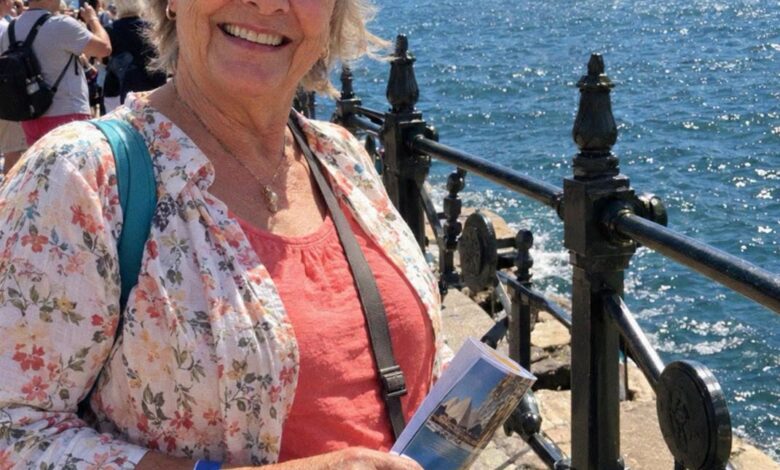
At 69, I Sold My House to Travel Around the World Despite My Children’s Protests – In Australia, a Man Invited Me to His Home for Coffee, but When I Walked Into His Living Room, I Froze
I stopped so suddenly in Arthur’s living room that my purse slipped from my shoulder. For a few seconds, I couldn’t hear the kettle in the kitchen. I couldn’t hear the clock ticking behind me. I could only stare above his fireplace. And for more than twenty years, I’d believed it was gone.
“Abigail?”
Arthur’s voice came from behind me. I turned. He was holding two coffee mugs. I pointed above the fireplace.
“Where did you get that?”
His face changed. That was when I knew this wasn’t some strange coincidence.
I had spent almost my entire adult life taking care of other people. A husband, four children, and then grandchildren. I worked as a school secretary for thirty-two years, packed lunches, picked up sick kids, loaned money whenever someone needed it but rarely got it back, and babysat whenever someone called.
After my husband, Robert, died twelve years ago, I became even more useful. That sounds bitter. Maybe it is a little. My children weren’t terrible people, but somewhere along the way, they became used to me always being available. If Karen needed someone to watch her boys, she called. If David was short on rent, he called. If Melissa needed help setting up a birthday party, she called. If Eric needed a ride from the airport, somehow I was always the first option. But weeks could pass without anyone calling just to ask how I was. My children rarely helped me. I told myself that it was normal. Families were busy.
After my husband died, I struggled for years to feel like myself again.
Then one Tuesday morning, I stood in my kitchen looking at a wall calendar covered with other people’s plans. My grandson’s soccer tournament. Melissa’s dentist appointment because I was watching her daughter. A reminder to transfer money to David. Nothing on that calendar belonged to me.
And I suddenly realized I was sixty-nine, and I’d spent most of my life waiting for “someday.” Someday we’d visit Italy. Someday I’d see Japan. Someday we’d go to Australia. Someday I’d sit in a café in Paris and order something I couldn’t pronounce. Robert and I had talked about traveling after retirement. Then he got sick. “Someday” ended before it started.
I made a major decision. I sold the house and booked a trip around the world.
My children reacted as if I’d sold a national monument. “You’re being selfish, Mom,” Karen said. “What about the grandkids?” Melissa asked. David was worse. “You’re seriously going to waste all that money traveling?” Then Eric snapped and said something I still remember perfectly. “That house was supposed to stay in the family.”
I stared at him. “It’s my house.”
He didn’t like that answer. When I refused to change my plans, Karen and David blocked my number. That hurt more than I let anyone see. But I stuck to my guns anyway. I told myself that while I could still walk through airports, carry my own suitcase, climb stairs without asking permission from my knees, and explore, I would see what I could. I wanted to do that one thing for myself.
Australia was my fourth stop. And that was where I met Arthur.
Arthur was seventy-one, widowed, gentle, and had the kind of dry humor that sneaked up on you. We met in Melbourne at a small second-hand bookstore. I reached for a detective novel at the same time he did. He looked at my hand over his.
“I suppose at our age, fighting over it would be undignified.”
“At our age?”
He smiled. “Fair point. You look thirty-five.”
“Now I know you’re definitely dishonest.”
Arthur laughed. We had coffee that afternoon, then another two days later. Then an afternoon walk through a garden where he spent twenty-five minutes arguing that roses were overrated.
“They’re needy,” he said.
“They’re flowers.”
“Exactly. Imagine being that demanding and not even paying rent.”
I laughed more around Arthur than I had in years. He loved jazz. So did I. We both also liked old movies and gardening. Arthur also read detective novels, grew tomatoes badly, and had been married to his wife, Anne, for thirty-eight years before she died. We didn’t pretend we were young and didn’t play ridiculous games. We talked about spouses we’d lost. Children. Regrets. Loneliness.
Once, over a late lunch, Arthur said, “Nobody warns you that grief gets quieter, but it doesn’t entirely leave.”
I knew exactly what he meant.
After several afternoons together, he invited me to his home. “I’ve got a whole shelf of old records you’d love,” he said. “Come for coffee, and I’ll show you.”
I trusted him.
Arthur’s house was warm and ordinary, filled with books, mismatched furniture, and family photos along the hallway.
“I’ll put the kettle on,” he said. “Make yourself at home.”
I stepped into the living room and froze. A painting hung above the fireplace. The painting was a cottage beside a lake with two pine trees leaning toward the water. A crooked wooden dock was also featured. And in the bottom right corner, almost hidden in the grass, were the initials “R.M.”
It was Robert’s painting. The one I thought had been destroyed. I knew every brushstroke. I’d watched him paint it. My hands started shaking.
Arthur put the mugs down. “Abigail, sit down.”
“No.” My voice sounded sharper than intended. “I need you to tell me where you got that.”
He looked at the painting. “From Robert.”
I stared at him. “What did you say?”
“Robert sent it to me.”
My first thought was that it was impossible. My second was worse. “You knew my husband?”
Arthur nodded. I felt the room shift.
“How?”
He sat slowly. “I was twenty-four. Robert would’ve been twenty-two or twenty-three. He came to Australia for almost a year.”
I knew my husband had traveled before we met. I knew he’d gone to Australia. But he’d rarely talked about it.
Arthur continued. “We initially worked together for a few months at a hotel outside Melbourne. Terrible place. Terrible pay.” A small smile crossed his face. “Robert was worse at carrying luggage than anyone I’ve ever seen.”
That sounded exactly like him. I finally sat. Arthur told me they became friends quickly. They traveled together on weekends, listened to records, played cards, and worked bad jobs. Robert painted whenever he could afford the supplies.
“That cottage,” Arthur said, pointing toward the fireplace, “was based on a place we stayed near a lake. He painted the first version there.”
“But he painted it after we were married.”
Arthur paused. “He painted it again.”
That confused me. Then he explained. Years after he painted the second version at home and it was destroyed, Robert created a third one from memory: the one hanging over Arthur’s fireplace. It wasn’t the exact painting I’d lost. It was a copy. That was why the details looked so familiar.
“Why would he send it to you?”
Arthur stood. “There’s something I need to show you.”
He left the room. My heart was pounding. When Arthur returned, he was carrying a wooden box. He placed it on the coffee table. Inside were letters, dozens of them. Every envelope had one sender written across the front. Robert.
I picked up the first letter. The return address was from our old house. My hands started shaking again. “How long were you two writing?”
“On and off for decades.”
I looked at Arthur. “Robert never told me.”
That hurt. Arthur saw it. “He wasn’t hiding an affair, Abigail.”
“I didn’t say that.”
“You thought it.”
I almost laughed. He was right. Arthur explained that after Robert returned to the United States, they wrote occasionally. Then life became busy. Marriage, children, and work. Years passed between letters. But when Robert became ill, he found Arthur online through an old friend. They started writing again.
“Why didn’t he tell me?”
Arthur looked at his hands. “Because most of what he wrote was about you.”
That stopped me. “Me?”
He nodded. Arthur took out one envelope. “He sent this with the painting.”
He handed it to me. The envelope was sealed. My name was written on it. I recognized Robert’s handwriting immediately, but I couldn’t open it yet. Instead, I asked, “Why do you have this?”
Arthur leaned back. “Because Robert asked me to keep it.”
“Indefinitely?”
“Yes.”
“Why?”
Arthur gave me a sad smile. “Because he hoped you’d visit Australia and go to that secondhand bookstore he told you about. I went there every day after I got Robert’s last letter, hoping to bump into you.”
I stared at him, mouth agape. Then he told me what Robert had written in his final letters. He’d worried about me. Not because I couldn’t manage money or I couldn’t live alone. But because I never seemed to believe I was allowed to choose myself.
“He said you gave everything away,” Arthur told me. “Time. Money. Energy.”
I looked down. “Robert said you were happiest when you were planning trips you never took.”
My throat tightened. Arthur continued. “Your husband wrote that his biggest regret wasn’t dying before retirement. It was that he helped you believe life could always be postponed.”
Tears ran down my face. I finally opened the envelope.
Robert’s letter was four pages long. I couldn’t read it all aloud without stopping, but one part broke me.
Abigail, if you’re reading this in Australia, then you’ve finally done something we’ve both been talking about since we were young. And if I’m not there with you, don’t turn the trip into a memorial for me. See things because you want to see them.
The letter continued. Eat food I would’ve hated. Stay too long somewhere beautiful. Leave somewhere boring early. Spend money on yourself without explaining it to anyone. The children love you, but don’t let loving them become the reason you never live without permission.
I covered my mouth. Arthur looked away to give me some privacy. Then I read the last paragraph.
I asked Arthur to keep this because Australia always felt like the place where my life became mine for the first time. Maybe it’ll do the same for you. And if Arthur is still around, make him buy the coffee. He still owes me twelve dollars.
I laughed through my tears. Arthur looked at me. “I wondered whether he mentioned that. Interest seems unreasonable after all these years.”
That made me laugh harder. I cried after that. Not the way I’d cried at Robert’s funeral. This was different. It felt like grief and relief sharing the same room. For over a decade, I’d carried a quiet guilt whenever I did something that would’ve been impossible if Robert were alive. Selling the house. Traveling alone. Enjoying myself. Part of me had wondered whether moving forward meant leaving him behind. And there he was, in his own handwriting, telling me to go.
Arthur and I sat talking until the coffee grew cold. He told me stories about Robert that I’d never heard. Robert falling asleep during a jazz concert, getting lost while insisting he knew exactly where he was, and trying to cook fish over a campfire before dropping it in the dirt.
“That sounds like him,” I said, giggling.
Arthur smiled. “Your husband talked about you constantly near the end.”
That surprised me. Then something dawned on me. “You knew I existed before we met.”
“Of course.”
“Then, when we met at the bookstore…”
“I didn’t know it was you.”
My married name wasn’t unusual, and Arthur hadn’t seen recent photos of me. Only after our second afternoon together, when I mentioned Robert and where we’d lived, did Arthur begin to wonder.
“Why didn’t you tell me immediately?”
“Because imagine you’re traveling alone in Australia and some strange man says, ‘By the way, I knew your dead husband and have been storing his letters for twelve years.’”
I smiled. “That would’ve been memorable.”
“I thought coffee was safer.”
“So you invited me here on purpose?”
“Yes.”
“Because of the painting.”
“Partly.”
I raised an eyebrow. Arthur looked almost embarrassed. “And partly because I wanted to see my best friend’s wife. The one he loved with all his heart.”
That changed the air between us. I looked down at Robert’s letter. My heart gave a stupid little flutter I hadn’t felt in years. Then he reached across the table and simply turned his hand palm-up between us. I looked at it for a second. Then placed mine in his.
I stayed in Australia three weeks longer than planned. Arthur showed me places tourists missed. We listened to records and ate terrible sandwiches near the beach. He took me to the lake where he and Robert had stayed as young men. The cottage was long gone; the water wasn’t. We stood on the shore together.
“I thought coming here would make me sad,” I said.
“Does it?”
“A little.” Then I smiled. “But not only sad.”
I didn’t cancel the rest of my trip. Instead, Arthur accompanied me for two stops. Then I continued alone.
Over time, my children slowly started calling again. Karen apologized first. Then Melissa admitted she’d been angry because my leaving forced her to see how much she’d relied on me. David took longer. Eric finally said, “I guess I thought the house meant you’d always be there.”
I told him, “I’m still your mother. I’m just not your furniture.”
We both laughed.
Arthur and I kept talking. Every day. Six months later, I returned to Australia. Not because Robert had subliminally sent me there, or because my children had pushed me away. I did it because I wanted to.
Arthur met me at the airport, holding a tiny cardboard sign that said: Abigail — coffee still owed!
I laughed so hard that I cried.
I still travel. Sometimes with Arthur. Sometimes alone. And the painting now hangs in the little apartment Arthur and I share part of the year. Below it, framed beside Robert’s letter, is a receipt from the first coffee Arthur bought me after I returned. Twelve dollars exactly.
At my age, I thought selling my house meant I was walking away from the life I’d built. I was wrong. I was finally walking into the part of it I’d kept postponing. And somehow, halfway around the world, I found a piece of the man I loved and one I never expected to befriend. For the first time in my life, “someday” wasn’t waiting for me anymore. I was already there.