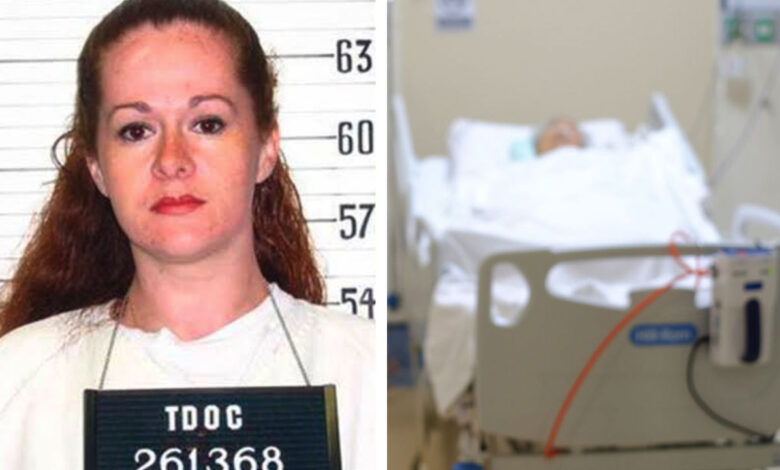
New update in Christa Pike case as what the botched execution did to her body comes to light
Tennessee’s top prison official is stepping down after Christa Pike’s botched execution on Wednesday.
Christa Pike was supposed to die on Wednesday, September 30, but two rounds of the lethal injection drug failed to kill her, and she was taken to an off-site medical facility.
Pike would have been the first woman executed in Tennessee in more than 200 years.
She was convicted of murdering 19-year-old Colleen Slemmer, a fellow Job Corps student, more than three decades ago.
Since the failed execution, Governor Bill Lee has paused all executions in the state for the rest of the year while an independent review looks into what went wrong.
Pike’s is the second botched execution in Tennessee this year, and now the head of the state’s prison system is leaving.
The commissioner steps aside
On Saturday, October 3, Governor Lee announced that Tennessee Department of Correction Commissioner Frank Strada is resigning. According to CNN, Strada said that stepping aside was in the state’s best interests.
His exit comes as investigators try to work out why the execution failed
Pike’s team had raised concerns well before the execution. In a lawsuit filed in January, her lawyers argued that her blood disorder, thrombocytosis, along with PTSD and small veins, made it “sure or very likely” she would suffer “unnecessary and superadded pain and suffering, terror, and disgrace.”
Dr. Joel Zivot, the anesthesiologist who backed the claim, wrote that the disorder “would very likely produce … bloody froth in (Pike’s) lungs.” Zivot is retained by her defense and openly opposes the death penalty.
Since the failed attempt, he’s said the outcome was “predictable.” He points out that doctors and nurses stay out of executions on ethical grounds, which leaves IV lines to untrained staff.
Pike’s lawyers say they warned the state and the courts about exactly this and were dismissed. Tennessee Attorney General Jonathan Skrmetti said Pike had “offered nothing but speculation,” and the state’s courts rejected her challenge.
Pike’s current condition
In an emergency motion filed Friday in Davidson County Chancery Court, Pike’s lawyers said her arms were swollen, burned and blistered by the time she reached the hospital.
According to the filing, the execution team spent more than an hour trying to get the IV line in and used at least seven needles. Her lawyers believe problems with the IV meant the drug, pentobarbital, leaked into the tissue around it instead of entering her bloodstream.
Before the second dose was given, Pike reportedly said her arm felt “like it’s about to burst open.”
Her lawyers say hospital staff are now working to save her life and flush the drug out of her system. They’ve asked a judge to order the state to preserve all evidence from the execution. An expedited hearing has been granted, but no date has been set
In May, Tony Carruthers’ execution was called off after the team punctured him more than a dozen times trying to establish an IV line.