Teen Wore a Dress to His Best Friend’s Funeral – Family Nearly Had Him Removed Before He Reached the Microphone
I almost had my son’s best friend removed from the funeral because of what he was wearing. Then he stepped up to the microphone, explained the reason behind his red dress, and changed the way everyone in the room remembered my son.
My name is Mrs. Harris, and seventeen days after my son Jack turned eighteen, we buried him.
Cancer took him from us after fourteen months of treatments, hospital visits, and desperate hopes that the next scan would bring better news. Even now, I struggle to describe those months. They were filled with fear, exhaustion, and moments of joy that felt precious precisely because we never knew how many more we would have.
Jack was more than his illness. He loved old horror movies, burned grilled cheese because he refused to cook it on low heat, and put ketchup on nearly everything despite claiming to hate tomatoes. He could name almost every capital city in the world, yet somehow never remembered to bring his laundry downstairs.
And for most of his life, his best friend, Theo, was right beside him.
The two boys had met when they were seven years old. Theo lived four houses away, and by the time they were ten, he was practically part of our family. He slept over so often that our spare bedroom eventually became known as Theo’s room.
His home life was complicated. His parents separated, reconciled, and separated again before finally divorcing. Their disagreements often made holidays difficult, so there were Christmases when Theo stayed with us because neither parent could decide where he belonged.
Jack never treated it as a big deal.
He would simply walk into the kitchen and announce, “Mom, Theo’s staying.”
He wasn’t asking permission. He was telling me what was happening.
And I always said yes.
When Jack became ill, Theo never abandoned him. He came over after school, sat on Jack’s bedroom floor doing homework, and watched terrible movies with him. He stayed through the hair loss, the difficult treatments, and the days when Jack either couldn’t bring himself to speak or talked nonstop because silence made him afraid.
Sometimes, Theo saw more of my son than I did. My husband, Daniel, and I worked opposite shifts to keep our jobs while spending as much time as possible at the hospital.
Theo never complained.
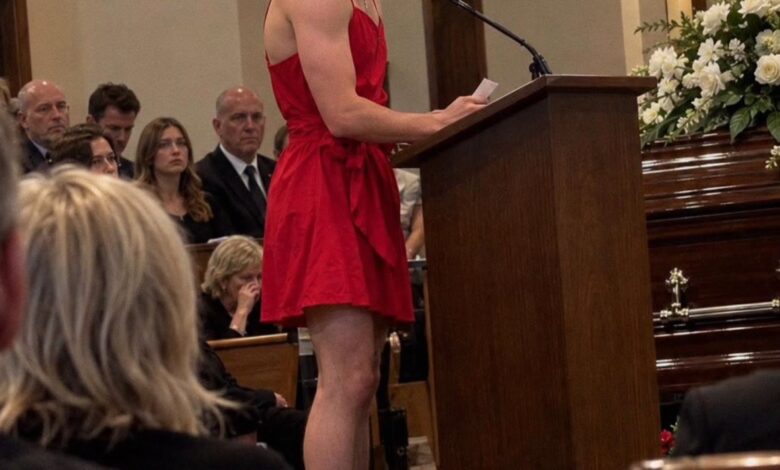
So when he arrived at Jack’s funeral wearing a bright red, knee-length dress, I didn’t know what to think.
The room was filled with black, navy, and gray clothing. Theo’s red dress stood out immediately. People turned to stare, and whispers traveled through the rows of mourners.
One of Daniel’s brothers muttered, “What the hell?”
My first thought embarrasses me now. I wondered whether Theo was trying to make the funeral about himself. Then I worried that perhaps something had happened between the boys before Jack died.
I leaned toward two of Jack’s school friends and quietly asked whether they knew of any argument.
They shook their heads.
“No, Mrs. Harris,” one whispered.
Theo sat alone near the aisle, his hands clenched tightly together. He looked nervous, almost as though he expected someone to tell him to leave.
When Daniel noticed him, his face tightened.
“What is he doing?”
“I don’t know,” I answered.
“This is Jack’s funeral.”
“I know.”
Daniel began to stand, but I caught his sleeve.
“Don’t.”
“He’s wearing a dress.”
“I can see that.”
“Why?”
I had no answer.
We were exhausted, heartbroken, and struggling to understand how our son’s funeral could have arrived so soon. Grief had left us with little patience for anything we couldn’t explain.
Then the time came for the eulogies.
I had almost forgotten that Theo was supposed to speak.
He stood and walked toward the microphone as the whispers followed him. For a moment, he simply looked at Jack’s coffin. Then he took a breath.
“About six months ago, Jack and I were watching this terrible movie in his room,” he began.
A faint smile appeared on his face.
“He said it was a classic. It was not.”
A few of Jack’s friends laughed softly.
Theo explained that Jack had just returned from another scan. The results had been difficult, and the doctors had begun discussing new treatment options and managing expectations.
Then Theo said something that made my heart stop.
“Jack asked me if I’d speak at his funeral.”
I looked at Daniel. He slowly sat back down.
Theo continued, his voice breaking.
“I told him to shut up. I was mad at him for even saying it.”
He laughed through his tears before explaining what Jack had said next.
“I told him, ‘I’ll speak at your funeral when you show up to mine wearing a dress.’”
Several people smiled.
Theo looked down at the red fabric.
“Jack said, ‘Fine. Then you have to wear one to mine.’”
He paused.
“Then he said it had to be red. Specifically red. He said black makes me look like an undertaker.”
A few people laughed, and someone behind me began crying.
Theo wiped his face.
“I told him there wasn’t going to be a funeral. I said he was going to get better.”
The room became completely silent.
“He said, ‘Probably.’”
I felt my hands begin to shake.
Jack had never told us about this conversation. He had asked whether his hair would grow back, whether he could still attend college, and whether we would let him travel if the treatment worked. He spoke about the future so often that I had convinced myself he believed in it as desperately as I did.
But six months before his death, my son had asked his best friend to make a promise about his funeral.
Theo explained that he had been frightened. He didn’t want to make the promise, because doing so meant acknowledging something neither boy wanted to face.
But he had promised.
Then Theo reached into the pocket of the dress.
“The stupid thing has pockets,” he said quietly. “Jack would have appreciated that.”
A small laugh passed through the room.
Theo pulled out a folded piece of paper.
“This is why I didn’t just ignore him. Jack wrote it down.”
He looked toward me.
“Mrs. Harris, I’m sorry. I should have told you before today. I just couldn’t.”
Then he unfolded the note and began to read.
“Jack wrote, ‘Theo, if you’re reading this because I died, first of all, that’s embarrassing for me.’”
This time, the laughter was real, even through the tears.
That sounded exactly like my son.
Theo continued.
“‘Second, you promised. Red dress. Don’t chicken out just because my relatives are judgmental.’”
Daniel made a sound that was half laugh and half sob.
Then Theo read the next line.
“‘Third, don’t let my funeral be the first time you lie to me just because I’m not there to call you out.’”
He lowered the paper.
“I almost didn’t come,” he admitted.
He told us his father had warned him not to wear the dress. His mother worried that people would misunderstand, and his sister had told him he was being ridiculous. But his sister had given him the dress anyway.
Theo looked at me.
“I didn’t want to upset you.”
Those words broke my heart.
He had been sitting just a few feet away, terrified of hurting us, while I had been wondering whether he should be removed from the funeral.
I stood and walked toward him.
For one terrible second, he seemed to think I was coming to take him away from the microphone.
Instead, I wrapped my arms around him.
He was taller than me now. I couldn’t remember when that had happened. I had known him since he was a little boy with missing teeth, and now he was standing in front of me, trembling with grief.
He folded into my arms and began to sob.
“I’m sorry,” he whispered.
“No.”
“I should have told you.”
“No.”
“I didn’t mean to make today worse.”
“You didn’t,” I told him.
I held the back of his head, just as I had done when he was a child.
“Finish it.”
He pulled away slightly.
“Are you sure?”
“Finish what Jack asked you to say.”
I returned to my seat beside Daniel, who was now crying openly.
Theo looked at his note, then folded it carefully.
“I actually wrote a eulogy,” he said. “Seven pages.”
Someone among Jack’s friends called out, “Jeez, Theo.”
Theo laughed.
“Exactly. Jack would have hated it.”
He put the pages aside and decided to speak from the heart instead.
He told stories about their childhood: the time they broke our garage window with a hockey puck and spent hours inventing increasingly ridiculous explanations, eventually blaming a bird. When Daniel asked what kind of bird could carry a hockey puck, Jack had answered, “A strong one.”
Theo described Jack cheating at Monopoly and claiming it wasn’t cheating because the bank had insurance. He remembered their first day of high school, when Theo had a panic attack in the bathroom and Jack sat outside the stall pretending they were deliberately skipping class.
Then his voice softened.
“When Jack got sick, everybody started calling him brave,” Theo said. “He hated that.”
I remembered Jack telling me that if one more adult called him brave while putting a needle in him, he might become violent.
Theo continued.
“Jack said being sick wasn’t brave. It was just happening to him.”
He paused and looked toward the coffin.
“But I think there was one thing he was brave about. He knew something most of us weren’t willing to know.”
I closed my eyes.
“He knew he might die,” I whispered.
The words hurt, even though we had already buried him.
Theo nodded.
“And somehow, he still spent half his time trying to make everyone else less afraid.”
Then he touched the red dress.
“This wasn’t Jack making fun of me,” he said. “Okay, it was partly Jack making fun of me. But mostly, I think he wanted one last thing he could control.”
That was when I finally understood.
Cancer had taken so much from Jack. His school, his hair, his appetite, his privacy, and the future he had imagined for himself. Eventually, it even took away his ability to walk without help.
But this was something he had chosen.
A red dress. A promise. One last joke shared between two best friends.
Theo finished by looking down at himself.
“I hate it.”
From the back of the room, his sister called, “You look great!”
The room erupted in laughter.
Even I laughed.
Theo shook his head, smiled through his tears, and looked at Jack’s coffin one last time.
“You win, idiot.”
Then he stepped away from the microphone.
After the service, something remarkable happened. The same people who had stared at Theo when he arrived now approached him to offer their condolences and tell him how beautiful his tribute had been.
Daniel’s brother was among the first.
“Theo,” he said awkwardly.
Theo looked nervous again.
“I owe you an apology,” my brother-in-law continued. “I judged you before you even sat down.”
Theo shrugged.
“It’s okay.”
“No,” Daniel’s brother replied, looking toward Jack’s coffin. “It isn’t.”
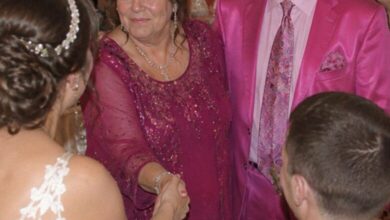
He held out his hand, and Theo shook it.
Others followed. Some hugged him. Some told him Jack would have loved what he had done. One elderly aunt admitted that she still didn’t understand the dress but thought his speech was beautiful.
Theo answered with a small smile.
“Honestly, that’s fair.”
For the first time that day, I saw the boy I had known for so many years.
Later, after most of the guests had moved to the reception hall, I found Theo standing beside the photographs we had displayed of Jack.
One photograph showed the two boys at eight years old, covered in mud, missing their shoes, and grinning like they had just gotten away with something.
Theo stood beside me.
“I need to tell you something,” he said.
I turned toward him.
“Jack didn’t want you to know.”
My stomach tightened.
“Know what?”
“That he thought he was going to die.”
I stared at the photograph.
Theo hurried to explain that Jack hadn’t hidden his fears because he didn’t trust us. He believed his parents needed hope.
“He said you and Mr. Harris needed hope,” Theo told me.
That hurt in a way I couldn’t explain.
“He was the sick one,” I whispered.
“I told him that.”
“What did he say?”
Theo smiled sadly.
“He said, ‘Yeah, but Mom’s dramatic.’”
I laughed through my tears.
“That little jerk.”
“He loved you,” Theo said.
“I know.”
Then he told me something I have never forgotten.
“Jack wasn’t pretending to be hopeful. He wanted college. He wanted to travel. He really thought treatment might work. He just knew it might not.”
Both things could be true.
Hope and fear could exist together.
My eighteen-year-old son had somehow learned that before I did.
I asked Theo whether Jack had talked about dying often.
“Maybe three times,” he answered.
“Was he scared?”
Theo didn’t respond immediately.
That silence told me more than any easy reassurance could have.
“Yes,” he finally said.
I started crying again, and Theo put his arm around me.
“He wasn’t scared all the time,” he said gently.
“Thank you for not lying.”
He nodded.
“I promised him that too.”
For a while, I struggled with the way people remembered Jack’s funeral. The red dress became part of the story, and I worried that my son’s life would be reduced to a strange tale about his best friend wearing something unexpected.
But with time, I began to understand.
The dress wasn’t really about Theo. It wasn’t even just about the joke.
It was proof that Jack had remained himself, even when death was close enough for him to see it. He was still sarcastic, funny, stubborn, and determined to make his best friend uncomfortable.
He was still thinking six months ahead about how to deliver one final punchline.
Theo returned the dress to his sister the next day. She refused to take it back, saying it had “funeral energy” now, so he kept it.
Years passed.
Theo eventually graduated from college, and Daniel and I attended the ceremony. We sat beside his mother, and afterward, Theo approached us in his cap and gown and hugged us both.
Then he whispered, “I considered wearing red.”
Daniel shook his head.
“Don’t push your luck.”
Theo laughed, and for a moment, everything felt lighter.
For his graduation, we gave him one of Jack’s watches. It wasn’t expensive. It was simply the black watch Jack had worn almost every day before treatment made his wrists too thin.
Theo stared at it for a long time.
“I can’t take this.”
I closed his hand around it.
“Yes, you can.”
He cried.
So did I.
We do that less often now, but grief never really disappears. It changes shape. Some days, Jack feels far away. Then I remember one of his ridiculous phrases, and suddenly, he is beside me again.
I still think about the moment Theo entered the funeral home: the staring, the whispers, Daniel beginning to stand, and my own suspicion.
For several minutes, almost every adult in that room believed we understood what we were seeing.
We didn’t.
We saw a teenager in a red dress at his best friend’s funeral and invented explanations before giving him a chance to speak.
Theo knew people would judge him. Jack had predicted it months earlier.
That may be the most remarkable thing about the entire story.
There was one final line in Jack’s note that Theo hadn’t read at the funeral. He showed it to me later.
Beneath the warning about judgmental relatives, Jack had written:
“If Mom looks mad, give her thirty seconds. She’s nice when she has all the information.”
I stared at the words for a long time.
Then I told Theo that Jack had given me far too much credit.
Theo smiled.
“No. He knew you.”
Perhaps he did.
Today, when I think about my son’s funeral, I don’t remember only the dress or the whispers. I remember a boy who was dying and still believed that people could become kinder if they were given enough truth and enough time.
That day, because of Theo, we did.
And I learned a lesson I wish I had understood sooner: sometimes, the thing we judge most quickly is the very thing we understand least.
Before you decide what someone’s actions mean, give them the chance to tell you why. You may discover that what first looked strange or hurtful was actually an act of love, loyalty, and courage.