After 42 Years, They Gave My Mother a $10 Gift Card—Then Hundreds of Her Former Students Returned to Show Her What She Was Really Worth
**After 42 Years, They Gave My Mother a $10 Gift Card—Then Hundreds of Her Former Students Returned to Show Her What She Was Really Worth**
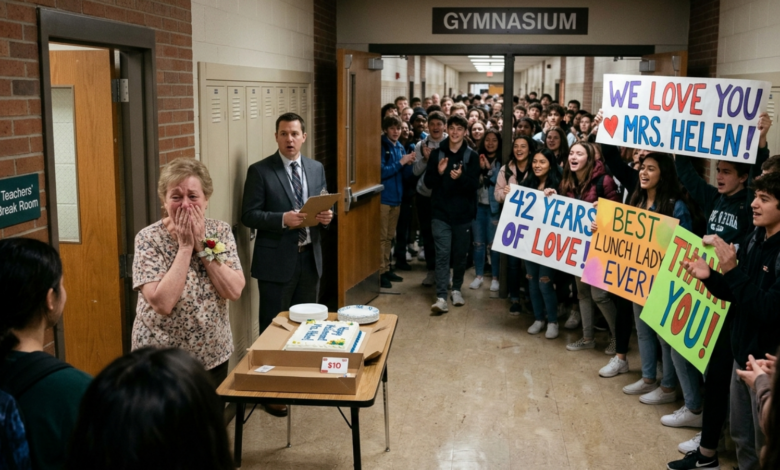
For forty-two years, my mother—Miss Bernie—stood behind a cafeteria counter. She wore a white apron, remembered names, and quietly made sure no child left hungry or invisible. On the day she retired, the school gave her a cheap grocery-store cake with misspelled blue letters and a ten-dollar gift card.
Then the hallway filled with people.
### The Gathering
Daniel Brooks, now a doctor, spoke first. His voice cracked as he recalled the meals she set in front of a hungry teenager: mashed potatoes, chicken, green beans, a dinner roll. “She said that every time. Every single time I was hungry.” He held up a faded photograph of himself at a cafeteria table beside the woman in the white apron. “I became a doctor because somebody made me believe I was worth taking care of before I had anything to offer the world.”
One by one, others stepped forward.
A nurse whose mother was in prison. A woman who had moved through foster homes. A firefighter who tried to repay the lunch money she had covered and was told to take his own mother to dinner instead. A construction-company owner who once arrived with blue fingers and left with warm gloves. An accountant who discovered, years later, that the “school fundraiser” that paid for her class trip had never existed. A sergeant who carried her words overseas through the darkest nights: “You don’t have to be strong every minute of every day. Just don’t give up on yourself.”
Nearly every hand in the crowded hallway rose when bank president Thomas Caldwell asked who Miss Bernie had once helped with a meal, a crisis, or something they were too ashamed to ask anyone else for.
### The Proposal
Caldwell opened a folder. Alumni, local businesses, and Daniel’s hospital had been working for months. They were establishing the Miss Bernie Student Meal and Opportunity Fund—emergency meals, school supplies, transportation help, scholarships, and paid internships. The bank would provide seed money. The hospital would support students interested in healthcare careers. And they wanted Miss Bernie herself, not as an unpaid volunteer, but as a paid community adviser with flexible hours so no student in the town would feel invisible.
“You don’t have to say anything today,” Caldwell told her. “You’ve already said enough with forty-two years of actions.”
Daniel handed her a thick envelope of letters—handwritten notes, emails, photographs—collected over decades. On the first page: “To the woman who made sure we never went hungry.”
### What Followed
The story spread. A video of the gathering circulated. The local news ran the headline. The school board held an emergency meeting. The planned switch to vending machines was reconsidered. Dr. Whitfield, the principal who had offered the ten-dollar card and the remark that “nobody is irreplaceable,” issued a public apology.
When a reporter asked whether he should lose his job, Mom answered simply: “No. I think he should learn something… People make mistakes. What matters is whether they become better after they realize they’ve hurt someone. But he should also understand that saving money means nothing if the children who need us are the ones who suffer.”
Two months later the gymnasium filled. A wooden plaque was unveiled:
**THE MISS BERNIE STUDENT CARE FUND**
*No student should ever have to choose between hunger and dignity.*
Donations reached $425,000. The fund began operating under one non-negotiable rule Mom insisted upon: no child would ever have to stand in a special line.
### A Year Later
Mom officially retired, yet she still visited the school twice a week as adviser. One ordinary Monday she noticed a thin boy staring at the food, sleeves too short, backpack worn. She walked over the same way she always had.
“Hello, sweetheart. What’s your name?”
“Ethan.”
“Have you tried the chicken today? … And if you like the mashed potatoes, you can have a little extra. The cook made plenty today.”
“Do I have to pay?”
“No, sweetheart. You just have to eat.”
She sat nearby and talked about the weather and his classes until his shoulders relaxed.
That evening I asked her why she had never told me how much of her own money she spent over the years. She never kept track. She only knew what it felt like to worry whether there would be enough food tomorrow, and she recognized the same quiet signs in the children who drank water to fill their stomachs or said they weren’t hungry because they knew they couldn’t pay.
### The Graduation Speech
On the second anniversary of her retirement she stood before a new class of graduates without notes.
“Some of you will become doctors… Some of you may have difficult days… If that happens, please remember that your life is not decided by your hardest day. You don’t have to become rich or famous to matter. You don’t have to wait until you’re successful to be kind… Sometimes, making a difference means sharing your lunch. Sometimes it means sitting beside someone who is having a terrible day and letting them know they don’t have to face it alone.
“For forty-two years I served lunch in this school. I thought I was just feeding children. Then one day hundreds of those children came back and reminded me that we had been taking care of one another all along.”
The gym rose to its feet.
As for the ten-dollar gift card, Mom eventually used it. She bought herself a cup of coffee and a blueberry muffin. Then she took the remaining balance and bought breakfast for a young man outside the shop who was counting coins in his palm.
When I asked why, she laughed.
“Well, sweetheart, I had more than enough.”
That was Miss Bernie. She had always believed there was enough to share. Sometimes all it took was one person willing to prove it.