A Viral Four Countries Military Operation Story Is Fictional
A Facebook reel says that four countries have joined forces to attack. The title attached to the video sounds like a news bulletin. The article in the author’s comment explicitly calls the scenario fictional. Its own text calls the report imaginary and does not identify four real governments that announced the operation described.
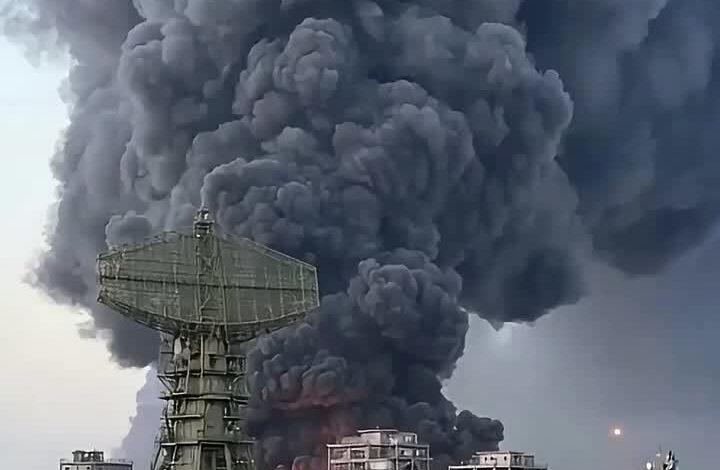
The distinction is visible in the material the publisher chose to attach to the post. The reel uses a format associated with live news, with a red badge, a headline and footage of smoke. Such elements can make an edit resemble a broadcast. The link, however, asks the reader to interpret the accompanying story as an invented scenario. Its references to regional tension and military coordination are part of that scenario.
The account gives readers a broad outline instead of names and dates. It says that four nations agreed to act together following emergency meetings. It describes governments watching the results and suggests that the event could reshape international relations. Because it does not identify participants or announcements, it provides no bridge from those details to an actual operation taking place on a particular day.
The lack of names is particularly important in a story about multiple governments. A verified report would help readers identify which governments announced a common action, what each said it was doing and where those announcements can be checked. Real events can develop before every detail is available, but the public account should still give readers enough information to distinguish a documented event from general speculation.
A prominent visual can create its own impression about the place where an event occurred. A viewer may see a large cloud of smoke and assume the camera captured the operation in the headline. The source does not identify the origin of the clip or connect the image with the events in the fictional article. The fiction label addresses the story as written. Any separate claim about the footage would need evidence about its origin.
The reel and the author’s link travel differently. People can forward only the reel, take a screenshot or see the video without opening the comment that contains the article. The qualifier may therefore be missing when the clip reaches a new audience. A reader who has both parts can make the connection clear by explaining how the publisher describes the article.
There may be other online posts that use similar wording to discuss genuine tensions in a specific region. Similar wording does not make them evidence for this one. Each post needs to be checked against its own source. A claim about four named countries can be examined by checking reports or statements involving those particular countries. Here the source does not provide identities to check.
The Facebook clip can be understood as an illustration paired with a fictional scenario. The wording in the author’s linked article is the basis for that reading. Viewers can accurately describe the post and its visual style without treating it as proof that four governments announced a real attack. The attached article describes an imagined event and offers no documentation of the operation promised by the headline.