He Gave Part of His Liver to Save His Father Then a Tragic Twist Changed Everything
The kitchen clock in the Miller household did not tick; it hummed—a low, rhythmic vibration that sounded like a slowing heartbeat. For Marcus, that sound had become the backdrop of his twenty-fourth year, counting down moments he feared were running out. Sitting across from his father, David, at the battered oak table, Marcus watched the older man struggle to lift a simple glass of water. David’s hands, once strong enough to frame houses and haul timber without a moment’s pause, trembled violently now. His skin carried the dull, mustard-yellow tint of late-stage liver failure, and his eyes, once sharp and commanding, were now clouded with a perpetual glaze of exhaustion.
“You don’t have to look at me like that, son,” David rasped, his voice sounding like dry leaves scraping across concrete. He forced a weak, reassuring smile, setting the glass down before he spilled it onto the faded tablecloth. “I’m still here, you know. Still breathing.”
“I know Dad,” Marcus replied softly, running a tired hand through his dark hair. “I just… I wish the doctors had better news today. It feels like every appointment is just another delay.”
The news from the regional clinic had been devastatingly clear: David’s name was on the national organ transplant registry, but time was a luxury he no longer possessed. Without a living donor willing to share a portion of their liver, David had less than six months to live. Every passing week brought increased swelling, fluid buildup, and cognitive fatigue.
In the doorway stood Evelyn, Marcus’s stepmother. She folded her arms across her silk robe, her face a carefully crafted mask of sorrow. Evelyn had married David six years ago, after Marcus’s biological mother had passed away following a long illness. While she had always maintained a polite demeanor toward Marcus, there was an undeniable coldness beneath her polished exterior—a quiet, calculating distance that Marcus had never quite managed to breach.
“We have to stay positive,” Evelyn said, stepping into the room and placing a manicured hand on David’s frail shoulder. “God provides, David. You know that. We just need to pray for a miracle and trust the medical system.”
Marcus looked from his stepmother to his father. Praying wasn’t going to save David’s life. Science, surgery, and human sacrifice would.
Later that night, as heavy storm clouds gathered over the small town, Marcus sat alone in his bedroom, staring at the medical forms spread across his desk. The risks of living organ donation were laid out in stark, unyielding black ink: infection, severe bleeding, organ failure, permanent damage, and, in rare cases, death. The doctors had been brutally honest during his preliminary consultation earlier that week. A living liver donation required removing up to 60 percent of his healthy organ. The recovery would be brutal, painful, and long. He would be off work for months, unable to lift heavy objects or push his body.
Yet, as Marcus looked at a dusty photograph on his bookshelf—a picture of his father carrying him on his shoulders at a county fair years ago, laughing against a clear blue sky—the choice felt already made. His father had sacrificed everything to raise him alone after his mother died, working eighty hours a week so Marcus could go to college without debt. How could Marcus hesitate now when he had the power to give his father life?
A soft tap on his door interrupted his thoughts. Evelyn slipped into the room, closing the door quietly behind her. Her eyes scanned the medical documents on his desk before settling on his face.
“You’re really thinking about doing this, aren’t you?” she asked, her voice hushed.
“He’s my father, Evelyn. If I’m a match, I have to,” Marcus said firmly, picking up a pen.
Evelyn watched him for a long moment, a complex emotion flitting across her face—something that looked dangerously like calculating hesitation before it vanished behind a mask of maternal concern. “It’s a noble thing, Marcus. Truly noble. But you must understand… if anything happens to you, or to him… everything changes. The house, the business, the family estate… surgery carries financial risks too, Marcus. If you undergo this, you must promise me you won’t let your emotions cloud your judgment about the future.”
Marcus frowned, struck by the odd, transactional turn of her words. Why was she talking about property and legal estates at a time like this?
“I only care about keeping my dad alive,” Marcus replied sharply, meeting her gaze.
Evelyn gave a slow, deliberate nod, stepping back toward the door. “Of course. We all do. Just… think carefully, Marcus. Once you give a piece of yourself away, you can never ask for it back.”
As the door clicked shut, Marcus looked back at the papers. He picked up his pen and signed his name on the consent line. But deep down, Evelyn’s parting words chilled him far more than the impending surgery ever could.
The fluorescent lights of Saint Jude Memorial Hospital were blindingly bright, casting a sterile, uncompromising glare over the pre-operation holding room. The smell of antiseptic, heavy scrubbing soaps, and rubbing alcohol hung thick in the air, stirring a knot of apprehension in Marcus’s stomach. He lay prone in his hospital gown, his arm hooked to a cold IV line that steadily dripped saline into his veins. Every time the plastic tube jostled against his skin, it reminded him that his reality had narrow boundaries now—bounded by hospital walls and the ticking clock of his father’s failing health.
In the bed directly beside him sat David. For the first time in months, a faint, genuine glimmer of hope illuminated his father’s sunken, yellowed eyes, though his physical frailty was agonizingly obvious. His shoulders were sloped, his hands trembled continuously, and his chest heaved with every laborious breath.
“Marcus,” David whispered, leaning sideways over his bed rail as far as his monitors and IV tubes would allow. “You don’t have to do this, son. I’ve lived a good, full life. I’ve watched you grow into a strong, honorable man. You have your entire future stretching out in front of you. Don’t risk it for a fading old man.”
Marcus reached across the narrow gap between their beds, gripping his father’s frail, calloused hand firmly. The skin was paper-thin and dry, but the heartbeat pulsing through David’s wrist was real, and Marcus clung to it.
“Dad, stop talking like that,” Marcus insisted softly, his tone resolute. “You raised me on your own after Mom died. You skipped meals so I could have sneakers. You broke your back so I could have an education. This isn’t a sacrifice; it’s an honor. We do this together, and we walk out of this hospital together.”
David’s eyes welled with tears, a single droplet spilling over his hollow cheek as he squeezed his son’s hand back. “I don’t deserve a son like you, Marcus. I really don’t.”
The heavy double doors swept open, and Dr. Harrison, the lead transplant surgeon, stepped into the room holding a glowing digital tablet. He was accompanied by two senior surgical nurses in pale green scrubs. Dr. Harrison was a tall, silver-haired man whose calm, steady demeanor immediately commanded confidence.
“It’s time, gentlemen,” Dr. Harrison stated, reviewing their final bloodwork screens. “Marcus, your vitals are exceptional. Your liver tissue is young, dense, and an absolute perfect genetic match for your father. We’ll be removing approximately 60 percent of your right lobe. If all goes smoothly, both your liver and his will undergo cellular regeneration, returning to near-full capacity within four to six months.”
“And if complications arise?” Marcus asked, feeling the cold weight of mortality sink into his chest.
Dr. Harrison paused, looking Marcus squarely in the eyes with absolute honesty. “Major organ resection always carries inherent danger, Marcus. We are talking about potential internal hemorrhage, bile duct leaks, systemic infection, or sudden vascular blockage. But we have an elite surgical team staged in OR 4. You are giving your father the ultimate gift of life. Hold onto that courage.”
Out in the glass corridor, Evelyn stood watching the preparation. She was dressed impeccably in a tailored dark blazer, her fingers tightly interwoven over her designer handbag. When Marcus looked through the pane and caught her eye, she gave him a brief, practiced nod. There were no tears in her eyes, no anxious pacing—just a cold, calculating gaze that chilled Marcus to the bone. Next to her stood Richard, David’s younger brother and business partner. Richard looked visibly flushed, shifting his weight nervously from foot to foot as he leaned down to whisper frantically into Evelyn’s ear.
“Time to roll,” the head nurse called out gently, unlocking the caster wheels on Marcus’s bed.
As the bed began to move backward toward the surgical suite, Marcus held his father’s gaze for as long as he could. “I love you, Dad! See you in recovery!”
“I love you, Marcus!” David shouted back, his voice breaking under the weight of tears. “God keep you safe, my son!”
The heavy steel doors slammed shut, sealing Marcus inside the sterile world of Operating Room 4. The room was freezing, dominated by massive overhead lights and arrays of glowing cardiac monitors. The surgical team moved around him with robotic precision, strapping down his arms, placing heart monitors over his chest, and placing an oxygen mask firmly over his face.
“Take a deep, slow breath for me, Marcus,” the anesthesiologist whispered, her voice echoing as she adjusted the gas flow valves. “Count down backwards from ten. Think about somewhere peaceful.”
Marcus closed his eyes. He pictured his father’s woodworking workshop back home, bathed in golden sunlight, filled with the clean aroma of fresh pine sawdust and warm laughter. As the heavy chemical darkness pulled him under, the last sound he heard was the steady, rhythmic beep… beep… beep… of his heart monitor. He was completely unaware that as he slipped into unconsciousness, a cold, calculated betrayal was already taking root in the corridor outside.
Pain was the first thing that returned to Marcus—not a sharp, clean pain, but a deep, throbbing agony that felt as though a hot iron was pressed firmly against his lower abdomen. He tried to draw a breath, but his lungs burned, restricted by thick surgical bandages wrapped tightly around his torso. When he forced his heavy eyelids open, the ICU was a blurry smudge of white walls, flickering monitors, and hanging IV bags.
“He’s waking up,” a soft voice murmured. Nurse Sarah adjusted the dosage on his IV pump. “Easy, Marcus. Don’t try to move or sit up.”
“My dad…” Marcus gasped out, his throat dry and raw from the breathing tube that had just been removed. “How… how is my dad?”
“The surgery was long, Marcus,” Dr. Harrison said, stepping into view with a solemn expression. “Your father survived. The liver graft took well, and his vitals are stabilizing rapidly. Your sacrifice saved his life.”
Marcus let out a ragged sigh of relief, closing his eyes for a moment. “Thank God…”
“However,” Dr. Harrison continued, his tone dropping into a grave silence, “your own recovery has hit a severe, unexpected complication. During the resection, your remaining liver tissue suffered a massive vascular thrombosis—a sudden blood clot that cut off crucial oxygen supply. The tissue damage is extensive. Your remaining liver isn’t regenerating. You are entering acute liver failure. Unless your remaining tissue recovers or you receive another transplant, you will not survive.”
The irony was a physical blow. He had given his father a future, only to have his own ripped away in a matter of hours.
“Where is my family?” Marcus managed to ask, his voice barely a whisper. “Where’s Evelyn? Where’s my uncle?”
“Your stepmother came by briefly,” Dr. Harrison said with visible hesitation. “She was informed of your condition. But… she left with your uncle Richard, stating they had urgent legal and financial matters regarding your father’s estate and business affairs.”
A sickening dread settled in Marcus’s stomach. They knew he was dying, and they had walked away.
Two days passed in a haze of terrifying fevers, relentless nausea, and suffocating isolation. Neither Evelyn nor Uncle Richard returned. Every time Marcus asked about his father, he was told David was still too weak in the step-down unit to be informed about Marcus’s condition. “If we tell David his son is dying because of his organ, the psychological shock could trigger acute organ rejection,” Dr. Harrison explained. Marcus was trapped in a silent, agonizing nightmare.
On the third evening, Evelyn stepped into his darkened room holding a sleek leather folder. There was no warmth in her eyes—only a cold, transactional resolve.
“David is resting,” she said softly, closing the door. “The doctors say he’s making a full recovery.”
“I’m dying, Evelyn,” Marcus rasped, staring at her through yellowed, jaundiced eyes. “Did you look into living donor options? Did you tell anyone? Did you file the emergency paperwork?”
Evelyn sat down calmly in the visitor chair. “Marcus… organ transplants cost hundreds of thousands of dollars. The family business is heavily in debt, and Richard discovered David took out massive loans. Trying to secure another donor and paying for an emergency ICU transplant would bankrupt everything your father built. It would leave David with nothing to live on.”
Marcus stared at her, disbelieving. “You’re letting me die? For money?”
“We are simply letting nature take its course,” Evelyn replied smoothly, pulling a legal document from the folder. “Your father signed over his healthcare power of attorney to me months ago during his early diagnosis. If you become incapacitated, decisions fall to me and Richard. This is a waiver releasing the estate from financial liability for ongoing experimental treatments. Sign it, Marcus. Make it easier for your father.”
In that moment, the terrifying truth revealed itself: Evelyn wasn’t just standing by—she was actively cutting away any heir who stood between her and sole control of the family fortune.
With what little strength he had left, Marcus shoved the pen off the bed, letting it clatter across the floor. “Get out!” he choked out, his chest heaving. “Get the hell out of my room!”
Evelyn picked up the pen calmly, adjusting her jacket. “You’ll slip into a hepatic coma soon, Marcus. Think about what’s cleanest for David.”
As she slipped out the door, leaving it slightly ajar, Marcus stared at the nurse call button hanging near his pillow. Forty-eight hours. If he was going to die in this bed, he wasn’t going down without a fight. He slammed his thumb down on the red button and held it.
Nurse Sarah rushed into the room, alarmed by the continuous emergency signal flashing on her monitor board. “Marcus! What’s wrong? Are you in pain?”
Marcus reached out, gripping her wrist with surprising force despite his trembling hands. “Sarah, please listen to me. Don’t call the doctors yet. Just listen.”
Sarah paused, startled by the sheer desperation in his bloodshot yellow eyes. “Marcus, your pulse is racing—”
“They’re lying to my father,” Marcus whispered, tears of rage and fear running down his sunken cheeks. “Evelyn… my stepmother. She’s keeping him isolated and refusing to let doctors look for a living donor for me because she wants the estate. She just came in here and tried to force me to sign a liability waiver.”
Sarah stared at him, horror slowly replacing her professional composure. “Marcus… that’s a serious accusation.”
“Look at my charts, Sarah!” Marcus rasped, his voice breaking. “Has anyone placed my name on the UNOS emergency donor search list? Has anyone contacted regional transplant networks?”
Sarah’s face went pale. As an experienced ICU nurse, she knew protocol required an immediate emergency national appeal filed by the primary healthcare proxy when a living donor experienced primary graft failure. But no such paperwork had crossed her desk. Evelyn had deliberately blocked the medical team from taking action.
“She told me I have two days,” Marcus choked out. “My dad doesn’t know I’m dying for him. Please, Sarah… you have to help me tell him. Or help me find someone who will listen before it’s too late.”
Sarah stood frozen, torn between hospital hierarchy and the dying young man gripping her arm. She reached into her pocket and pulled out her personal smartphone. “I didn’t become a nurse to watch someone get murdered by neglect,” she whispered. “Who do we call?”
“Call Arthur Vance,” Marcus gasped. “He’s my father’s corporate attorney… and his oldest friend. His number is in my phone in the drawer.”
While Sarah made the urgent call from the hallway, news of the donor’s deteriorating condition began to spread quietly among the ICU staff. Within two hours, Arthur Vance arrived at the hospital, accompanied by an independent medical advocate and a court representative. When Vance reviewed the legal filings and realized Evelyn had been actively suppressing medical requests while attempting to liquidate company shares, his fury was absolute.
The next morning, early sunlight filtered through the blinds of Room 412, where David sat in a wheelchair near the window. His color had returned, and his breathing was clear, though he was visibly anxious.
The door opened, and Evelyn walked in carrying fresh flowers. “Good morning, sweetheart,” she smiled, kissing his cheek. “You look so much better today.”
“Where is Marcus?” David asked, his brow furrowed with deep anxiety. “I’ve asked the nurses three times today. Why haven’t I seen my son?”
“He had a slight fever, David,” Evelyn lied smoothly, setting the flowers on the counter. “The doctors just want to make sure he doesn’t contract an infection before he visits you. He’s fine, just resting.”
Before David could question her further, the door swung open wide. Dr. Harrison entered, flanked by two uniformed hospital security officers and Arthur Vance.
Evelyn froze, her hand pausing mid-air. “Arthur? What are you doing here?”
Arthur walked straight to David, placing a heavy, supportive hand on his old friend’s shoulder. “David… I received a urgent call at two o’clock this morning from your son’s nurse. And then I spent the rest of the night uncovering what your wife has been doing behind your back.”
“What are you talking about?” David asked, his voice rising in sudden panic. “Is Marcus okay? Tell me!”
“No, David. He isn’t,” Dr. Harrison spoke up grimly. “Marcus suffered severe post-operative vascular complications. His remaining liver is failing, and he is in critical condition in the ICU.”
David’s breath caught in his throat, his face draining of color. “What?! Why wasn’t I told?!”
“Because your wife claimed she had full power of attorney and instructed us that you were too emotionally unstable,” Dr. Harrison revealed. “She explicitly refused to sign the authorization allowing us to place Marcus on the Emergency Donor Registry.”
David turned to Evelyn, his face a horrifying mix of betrayal and shock. “Evelyn… tell me this isn’t true.”
Evelyn backed away toward the wall, her calm, polished facade fracturing into sheer panic as the cold reality of her exposure caught up with her. “David, listen to me! I did it for us!” she shrieked, her voice thin and desperate. “The medical costs for a second emergency operation would have destroyed everything! The hospital fees, the donor logistics, the specialized ICU teams—it would have drained the business completely! We would have been left homeless, penniless, with nothing to live on!”
“He gave me half his organ!” David roared, a sound so thunderous and agonizing that it echoed off the concrete walls and reverberated down the surgical corridor.
Ignoring the sharp pulls in his fresh abdominal incision, David forced himself up out of his wheelchair. He trembled violently with a volatile mixture of rage, physical weakness, and profound sorrow. He stood tall, towering over Evelyn as she cowered against the medical cabinets.
“He cut himself open to keep me breathing, and you tried to let him rot in the dark for money?!” David spat, his tears streaming uncontrolled down his cheeks. “You aren’t a human being, Evelyn. You’re a monster.”
“David, please, let me explain—”
“Arthur,” David rasped, turning his tear-streaked face toward his lifelong friend and attorney. “Revoke every legal power, every proxy, and every privilege this woman holds over my life, my estate, and my family. Call the state prosecutors. Call the police. Do whatever it takes to ensure she never takes another breath near me or my son.”
Arthur Vance gave a firm, unyielding nod, gesturing toward the waiting officers. “Please remove Mrs. Miller from the premises immediately. Formal legal filings for corporate fraud, medical endangerment, and attempted grand theft are being drafted right now.”
As security forcibly escorted the sobbing, screaming Evelyn down the hallway, David collapsed back into his chair, gripping Dr. Harrison’s coat sleeve with trembling, white-knuckled fingers. “Take me to my son,” David pleaded, his voice cracking. “Take me to Marcus right now!”
When the wheelchair was rolled into the glass-walled ICU suite, the sight broke David’s heart into pieces. Marcus lay nearly lifeless under a web of monitoring wires and IV lines, his skin deeply jaundiced, his breathing shallow. David dropped to his knees beside the bed, weeping openly as he cradled his son’s frail, cold hand between both of his own.
“I’m so sorry, Marcus… I’m so sorry I was blind,” David sobbed, kissing his son’s bruised fingers. “I should have protected you…”
Marcus’s dark eyelashes flickered open slowly. He offered his father a faint, peaceful smile despite the pain radiating through his body. “You’re alive, Dad… you’re safe. That’s all that matters to me.”
“You are not dying for me, son. I swear on your mother’s memory, I won’t let you,” David declared, his voice filled with fierce, fatherly determination.
With Arthur Vance overriding all fraudulent medical proxies, Marcus was placed at the top of the regional UNOS emergency organ transplant queue within hours. The story of Marcus’s selflessness—and the shocking betrayal he survived—swept through the news networks. The public response was overwhelming.
Within thirty-six hours, an emergency altruistic donor match was confirmed: a twenty-eight-year-old paramedic from a neighboring county who had registered after seeing Marcus’s story on the news. The second surgery was a grueling, fourteen-hour battle in the operating room, but Marcus’s fighting spirit proved unbreakable. Supported by an elite surgical team, his body accepted the new liver tissue, and his blood parameters stabilized.
Six months later, a warm, golden autumn afternoon bathed the front porch of the Miller residence in light. The quiet house was no longer heavy with sickness, secrets, or despair.
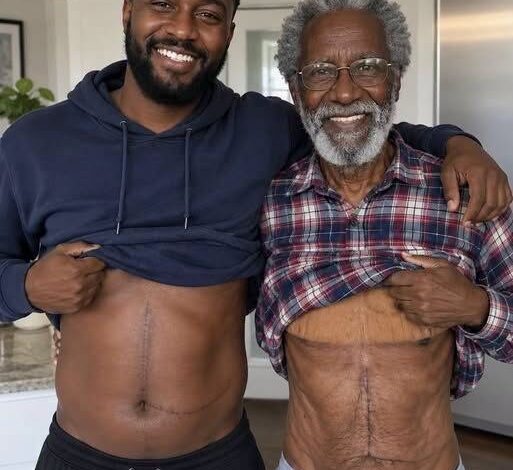
Marcus sat comfortably on the wooden bench, absentmindedly tracing the faint, faded scar running across his stomach—a scar matching the one his father bore beneath his flannel shirt. Beside him sat David, looking healthier, stronger, and more vibrant than he had in over a decade, holding two mugs of hot tea.
“Evelyn and Richard’s criminal trial starts next month,” David said quietly, his voice calm and firm. “Arthur told me the state prosecutor has airtight evidence of wire fraud and medical neglect. They are facing severe prison sentences. They will never touch this family again.”
“They don’t matter anymore, Dad,” Marcus replied gently, taking a slow sip of tea and looking out over the autumn leaves covering the lawn. “They’re part of the past. What matters is that we’re sitting right here, together.”
David looked at his son, his eyes shining with quiet pride and unbounded gratitude. He reached over, placing his hand over Marcus’s scar on the bench.
“I spent my entire life believing my job was to save you, Marcus,” David whispered, his emotion slipping through his voice. “And yet, when the dark came, you saved me twice. You saved my body from disease, and you saved my soul from deception.”
“We saved each other, Dad,” Marcus answered, a brilliant, calm smile breaking across his face.
A cool autumn breeze drifted through the maple trees surrounding the yard, carrying away the lingering memory of past hurts. The Miller home was silent no longer; it was filled with the steady, unbreakable beat of two hearts living on borrowed time made permanent by love.