At 2:13 in the morning, a bald little boy whispered that he missed his dog—and all I had was a yellow mop bucket.
At 2:13 in the morning, a bald little boy whispered that he missed his dog—and all I had was a yellow mop bucket.
“I want Duke,” he kept saying.
Not loud. Not dramatic. Just the kind of quiet that breaks you faster.
I was outside room 412 with my cart and bleach water when I heard him crying.
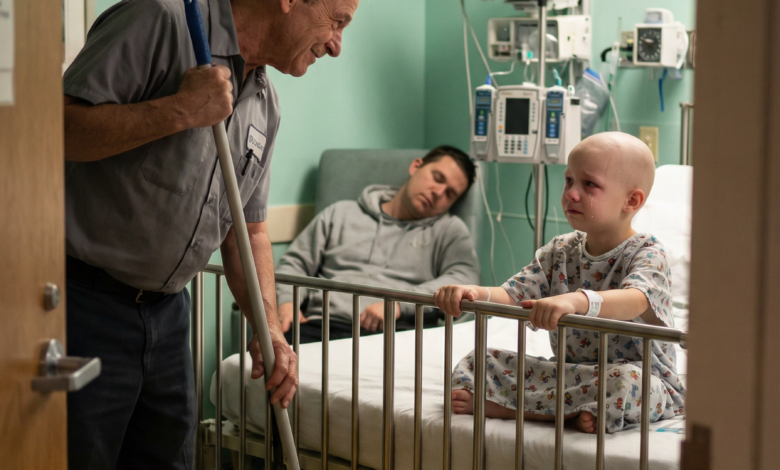
The monitors were steady. No emergency. No code. Just a seven-year-old boy in a hospital bed, knees pulled to his chest, staring at the dark window like it might open and send him home.
His mom was asleep with her head against the wall.
His dad was folded into one of those hard chairs, boots still on, one hand hanging down like he’d passed out in the middle of trying to be strong.
I tapped the doorframe. “You okay, buddy?”
He looked at me, eyes swollen and shiny.
“Not really.”
I stepped in a little. “Bad dream?”
He shook his head.
“I miss my dog,” he said. “He sleeps by my feet every night. He won’t know where I went.”
That one got me.
Because kids say things adults don’t.
Adults say they’re tired. Kids say the real thing.
I asked his parents once, a few nights before, where they were from. Small town almost two hours away. His dad had been missing work. His mom was living out of a duffel bag. They were taking turns calling home, arguing with bills, talking to relatives, trying to sound hopeful for people they didn’t want pity from.
They had another child back home with an aunt.
And a dog.
The boy’s name was Eli.
The dog was a mutt named Duke who, according to Eli, was “part beagle, part vacuum cleaner, part best friend.”
I looked at the clock.
I looked at my mop bucket.
Then I reached into my pocket and pulled out a black marker I used for labeling supply bottles.
“You ever see a hospital dog this ugly?” I whispered.
He blinked.
I crouched down and drew two floppy ears on the side of the yellow bucket. Big cartoon ears. Then a nose. Then a lopsided grin.
Eli stared for one second.
Then two.
Then the corner of his mouth twitched.
I put the mop handle against the bucket like a tail. “This here,” I said, “is Duke’s night-shift cousin. His name is Bucket.”
That got a tiny laugh.
A real one.
Not polite. Not forced. A cracked little laugh from somewhere deeper than pain.
I made the bucket bark under my breath.
Not loud enough to wake the parents. Just enough for Eli to hear.
He covered his mouth, trying not to giggle.
“Does he know tricks?” he asked.
“Terrible ones,” I said. “But he tries hard.”
I crumpled a clean paper towel into a ball.
Eli tossed it weakly across the blanket.
I pushed the bucket after it and made the worst dog noises a grown man has ever made.
He laughed harder.
So I kept going.
I made Bucket sniff the chair leg. I made Bucket get distracted by an IV pole. I made Bucket “sit” and “roll over,” which was really just me tipping the bucket and nearly losing my job.
At one point Eli laughed so suddenly he had to grab his stomach.
His mother woke up halfway and looked panicked for half a second, like she’d forgotten where she was.
Then she saw me.
Saw the bucket.
Saw her son smiling.
She didn’t say a word. She just pressed her hand over her mouth and started crying silently into her sweater.
His dad woke next.
He looked confused, then embarrassed, like he should stop this nonsense.
But Eli looked at him and said, “Dad, Bucket can play fetch better than Duke.”
His dad let out this broken little chuckle that sounded one inch away from tears.
“Well,” he said, rubbing his eyes, “that’s a serious accusation.”
For the next twenty minutes, room 412 didn’t feel like a hospital room.
It felt like a family room at midnight.
A weird one, sure.
A tired one. A scared one. A room with plastic chairs, humming machines, stale coffee in a paper cup, and a janitor on his knees pretending a mop bucket was alive.
But still.
A family room.
Eli started telling me about Duke.
How Duke hated baths.
How he stole grilled cheese right out of his sister’s hand.
How he slept with one paw on Eli’s ankle like he was standing guard.
Then Eli’s voice got smaller.
“What if he forgets me?”
I answered before I could overthink it.
“Dogs don’t do that,” I said. “People do, sometimes. Dogs don’t.”
His dad looked down at the floor when I said it.
His mom shut her eyes.
Because I think everybody in that room knew that sickness teaches children ugly things too early.
Who shows up.
Who drifts away.
Who says, “Let us know if you need anything,” and disappears when the need gets inconvenient.
But a dog?
A dog waits at the door.
A dog believes in you on your worst day.
A dog doesn’t care what the mirror says, or what the chart says, or how much hair is left on your pillow.
Eli laid back slowly.
I tucked the blanket around his legs the way I’d seen nurses do a hundred times.
Bucket stood guard beside the bed.
“Can he stay?” Eli whispered.
I looked at the door.
Looked at the hallway.
Looked back at him.
“For five minutes,” I said.
He smiled with his eyes half closed.
“Tell him good boy.”
I patted the side of the bucket.
“Good boy, Bucket.”
Eli fell asleep before I finished the sentence.
Just like that.
Not cured.
Not safe.
Not suddenly free of all the things a seven-year-old should never have to carry.
But asleep.
Peaceful.
His father stood up and came over to me while his wife brushed Eli’s forehead with her fingers.
The man looked like he hadn’t cried in years and had done enough of it lately to make up for all of them.
He pulled out his wallet.
I shook my head before he could say anything.
“Don’t,” I said.
He nodded once, hard.
Then he said the kind of thing a man says when thank you feels too small.
“He’s had a rough week.”
I looked at Eli.
At the IV line.
At the little paper towel ball lying on the blanket like proof that joy had been there.
“Yeah,” I said. “I know.”
When I rolled my cart back into the hallway, the floor still needed mopping.
The trash still needed taking out.
The lights were still dim, the machines still humming, the night still long.
Nothing important had changed.
And maybe everything had.
Because medicine does what it can.
But sometimes, in this country, in these long nights, in these rooms where parents sleep sitting up and children miss home so hard it hurts to breathe—
sometimes healing starts with being seen.
Sometimes it starts with someone stopping.
Sometimes it looks ridiculous.
Sometimes it looks like a yellow mop bucket with floppy ears, standing watch beside a little boy who finally, finally fell asleep smiling.