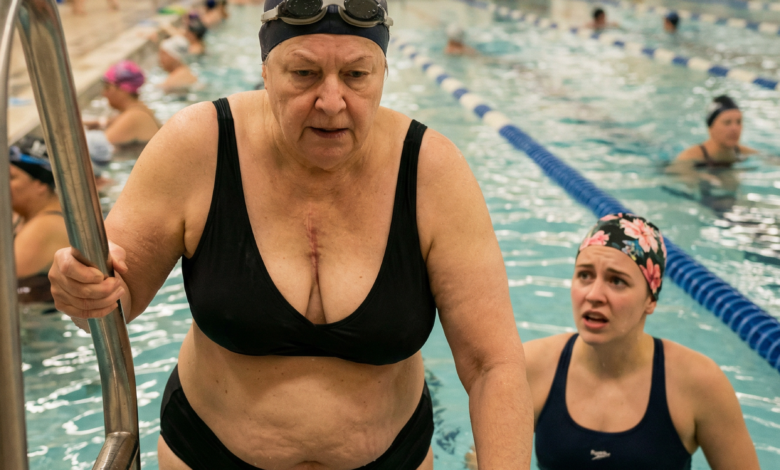
At 58, I dragged my scarred body into the fast lane to prove a younger woman wrong—and found out she was drowning too.
At 58, I dragged my scarred body into the fast lane to prove a younger woman wrong—and found out she was drowning too.
“You need to move.”
I had barely touched the wall when a hand slapped the water beside me.
I turned, out of breath, goggles halfway off, and saw a woman maybe thirty years old staring at me like I’d wandered into the wrong church.
“This lane is for serious swimmers,” she said.
I looked down at my own body in the water. Thick waist. surgery scar peeking above my suit. Arms that still shook when I pushed too hard.
“I am serious,” I said, though my voice came out smaller than I wanted.
She gave me that look people give older women when they’ve already decided what we are.
Tired. Slow. In the way.
I moved over without another word.
Then I went into the locker room, locked myself in a stall, and cried so hard I had to press my fist against my mouth to keep from making noise.
Not because of her.
Because six months earlier, I had been in a hospital bed with wires on my chest while my daughter stood over me trying not to look scared.
The doctor had called it “a warning.”
Stress. High blood pressure. Too much grief, too little sleep, too many years taking care of everybody and calling it a life.
He told me if I didn’t change something, the next heart attack might not leave me another chance.
So I started swimming at the county pool at 6 a.m.
Not because I loved it.
I hated the cold walk from the locker room. Hated the smell of chlorine. Hated standing there in a bathing suit under those bright lights, feeling every year of my age.
But in the water, for one hour, nobody needed anything from me.
Not my grown son who only called when money was tight.
Not my daughter who kept hinting I should move closer “just in case.”
Not the empty house with my dead husband’s coffee mug still in the cabinet because I couldn’t bear to throw it away.
Just me.
And the sound of my own breathing.
At first, I was awful.
I fought the water like it had insulted me personally.
One morning, the young lifeguard stopped me before I started my second lap.
“Ma’am, you’re going to wreck your shoulders.”
I wanted the tile floor to crack open and swallow me.
“I’m just trying not to die,” I said.
He blinked, then softened.
“Okay,” he said. “Then let me show you how to make it easier.”
His name was Travis. College kid. Kind eyes. Voice still carrying that leftover boyishness.
He spent twenty minutes teaching me how to turn my head to breathe, how to reach long instead of hard, how to stop attacking the water and let it hold me.
Nobody had taught me anything gently in a very long time.
After that, I kept coming back.
Then I came more.
Three days a week became five.
My laps got smoother. My breathing got quieter. My heart stopped feeling like an enemy.
I began timing myself with the giant wall clock like it was a secret I was keeping from the world.
Then one Tuesday, I got in the fast lane on purpose.
I knew exactly what I was doing.
The same woman was there. Blond ponytail. expensive goggles. sharp mouth.
She caught me at the wall after two laps.
“You don’t belong here.”
I was tired. My lungs were burning. My cap was half slipping off.
But something in me had gotten tired of moving.
“I held the pace,” I said.
She laughed once, short and ugly.
“You’re almost sixty. This lane is for real swimmers.”
I don’t remember driving home.
I just remember standing in my kitchen afterward, still damp, staring at my own reflection in the microwave door and thinking, Is this how it starts?
First people talk to you like you’re fragile.
Then they talk to you like you’re finished.
Then one day your children take your car keys and tell you it’s for your own good.
I called Travis.
“How do I get faster?” I asked.
He was quiet for a second. “What happened?”
“Someone decided I’m old.”
Now he laughed, but not at me.
“Good,” he said. “Anger is useful. Let’s work.”
So we did.
He made me do sprint sets until my arms trembled.
Kick drills. Flip turns. Strength work with resistance bands in the shallow end while retirees did water aerobics and stared like I’d lost my mind.
I lost twelve pounds.
Then I gained back something better.
The feeling that my body still belonged to me.
Three months later, the pool held a community meet.
Nothing fancy. Just local people, folding chairs, bad coffee, and too much nervous energy in the air.
I signed up for the 100 freestyle.
When I walked onto the deck, I saw her again.
Kelsey.
That was her name, according to the heat sheet.
She saw mine too. Her mouth tightened.
The horn went off.
I dove.
I don’t remember most of the race. Just the water rushing past my ears and the sound of my own pulse and one wild thought repeating in my head:
Not finished. Not finished. Not finished.
I touched the wall and looked up.
Fourth place.
Not a medal.
Didn’t matter.
I had beaten Kelsey by almost two full seconds.
That should have been the end of it.
But later, in the locker room, she sat down on the bench across from me while I was peeling off my cap.
I waited for an excuse or a complaint.
Instead she said, very quietly, “I was cruel to you.”
I looked at her.
Without the goggles and swim cap, she looked younger. Also sadder.
“I used to compete,” she said. “In college. I was good. Then life happened. Desk job. Back pain. Weight gain. Bad sleep. I come here every morning trying to feel like I’m still that girl.”
She laughed, but there was no humor in it.
“And then you showed up getting stronger while I keep getting slower. I hated you for it.”
I sat there holding my towel in both hands.
This woman I had turned into a villain was just scared in a different direction.
“I thought if I slowed down,” she said, “then maybe I was already becoming somebody I didn’t recognize.”
I let that sit between us.
Then I said, “Honey, I had a heart attack. I already became somebody I didn’t recognize.”
She looked up at me then. Really looked.
We started training together two weeks later.
She taught me starts and pacing.
I taught her that not every swim had to feel like punishment.
She pushed me when I got timid. I steadied her when she got mean with herself.
Last month, at another meet, she won her age group.
I took second in mine.
Afterward, a teenage girl on the pool deck asked Kelsey, “How do you stay so motivated?”
Kelsey pointed right at me.
“You find someone who refuses to disappear,” she said.
I’m 58.
I started swimming because I was afraid of dying.
But that isn’t the truth anymore.
The truth is, I was afraid of becoming easy to dismiss.
Easy to replace.
Easy to manage.
I was afraid of becoming a woman people spoke around instead of to.
The water gave me something back.
Not youth.
Something better.
Proof.
Proof that a body can break and still learn.
Proof that fear can look like meanness.
Proof that another woman is not your enemy just because she reminds you of what you’ve lost.
There is room in the lane.
More than that, there is room in this life.
And I’m not moving over anymore.