Boy Told Cashier He Needed The Doll Today Because Sister’s Funeral Is Tomorrow
The boy in front of me at the store was counting coins when he said the words that stopped everyone. “I need the doll today because my sister’s funeral is tomorrow.”
He couldn’t have been older than seven. He was wearing a wrinkled shirt that was too big for him. His hair was combed but not well. Like someone had tried but didn’t really know how.
On the counter was a cheap doll. The kind that costs less than ten dollars.
The boy had a ziplock bag full of change. He was dumping it out, separating coins into stacks. His small hands were shaking.
The cashier was patient. She waited while he counted. The people behind me were not patient. Someone muttered about the wait. Someone else checked their watch dramatically.
The boy counted slowly. One dollar. Two. Three. Four. Five. Six.
He counted the remaining coins twice. Then looked up at the cashier with hopeful eyes.
“How much?” she asked gently.
“Six dollars and seventeen cents.”
She pointed to the register screen. “It’s $8.47 with tax.”
The hope drained from his face. “But I need it today.”
“I’m sorry, sweetie.”
“The funeral is tomorrow. I have to bring it. I promised her.”
His voice broke on “promised.”
The cashier looked around like she was hoping someone would help. The line behind us was getting longer.
“Do you have anyone with you?” the cashier asked.
“My grandma. But she’s in the car. She gave me all the money we have.”
A woman behind me spoke up. “Can someone help this kid so we can move along?”
The boy started crying. Not loud. Just tears running down his face while he scooped his coins back into the bag. He kept dropping them. His hands wouldn’t work right.
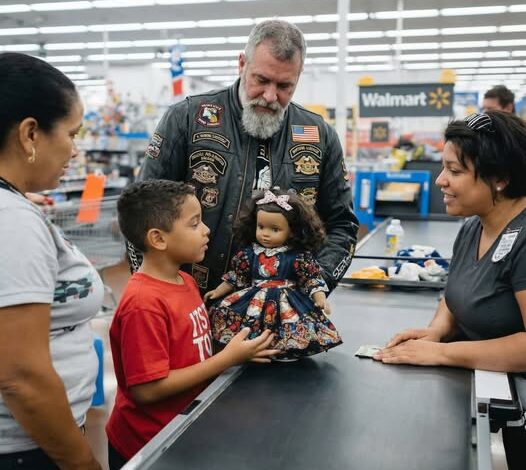
I reached for my wallet. But before I could pull out cash, a hand reached past me. Big hand. Rough. Holding a hundred dollar bill.
“Ring up the doll,” a man’s voice said.
I turned around. A biker had stepped out of line. He was tall, broad, late forties maybe. Leather vest with patches. Gray in his beard. His face was hard but his eyes were soft.
The cashier hesitated. “Sir, it’s only—”
“I know what it costs. Ring it up. Keep the change for whatever else he needs.”
The boy looked up at this man. This stranger who looked like he belonged on a motorcycle, not in a dollar store buying dolls for children.
“I can’t take your money,” the boy said.
“You’re not taking it. I’m giving it.”
“But why?”
The biker crouched down. Looked the boy in the eye. “Because when my daughter died, I didn’t give her anything to hold onto. And I’ve wished I had every day for the last fifteen years.”
The boy’s eyes went wide. “Your daughter died too?”
“Yeah. She was six. Car accident.”
“My sister was five. She was sick.”
The biker nodded. “I’m sorry.”
“Me too.”
The cashier rang up the doll. Put it in a bag. Handed the boy his change. Ninety-one dollars and fifty-three cents.
The boy stared at the money. “This is too much.”
“Give it to your grandma. Help her with the funeral costs.”
The boy took his bag and his change. But he stopped and turned back.
“I hope your daughter is somewhere nice,” he said.
The biker’s jaw worked. “I hope so too.”
The boy left. The biker stood there for a moment, staring at nothing.
I caught him in the parking lot. “That was incredible. What you did in there.”
He shook his head. “It wasn’t enough.”
“Why didn’t you give your daughter something? If you don’t mind me asking.”
He stopped walking. Turned to face me. And what he said next changed everything I thought I knew about that moment.
“Because I was the one driving the car.”
The words hung in the air between us. The parking lot noise faded. It was just him and me and that terrible confession.
“It was fifteen years ago,” he said. “March 14th. I’ll never forget the date. Emma was six. We were driving to her dance recital. She was in the back seat in her pink tutu. Talking non-stop about how she was going to be a ballerina.”
He pulled out his wallet. Showed me the worn photograph I’d seen him look at in the store. A little girl with blonde hair and a huge smile. Wearing a pink tutu.
“I was arguing with my ex-wife on the phone. Hands-free, but I wasn’t paying attention. Not really. Emma asked me something about her dance and I turned around to answer her. Just for a second. Maybe two seconds.”
His voice was steady but his hands were shaking.
“When I looked back at the road, the car in front of me had stopped. Dead stop. I hit the brakes but it was too late. We hit them at forty miles an hour.”
“Jesus,” I whispered.
“I walked away with a bruised rib. The people in the other car were fine. But Emma. The impact. Something went wrong. Internal bleeding. She died in the hospital three hours later.”
He put the photo back in his wallet. Carefully. Like it might break.
“I didn’t give her anything to hold onto because I couldn’t. They wouldn’t let me see her at the end. My ex-wife blamed me. She screamed at me in the hospital. Said I killed our daughter. Security had to remove me.”
“That wasn’t your fault. It was an accident.”
“I was distracted. I looked away. That makes it my fault.”
“You can’t carry that forever.”
“Can’t I? I killed my daughter. That’s not something you get over. That’s something you live with every day until you die.”
We stood there in silence. A shopping cart rattled past us. Someone’s car alarm went off in the distance.
“The funeral,” he continued. “My ex-wife planned everything. I wasn’t allowed to participate. I sat in the back of the church. People stared at me. The man who killed his own daughter. After the service, I tried to approach the casket. My ex-wife stopped me. Said I had no right.”
“That’s cruel.”
“That’s grief. She needed someone to blame. I was convenient. I blamed myself too.”
“Is that why you helped that boy? Guilt?”
He thought about it. “Maybe at first. But then I saw his face. Saw how much he needed to keep that promise to his sister. And I thought about Emma. About how she died thinking I didn’t care enough to pay attention. Died thinking she wasn’t important enough for me to watch the road.”
“She didn’t think that.”
“You don’t know that. Neither do I. And that’s what keeps me up at night.”
A woman walked past us with a cart full of groceries. Gave us a strange look. We were just two men standing in a parking lot having an intense conversation.
“After Emma died,” the biker said, “I fell apart. Lost my job. Lost my marriage. Started drinking. Got into fights. Spent a few nights in jail. I was trying to punish myself. Trying to hurt as much as Emma must have hurt.”
“What changed?”
“I tried to kill myself. Pills and whiskey. Woke up in the hospital. They sent me to psychiatric care. I spent three months in a facility learning how to live with what I’d done.”
He pulled out his keys. They had a small pink ballet slipper keychain.
“The therapist told me I had two choices. Die slowly from guilt. Or live intentionally and try to make something good come from something terrible.”
“So you chose to live.”
“I chose to try. Some days are harder than others. But yeah. I try.”
“Do you have other kids?”
“No. My ex-wife and I split up six months after Emma died. I never remarried. Never had more kids. Couldn’t bear the thought of replacing her.”
“You wouldn’t be replacing her.”
“Tell that to my brain at 3 AM.”
A motorcycle was parked nearby. Big Harley. Black and chrome. He walked toward it.
“Is that why you ride?” I asked.
“Part of it. After I got out of treatment, I needed something. Some way to feel alive. Some way to focus. Riding does that. When you’re on a bike, you pay attention. You watch the road. You don’t get distracted.”
“Penance.”
“Maybe. Or maybe just common sense learned the hard way.”
He straddled the bike. Put on his helmet.
“That boy in there,” I said. “You gave him something important. You know that, right?”
“I gave him money for a doll.”
“You gave him more than that. You gave him permission to grieve. To keep his promise. You validated what he was feeling.”
The biker was quiet for a moment. “When Emma died, nobody validated what I was feeling. They just told me it was my fault and I should feel guilty. Which I did. Which I do. But nobody said ‘you loved her and love makes us do foolish things like turn around in a car or spend our last six dollars on a doll.’”
“You’re a good man doing the best you can with an impossible situation.”
“I’m a man who killed his daughter. But I appreciate the sentiment.”
He started the engine. It roared to life.
“What’s your name?” I asked.
“Marcus.”
“I’m David. And for what it’s worth, I think Emma would be proud of what you did in there.”
He didn’t answer. Just nodded. Pulled out of the parking spot and rode away.
I stood there for a while, thinking about the boy with the doll. About Marcus and his dead daughter. About grief and guilt and the impossible weight of living with tragedy.
I went home that day but I couldn’t stop thinking about what I’d witnessed. About the boy. About Marcus. About the cruelty of life and the small kindnesses that make it bearable.
Two days later, I went back to that dollar store. I don’t know why. Maybe I was hoping to see the boy again. To know if he’d made it to the funeral. If the doll had brought him comfort.
The same cashier was working. I approached her during a slow moment.
“A few days ago,” I said. “There was a boy here. Buying a doll for his sister’s funeral. Do you remember?”
Her face softened. “Oh yes. I think about him every day. That was heartbreaking.”
“Did you happen to catch his name? Or his grandmother’s? I wanted to. I don’t know. Send flowers or something.”
She shook her head. “I didn’t get a name. But I remember the grandmother came in after. Looking for the boy. She was panicked. Said he’d taken all their money and disappeared.”
“He came in alone?”
“Yeah. She didn’t know he’d left the car. When I told her what happened, she started crying. Said her grandson was trying to take care of everything. Trying to be the man of the family since the sister died.”
“Did she say anything else?”
“She asked me who paid. I told her about the biker. She wanted to thank him but he was already gone. She said her grandson’s name was Tyler. Said he and his sister Lily were inseparable. When Lily got sick, Tyler promised he’d take care of her forever.”
“Even after death.”
“Especially after death. The grandmother said Tyler felt guilty. Thought if he’d been a better brother, Lily wouldn’t have gotten sick. Which is crazy. She had leukemia. Nothing a seven-year-old could have prevented.”
“Kids don’t think logically about death.”
“Neither do adults, honestly.”
She was right about that.
I thanked her and left. But I couldn’t let it go. I looked up recent obituaries. Found one for Lily Martinez. Five years old. Died after a two-year battle with leukemia. Services at St. Michael’s Church.
The funeral had been two days ago. I’d missed it.
But the obituary listed a fundraiser. The family had medical debt. Funeral costs. They’d set up an account at a local bank.
I went to the bank. Made a donation. Not much. A few hundred dollars. But something.
The teller asked if I wanted to leave a name. I said no. Then I changed my mind.
“Put it from Marcus,” I said. “Just Marcus.”
She wrote it down. “He’ll be happy to know people care.”
“I hope so.”
Three weeks later, I got a message on Facebook. From someone named Rosa Martinez.
“Are you the David who was at the dollar store?”
I stared at the message. How had she found me?
“The cashier remembered your face. She’s my niece. She helped me find you. I wanted to say thank you. For the donation. For caring about a stranger’s family.”
I wrote back. “I didn’t do much. It was Marcus who helped Tyler.”
“We’ve been trying to find Marcus. To thank him. Do you know how to reach him?”
I didn’t. I’d never gotten his last name. Never gotten his number.
“I don’t,” I wrote. “But if I see him again, I’ll tell him you’re looking.”
“Please do. Tyler talks about him every day. Says a biker angel helped him keep his promise to Lily. He wants to thank him.”
I promised I would.
But I didn’t know how to find Marcus. I didn’t even know what club he belonged to. Didn’t know where he lived.
For weeks, I kept an eye out. Looked at every biker I saw. Checked parking lots for that black and chrome Harley.
Nothing.
Two months after the dollar store, I was at a red light. A motorcycle pulled up next to me. Black Harley. Gray-bearded rider.
I rolled down my window. “Marcus?”
He looked over. Recognition flickered in his eyes. He pulled into a parking lot. I followed.
We got out of our vehicles. Stood in the afternoon sun.
“David, right?” he asked.
“Yeah. I’ve been looking for you.”
“Why?”
“The boy from the dollar store. Tyler. His grandmother wants to thank you. They’ve been trying to find you.”
Marcus shook his head. “I don’t need thanks.”
“I know. But they need to give it. Tyler talks about you every day. Calls you his biker angel.”
“I’m no angel.”
“To him you are.”
Marcus was quiet. Staring at his motorcycle. At the pink ballet slipper keychain.
“I can’t,” he finally said. “I can’t meet them. Can’t have them thank me. Because if they knew who I really was, what I really did, they wouldn’t want to thank me.”
“You helped a grieving child. That’s all they know. That’s all they need to know.”
“It’s not enough.”
“It’s everything to them.”
He looked at me. His eyes were tired. The eyes of a man who carried weight no one should have to carry.
“What do I say to them?” he asked. “What do I say to a kid who thinks I’m good when I’m not?”
“You say ‘you’re welcome.’ You say ‘I’m sorry for your loss.’ You let them have their moment of gratitude. Because they need it. Just like you needed to help Tyler that day.”
Marcus rubbed his face. “What if I break down? What if I can’t hold it together?”
“Then you break down. And that’s okay too.”
He stood there for a long time. Thinking. Fighting with himself.
Finally, he nodded. “Okay. I’ll meet them. But you come with me.”
“Why?”
“Because if I start drowning, I need someone to pull me back.”
“Deal.”
We arranged to meet at a park the following Saturday. Rosa brought Tyler. Tyler brought the doll.
Marcus arrived on his motorcycle. Helmet in hand. Looking nervous in a way I hadn’t seen before.
Tyler saw him and ran. Ran straight to this man he’d met once for five minutes in a dollar store.
Marcus caught him. Knelt down. Tyler wrapped his arms around his neck.
“You came,” Tyler said. “I thought I’d never see you again.”
“I’m sorry it took so long.”
“It’s okay. You’re here now.”
Rosa approached. She was maybe sixty. Gray hair. Kind eyes. Exhausted face.
“Thank you,” she said to Marcus. “Thank you for helping my grandson. For helping our family.”
Marcus nodded. Couldn’t speak.
Tyler pulled back. Held up the doll. “I put her with Lily. Just like you said. So Lily wouldn’t be alone.”
“Good,” Marcus managed. “That’s good.”
“I also gave her some of the money. For her journey to heaven. Is that okay?”
“That’s perfect.”
“Grandma used the rest for the funeral. She said it was a blessing. Said God sent you.”
Marcus flinched at that. “I’m not. I’m not sent by God.”
“Yes you are,” Tyler said with the certainty only children have. “You helped me when nobody else would. That’s what angels do.”
Marcus’s eyes filled with tears. He looked at me. Drowning.
I stepped forward. “Tyler, can I tell you something about Marcus?”
The boy nodded.
“Marcus had a daughter once. She died when she was six. Around your age.”
Tyler’s eyes went wide. “Really?”
Marcus nodded.
“What was her name?”
“Emma.”
“Did you give her something to hold onto?”
Marcus shook his head. “No. I didn’t. And I’ve regretted it ever since. That’s why I helped you. So you wouldn’t have the same regret.”
Tyler thought about this. Then he did something that broke all of us.
He held out the doll. “You can have this. To give to Emma. So she has something too.”
Marcus stared at the doll. At this child offering his most precious possession.
“I can’t take that,” Marcus said. “That’s for your sister.”
“But your daughter needs it too. And Lily won’t mind sharing. She was nice like that.”
Marcus lost it. Completely broke down. Sobbing in a park while a seven-year-old hugged him and a grandmother cried and I tried to hold myself together.
When Marcus finally collected himself, he said, “Tyler, I can’t take your doll. But thank you. Thank you for thinking of Emma. That’s the kindest thing anyone has ever offered me.”
“Are you sure?”
“I’m sure. You keep it. You visit your sister and you tell her about the biker who helped you. And maybe someday, when you’re older, you’ll help someone else the way I helped you.”
“I will. I promise.”
Tyler hugged him again. Rosa thanked him again. We stood there in the park until Tyler started getting restless and Rosa said they needed to go.
As they walked away, Tyler turned back. “Will I see you again?”
Marcus nodded. “Yeah, kid. You’ll see me again.”
Marcus kept that promise. Started visiting Tyler and Rosa once a month. Took Tyler for rides on his motorcycle when he got older. Became something like family.
He told me later that Tyler saved his life as much as he saved Tyler’s.
“That kid reminded me that I could still do good,” Marcus said. “That I wasn’t just the man who killed his daughter. I could also be the man who helped a grieving boy. Both things could be true.”
“Both things are true.”
“I’m starting to believe that.”
Years passed. Tyler grew up. Graduated high school. Went to college. Became a teacher, like his sister Lily had wanted to be.
Marcus was there for all of it. Proud as any father would be.
On the fifteenth anniversary of Emma’s death, Tyler did something Marcus never expected.
He organized a memorial. For Emma. For Lily. For all the children lost too soon.
He invited Marcus. Asked him to speak.
Marcus almost said no. But Tyler insisted.
“You carried Emma’s memory alone for fifteen years,” Tyler said. “Let us help you carry it.”
So Marcus spoke. At a memorial full of strangers and family and friends. He talked about Emma. About the accident. About his guilt. About the long road to forgiveness.
About a boy in a dollar store who reminded him that love transcends death. That promises matter. That sometimes the smallest gestures change everything.
When he finished, there wasn’t a dry eye in the room.
Tyler stood up. Walked to the front. Held up a doll. The same doll from fifteen years ago. Worn now. Faded.
“I told Marcus he could have this for Emma,” Tyler said. “He said no. But I’ve kept it all these years. And now I think it’s time.”
He handed the doll to Marcus.
Marcus held it like it was made of glass. Like it was the most precious thing in the world.
“I’ll make sure she gets it,” Marcus said.
Tyler hugged him. “She already has it. She’s had it this whole time.”
Marcus still rides. Still carries Emma’s photo in his wallet. Still wears the pink ballet slipper keychain.
But he’s different now. Lighter somehow. Like he finally gave himself permission to be both the man who made a terrible mistake and the man who does good in the world.
He started a foundation. Helps families with funeral costs when children die. Makes sure every kid gets something to hold onto. Every family gets support.
He calls it Lily and Emma’s Promise.
Tyler helps him run it.
They’ve helped hundreds of families over the years. Hundreds of children who got their dolls and teddy bears and blankets. Hundreds of siblings who got to keep their promises.
I asked Marcus once if he’d forgiven himself.
“Some days,” he said. “Not every day. Maybe not ever completely. But some days I think maybe Emma would be proud. Maybe she’d understand. Maybe she’d forgive me even if I can’t quite forgive myself.”
“I think she would.”
“I hope so.”
He looked at me. “You know what the therapist told me fifteen years ago? She said grief and guilt are lifelong companions. But they don’t have to be the only companions. There’s also love. And hope. And the choice to do better.”
“You chose better.”
“I chose to try. That’s all any of us can do.”
He started his motorcycle. The engine roared.
“Where you headed?” I asked.
“Cemetery. Taking some flowers to Emma. And Lily. Tuesday is their day.”
“Their day?”
“Yeah. I visit them every Tuesday. Tell them about the families we helped. The kids who got their promises kept. I like to think they’re watching. That they’re proud.”
“I’m sure they are.”
He rode away. And I stood there thinking about chance encounters in dollar stores. About how one moment of generosity can ripple outward for years.
About a biker who thought he was beyond redemption and a boy who saw an angel.
About how sometimes the people we save end up saving us right back.