He Raised Me Like His Own After My Parents’ Death — But the Truth Came Out After His Funeral
I lost my parents in a car crash when I was four.
That night took their lives — and took my ability to walk.
Everyone said I was lucky to survive.
But my life never felt lucky after that.
The state started talking about foster homes.
Strangers. Institutions.
Until my uncle Ray walked into the hospital room and shut it down.
“I’m taking her,” he said. “She’s not going anywhere.”
Ray wasn’t soft.
He was built like a wall and spoke like gravel.
But from that moment on, he became my entire world.
He learned how to lift me without hurting me.
Set alarms every two hours to turn me in bed.
Fought insurance companies like they were personal enemies.
When kids stared at me in the park, he knelt beside me and said,
“Her legs don’t listen to her brain — but she’ll beat you at cards.”
He tried to braid my hair.
(It was awful.)
He watched YouTube videos to learn how to be both father and mother.
When I cried about never dancing, never standing in crowds, never being normal —
he held my face and whispered:
“You are not less. Not ever.”
Ray made my small bedroom into a whole universe.
Shelves I could reach.
Ramps he built himself.
A garden box so I could grow plants by the window.
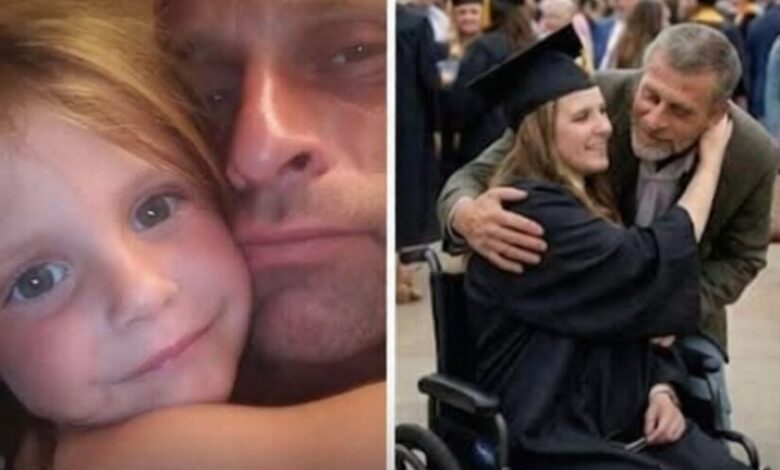
For twenty-two years, he carried me through life.
Then he got sick.
First it was forgetting things.
Then catching his breath.
Then the doctors stopped whispering.
Stage four cancer.
Hospice moved into our living room.
The night before he died, Ray sat beside my bed and held my hand.
“You’re gonna live, kiddo,” he said softly.
“You’re gonna live big.”
I cried.
“I don’t know how without you.”
His eyes filled.
“I’m sorry,” he whispered.
“For what?” I asked.
“For things I should’ve told you.”
He kissed my forehead.
The next morning, he was gone.
After the funeral, our neighbor came to my room with shaking hands.
“Ray asked me to give you this,” she whispered.
An envelope.
My name in his rough handwriting.
I thought it would be a goodbye.
Something comforting.
Instead, the first line made my blood go cold.
“Hannah, I’ve been lying to you your whole life.”
My chest tightened as I kept reading.
Ray wrote about the night of the crash.
Not the version I knew.
My parents weren’t just driving home.
They were leaving.
They had told Ray they were moving to start over —
and they weren’t taking me with them.
He said he screamed at them.
Called them selfish.
Told them they didn’t deserve me.
And then he saw the bottle.
My dad had been drinking.
Ray wrote that he could’ve stopped them.
Taken the keys.
Called a cab.
But he didn’t.
Because he was angry.
Because he wanted to win.
Twenty minutes later, they were dead.
And I was paralyzed.
Ray admitted something that shattered me:
At first, when he looked at me in that hospital bed…
he saw the price of his temper.
He resented himself.
And sometimes — the pain of it — he resented the reminder.
Taking me in wasn’t just love.
It was penance.
Then came the next truth.
The money.
All those years I thought we were barely surviving —
Ray had quietly built a trust with my parents’ life insurance and every overtime shift he ever worked.
He sold the house.
Everything was for my future.
For rehab.
For equipment.
For a life bigger than my bedroom.
His final words ripped me apart:
“I couldn’t undo that night.
So I spent the rest of my life trying to carry you forward.
If you can forgive me, do it for yourself.
If you can’t, I understand.
I love you either way.”
I screamed.
I sobbed.
I wanted to hate him.
He helped cause the crash that destroyed my body.
And he was the man who spent twenty-two years saving my life.
The same hands.
The same heart.
The same guilt.
A month later, I checked into intensive rehab.
They strapped me into a harness over a treadmill.
My legs shook.
My muscles burned.
I almost quit.
Then I heard Ray’s voice in my head:
“You’re gonna live, kiddo.”
I stood.
Only for seconds.
But I stood.
Last week, I did it again.
And again.
Some days I forgive him.
Some days I can’t.
But I know this:
He didn’t run from what he did.
He spent the rest of his life trying to make it right.
He carried me as far as he could.
Now the rest is mine.