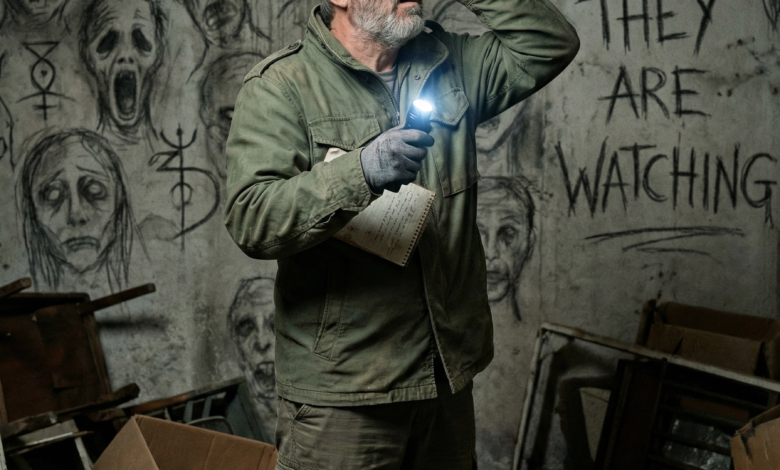
I opened a foreclosed house for a routine inspection and found a dead woman’s son still begging from the basement walls.
I opened a foreclosed house for a routine inspection and found a dead woman’s son still begging from the basement walls.
“Just note the damage and move on,” my supervisor had texted me that morning.
That was my job.
I’m Tony. Forty-one. Divorced. No kids. I inspect houses nobody loves anymore.
I check foundations, leaks, bad wiring, weak water pressure, mold behind drywall, rot under sinks. I walk through other people’s endings with a flashlight and a clipboard, then I drive to the next address.
Most houses blur together.
Peeling paint. Empty closets. A family calendar still hanging in the kitchen, stuck three months behind like time gave up before the owners did.
This one sat on a quiet street outside a fading mill town.
Bank-owned. Empty for almost a year.
The front porch sagged. The furnace was shot. The roof looked tired enough to quit in the next hard storm. In the upstairs bathroom, the pipes groaned like an old man getting out of bed.
Nothing unusual.
Then I opened the basement door.
At first I thought it was water staining.
Then I stepped down two stairs and realized the walls were covered in drawings.
Not doodles. Not random scribbles.
Real drawings.
Hundreds of them.
Birds in flight. A mother asleep in a chair. A skinny boy at a kitchen table. Old downtown buildings. Trees in winter. Hands. Eyes. Faces with so much feeling in them it made my chest tighten.
Some were done in pencil. Some in charcoal. A few had color, but only a little, like the artist had to ration it.
And in the far corner, written neatly between two sketches, were the words that stopped me cold.
If you’re seeing this, it means they finally took the house.
My name is Michael. I was sixteen when I started drawing down here because upstairs hurt too much.
If they paint this over, that’s okay. I just need one person to know I was here, and that art kept me alive.
Please don’t laugh at it.
I sat down right there on the basement steps.
I don’t know how long.
I’m not the kind of man who cries easy, but something in that message got under my skin. Maybe because the basement was colder than the rest of the house. Maybe because whoever wrote it had tried so hard to make sure he disappeared politely.
Like he was apologizing for existing.
I took the required photos for the report.
Then I took more.
Close-ups. Wide shots. The note in the corner. A drawing of a woman wrapped in a blanket, smiling at somebody off-page like she was trying to look stronger than she felt.
I filed the inspection that afternoon.
Under additional notes, I wrote: Extensive original artwork on basement walls. Likely created by minor resident. Worth preserving before renovation.
I knew nobody would care.
A bank doesn’t preserve grief.
For two nights I kept thinking about that line.
I just need one person to know I was here.
On the third night, I looked up the property records.
The former owner was a woman named Denise Carter. Deceased.
I found an emergency contact listed in an old county filing and called the number.
A woman answered, cautious from the first hello.
I told her my name. Told her why I was calling. There was a long silence.
Then she said, “I’m his aunt.”
Her voice changed on that last word. Softer. Tired.
She told me Denise had died after a long fight with cancer. Michael had been fifteen. There wasn’t much family left, and what was left didn’t have room, money, or stability. He was moved into foster care and bounced around more than once.
“He used to draw in that basement for hours,” she said. “When his mom got too sick, that was where he went. He said it was the only room where he could breathe.”
I asked where he was now.
“At a public high school on the other side of town,” she said. “Senior year. He works part-time. Keeps to himself. And before you ask, no, he doesn’t draw anymore.”
That hit me harder than I expected.
She gave me his email after I promised I wasn’t trying to bother him.
I sent him six photos and one sentence.
Your walls are still here. And they matter.
He wrote back less than an hour later.
I thought they were gone.
Then another message.
I thought everything from that house was gone.
Then a third.
Thank you for seeing it.
We met the next weekend at a coffee shop near the bus line.
He was taller than I expected. Thin. Quiet. One of those kids who looked like he’d learned not to take up too much space.
He didn’t say much at first.
Then I showed him more photos on my phone, and his whole face changed.
Not happier exactly.
More like awake.
He pointed to one sketch and said, “That was my mom after chemo. She hated when I drew her tired, so I had to do it from memory.”
He pointed to another. “That was the view from the basement window in winter.”
Then he laughed once, short and embarrassed. “I used to think if I got good enough, maybe I could draw us a different life.”
There are things people say that stay with you.
That was one of them.
I asked why he stopped.
He stared into his cup and said, “Because it worked too well. Every time I drew, I missed her more.”
A friend of mine runs an art program out of a community center. No big speeches, no pity, just studio space, donated supplies, and people who still believed talent could be a life raft.
I made a call.
Michael said he didn’t want charity.
I told him it wasn’t charity.
“It’s rent,” I said. “You left part of yourself on those walls. The rest of us are late paying attention.”
That finally got a smile out of him.
He started going twice a week.
Then four times.
Then he was staying late, helping younger kids shade faces and mix color and stop being afraid of blank paper.
A few months later, the center held a small local show.
Nothing fancy. Folding chairs. Cheap crackers. Paper name tags.
Michael sold four pieces.
One was a winter tree.
One was a woman wrapped in a blanket, smiling like she was trying not to scare her son.
He used the money for application fees.
Last spring, he got into an art school on scholarship.
At graduation, after all the noise and clapping and phones in the air, he found me near the back of the gym and handed me a flat package wrapped in brown paper.
It was a drawing of me standing at the basement stairs, one hand on the rail, looking up at his walls like I’d just found a church where nobody expected to be saved.
At the bottom he wrote, You were the first person who saw the house and looked for me.
That drawing hangs in my office now.
So does the lesson.
People do not disappear all at once.
They leave themselves in corners. In margins. In old houses. In songs, recipes, carvings, notes, sketches, half-finished quilts, penciled names on a wall no one thinks to save.
And sometimes the difference between a lost kid and a living artist is one stranger who stops walking long enough to say:
I see you.