I Paid for an Elderly Womans Groceries, Two Days Later, My Entire Life Took a Turn I Never Expected
I never thought a $12 grocery bill would reroute my entire life. I wasn’t trying to be a hero, or generous, or memorable. I just wanted to keep a stranger from feeling the kind of humiliation I’d tasted myself more times than I cared to admit. But life has a habit of circling back with consequences—sometimes brutal, sometimes astonishingly kind.
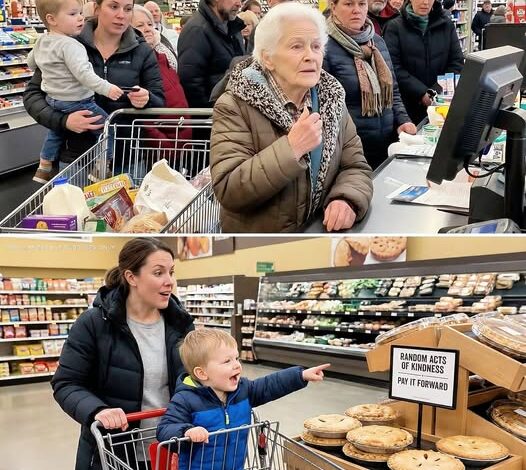
Two days before payday, I stood in line at the grocery store, Owen balanced on my hip like a warm, wiggling bowling ball. He was three, curious about everything and incapable of staying still for more than three seconds at a time. My account had exactly $27 in it. My nerves had maybe half that.
“Mommy, look! Sour worms!” he announced, already lunging toward the candy rack.
“No, buddy,” I said, hitching him higher. “Not today.”
“But they’re sour,” he repeated, drawing out the word like some kind of toddler philosopher.
His pout made nearby shoppers smile. My voice, worn thin by work and worry, did not.
Ahead of us stood an elderly woman with silver hair wound into a neat bun, the kind that said she’d lived through harder times than mine. Her cart held the basics—milk, potatoes, a can of soup, bread—and one treat: a small apple pie, golden under its crinkled package.
When the cashier read her total, she hesitated. She inserted her card.
Beep. Declined.
She tried again.
Declined.
The air shifted. A man behind me groaned dramatically; someone else muttered, “People need to stop shopping if they can’t afford it.”
The woman’s hands trembled. “I’ll put the pie back,” she whispered.
Something cracked in me right there between the gum rack and the register. That pie wasn’t extravagance. That was a piece of comfort. A bit of sweetness. A permission to feel human.
“I’ll pay for it,” I heard myself say.
Her eyes widened. “Oh, dear, you don’t need to—”
“Please,” I said, tapping my card before I could overthink it.
Her relief softened her whole face. “Thank you,” she murmured. “You have no idea what this means.”
Owen, oblivious to everything but kindness itself, waved at her. “Bye-bye, Grandma! Have a good day!”
She actually laughed—a quiet, broken little laugh—and waved back. “You too, sweetheart.”
Two days later, walking into the same grocery store, I saw a printed screenshot from the security camera taped to a display near the entrance. My face. Owen’s face. A message above it:
Please contact us. You helped my mother, and we’d like to thank you.
Heat climbed up my neck. A public shout-out was the last thing I wanted. The manager apologized and took it down, but the note stayed with me all day. That night, when Owen was asleep and the house was still, I dialed the number.
A man answered on the first ring.
“Are you the woman with the little boy? The one who helped my mom?”
“I… guess that’s me.”
He exhaled like he’d been holding in a breath for two days. “She hasn’t stopped talking about you. Would you meet us? She wants to thank you properly.”
The next morning, I met them at a small café that smelled like cinnamon and warm pastries. Margaret—the woman from the store—walked in wearing a blue cardigan and a smile that could anchor you in place. Next to her stood her son, John.
She hugged me before I even sat down. “You came,” she said, and her gratitude felt so pure it almost hurt.
We talked over coffee while Owen devoured a muffin the size of his face. John explained that the situation wasn’t what it had looked like.
“My mom gives most of her money away,” he said quietly. “Her card had just expired. She would’ve figured it out, but you stepped in before she had to struggle through it.”
Margaret took my hand. “You didn’t just help me with groceries. You helped me feel seen. That’s rarer than people think.”
Then, with the calm certainty of someone who’d made up her mind long before speaking, she said:
“I want to open a savings account for your son. Ten thousand dollars. For his future.”
I stared at her, stunned. “I can’t accept that.”
“Yes,” she said firmly. “You can. This isn’t charity. It’s gratitude. Kindness deserves a return.”
I cried. Not because of the money—though God knows it mattered—but because kindness like that had been absent from my life for a long time.
From that day on, we didn’t just stay in touch—we grew into something like family. Coffee became dinners. Dinners turned into long walks at the park. Owen adored Margaret instantly, and he warmed to John just as quickly.
John and I talked about the messy parts of our pasts—the spouses who walked away, the damage left behind, the slow rebuilding. In those conversations, tenderness crept in quietly, like sunlight finding its way through a window you didn’t realize you’d opened.
A year later, under the wide branches of the oak tree in Margaret’s backyard, John and I got married. Owen wore a bow tie and carried the rings with a seriousness that almost made me laugh. Three months later, the adoption papers were signed.
“Does this mean I get to call him Dad now?” Owen asked.
“You already do,” I whispered.
Every Christmas, Owen brings up the story. “Remember when we met Grandma Margaret at the store?” he says with pride.
And every time, I smile—because that moment, that $12 act of kindness, was the hinge that swung our entire lives into a new direction.
Miracles don’t always announce themselves with thunderclaps. Sometimes they arrive disguised as grocery bags, trembling voices, and a slice of apple pie.
That’s how love found us again—quietly, unexpectedly, and with a generosity I will never forget.