I Saw My Husband’s Face After 20 Years of Blindness – and Realized He’d Been Lying to Me This Whole Time
For twenty years, I built a picture of my husband in my mind.
I imagined the curve of his smile, the color of his eyes, the way light might catch in his hair. I constructed him from touch and tone and breath against my cheek.
The day I finally saw his face was the day I realized the foundation of our life had a crack running straight through it.
I lost my sight when I was eight.
It began as a childish dare on a playground. I was on the swings, pushing myself higher and higher because I loved that dizzy feeling of flying. A boy from our street stood behind me, laughing.
“Bet you can’t go higher than that!”
“Watch me!” I shouted back.
Then came the shove.
My hands slipped from the chains. Instead of soaring forward, I flew backward. There was a sharp crack when my head hit a jagged rock near the mulch border.
I don’t remember the ambulance. I remember waking up to my mother crying and doctors whispering about “optic nerve damage” and “severe trauma.”
There was one surgery. Then another.
They couldn’t save my vision.
At first, I thought the darkness was temporary. I waved my hands in front of my face, waiting to see them. Weeks passed. Then months. Eventually, the waiting stopped.
I hated the dark. I hated depending on people. I hated hearing classmates rush past while I traced lockers with my fingertips.
But I refused to disappear.
I learned Braille. I counted steps to memorize rooms. I trained my ears to catch the smallest shift in breathing. I graduated with honors. I went to university. Every year, I saw specialists, clinging to the fragile thread of hope that maybe, someday, something would change.
When I was twenty-four, I met Nigel.
He introduced himself as the new ophthalmic surgeon at the clinic. His voice struck something deep inside me—an echo I couldn’t quite place.
“Do we know each other?” I asked the first day.
There was a pause.
“No,” he said gently. “I don’t believe we do.”
Something about that pause lingered.
Still, he was kind. He explained my condition clearly, without pity. When he spoke about experimental procedures, he sounded determined, not ambitious.
Over time, he became more than my doctor. He became my friend. He described the sky after appointments—“clear and sharp blue today”—and walked me carefully to my car.
Eventually, he crossed the line he wasn’t supposed to cross.
“I know this is complicated,” he admitted one evening. “But I’d regret it forever if I didn’t ask. Would you go to dinner with me?”
I should have hesitated.
I didn’t.
Dating him felt easy. He let me cook, even when I burned things. He memorized exactly where to place my coffee mug—three inches from my right hand. He described sunsets without exaggeration.
By the time we married, he was no longer my doctor.
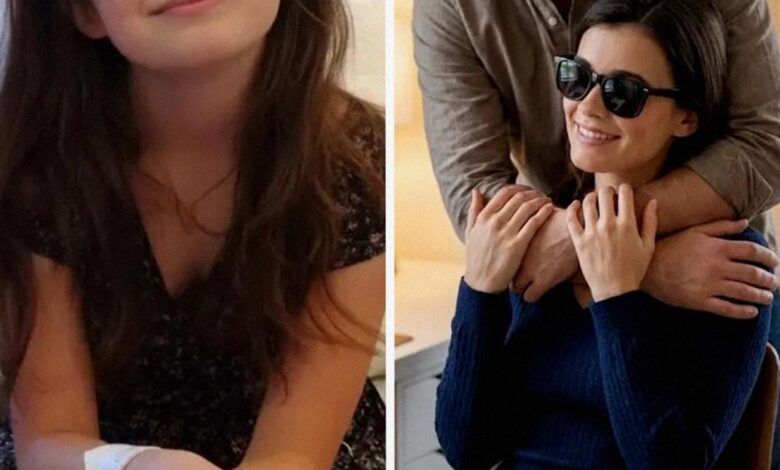
The night before the wedding, I traced his face with my fingertips.
“You have a strong jaw,” I murmured.
“Is that good?” he asked.
“You feel steady.”
“I am,” he promised.
We had two children—Ethan and Rose. I learned their faces through touch. Nigel built a brilliant career specializing in optic nerve reconstruction. Many nights, I woke at two a.m. to find his side of the bed empty.
“I’m close,” he would whisper when he returned. “Close to something big.”
I assumed he meant a patient.
After twenty years of blindness, he came home one evening trembling with excitement.
“I figured it out,” he said. “You’re going to see again.”
My heart pounded so hard it hurt.
“Don’t play with me,” I whispered.
“I would never.”
He knelt in front of me and explained a regenerative graft procedure that could reconnect damaged pathways. Risky, experimental—but my scans showed promise.
“And you would perform it?” I asked.
“I would stake everything on it.”
I was terrified. What if nothing changed? What if seeing shattered the life I had carefully constructed in darkness?
But I trusted him.
The morning of surgery, I told him, “If this works, I want you to be the first thing I see.”
His breath caught.
When I woke, my eyes were wrapped in bandages.
“It was successful,” he said. But there was no joy in his voice.
He began unwrapping the layers.
“Before you see this,” he whispered, “just… don’t hate me.”
Light pierced through my eyelids. At first, everything was white and gold. Then shapes sharpened. A blue curtain. Gray machines.
And then a face.
Dark hair streaked with silver. Brown eyes rimmed with exhaustion. A thin scar near his left eyebrow.
My breath stopped.
That scar.
A swing. A shove. A fall. A rock.
“How is it possible that it’s YOU?” I gasped. “You pushed me!”
His face drained of color.
“I was eight,” he whispered. “I didn’t mean for you to fall like that.”
“But you did,” I said. “You disappeared. You let me marry you without telling me who you were.”
The world felt too bright. Too sharp. The man who gave me my sight back had taken it in the first place.
I left the hospital without looking at him.
At home, I saw our life for the first time—gray couch, pale yellow walls, wedding photos of me smiling with closed eyes while he looked at me like I was everything.
In his office, I found years of research. Journals. Surgical sketches. My name on folders dated fifteen years earlier.
He hadn’t stumbled into ophthalmology.
He had chased it.
When he finally stood in the doorway, his voice was raw.
“I recognized you that first day,” he admitted. “When you said my voice sounded familiar, I knew. I’ve carried that guilt my entire life. I became a surgeon because of you. I searched for your name for years.”
“Then why hide it?” I asked.
“Because I was ashamed. And because I loved you. I was terrified you’d refuse me—and the surgery.”
I studied him properly for the first time. The lines of exhaustion. The fear in his eyes. The hope.
“You took my sight,” I said quietly. “But you spent your life trying to give it back.”
“Every single day,” he replied.
The anger didn’t disappear. It shifted.
“No more secrets,” I said.
“Never again.”
For twenty years, I had known him in darkness.
Now, standing in the light, I saw the full truth—the boy, the guilt, the man who built his life around redemption.
And this time, with open eyes, I chose him.