I Stopped to Help an Elderly Woman After Her Car Crashed – Two Days Later, My Whole Life Changed
I honestly thought pulling over that afternoon was just the decent thing to do. An elderly woman in trouble, a wrecked car, a moment of humanity—nothing more. But when my phone rang two days later and my mother practically screamed for me to turn on the TV, I realized that single choice had kicked off something far bigger than a roadside good deed.
My wife had been the kind of person who made life feel wide open, like the future was something we could mold with our bare hands. We’d stay up too late in the kitchen talking about Nina’s future, mapping out vacations, laughing at jokes so old and internal they barely made sense anymore. Cancer stole all of that three years ago. It gutted my life in one swift, merciless sweep, leaving me to raise a grieving daughter while stumbling through my own wreckage.
The grief came in unpredictable waves. I’d reach for my phone to text her something stupidly mundane before remembering she wasn’t there to read it. I’d plate two servings of dinner before catching myself. Every corner of the house held memories that were precious and painful in the same breath. But Nina needed someone functional, someone present. She’d already buried her mother. She couldn’t lose her father to despair too. So I anchored myself to one purpose: show up for my daughter. Completely. No dating, no trying to “move on,” no space for a new relationship when the old one was still carved into my bones. It wasn’t fear—it was loyalty to the life I’d promised my wife we’d give our daughter.
Most afternoons, the commute home was my mental reset. Twenty-three minutes where the world quieted enough for me to plan dinner, think about Nina’s assignments, or try to decipher if she seemed okay. That Tuesday felt like any other until traffic inexplicably halted. Drivers slowed, craned their necks, then swerved around some unseen disturbance. When I edged forward, I saw it: a silver sedan crushed against the guardrail, the hood crumpled like a kicked can, steam hissing against the cold air. The passenger-side headlight dangled crookedly, swinging like a broken lantern.
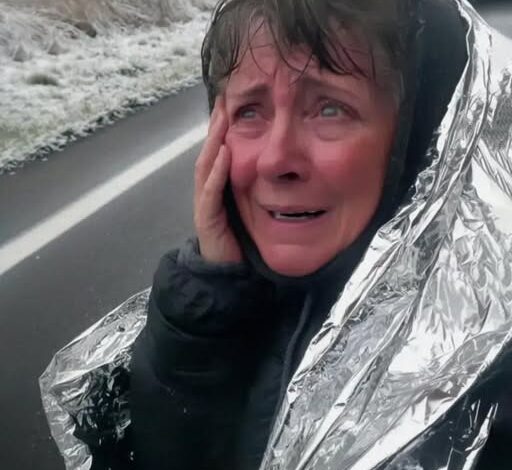
Next to the wreck sat an elderly woman who looked like the life had drained out of her. Her gray hair hung in damp strings, her hands shaking violently in her lap. She stared at the wreckage the way someone stares at the end of their own story. Three cars slowed down, assessed her like a problem too complicated to bother with, and sped away.
I felt something flare in me—anger, disbelief, I don’t know. I pulled onto the shoulder before I could talk myself out of it. As I stepped toward her, palms visible, I softened my voice. “Ma’am? Are you alright?”
Her eyes lifted slowly, like she’d been underwater for hours and was just now surfacing. “The brakes… they just stopped working,” she whispered. “I thought this was it for me.”
There was such defeat in her voice it rattled me. I jogged back to my car, grabbed the scratchy emergency blanket from my trunk, and draped it around her shoulders. She was trembling so hard I could feel it through the fabric. “You’re okay now,” I said, crouching beside her. “Just breathe with me. In. Out.”
That did it. Her composure cracked wide open. She collapsed into sobs so deep and raw they shook her entire body. I stayed next to her, steadying her shoulder, murmuring whatever reassurance I could manage. When she finally managed to speak again, she whispered, “I’m Ruth. I can’t believe you stopped.”
“I’m Leo,” I said. “And I’m staying with you until help gets here.”
I called 911, kept eye contact with her so she wouldn’t drift back into that hollow place, and waited for paramedics. When they arrived, she gripped my arm hard. “You probably saved my life today,” she said. Her eyes were wet, but steady now.
After the ambulance pulled away, I stood on the shoulder watching the flashing lights fade into the distance, feeling strangely wrung out. By the time I got home, Nina was doing her homework at the dining table, earbuds in. Life snapped back to normal—dinner, dishes, algebra. Two days passed without incident.
Then Mom called.
“Turn on the news right now!” she shrieked before I could even say hello.
My stomach knotted. I grabbed the remote and flipped through channels until I found the segment. There was Ruth, sitting in a studio, looking composed but emotional under the bright lights.
“It was the scariest moment of my life,” she said. “Dozens of people drove past. I thought I’d die right there. Then this man—this stranger—showed up and stayed with me until the ambulance came.”
The screen cut to grainy body-cam footage of me kneeling beside her, blanket around her shoulders. The reporter’s voice played over it: “His act of kindness likely saved her life.”
Then Ruth looked directly into the camera. “Leo, if you’re watching this… I’d love for you to visit my family’s café. I want to thank you properly.”
Mom was crying. Nina bolted into the room, phone in hand. “Dad, you’re trending! Can we go? Please?”
Her excitement made the decision for me.
That Saturday, Nina and I walked into a cozy café that smelled like cinnamon and fresh coffee. As soon as the bell on the door jingled, everyone turned. And then—unexpectedly—they applauded. Nina’s face lit up brighter than I’d seen in years.
Ruth hurried over, flour on her apron, and hugged me like a long-lost relative. “You came! Sit, sit. Everything today is on us. Your daughter is beautiful—what can I bring her? Hot chocolate? We make it by hand.”
She ushered us to a booth, then waved over a woman in her early thirties with warm eyes and a shy smile. “This is my daughter, Virginia.”
She set the drinks down, but her gaze rested on me longer than necessary. “There aren’t enough words to thank you for what you did,” she said softly.
We talked. All of us. Laughing, sharing stories, easing into something unexpectedly comfortable. One visit turned into two. Then three. Soon Saturdays at the café became tradition. Nina blossomed there—laughing, chatting, growing closer to Ruth and Virginia.
And somewhere along the way, Virginia and I began talking about deeper things. Loss. Parenting. Hope. She made me feel seen in a way I hadn’t let myself feel in years. When we finally went on a real date, Nina all but shoved me out the door.
“Dad, you deserve to be happy,” she said. “Mom would want this for you.”
Ruth cried when she found out. Virginia just squeezed my hand and smiled.
And I realized something: pulling over that Tuesday didn’t just help an elderly woman. It cracked open a future I’d assumed was closed to me forever. Love didn’t replace what I lost, but it found the space grief hadn’t filled.
Sometimes one small moment of choosing kindness is enough to restart an entire life.