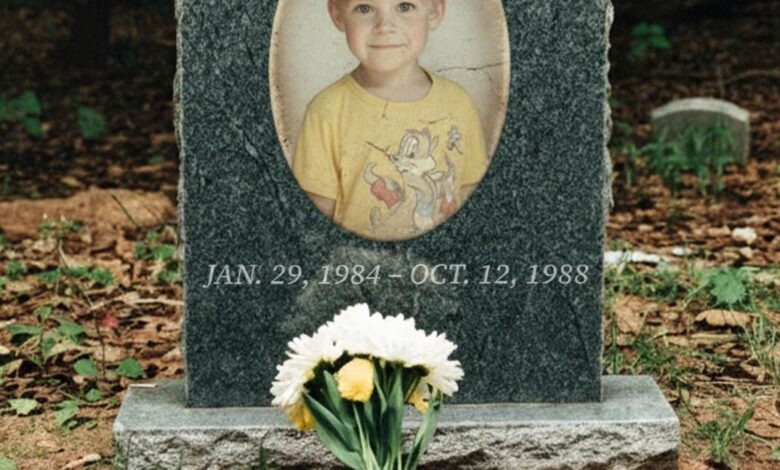
I Stumbled Upon a Headstone in the Woods and Saw My Childhood Photo on It – I Was Shocked When I Learned the Truth
We had only been in Maine for three weeks when everything shifted. After sixteen years in Texas, the cold felt like a reset button. The air was sharp enough to wake you from the inside out, and the silence around our new cottage was the kind that made your thoughts louder. Lily said the place smelled like Christmas. She’d stood barefoot at the back door that first morning, wrapped in one of my flannels, looking more peaceful than I’d seen her in years. Our son Ryan, eight years old and built entirely from enthusiasm and scraped knees, was adjusting a little faster than she was. Our Doberman, Brandy, spent his days discovering every twig, pinecone, and shadow on the property like it was personal business.
That Saturday we decided to wander into the woods behind the cottage to pick mushrooms—not the dangerous kind, just the ones Lily liked to sauté in butter until the house smelled like a cabin on a holiday postcard. Ryan charged ahead with a plastic bucket, sword-fighting ferns, while Brandy barked at every rustle. It was one of those perfect crisp days that slides peacefully into your memory even before it’s over. Until it took a turn.
Brandy’s bark dropped—lower, sharper, more serious. I looked up and Ryan was gone.
“Ryan?” I called, my voice tightening. “This isn’t a game. Answer me.” The woods swallowed the sound whole. Brandy barked again somewhere ahead, not frantic now, but urgent. I pushed through the underbrush, stepping over slick roots and ducking branches, the trail narrowing around me until the trees started blocking out the sun. The air cooled sharply. Something in my chest tightened.
“Lily, hurry!” I shouted back.
“I’m coming!” Her voice trembled somewhere behind me.
Then I heard it—not his voice, but his laugh. Light, relieved, completely unaware of the punch of fear still in my throat. Brandy barked again, but happier this time. I pushed forward faster, breaking through a wall of brush into a clearing I had never seen.
I froze.
Headstones. A handful of them, scattered among the moss and pine needles like forgotten pieces of another life. Lily stepped up beside me, breathing hard. Her eyes scanned the scene, unsettled and curious.
“What is this?” she whispered. “Those are graves, Travis. And… someone’s been tending them.” She pointed out the dried bouquets—dozens of them—laid carefully at several stones.
Before I could answer, Ryan called out, “Mom! Dad! I found something! It’s a picture of Dad!” He was crouched before a small headstone wedged between two elm trees. His finger traced something on its surface.
“What do you mean, a picture?” I asked, moving toward him. My stomach tightened. I already felt wrong.
“It’s you,” he said without turning. “Baby you. Like the picture above the fireplace.”
The world tilted when I saw it. Set into the stone was a small ceramic portrait, aged and chipped but unmistakably me at four years old. Same haircut, same uncertain stare, same yellow shirt from a torn Polaroid we kept in a drawer back home.
Beneath it: JANUARY 29, 1984. My birthday.
Lily grabbed my arm. “We need to go,” she said quietly. “This is too strange.”
But I couldn’t move. I couldn’t breathe. I touched the ceramic frame. It was ice-cold. Something deep inside me shifted—recognition I didn’t want.
That night, after we got home and Ryan fell asleep, I sat at the kitchen table staring at the photo on my phone. “This doesn’t make sense,” I muttered. “I’ve never been here. But that’s me.”
Lily sat across from me, hands wrapped around a mug she’d forgotten to drink from. “Travis, your adoption… Are you sure there wasn’t any mention of Maine?”
“No.” I ran a hand through my hair. “My adoptive mom told me she got me from a firefighter named Ed after I was found outside a burning house at four years old. No parents, no records. Just a note pinned to my shirt that said, ‘Please take care of this boy. His name is Travis.’”
Lily reached for my hand, squeezing gently. “Maybe someone here knows something. Maybe that’s why we ended up in this town.”
The next morning I went to the local library to ask about the land behind our cottage. The woman at the desk frowned. “There was a family living off-grid back there years ago,” she said. “Their cabin burned down. It was tragic. People don’t talk about it much anymore.” She slid a sticky note toward me. “If anyone knows the story, it’s Clara. Nearly ninety. Sells apples at the market. Lives at this address.”
I found Clara’s house tucked under heavy pine branches, lace curtains in every window. When she opened the door and saw me, her eyes widened like she’d been waiting her whole life for this moment.
“You’re Travis,” she said softly. Not asked—stated.
Inside, her living room smelled like cedar and old paper. She took my phone, examined the headstone photo, and her hands started trembling.
“That picture was taken by your father,” she said. “Your real father. The day after you and your brother turned four.”
My heart dropped. “Brother?”
“Your twin,” she said. “Caleb. You two were identical. Always together.”
I felt the room sway. “Why didn’t anyone tell me?”
“Because your family’s cabin burned down that winter,” she said quietly. “Your parents and one child were found. Everyone assumed the other was gone too.”
“But I wasn’t,” I said.
“No. You weren’t.”
I asked how I’d ended up in Texas, but Clara didn’t have that answer. She only knew that the fire erased almost everything—records, belongings, history. And after the tragedy, my father’s younger brother, Tom, returned to the property and placed memorial stones. Including mine.
“Why put my photo on a grave if no one knew I was dead?” I asked.
“Because hope and grief do strange things,” she said.
Tom lived on the edge of town. When he opened the door and saw me, he stared long enough to make my skin prickle. Then he whispered, “You look exactly like your father.”
Inside, his house was warm and cluttered with bird feeders and old books. He told me he never believed both boys had died. “Your mother would’ve tried to save you,” he said. “She would’ve carried at least one of you out of that fire.”
We spent the afternoon sifting through his old boxes—charred drawings, smoke-damaged birthday cards, pieces of a life I never got to know. At the bottom, I found a tiny yellow shirt, scorched at the sleeve. Mine.
A week later, Lily and I returned to the clearing with Tom. Ryan stood beside me as I placed the old birthday card at Caleb’s headstone.
“Dad? Are we visiting your brother?” he asked.
“Yeah,” I said quietly. “His name was Caleb.”
“I wish I could’ve met him,” Ryan murmured.
“Me too,” I said, resting a hand on his shoulder.
The trees swayed. Brandy sniffed the ground. And for the first time, the headstone didn’t feel like a threat—it felt like a doorway that had finally opened.
Maybe someone wrote that note to save me. Maybe someone carried me out of the fire. Maybe someone believed I deserved a life far away from tragedy. And maybe, after all these years, the woods had simply decided to return me home.