I Walked My Neighbors Daughter to School Every Morning, One Day, My Life Turned Upside Down Because of It
For two years, I walked my neighbor’s daughter to school every morning. She held my hand, talked nonstop, and eventually started calling me Daddy. I never corrected her. I didn’t know how. Then one morning, a man who looked exactly like her showed up, took her by the hand, and told me he had an offer that would change both our lives forever.
It started on an ordinary morning after a night shift. I was walking home, tired and half-asleep, when I heard a child crying. Not loud, dramatic sobbing—just that quiet, exhausted crying that comes after someone’s been hurting for a while.
I followed the sound. I don’t think I even made a conscious decision.
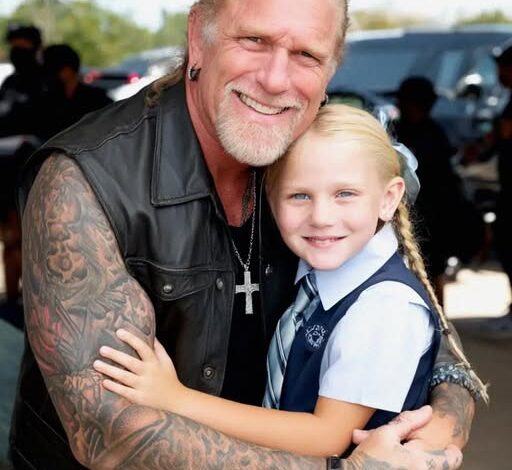
I found her sitting by a dumpster behind an apartment building. She couldn’t have been older than six. She was in a school uniform, knees tucked to her chest, backpack on the ground beside her, clutching a little lunch bag like it was an anchor.
“Hey,” I said gently. “Are you okay?”
She looked up at me like she’d forgotten other people existed. Her eyes were swollen and red, but dry.
“They’re all gonna have their dads,” she said.
“Who is?” I asked, crouching a few feet away.
“Everyone at school. Today’s daddy-daughter day.” She sniffed and wiped her nose on her sleeve. “I don’t have anybody.”
She told me her dad was in prison. Her mom had died years ago. She lived with her grandmother, who could barely walk. That morning, her grandma had told her to go alone.
Something in my chest cracked open.
I was fifty-six years old, and once upon a time, I’d believed I’d have a family. A fiancée. A future. A house filled with noise and life.
A week before my wedding, my fiancée sat me down and told me she was pregnant—with her boss’s child. She packed a bag and left. Just like that.
That was the day everything collapsed.
I spent years numb. Depressed. Convinced I wasn’t meant for love or family. Motorcycles saved me. The road. The silence. The rules. For three decades, that was enough to keep me standing.
But standing in front of that little girl, something I’d buried deep stirred awake.
I asked her name. Marissa.
I asked about her grandma. She nodded and said she got tired a lot.
I didn’t overthink it. I didn’t worry about how it might look. I just said it.
“I could walk with you today. If you want. If your grandma’s okay with it.”
Her face lit up like someone had turned on the sun.
She grabbed my hand, tight, like she was afraid I’d vanish.
Her grandmother answered the door—a frail woman with trembling hands and tired eyes. She looked at us for a long moment. Then she nodded.
“Thank you,” she said quietly.
At school, Marissa never let go of me. She told everyone I was her “angel man.” When I brought her home, her grandmother thanked me again. Marissa hugged me and asked when I’d come back.
I told myself I wouldn’t.
I came back the next morning.
And the next.
Every day at seven, she waited on the porch, backpack ready, eyes scanning the street. When she saw me, her face would light up, and that was it. I was done for.
Six months later, at a school breakfast, she stood up on a chair and announced, “This is my Daddy Mike.”
I opened my mouth to correct her, but her grandmother touched my arm.
“If calling you daddy helps her heal,” she said softly, “please don’t take that away.”
So I became Daddy Mike.
Not on paper. Just in her heart.
In mine too.
Every morning, she’d look up at me and ask if I’d ever leave her like her real dad. I always said no. I meant it.
Then one morning, everything shattered.
I walked up to her porch at the usual time and saw a man holding her hand. She was pulling back, crying. When she saw me, she screamed my name.
The man turned. Same eyes. Same nose. Hard expression.
“I’m her uncle,” he said. “We need to talk. I have a deal for you.”
Her grandmother had died that morning. Hospice. Quiet. Final.
He didn’t soften it. Didn’t mourn. He said he didn’t want Marissa. He had a life elsewhere. Kids. A job. Responsibility wasn’t something he was interested in inheriting.
He gave me two options: he’d take her across state lines, uproot her, and she’d “adjust.” Or I could keep her.
Adopt her. Clean break.
The way he said it—like she was an object—made my stomach churn.
I was terrified. Too old. Too afraid. What if I failed her? What if I died and left her alone again?
Then I looked at Marissa. Standing there in her school uniform, tears on her face, looking at me like I was the only solid thing she had left.
“I’ll take her,” I said.
She ran into my arms and held on like she’d been holding on her whole life.
That night, I tucked her into bed in my house. She asked if I was leaving. I told her no. She fell asleep holding my hand.
The next morning, we walked to school like always. At the front desk, the secretary slid a form across the counter.
“Guardian?” she asked.
“Yes,” I said, taking the pen.
For the first time in thirty years, my life didn’t feel empty. It felt full.