I Walked Out on My New Husband at Our Wedding Reception—After What He Did – Wake Up Your Mind
I had always imagined my wedding day as a quiet promise to myself, a moment where everything I had worked for, hoped for, and believed in would finally make sense. I wasn’t chasing perfection or fairy-tale theatrics. I just wanted a day that felt intentional, respectful, and honest. A day that reflected love, not spectacle.
I paid for that day myself.
Every last detail.
The venue with its wide windows and soft ivory walls. The flowers were arranged just the way I wanted, simple, elegant, unfussy. The photographer whose portfolio I’d studied for weeks. The music, the seating, the cake. All of it came from my savings, my planning spreadsheets, and countless late nights making decisions alone. My parents helped where they could, but I never wanted to burden them. This was my responsibility, my vision, my commitment.
And when my new husband chose to humiliate me at our reception, I walked away without a word—and never went back.
Calvin and I had been together for just over three years when we got married. Ours was not one of those relationships that people described as effortless. We didn’t finish each other’s sentences or share every passion. But we loved each other—or at least, I believed we did—and we had learned to navigate our differences.
We bonded over long hikes that left our legs aching and our minds clear. We spent lazy Sunday mornings flipping pancakes, arguing about whether blueberries belonged in the batter, and watching old black-and-white films on my laptop. Those were the moments I held onto when things felt off.
Because things often felt off.
One of the biggest cracks between us was Calvin’s obsession with pranks.
He called them jokes. Harmless fun. Proof that he didn’t take life too seriously.
I hated them.
Not in a mild, eye-rolling way, but in a deep, visceral way that made my stomach knot. I didn’t like being startled, embarrassed, or made into the punchline of someone else’s amusement. I’d told him that early on—clearly, directly, more than once.
He’d laugh it off.
“Relax,” he’d say. “You’re too tense. You need to loosen up.”
So I compromised. Or rather, I swallowed my discomfort.
I smiled when he switched the sugar for salt. I laughed weakly when he pretended to forget important plans just to see my reaction. I told myself that relationships required flexibility, that love meant choosing your battles. I didn’t want to be labeled difficult or humorless. I didn’t want to be the woman who “couldn’t take a joke.”
By the time we got engaged, the imbalance between us had become undeniable.
I was the planner. The organizer. The adult.
I handled the budget, the appointments, and the vendor calls. I tracked deadlines and RSVPs. Calvin’s involvement rarely extended beyond nodding vaguely and saying, “Sure, that’s fine.” He promised to mail the invitations and then sent half of them late. When I reminded him, he shrugged.
“It’ll work out,” he said.
I told myself he’d step up when it mattered.
I told myself a lot of things.
On the morning of the wedding, I woke up calm.
Not giddy. Not nervous. Just quietly determined to enjoy the day I had worked so hard to create.
My mother helped pin small pearl clips into my hair, the same ones we’d chosen together months earlier. I followed makeup tutorials obsessively in the weeks leading up to the wedding—not for social media, not for anyone else, but because I wanted to feel like the best version of myself. Confident. Radiant. Seen.
I remember thinking, as I looked at my reflection, that maybe this was the day Calvin would finally look at me the way I had always looked at him—with care, admiration, and respect.
The ceremony itself was beautiful.
The light streamed in just right. Our vows were simple and heartfelt. I felt my eyes sting with tears as I spoke mine, my voice trembling despite my efforts to stay composed. Calvin smiled but didn’t cry. I noticed, but I told myself that people expressed emotion differently.
For a moment—just a moment—I believed in us completely.
Then we moved on to the reception.
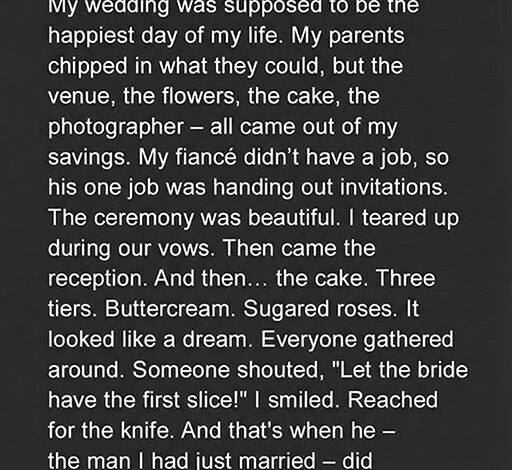
The atmosphere shifted into celebration. Music filled the space. Glasses clinked. Guests laughed and danced. I allowed myself to relax, to feel proud. When the cake was wheeled out—a three-tier buttercream design I had agonized over for weeks—I felt a swell of satisfaction.
Someone called out, “Let the bride have the first slice!”
I stepped forward, smiling, reaching for the knife.
That was when it happened.
I felt a sudden, forceful shove from behind.
Before I could react, my face collided with the cake.
Frosting clogged my nose and mouth, stealing my breath. Buttercream smeared across my lashes, blinding me. My veil stuck to the icing, tugging painfully at my hair. For a split second, the room went silent.
Then someone laughed.
I stood there, frozen, my chest heaving, my heart pounding so hard it hurt. My makeup melted off my face in streaks. All that time, all that care—ruined in an instant.
Calvin was laughing.
Not chuckling. Not apologizing.
Laughing.
When he noticed my expression, his smile faltered slightly, replaced by irritation.
“Oh, come on,” he said. “It’s just a joke. Lighten up.”
I wanted to scream. I wanted to ask him how he could do this—how he could choose humiliation over kindness on the one day that was supposed to belong to us.
But I couldn’t breathe properly. The smell of sugar made me gag. My throat burned with unshed tears.
And some small, exhausted part of me knew that reacting would only feed him.
Someone reached toward me with a napkin, but I barely registered it. I turned and pushed my way through the crowd, my vision blurred by tears and frosting.
That was when I saw him.
One of the servers stood near the exit, watching me with quiet concern. He looked young, maybe in his early twenties, dressed neatly, his expression steady amidst the chaos. When he saw me rushing toward the door, he stepped forward without hesitation and handed me a clean cloth napkin.
No words.
No staring.
Just understanding.
I took it, nodded, and wiped my face. In that brief moment, his simple kindness felt like a lifeline.
Then I left.
I didn’t stay for the dancing. I didn’t say goodbye to anyone. I drove home alone, still wearing my ruined dress.
Calvin returned hours later.
I was sitting on the edge of the bed, unmoving, my veil torn, cake still tangled in my hair.
He didn’t ask if I was okay.
“You embarrassed me,” he said flatly. “Everyone was staring. You couldn’t just laugh it off?”
I reminded him—quietly—that I had told him how much I hated pranks. That he had promised.
He rolled his eyes.
“It was cake,” he snapped. “You’re too sensitive.”
That was the moment everything became clear.
This wasn’t thoughtlessness. It was a choice.
The next morning, I filed for divorce.
He didn’t fight it.
“Fine,” he said. “I don’t want to be married to someone who can’t take a joke.”
The weeks that followed were a blur of grief and numbness.
I barely left my apartment. I deleted every wedding photo. I stopped answering calls. I felt foolish, humiliated, and hollow.
But slowly—almost imperceptibly—things began to shift.
I started cooking meals that nourished me. Taking evening walks. Buying flowers for no reason. Reclaiming pieces of myself I had abandoned.
One night, scrolling through social media, I received a message.
“Hi. You probably don’t remember me. I was one of the servers at your wedding. I saw what happened. I just wanted you to know—you didn’t deserve that.”
His name was Jonah.
We talked.
Then we talked some more.
He listened. He remembered. He never rushed me.
Coffee turned into dinners. Dinners into long walks and quiet laughter.
When I finally told him everything, he took my hand and held it like it mattered.
“You deserved kindness,” he said. “Always.”
Today, we celebrate ten years of marriage.
We live in a small house with a yellow door. We plant tomatoes every spring. We watch old movies under the same blanket.
Sometimes he hugs me from behind and whispers, “You still look better than that cake.”
And I laugh—because now I know what love really looks like.
It looks like respect.
It looks like safety.
It looks like home.