I Was Asked to Train My Higher-Paid Replacement, So I Taught My Boss an Unexpected Lesson!
I found out I was being replaced on a Tuesday morning—the kind of day that starts ordinary but ends up rearranging your entire sense of worth. My boss called me into his office, fake sympathy plastered across his face, and told me they were “moving in a different direction.” Before I could even absorb it, he added that I’d be training the new hire who would take over my role. No warning. No apology. No severance discussion. Just expectation.
I agreed, because shock has a way of making you compliant before the anger shows up.
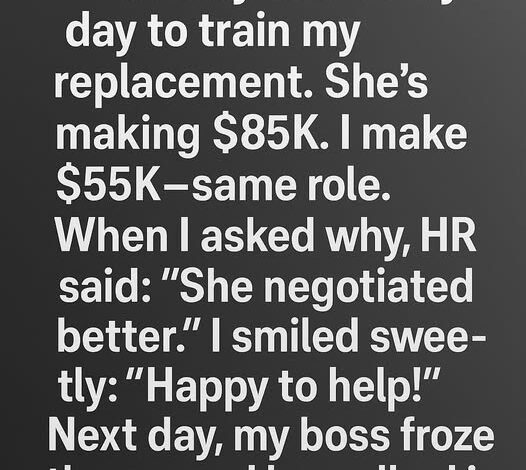
A day later, curiosity got the better of me. I checked the internal system for her job posting, the one I was supposedly “no longer a fit” for. What I saw froze me in place: they were offering her $30,000 more than what I was making.
Same title. Same duties. Same everything—except the salary gap big enough to choke on.
When I confronted HR, they didn’t blink.
“She negotiated better,” the rep said with a shrug, as if being underpaid for years was my personal failure. “It happens.”
Something inside me snapped cleanly. Not loudly. Not theatrically. Just a cold, sharp clarity. If they thought I was going to crumble, cry, or cling to the job, they had chosen the wrong person to underestimate.
So I trained my replacement—but not the way they imagined.
I followed my job description to the letter. Only the letter. Every unwritten task, every “quick favor,” every emergency patch job, every piece of institutional knowledge I had quietly carried like a second job—I dropped them. I made management handle anything that wasn’t explicitly documented.
The new hire, Clara, was smart—smart enough to recognize something was off. On her second day shadowing me, she frowned and asked, “Wait… who handles vendor escalations?”
“That’s not part of my role,” I said, and pointed her toward my boss.
On the third day: “Who communicates with the regional teams about system outages?”
“Also not part of my role.”
By day five: “Who fixes the reporting errors when the dashboard crashes?”
I smiled. “You should ask management. They’ll know.”
Except they didn’t know. Because they had leaned on me for years without noticing, or caring, how much I carried. Watching the realization slowly spread across their faces was its own kind of justice. My boss started hovering. HR started checking in. The panic was visible.
Meanwhile, Clara was piecing it together too—the pay gap, the invisible labor, the decades-old culture of squeezing loyalty out of employees like juice from an orange. At lunch she whispered, “I’m really sorry. You deserved more.”
“I know,” I said simply. And I meant it.
On my last day, I walked in early, cleaned my desk, and handed in a resignation letter so short it could’ve been a text message. No drama. No emotion. Just a clean break.
My boss sputtered something about “proper notice.” I reminded him, gently, that he had already replaced me. And training my replacement was notice enough.
They didn’t even know what they didn’t know until I was already walking out the door.
What happened next was predictable: missed deadlines, snarled workflows, confused clients, errors piling up like snowdrifts. The tasks that “weren’t part of my role” but that I had handled anyway came roaring back as operational failures no one was prepared for. My boss ended up pulling late nights, doing work he didn’t understand, scrambling to keep the ship from sinking under the weight of his own negligence.
Meanwhile, I accepted a new role with a company that didn’t blink when I stated my salary requirements upfront. I matched Clara’s salary—then added a number that reflected my actual worth. They agreed.
Turns out, negotiating isn’t about arrogance. It’s about refusing to apologize for your value.
Looking back, the betrayal doesn’t sting the way it did at first. What lingers is something quieter, stronger: the certainty that walking away wasn’t just the right move—it was overdue. I had been shrinking myself to fit into a place that had never intended to grow with me.
Training my replacement didn’t break me. It broke the illusion that my loyalty was ever being repaid.
And stepping into a job that values me—not just my work, but me—made one thing clear: the moment you stop begging to be seen, the world has no choice but to look up.