I’m A 68-Year-Old Biker Who Just Adopted The Baby Nobody Else Would Take
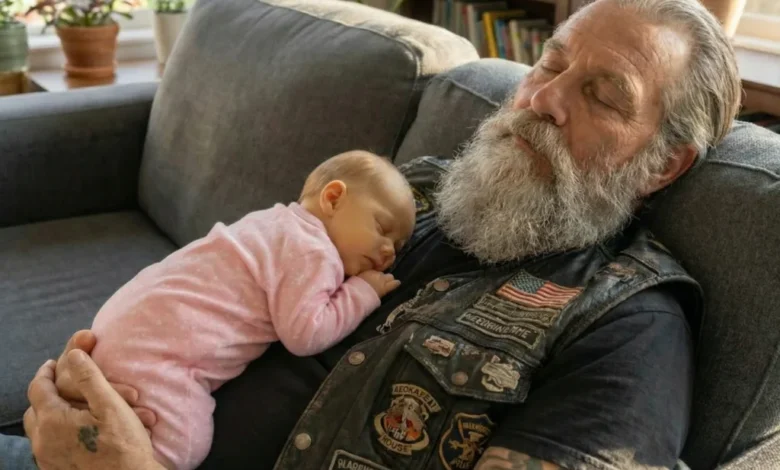
I’m 68 years old, I ride a Harley, and three weeks ago I became a father for the first time. The baby nobody else wanted is sleeping in a crib in my living room right now.
Her name is Maya. She’s four months old. She has Down syndrome, a heart defect, and she was born addicted to methamphetamine.
The social worker told me she’d been in the system for three months. Twelve families looked at her file. Not one of them said yes.
Too many medical problems. Too much risk. Too expensive. Too complicated.
Maya was headed for institutional care. A group home for medically fragile children. She would have grown up there. Probably died there.
I met her by accident.
I was at the hospital visiting my buddy Carlos. He’d had bypass surgery. I was bringing him magazines and giving him grief about his diet.
On my way out, I got turned around. Ended up on the wrong floor. The NICU. I was about to leave when I heard a baby crying.
Not normal baby crying. The kind of crying that sounds like giving up.
A nurse came out looking exhausted. She saw me standing there in my leather vest and patches.
“Can I help you?” she asked.
“Wrong floor. Sorry.”
She nodded. Then stopped. “You look like someone who doesn’t give up easy.”
“Excuse me?”
“That baby in there. Room 412. She’s been crying for two hours. Nothing works. She just cries. Like she knows nobody’s coming for her.”
I don’t know why I asked. But I did.
“Can I try?”
The nurse looked at me like I was crazy. Then she said, “Wash your hands first.”
Maya was tiny. Five pounds. Tubes and wires everywhere. Her face was red from crying.
The nurse handed her to me. Showed me how to support her head.
“Her name’s Maya,” she said. “She doesn’t have a family. She’s a ward of the state.”
I held Maya against my chest. Started humming. Nothing in particular. Just a low rumble.
She stopped crying.
After a few minutes, she was quiet. Her tiny hand gripped my finger.
“I’ll be damned,” the nurse said.
I sat in that rocking chair for forty minutes. Just holding her. When I handed her back, Maya started crying again.
“You can come back tomorrow if you want,” the nurse said.
I came back every day for two weeks.
On the tenth day, a woman in a suit came in. Beth from Child Protective Services.
“The nurses told me about you,” she said. “Why do you keep coming?”
“Because she needs someone.”
Beth sat down. “Maya is medically complex. She needs surgeries. Special care. She’s going to institutional placement.”
“You mean you’re giving up on her.”
“We don’t have another option. Nobody will take her.”
I looked at Maya sleeping against my chest.
“I will,” I said.
That conversation changed my life.
Beth tried to talk me out of it. Listed every reason I shouldn’t adopt Maya. My age. My lifestyle. The medical needs. The cost.
I listened to all of it. Then I said, “She deserves better than an institution. If nobody else will give her a home, I will.”
Beth stared at me for a long moment. “I’ll start the paperwork.”
The next three months were a blur.
Background checks. Home studies. Medical evaluations. I took classes on caring for children with Down syndrome. Learned about feeding tubes and medications. Went to workshops on early intervention and physical therapy.
My house got inspected four times. They checked everything. Smoke detectors. Cabinet locks. Water temperature. Whether I had enough money to support a child long-term.
I passed every check.
But the hardest part wasn’t the paperwork. It was telling people what I was doing.
My daughter Lisa called when she heard. She lives in Oregon with her husband and two kids. We talk maybe once a month.
“Dad, are you serious?” she asked.
“Very serious.”
“You’re 68 years old. You can barely work your smartphone. How are you going to raise a special needs baby?”
“I’ll figure it out.”
“This isn’t like getting a dog. This is a lifetime commitment.”
“I know what it is, Lisa.”
“Do you? Because Mom died three years ago and you’ve been alone since then. Is this about being lonely? Because there are better ways—”
“This isn’t about me being lonely. This is about a baby who needs a home.”
“There are younger people. Couples. People who actually know what they’re doing.”
“Twelve families said no. Twelve. She was going to a group home.”
Lisa was quiet for a moment. “I just don’t want you to get hurt. What if something happens to you? What happens to her?”
“I’ve got a will. I’ve got life insurance. I’ve made arrangements.”
“With who?”
“People who will take care of her if I can’t.”
She sighed. “You’re really doing this.”
“Yes.”
“Then I guess I’m going to be a big sister.”
That made me smile. “I guess you are.”
My motorcycle club had mixed reactions.
Some of the brothers thought I’d lost my mind. A few made jokes. Called me grandpa. Said I was too old for this.
But most of them understood.
Danny, our club president, came over the day before Maya’s placement. Brought three other brothers. They helped me set up the nursery.
We assembled the crib. Put up shelves. Painted the walls yellow. Installed a baby monitor.
“You know what you’re getting into?” Danny asked while we were painting.
“No idea.”
“You’ll be 80 when she’s in middle school.”
“If I’m lucky.”
“She’s going to need you for everything. For decades.”
“I know.”
He set down his brush. “Why, Jack? Really. Why are you doing this?”
I thought about that question. I’d been asking myself the same thing for three months.
“My wife Sarah and I tried to have kids for ten years,” I said. “We had Lisa, and then nothing. Miscarriages. Failed treatments. We wanted more but it never happened.”
Danny nodded. He knew this story.
“When Sarah died, I thought that was it. Thought I’d just ride out my remaining years alone. Go on runs. Fix bikes. Wait to die.”
“That’s dark, brother.”
“It’s true. I didn’t have a purpose anymore. Then I held Maya and something clicked. Like maybe this is why Sarah and I couldn’t have more kids. Because I was supposed to be here now. For her.”
“You believe that?”
“I don’t know. But it feels right. And that’s enough.”
Danny clapped me on the shoulder. “Then we’ve got your back. Whatever you need.”
“I’m going to need a lot.”
“We know. That’s what brothers are for.”
Maya came home on a Tuesday in September.
Beth brought her in a car seat that looked bigger than she was. She showed me everything one more time. Medications. Feeding schedule. Warning signs for heart problems. When to call 911.
“You can still change your mind,” Beth said. “It’s not too late.”
“I’m not changing my mind.”
She handed me the car seat. “Then she’s yours. Officially.”
I looked at Maya. She was awake, staring at me with those big dark eyes.
“Hey baby girl,” I said. “Welcome home.”
Beth left after an hour. Promised to check in regularly. Said she’d be back in two weeks for a home visit.
Then it was just me and Maya.
I set the car seat on the floor. Unbuckled her. Picked her up.
She was so small. So fragile. I was terrified I’d break her.
“Okay,” I said out loud. “We can do this.”
Maya made a small sound. Not crying. Just acknowledging me.
I carried her around the house. Showed her everything. “This is the kitchen. This is where we’ll make your bottles. This is the living room. That’s my chair. That’ll be your chair when you’re bigger.”
I took her to the nursery. “This is your room. Uncle Danny and the brothers helped paint it. You like yellow?”
She yawned.
“I’ll take that as a yes.”
I sat in the rocking chair. The one I’d bought specifically for this. Started rocking. Humming the same tune I’d hummed in the hospital.
Maya’s eyes got heavy. She fought it for a while. Then gave in.
She fell asleep on my chest. Her tiny hand curled against my shirt.
I sat there for two hours. Just holding her. Watching her breathe.
This was real. This was my life now.
I was 68 years old and I was somebody’s dad.
The first week was brutal.
Maya woke up every two hours. Day and night. She needed bottles, diaper changes, medications. I was running on maybe three hours of sleep total.
I burned through my freezer meals in four days. Forgot to eat lunch twice. Wore the same shirt for three days because I couldn’t find time to do laundry.
Danny stopped by on day five. Took one look at me and said, “You look like hell.”
“Thanks.”
“When’s the last time you slept?”
“What day is it?”
He grabbed Maya from my arms. “Go sleep. Two hours. I’ve got her.”
“You know how to—”
“I raised three kids. I know how to hold a baby. Go.”
I slept for three hours. Woke up in a panic. Ran to the living room.
Danny was on the couch with Maya on his chest. Both of them were asleep.
“She’s fine,” Danny said without opening his eyes. “Took a bottle an hour ago. Changed her diaper. She’s good.”
I sat down in my chair. “I don’t know if I can do this.”
“Yes you can.”
“I’m exhausted. And this is just the beginning. She’s got surgery next month. Years of therapy after that. What if I can’t keep up? What if I’m too old?”
Danny opened his eyes. “Jack. You rode through a firefight in Vietnam. You stayed sober when everyone said you’d relapse. You held your wife’s hand while she died and didn’t fall apart. You can handle one tiny baby.”
“It’s different.”
“How?”
“I don’t want to let her down.”
“Then you won’t. You’re not a quitter. Never have been.”
Maya stirred. Made a small sound. Settled back down.
“She trusts you,” Danny said. “That’s all that matters.”
Week two got easier. I figured out a routine. Bottles at midnight, 3 AM, 6 AM, 9 AM. Naps in between. Medications with the 9 AM and 9 PM bottles.
The brothers started rotating through. Bringing food. Doing laundry. Holding Maya so I could shower.
Tommy, one of the younger members, came by every other day. He had a two-year-old at home. He taught me things the classes hadn’t covered. How to burp her properly. How to tell the difference between hungry crying and tired crying. How to do a diaper change with one hand.
“You’re a natural,” he said one afternoon.
“I’m faking it.”
“We’re all faking it. That’s parenthood.”
Lisa called every few days. Asked how it was going. If I needed anything.
On week three, she said, “I’m coming to visit next month.”
“You don’t have to do that.”
“I want to meet my sister.”
That word hit me. Sister. Maya had a sister. Family.
“She’d like that,” I said.
Maya’s first doctor’s appointment was on week three. Her pediatric cardiologist. Dr. Patel.
He examined her thoroughly. Listened to her heart. Checked her oxygen levels. Looked at her chart.
“Her heart function is stable,” he said. “But she’ll need surgery soon. The defect isn’t going to fix itself.”
“How soon?”
“Next month. Maybe sooner if she starts declining.”
“What are the risks?”
Dr. Patel was quiet for a moment. “It’s open heart surgery on a four-month-old. There are always risks. But without it, she won’t survive past a year.”
My stomach dropped. “What are her chances? With the surgery?”
“Seventy percent survival rate. Maybe higher. She’s small but she’s strong. I’ve seen babies in worse shape make it through.”
Seventy percent. That meant thirty percent chance she wouldn’t make it.
“When do we schedule it?” I asked.
“I’ll have my office call you. Probably three to four weeks out.”
I carried Maya out to my truck. Buckled her into her car seat. Sat in the driver’s seat for ten minutes.
Seventy percent.
I’d faced worse odds in Vietnam. But those odds were for me. Not for a baby I’d promised to protect.
“We’ll get through this,” I told Maya. “You’re a fighter. I know you are.”
She looked at me with those big eyes. Like she understood.
The brothers held a meeting that night. Called it a “club business” but it was really about Maya.
Danny stood up. “Jack’s baby has surgery next month. Recovery is going to be rough. He’s going to need help.”
“What kind of help?” someone asked.
“Everything. Food. Rides to appointments. Someone with him at the hospital. Someone watching his house. Everything.”
Tommy raised his hand. “I’ll coordinate a meal train. My wife can organize it.”
“I’ll handle hospital visits,” another brother said. “Make sure he’s not alone.”
“I’ll do yard work,” someone else offered. “House maintenance. Whatever needs doing.”
One by one, every member volunteered something. Time. Money. Skills. Support.
Danny looked at me. “You’re not doing this alone, brother. We’ve got you.”
I couldn’t speak. Just nodded.
Maya’s surgery was scheduled for October 15th. Three weeks away.
Those three weeks crawled by. Every day I watched her. Memorized her face. The way she smiled when she woke up. The sound she made when she was hungry. How she gripped my finger while she fell asleep.
I took pictures. Hundreds of them. Maya in her crib. Maya in my arms. Maya with the brothers.
Just in case.
Lisa arrived two days before the surgery. She walked in, saw Maya, and started crying.
“She’s so small,” Lisa said.
“I know.”
“And you’re really doing this. You’re really her dad.”
“I’m really her dad.”
Lisa held Maya for an hour. Talked to her. Told her about her nephews. About Oregon. About Grandma Sarah.
“Mom would have loved her,” Lisa said.
“Yeah. She would have.”
That night, after Lisa went to bed in the guest room, I sat in the rocking chair with Maya. It was 2 AM. She was asleep but I couldn’t put her down.
“You have to make it through this,” I whispered. “You have to. Because I don’t know what I’ll do if you don’t.”
She shifted in her sleep. Her hand found my finger. Held on.
“I know I’m old. I know I’m not what you would have picked. But I love you. And I’m not going anywhere.”
Surgery day was the longest day of my life.
We had to be at the hospital at 5 AM. They took Maya back at 7 AM. Said the surgery would take four to six hours.
I sat in the waiting room with Lisa and Danny. Couldn’t read. Couldn’t talk. Just waited.
At hour three, a nurse came out. “Everything’s going well. Dr. Patel will update you when they’re done.”
At hour five, I started pacing.
At hour six, Dr. Patel came through the doors.
I stood up. Couldn’t breathe.
He smiled. “She did great. Surgery was successful. She’s in recovery now.”
I had to sit down. My legs gave out.
“She’s okay?” I asked.
“She’s okay. It’ll be a long recovery. But she made it through.”
Lisa was crying. Danny had his hand on my shoulder.
“When can I see her?” I asked.
“Give us an hour. We’ll come get you.”
They let me into the PICU an hour later. Maya was in a bed surrounded by machines. Tubes and wires everywhere. But her chest was rising and falling. She was breathing.
I pulled a chair next to her bed. Took her tiny hand in mine.
“You did it, baby girl,” I whispered. “You’re so strong. So brave.”
Her eyes fluttered open. Just for a second. She looked at me. Then closed again.
But I saw it. Recognition. She knew I was there.
Recovery took six weeks. Six weeks of hospital rooms and medications and scares where her oxygen dropped and nurses rushed in.
But Maya fought. Every single day, she fought.
The brothers rotated through. Brought food. Sat with me. Held Maya when the nurses said it was okay.
Lisa stayed for two weeks. Then had to go back to her family. But she called every day.
On week four, they moved Maya out of the PICU. Said she was doing better than expected.
On week six, Dr. Patel said we could go home.
Bringing Maya home the second time felt different than the first.
The first time, I was terrified. Didn’t know what I was doing. Wasn’t sure I could handle it.
This time, I knew it would be hard. I knew there would be sleepless nights and scary moments and times I’d doubt myself.
But I also knew I’d do it anyway.
Because she was mine. And I was hers.
It’s been four months since the surgery. Maya is nine months old now. She’s gaining weight. Hitting milestones. Smiling all the time.
She has therapy three times a week. Physical therapy to help her get stronger. Occupational therapy for her hands. Speech therapy even though she can’t talk yet.
I take her to every appointment. Do her exercises at home. Celebrate every tiny victory.
Last week, she rolled over on her own for the first time. I called Danny immediately. He came over and we celebrated like she’d won the Olympics.
“That’s my girl,” I told her. “You’re doing so good.”
She smiled at me. That smile that makes everything worth it.
People still ask me why I did this. Why I adopted a medically fragile baby at 68 years old.
The answer is different now than it was in the beginning.
In the beginning, I said it was because someone had to. Because she needed a home and nobody else would give her one.
But that’s not the whole truth.
The truth is Maya saved me as much as I saved her.
I was 68 years old and alone and waiting to die. I didn’t have a purpose anymore. Didn’t have a reason to get up in the morning.
Then I held a crying baby and everything changed.
Now I have a reason. I have someone who needs me. Someone who lights up when I walk into the room. Someone who holds my finger like I’m her whole world.
Because I am. And she’s mine.
Is it hard? Yes. Am I exhausted? Every day. Am I scared something will happen to her? Constantly.
But I’m also happier than I’ve been in years.
Maya’s not nobody’s baby anymore.
She’s mine.
And I’m the luckiest man alive.