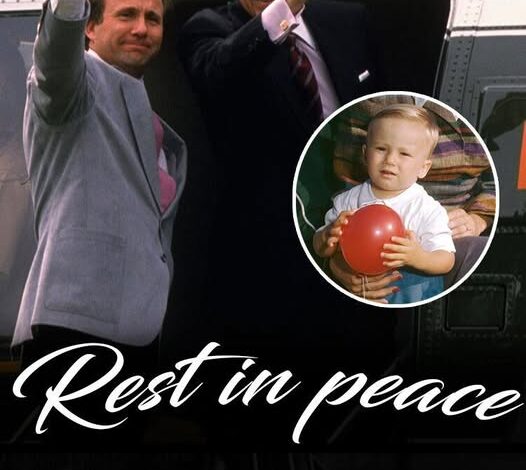
Michael Reagan, eldest son of President Ronald Reagan, died at 80.
Michael Reagan’s life unfolded in the space between prominence and uncertainty. Adopted at birth into one of America’s most recognizable political families, he carried the Reagan name without the guarantees of belonging it seemed to imply. From an early age, identity felt less inherited than negotiated.
Learning of his adoption not from his parents but from his sister left an early fracture. As Ronald Reagan’s public life expanded, Michael often experienced family through absence rather than presence. It was not cruelty that marked those years, but distance—missed moments that quietly accumulated into the sense that history frequently took precedence over intimacy.
Unlike children who either rebel against or uncritically sanctify powerful parents, Michael chose a more difficult middle ground. He honored his father’s legacy while speaking honestly about disappointment and emotional separation. Respect and grief coexisted, producing a relationship shaped less by open conflict than by unresolved complexity.
That willingness to confront discomfort extended beyond family dynamics. When Michael publicly disclosed that he had been sexually abused as a child, he did so without spectacle. At a time when male survivors—particularly those connected to conservative public life—rarely spoke openly, his decision carried quiet courage. He chose disclosure not as accusation, but as truth-telling, challenging assumptions about power, protection, and silence.
Faith became central to his healing. Michael described himself as “twice adopted,” a phrase that reflected not denial of pain but its reframing. Forgiveness, as he understood it, did not erase harm or minimize accountability. It allowed survival without surrendering to bitterness.
In his career as a conservative commentator and radio host, Michael brought an empathy shaped by lived vulnerability. He defended his father’s presidency while resisting simplification, reminding audiences that public achievement often extracts private cost. His loyalty never required self-erasure, and his criticism never curdled into resentment.
In this way, Michael Reagan complicated the Reagan legacy by humanizing it. He demonstrated that fidelity to family and truth are not opposites, and that strength can exist without silence. His life stood as evidence that honesty, even when uncomfortable, can be an act of integrity rather than disloyalty.
With his death at 80, Michael Reagan is remembered not only as the son of a president, but as a man who insisted on authorship of his own story. His legacy lies in showing that even in the long shadow of power, an individual life can claim clarity, voice, and light.