My Husband Dumped Me on the Roadside 30 Miles from Home – But an Older Woman on a Bench Helped Me Make Him Regret It
When I met Nick twelve years ago, I genuinely thought I’d hit the jackpot.
It was one of those easy summer Saturdays—friends, a grill, cheap beer, and music playing from a Bluetooth speaker with a dying battery. He walked up to me with a bottle in one hand and a crooked smile in the other, tilted my sunglasses straight, and said, “You look like you lost a fight with the sun.”
I laughed harder than the joke deserved. By the time the sky turned orange and someone started collecting paper plates, Nick and I were glued together like we’d always been that way.
Two years later, we were married in a small ceremony with fairy lights and folding chairs. Three years after that, Emma arrived with a wail that sounded like a battle cry. Lily followed two years later, softer but no less determined. Now they’re seven and five, and if the house ever went silent for more than five minutes, I’d assume something was on fire.
For a while, it felt like we were living the life everyone posts about on social media. A little house, two kids, a dog, bills paid just in time. It wasn’t glamorous, but it was ours.
Then something in Nick started to dim.
After Lily was born, it was like a switch flipped in him. At first, it was subtle—less eye contact, fewer jokes, more evenings spent staring at his phone like it held the answers to questions I didn’t know how to ask.
Then the criticism arrived.
If I forgot to take out the trash, he’d sigh and say, “You had all day, Julia. What exactly were you doing?” When the girls left toys scattered around the living room, it became, “You let them walk all over you. No discipline. No structure.” If dinner wasn’t piping hot or I bought the “wrong” detergent, it somehow became proof that I was failing at everything.
Arguments with him started to feel like stepping through a minefield in bare feet—every word a potential explosion. I kept telling myself he was stressed, that things would get better when work calmed down, when the kids were older, when we had more money. There was always a “when.”
That day, the day everything truly snapped, didn’t look special at first.
We were driving back from his mother’s house. That always left him tense and prickly. The girls had finally crashed in the back seat, their heads leaning together like they’d shared the same dream. I remember exhaling and thinking: Maybe we’ll make it home without a fight
About thirty miles from home, he pulled into a gas station. He filled the tank, then leaned back in the car and said, “Grab me a burger? Extra mustard.”
“Sure,” I said, grateful for something simple to get right.
Inside, I waited in line, ordered, and watched as the cashier frowned and shook her head. “We’re out of mustard, sorry. Just ketchup and mayo.”
When I came back to the car and told him, I thought it would be nothing. A minor annoyance. The kind of thing most people shrug off.
The way he looked at me, you’d think I’d sabotaged his entire life.
“Of course,” he muttered, loud enough for the cashier at the window two cars down to hear. “Of course you’d screw it up.”
My cheeks burned. “Nick, they just ran out. It’s not like—”
He didn’t want to hear it. For the next twenty minutes, he ranted. About the burger, about work, about money, about the house, about how I had it “easy” staying home with the girls and still managed to “mess up simple things.” The words piled on my chest, heavy and suffocating: careless, lazy, useless. I stared out the window and swallowed everything I wanted to say.
Right outside a Target parking lot, he slammed on the brakes so hard my seatbelt bit into my shoulder.
“Nick, what—?”
He leaned across me, yanked the handle, and shoved my door open. His face was empty. No anger, no sadness—just cold.
“Get out,” he said.
I blinked. “What? Nick, we’re thirty miles from home. The girls are—”
“Get out of my car, Julia. Good luck getting home.”
For a second, I thought it was a sick joke. Any second, he’d smirk and say, “Relax, I’m kidding.”
He didn’t.
My hands shook as I unbuckled my seatbelt. I stepped onto the curb on legs that suddenly didn’t feel like they belonged to me. I opened my mouth to say something—to plead, to curse, I’m not sure—but he was already slamming the door.
He drove off like he couldn’t get away from me fast enough, taillights shrinking into the daylight.
I stood there, stunned and stupid, watching his car vanish. People drove past without a second glance. The sun pressed hot fingers into my shoulders. That’s when I realized my purse—with my phone, wallet, keys—was still on the floor of the car.
No money. No phone. No car. No way to call anyone.
After a while, when my knees felt like they might give out, I sat down on a rough wooden bench near the edge of the parking lot. Cars rolled in and out. Nobody asked if I was okay. I stared at the asphalt and tried to swallow the lump in my throat.
How did I get here? How did the girl who once laughed at a barbecue with a cold beer in her hand end up abandoned in a parking lot by the man who promised to love her?
Ten minutes before, I’d been in a car with my family. Now I was mentally calculating whether it was physically possible to walk thirty miles home in flimsy flats.
That’s when I realized I wasn’t alone.
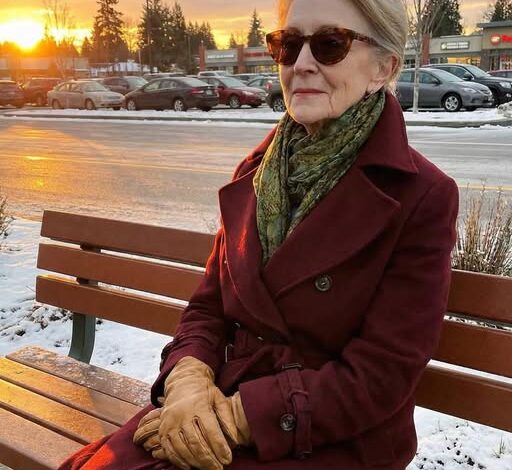
At the far end of the bench sat an older woman I somehow hadn’t noticed—perfect posture, cream-colored coat, dark sunglasses, silver hair pulled back in a low twist. She looked like she belonged in a glossy magazine, not on a bench outside a Target.
Without turning her head completely, she said, in a voice that was calm and dry, “Stop crying. Tears don’t fix anything.”
I flinched and swiped at my cheeks. Her tone wasn’t unkind; it was matter-of-fact, like she was commenting on the weather.
Then she added, “Do you want him to regret it? Today?”
My head snapped toward her. “What?”
She turned fully then, facing me, and even behind the sunglasses I could feel her studying me.
“In a few minutes,” she said quietly, “pretend you’re my granddaughter. Trust me. Your husband will regret leaving you here. And very soon.”
Part of me wanted to laugh in her face. Another part wanted to curl up and disappear. Instead, I just stared, caught somewhere between disbelief and curiosity.
Before I could respond, I heard the low purr of an engine approaching.
A black Mercedes glided up in front of us, glossy and immaculate, windows tinted too dark to see inside. The woman beside me adjusted her scarf like this was all perfectly choreographed.
“Right on time,” she murmured.
A man in a black suit stepped out from the driver’s seat. He looked like every professional driver you’ve ever seen in those old movies—impeccable, composed.
“Ma’am,” he said, opening the back door with a small bow. “Are you ready to go?”
“Yes, Marcus,” she replied. Then, without even glancing at me for confirmation, she added smoothly, “This is my granddaughter. She’ll be coming with us.”
There was a beat where the world seemed to pause. My brain whispered, You don’t know this woman. You have no idea who she is. Get up and walk away.
But my body moved before my fear did. Maybe it was survival instinct. Maybe it was sheer desperation. Maybe it was the way she’d said, I used to be like you.
I stood and slid into the back seat beside her.
The door shut with a soft thud that sounded absurdly final.
The car pulled away, merging back into traffic. I opened my mouth to ask a million questions—Who are you? Where are we going? Why are you helping me?—but she lifted one elegant hand.
“We’ll talk at home,” she said gently.
Home.
We drove for about half an hour, passing through neighborhoods that became more expensive with each turn. Small houses turned into bigger ones, then into actual estates with iron gates and names carved into stone. Finally, the car turned into a long, tree-lined driveway.
At the end of it stood a mansion that looked like it belonged in a movie.
Inside, everything gleamed. Marble floors, high ceilings, chandeliers dripping with crystals. A young woman in a crisp uniform appeared to take our coats, like it was perfectly normal for a bedraggled stranger in jeans and a stained T-shirt to arrive with the lady of the house.
“Come,” the woman said. “We’ll have tea and talk properly.”
We sat in a large, bright living room with tall windows overlooking manicured gardens. A maid brought in tea on delicate china and a plate of small sandwiches so pretty I almost didn’t want to eat them.
I felt like I’d wandered onto someone else’s set. Eventually, I cleared my throat.
“I… thank you,” I said quietly. “For helping me. But I really should get home. My girls will wake up from their nap, and they’ll wonder where I am.”
She stirred her tea slowly, then looked up at me, her gaze sharp and steady.
“I saw what happened,” she said. “Your girls were asleep in the back seat when he threw you out, weren’t they?”
I nodded.
“And he just drove away like you were baggage he’d decided not to check in,” she continued. “Tell me, Julia—how did you allow a man to treat you that way?”
Shame crawled up my neck and settled hot in my face. I didn’t know how to answer. It hadn’t happened all at once. It had been a long slow drip of small humiliations until I wasn’t sure what normal looked like anymore.
She watched me for a moment, then asked, “Do you still love him?”
I swallowed. “I don’t know,” I admitted. “We have kids. I keep thinking it’ll get better. That he’s just stressed. That if I try harder, be better, it’ll go back to how it was.”
She exhaled, a sound that carried years in it.
“I used to be like you,” she said. “My husband belittled me for years. Everything was my fault. Nothing I did was ever enough.” Her fingers tightened slightly around her cup. “One night, after a party, he left me stranded fifty miles from home. Bare feet, evening dress, country road. He was angry about something I said. So he drove away.”
My chest clenched. “What did you do?”
“I walked,” she said simply. “No one stopped. No one asked if I was okay. And even after that, I stayed with him for seven more years. For the children. Because that’s what women like us tell ourselves.”
She paused, eyes distant.
“One night, I stood in my kitchen, a bottle of sleeping powder in my hand, measuring more than I should into his dinner. I was so angry I could barely see straight. Then I realized I was one decision away from becoming someone I didn’t recognize. Someone capable of something irreversible. So I put the bottle down. And I left him instead.”
Her voice steadied. “He was rich, powerful, cruel. I took half of everything in the divorce. It did not give me back my youth. It did not erase the years of pain. But it bought me something money can’t usually buy.” She met my eyes. “Peace.”
Tears pricked my eyes again, but this time I didn’t fight them.
“When I saw you on that bench today,” she said softly, “I saw myself. Only you still have time to choose a different story. Don’t spend your life with a man who chips away at you until you can’t recognize yourself in the mirror.”
My voice came out small. “But my daughters… how can I take them away from their father?”
She leaned forward.
“Listen carefully,” she said. “Your daughters already see how he treats you. They notice everything—even if you think they don’t. They see you accept it. If you stay, they will grow up believing that love looks like a man making their mother feel small. Is that what you want them to copy one day?”
Her words hit me like a punch.
“No,” I whispered. “I don’t want that. I don’t want them to think this is normal.”
“Good,” she said. “That’s the beginning. I’ll give you my lawyer’s number. She’s excellent. She doesn’t lose.” Then a small, fierce smile tugged at her mouth. “But before we get to that part… let’s make sure your husband understands exactly what he’s losing.”
She led me upstairs into a walk-in closet that looked like an entire boutique had been transplanted from some high-end mall. Racks of dresses, shelves of shoes, bags lined up like art pieces.
From a row of silk dresses, she pulled out a scarlet one that looked like it could stop traffic.
“Here,” she said, holding it against me. “Let’s remind you what confidence feels like.”
She handed me matching heels and sat me at a mirrored vanity. As she brushed and curled my hair and handed me lip color and mascara, I finally asked what had been lurking at the back of my mind.
“Why did you tell your driver I was your granddaughter?” I asked.
She chuckled. “Because Marcus and my security detail are very strict. They don’t let strangers into the car with me. And I wasn’t about to leave you sitting on that bench. Granddaughter was the shortest explanation they’d accept.”
I stared at her reflection. “Who… are you?”
“My name is Tina,” she said. “Mrs. Tina to most people. You can just call me Tina.”
By the time she was done, I hardly recognized myself. The woman in the mirror had soft waves brushing her shoulders, eyes that looked awake instead of hollow, red lips that didn’t sag in apology. The dress hugged me in all the right places.
For the first time in a long time, I looked like someone who existed for more than just cooking, cleaning, and mediating tantrums.
When Marcus drove me home in that same black Mercedes, my heartbeat was steady. The house looked different than it had that morning—like a stage I was about to walk onto instead of a cage I was trapped in.
Inside, Nick was on the couch, remote in hand, the girls beside him. He didn’t even glance away from the TV when the door opened.
“Wow, that was fast,” he said. “Took you long enough to walk back, huh?”
Emma saw me first. “Mommy!” she squealed. “You look so pretty!”
Lily’s eyes went wide. “Are we going somewhere?”
They barreled into me, small arms wrapping around my waist. I hugged them tight, breathing them in like oxygen.
By the time Nick actually turned to look, his smirk died on his lips. His eyes dragged from my heels to my face.
“What the—where did you even—”
“Girls,” I said gently, cutting him off. “Go to your room and pack your favorite things in your backpacks. Your stuffed animals, a few books, your favorite pajamas. We’re going to Grandma’s for a while.”
They chirped excitedly and ran off, already arguing over which stuffed animal counted as “favorite.”
Nick frowned. “What are you doing? Julia, what is this?”
I took a breath.
“I’m leaving you,” I said. My voice wasn’t loud, but it didn’t shake. “We’re getting a divorce. And everyone—our families, your boss, your friends—is going to know exactly what you did today.”
Color rose in his face. “Oh, come on. You’re overreacting. You know I didn’t mean it like—”
Marcus stepped into the doorway behind me.
He didn’t say a word. He didn’t have to. Just his presence in that tailored suit, quiet and solid, shifted the energy in the room.
Nick’s mouth opened, then closed. For the first time in years, he looked unsure.
“I’ve already spoken to a lawyer,” I continued. “A very good one. I’m done being the woman you embarrass and abandon. The girls and I are leaving. You can explain the details to your attorney.”
He sputtered, then tried to backpedal, to minimize, to joke it away. Nothing landed. I walked past him, helped the girls with their backpacks, and left.
I moved in with my mom for a while. Within a month, thanks to Tina’s lawyer, the house was legally mine and the girls’. Nick didn’t put up much of a fight once he saw the paperwork and realized how bad he’d look if the story got out in full detail.
Tina and I still talk every week. She’s become the kind of woman I didn’t realize I needed in my life—sharp, kind, unflinching. The girls adore her. She takes them out for tea parties and lectures them, with a twinkle in her eye, about never letting people talk over them.
Nick still calls. He sends long texts about how sorry he is, how he “lost control,” how he “didn’t mean it.” He begs for another chance.
I don’t think he understands that the moment he left me on the side of the road, something in me snapped back into place. Some part of me that had been bent too far for too long finally straightened.
That afternoon on the bench, with the sun in my eyes and my heart in pieces, I met a stranger who reminded me that my life didn’t have to look like that forever.
Sometimes, it takes the kindness of someone who owes you nothing—and one outrageous, unexpected ride in a black Mercedes—to make you remember who you really are.